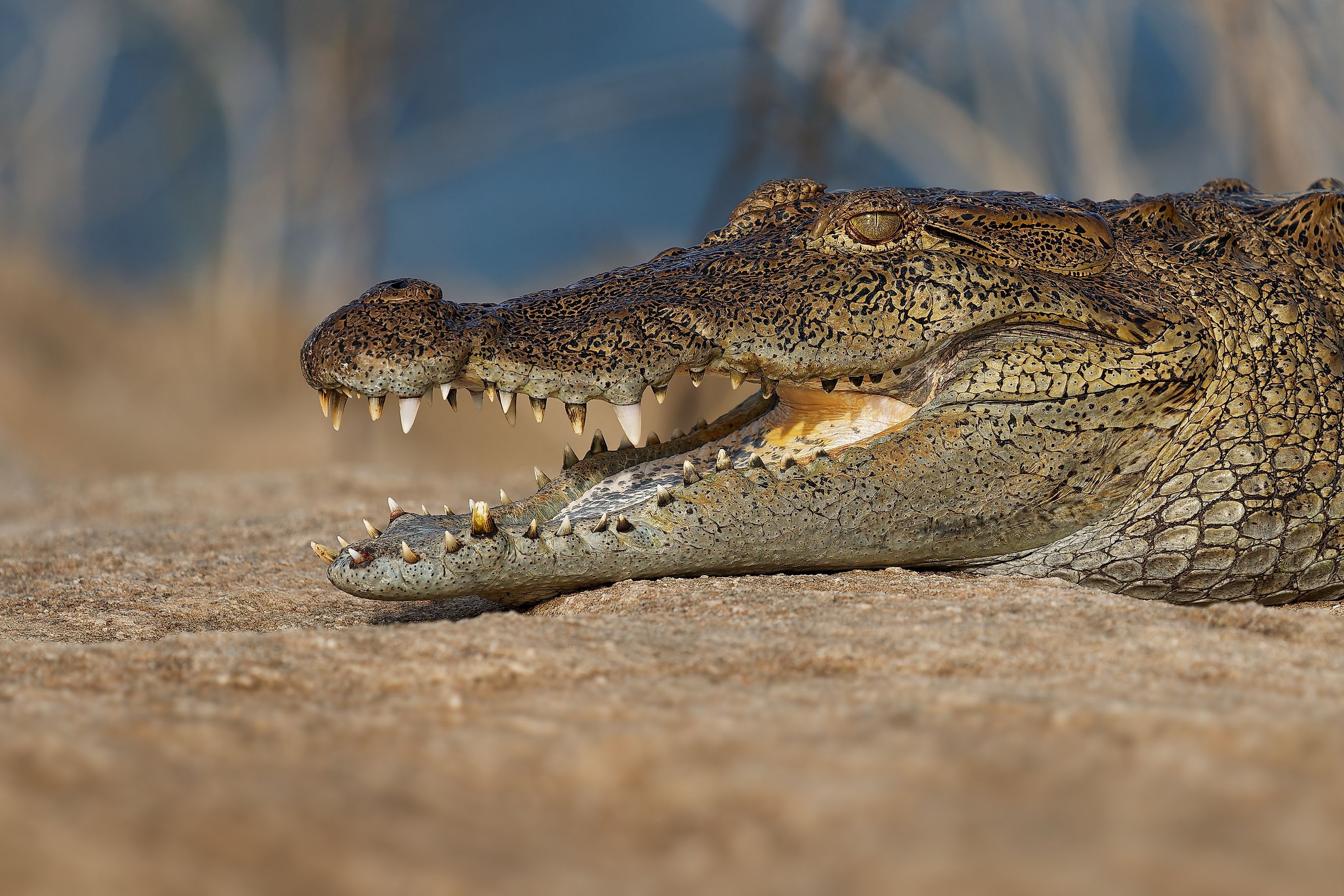
Mugger Crocodile
The mugger crocodile (Crocodylus palustris) is a medium-to-large freshwater crocodilian native to the Indian subcontinent and surrounding regions, including India, Sri Lanka, Nepal, Pakistan, Bangladesh, and Iran. Also known as the marsh crocodile or broad-snouted crocodile, it is recognized by the widest snout of any true crocodile and typically grows to between 3 and 3.5 meters (about 10 to 11.5 feet) in length. Unlike its coastal saltwater relative, the mugger favors inland lakes, rivers, marshes, and even man-made reservoirs, and it is notable for behaviors such as digging burrows, surviving droughts through dormancy, and traveling overland between water bodies. As an opportunistic ambush predator, it preys on fish, amphibians, birds, and mammals alike, and females are known for their attentive care of eggs and hatchlings.
Taxonomy Classification

The mugger belongs to the genus Crocodylus, which includes the "true crocodiles," and its species name palustris derives from the Latin word for "marshy" or "of the marsh," a fitting description of its preferred surroundings. The English name "mugger" has nothing to do with ambush or robbery, as is sometimes assumed. It comes from the Hindi and Urdu word magar, itself descended from the Sanskrit makara, a term for a water creature or aquatic monster that appears throughout South Asian mythology and iconography. This linguistic heritage places the mugger firmly within the cultural landscape of the region, where crocodiles have long occupied a place in religious symbolism and folklore.
Among living crocodilians, the mugger is most closely related to the saltwater crocodile and the Siamese crocodile, though it is readily distinguished from both by its distinctive skull shape. It occupies a distinct ecological niche, favoring inland freshwater systems rather than the coastal estuaries and open sea preferred by its saltwater cousin.
Physical Description

The most striking feature of the mugger is its snout, the broadest of any living member of the genus Crocodylus. This has earned it the alternative name "broad-snouted crocodile" and gives the animal a somewhat alligator-like profile at first glance. The wide jaw houses powerful musculature and a robust set of teeth, well suited to gripping and crushing prey of varying sizes.
Adult muggers are generally olive to grey-brown in color, with darker mottling that provides effective camouflage in silty water and among reeds. Juveniles tend to be paler, often tan with dark cross-bands that fade with age. Heavy armor plating, known as osteoderms, protects the back and neck, offering both defense and a degree of structural support. The eyes, ears, and nostrils sit high on the head, allowing the animal to remain almost entirely submerged while still monitoring its surroundings, a classic adaptation of ambush predators.
While most adults settle into the 3 to 3.5 meter range, exceptionally large individuals have been recorded approaching or exceeding 4 meters (about 13 feet), with a handful of historical reports suggesting lengths near 5 meters (roughly 16 feet). Males are typically larger than females, a common pattern of sexual dimorphism among crocodilians.
Range and Habitat

The mugger's range spans a broad swath of southern Asia. It is found across much of India, throughout Sri Lanka, and into Nepal, Pakistan, Bangladesh, and the southeastern reaches of Iran. This distribution makes it one of the more widely dispersed crocodilians in the region, though populations are increasingly fragmented.
What sets the mugger apart is its remarkable habitat flexibility. It thrives in a variety of freshwater environments, including natural lakes, rivers, marshes, and seasonal wetlands. It also readily colonizes human-made water bodies such as irrigation canals, village ponds, and large reservoirs behind dams. This willingness to occupy artificial habitats has, in some areas, helped the species persist where natural wetlands have been drained or degraded. Muggers can tolerate brackish conditions on occasion, but they are fundamentally freshwater animals and do not venture into the sea in the manner of saltwater crocodiles.
Behavior and Thermoregulation

The mugger is among the most behaviorally versatile of crocodilians, and much of that versatility centers on managing its body temperature. As an ectotherm, it relies on external heat sources to regulate its internal state, and it has developed impressive strategies to cope with the temperature extremes of its range.
One of the most notable behaviors is burrow digging. Muggers excavate tunnels into riverbanks and pond margins, sometimes several meters deep, which provide shelter from both punishing summer heat and cooler winter conditions. These burrows maintain a more stable temperature than the open air and offer refuge during periods of environmental stress. During prolonged dry seasons, when water bodies shrink or vanish entirely, muggers may enter a state of dormancy known as aestivation, retreating into burrows or mud and dramatically slowing their metabolism until conditions improve. This capacity to wait out drought is a key reason the species survives in regions with harsh, unpredictable climates.
Muggers are also capable of surprising overland movement. When their home waters dry up, individuals have been documented traveling considerable distances across land to reach new pools, an unusual feat for an animal so associated with water. In some cases, this behavior brings them into contact with human settlements.
Perhaps most intriguing are observations suggesting that muggers may engage in rudimentary tool use. Researchers have reported crocodiles balancing sticks and twigs on their snouts during the nesting season of certain birds, apparently to lure birds seeking nesting material within striking range. While such behavior warrants continued study, it hints at a cognitive sophistication that challenges the popular image of crocodiles as simple, instinct-driven reptiles.
Diet and Hunting

The mugger is an opportunistic generalist, and its diet shifts across its lifespan. Hatchlings and juveniles feed largely on insects, crustaceans, small fish, and amphibians. As they grow, their prey expands to include larger fish, reptiles, birds, and mammals. Large adults are capable of taking sizable prey, including deer and livestock that venture too close to the water's edge.
Like most crocodilians, the mugger is a patient ambush hunter. It relies on stealth, remaining motionless at the surface or just beneath it before launching a swift, explosive strike. Its broad snout and strong jaws allow it to seize and subdue prey effectively, and it often employs the characteristic "death roll" to dismember larger catches. When food is scarce, the mugger's slow metabolism allows it to endure long periods between meals, another trait that supports its survival in variable environments.
Reproduction and Life Cycle

Mugger reproduction is closely tied to the seasonal rhythms of its habitat. Breeding generally occurs during the dry season, with females constructing nests in sandy or soft soil along the banks of their water body. Unlike some crocodilians that build large vegetation mounds, muggers typically dig hole nests, depositing a clutch that may hold anywhere between ten and more than forty eggs.
As with many reptiles, the sex of mugger hatchlings is determined by the temperature at which the eggs incubate, a phenomenon known as temperature-dependent sex determination. This makes reproductive success sensitive to environmental conditions and, potentially, to shifts in climate. Incubation lasts roughly two to three months.
Female muggers display notable maternal care. They guard the nest against predators during incubation and respond to the calls of hatching young by excavating the nest and gently carrying the offspring to water. This attentive parenting improves the survival odds of vulnerable hatchlings, though mortality in the first years of life remains high due to predation and environmental hazards.
Conservation Status and Threats

The IUCN Red List classifies the mugger crocodile as Vulnerable, and the species is listed on Appendix I of CITES, which prohibits international commercial trade in wild specimens. While the mugger remains more numerous than some critically endangered crocodilians, its populations are fragmented and face persistent pressure.
Habitat loss is the foremost threat. The draining of wetlands, damming of rivers, and conversion of land for agriculture have all reduced the freshwater systems on which the species depends. Muggers also frequently drown in fishing nets set across rivers and ponds, a significant source of mortality. Egg collection, illegal hunting, and pollution add further strain. Because muggers often live in close proximity to people, human-wildlife conflict is an ongoing concern, occasionally resulting in the removal or killing of animals perceived as dangerous.
Conservation efforts, including captive breeding and reintroduction programs, have helped stabilize or bolster certain populations, particularly in protected reserves. The mugger's adaptability gives it a fighting chance, but its long-term future depends on the preservation of freshwater habitats and on managing coexistence with the communities that share its range.
Takeaway
Few crocodilians have proven as capable of living alongside people as the mugger. Its broad snout, tolerance of both natural and man-made water bodies, and ability to endure drought through burrowing and dormancy allow it to survive across a wide and often harsh range, making it one of the most widely distributed crocodiles in southern Asia.
That adaptability does not make the species secure. Its Vulnerable status reflects ongoing threats from habitat loss, drowning in fishing nets, pollution, and conflict with people. Because muggers so often live close to human communities, their future depends on practical coexistence. Protecting freshwater habitats, reducing accidental deaths, and supporting breeding and reintroduction programs can help rebuild and maintain local populations. The mugger's long-term survival is achievable, but not guaranteed.
Fun Facts

- The name "mugger" comes from the Sanskrit word makara, a mythical water creature, not from the idea of a mugging or ambush.
- Muggers have the broadest snout of any true crocodile, giving them an almost alligator-like appearance.
- They have been observed balancing sticks on their snouts to lure nest-building birds within striking range, a rare example of possible tool use in reptiles.
- When their water dries up, muggers can trek considerable distances overland to find a new pool.
- They dig deep burrows and can enter a dormant state called aestivation to survive scorching dry seasons.
- The sex of hatchlings is decided by nest temperature rather than genetics.
- Mother muggers gently carry their newly hatched young to the water in their mouths.
Quick Facts
- Scientific name: Crocodylus palustris
- Common names: Mugger, marsh crocodile, broad-snouted crocodile
- Family: Crocodylidae
- Length: Typically 3 to 3.5 meters (about 10 to 11.5 feet); large males occasionally reach 4 to 5 meters (13 to 16 feet)
- Weight: Up to around 200 kilograms (about 440 pounds) in large adults
- Lifespan: Approximately 40 years in the wild
- Range: Indian subcontinent, Sri Lanka, Nepal, Pakistan, Iran, and Bangladesh
- Habitat: Freshwater lakes, rivers, marshes, ponds, and artificial reservoirs
- Diet: Fish, amphibians, reptiles, birds, and mammals
- Conservation status: Vulnerable (IUCN Red List)
- CITES listing: Appendix I