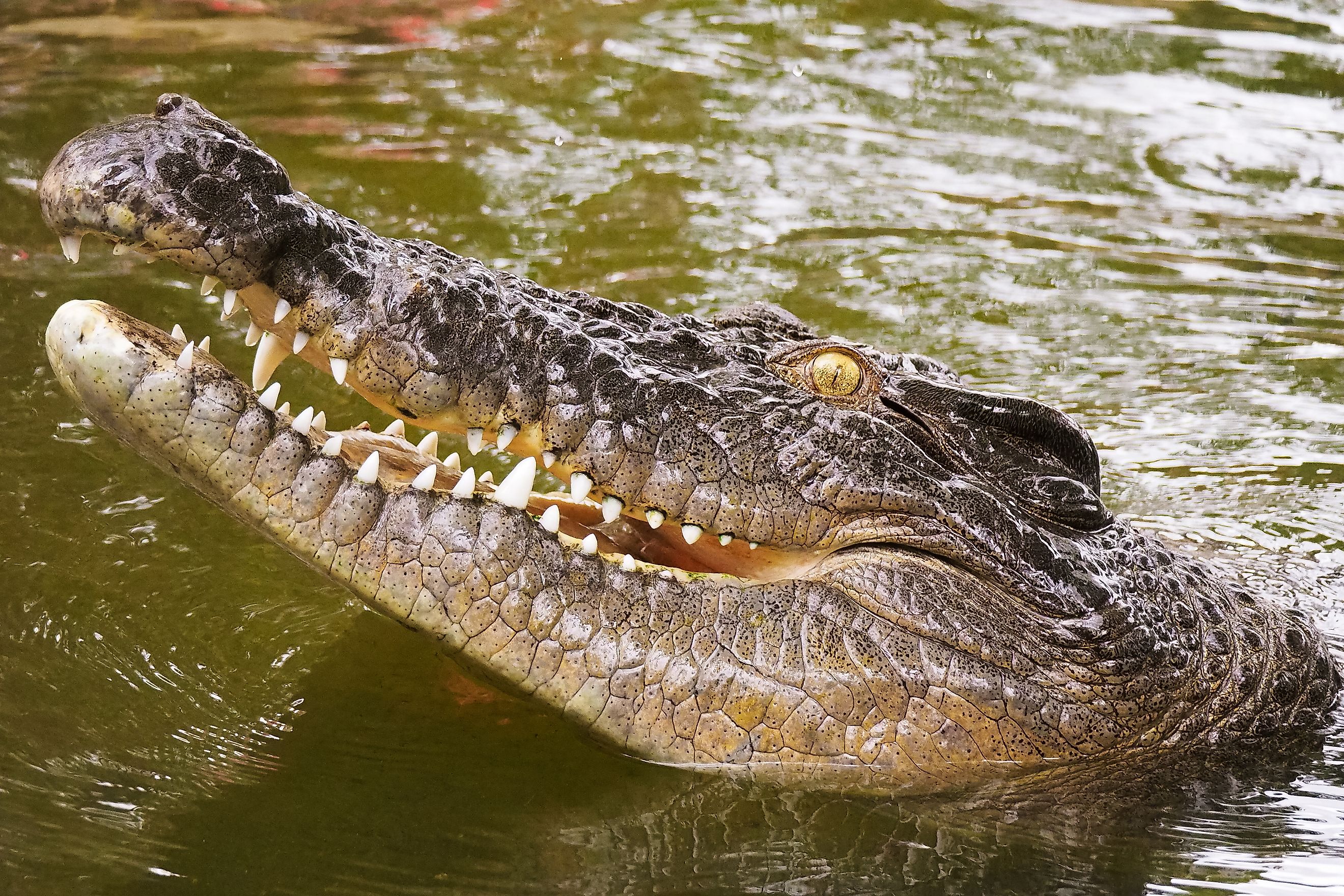
Saltwater Crocodile
No land or water reptile alive today grows bigger, and no living animal on Earth has been measured biting harder. The saltwater crocodile (Crocodylus porosus) is the heavyweight champion of the reptile world, a coastal ambush hunter that can exceed 20 feet (6 m) in length and slam its jaws shut with more force than any other creature ever recorded in a controlled test.
Despite the name, the saltwater crocodile is not a purely marine animal. It patrols estuaries, mangrove channels, tidal rivers, and brackish coastal wetlands, and it happily pushes far upstream into fresh water. Its range spans the Indo-Pacific. The species turns up along the eastern coast of India, throughout Southeast Asia and Indonesia, and across northern Australia and the western Pacific islands.
The saltwater crocodile is a survivor of an ancient lineage, a predator that has changed little in millions of years and still rules the waters it patrols. It is also, in parts of its range, a real danger to the people who live alongside it. Everything about the animal, from its record-breaking size to the way it raises its young, follows from that combination of raw power and hard-won adaptation.
Taxonomic Classification

The saltwater crocodile belongs to the order Crocodylia, family Crocodylidae, and genus Crocodylus. Its full scientific name is Crocodylus porosus, formally described by Johann Gottlob Schneider in 1801. It is one of roughly a dozen living species in its genus, and it is the only member widely regarded as the largest of all crocodilians.
Crocodilians are archosaurs, which places them closer to birds and to the extinct dinosaurs than to lizards and snakes. That distinction matters when the species is casually lumped with other reptiles. If you want to keep the family straight, there is a real difference between a crocodile and an alligator, and the saltwater crocodile sits firmly on the true-crocodile side of that split. Its close relatives include the Australian freshwater crocodile (Crocodylus johnstoni) and, more distantly, the New World species such as the Cuban crocodile. No major recent reclassification has moved the species, though DNA work continues to refine relationships across the genus.
Physical Description

Size is where this animal earns its reputation. Large adult males reach about 20 feet (6 m) and rarely exceed 21 feet (6.3 m), while weight ranges from roughly 2,200 to 3,300 pounds (1,000 to 1,500 kg) in the biggest bulls. Females are far smaller and seldom pass 10 feet (3 m). That gap between the sexes is one of the most pronounced examples of size dimorphism among reptiles, and it shapes almost everything about how the species breeds and defends territory. For context on where it ranks, the saltwater crocodile tops the list of the largest reptiles in the world.
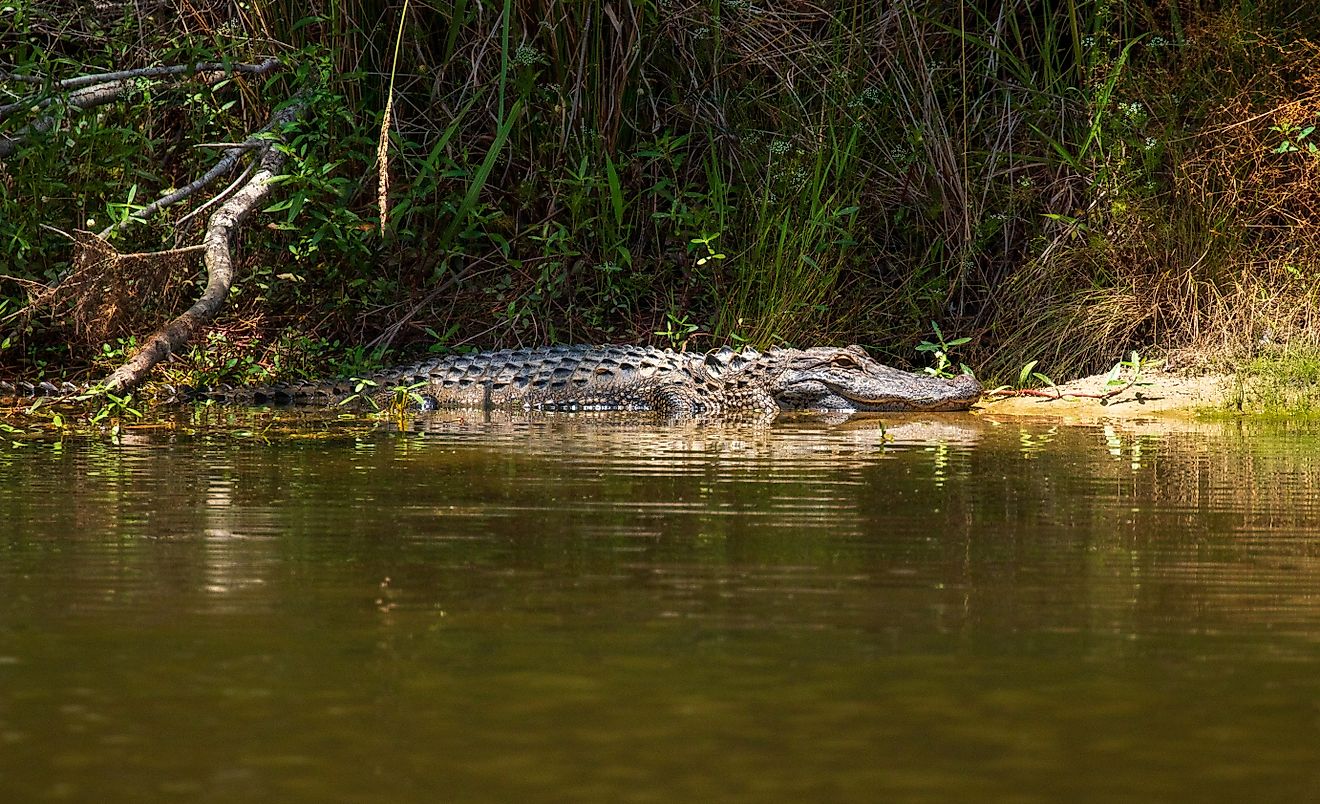
The body is built for ambush. A broad, heavy snout anchors a jaw lined with 60 or more conical teeth that are replaced continually through life. Adults are dark grayish-green above with paler, often yellowish undersides, and the back is armored with rows of raised bony plates called osteoderms. The eyes, ears, and nostrils sit high on the head, so a submerged crocodile can watch and breathe while nearly the whole body stays hidden underwater.
The jaw is the headline adaptation. In a controlled study led by Gregory Erickson and published in 2012, a saltwater crocodile produced a bite force of about 3,700 pounds of force (roughly 16,400 newtons), the highest ever directly measured in a living animal. By comparison, lions and tigers bite at around 1,000 pounds. Salt glands on the tongue allow the animal to shed excess salt, the physiological mechanism that enables it to live in seawater for extended periods.
Range and Habitat

The saltwater crocodile has one of the widest distributions of any crocodilian. It occurs along the eastern coast of India and Sri Lanka, throughout mainland and island Southeast Asia, across Indonesia and Papua New Guinea, and along the northern coast of Australia, reaching east into Micronesia and the Solomon Islands. Australia's Northern Territory, Queensland, and Western Australia hold some of the strongest populations today.
It prefers coastal and tidal habitats such as estuaries, river mouths, and mangrove forests, where salinity varies with tidal movement. Saltwater crocodiles also move well inland into freshwater rivers, swamps, and billabongs, especially during the wet season, and dominant males tend to claim the prime freshwater breeding stretches. Individuals have been recorded well over 100 miles (160 km) out to sea, riding currents to colonize new river systems, which helps explain how the species spread across so many scattered islands.
The current range is smaller and more fragmented than it once was. The species is considered extinct or nearly so in Thailand, Vietnam, and Cambodia, and it survives as isolated remnants across much of Southeast Asia. Many of these coastal wetlands overlap with a rich cast of specialized species, from mudskippers and fiddler crabs to the birds and snakes that hunt among the mangrove roots.
Diet

The saltwater crocodile is an opportunistic hypercarnivore and a true apex predator. Hatchlings and juveniles start on insects, crustaceans, small fish, and frogs. As they grow, the menu widens to include larger fish, turtles, snakes, birds, and mammals. The largest adults can take prey as large as water buffalo, wild boar, and livestock, and they will scavenge carrion when available.
The hunting method is patience followed by explosive speed. A saltwater crocodile lies still in the shallows with only its eyes and nostrils showing, then lunges to seize an animal at the water's edge. Small prey is swallowed whole. Large prey is dragged underwater and drowned, then dismembered with the "death roll," a rapid spin that twists off manageable pieces. Like other crocodilians, the species swallows stones, called gastroliths, that sit in the stomach and may aid digestion and buoyancy control. Because it is ectothermic and has a slow metabolism, a large adult can go weeks or even months between substantial meals.
Behavior

Saltwater crocodiles are territorial and, among the largest crocodilians, notably aggressive. Dominant males defend stretches of river and coastline against rivals, and disputes over territory and mates can turn lethal. Subordinate males are often driven out into less suitable habitat or pushed out to sea to search for a new system of their own.
Activity follows the temperature. The animals bask during the day to warm up and do most of their hunting at night, becoming more lethargic as cooler weather sets in. They are strong, efficient swimmers, propelled by a powerful laterally flattened tail, and they can hold their breath for long stretches while waiting out prey or resting on the bottom. Communication includes bellows, hisses, and infrasonic vibrations, as well as body postures that signal dominance. This combination of size, stealth, and aggression is why the species is widely regarded as one of the most dangerous animals to humans within its range, with attacks concentrated near territories and nesting sites.
Reproduction

Breeding is tied to the wet season. Mating occurs as the rains build, and females then construct mound nests of vegetation and mud along riverbanks and in swampy margins, generally between November and March across the Australian range. A typical clutch is 40 to 60 eggs, which incubate for roughly 90 days inside the warm, rotting mound.
Like many reptiles, the saltwater crocodile has temperature-dependent sex determination. Rather than genetics, nest temperature determines whether hatchlings develop as males or females. The mother stays close and guards the nest fiercely against predators such as monitor lizards, wild pigs, and birds. When the young hatch and call out, she often opens the mound, gently carries the hatchlings to the water in her mouth, and continues to watch over them for weeks. Even so, mortality among young crocodiles is very high. Those that survive mature at around 12 to 16 years, and adults can live for about 70 years, with some individuals believed to reach even greater ages.
Importance to the World

As the top predator of tropical estuaries and coastal wetlands, the saltwater crocodile helps regulate populations of fish, mammals, and other reptiles, and its presence is a marker of a healthy waterway. Removing an apex predator of this size tends to ripple through the whole food web, so the species matters well beyond its own numbers.
It carries economic and cultural weight too. Regulated crocodile farming and ranching, especially in Australia and Papua New Guinea, supplies a legal skin and tourism industry that gives local communities a financial reason to protect wild populations and their habitat. The animal also looms large in the folklore and identity of many coastal cultures across its range, and it features among the national animals associated with Australia. That mix of ecological role and economic value is central to why conservation programs have worked where they have.
Threats and Conservation

Globally, the saltwater crocodile is listed as Least Concern on the IUCN Red List, a status it has held since 1996 and that was reaffirmed in the 2021 assessment. The wild population is estimated at more than 400,000 non-hatchlings, and the species is considered secure thanks to large, well-managed populations in Australia, Papua New Guinea, and parts of Indonesia. It is listed on CITES Appendix I, except for the Australian, Indonesian, and Papua New Guinean populations, which are on Appendix II to allow regulated trade.
A healthy global status hides serious regional decline. Commercial hunting for hides through the mid-20th century drove numbers down sharply before protections took hold in the 1970s. Today the main pressures are habitat loss, illegal killing, and rising human-crocodile conflict as people and crocodiles compete for the same waterways. In the Philippines, the species is critically endangered, and in several Southeast Asian countries, it is functionally gone. Recovery stories, including protected populations in northern Australia and reintroductions in India's Bhitarkanika National Park, show that firm protection combined with community incentives can rebuild numbers, even if it also increases the risk of encounters with people.
Takeaway
The saltwater crocodile stands out for a remarkable collection of superlatives. It is the largest living reptile, has one of the strongest measured bites on Earth, and ranks among the most widely distributed and adaptable predators in the tropics. It thrives where salt water meets fresh, rules the estuaries it patrols, and raises its young with a level of parental care that surprises people who expect none from a reptile. Its global outlook is stable, a genuine conservation success after decades of overhunting, but that headline masks fragile pockets where the animal is nearly gone. Keeping the saltwater crocodiles secure will depend on protecting coastal wetlands and finding ways for large crocodiles and growing human populations to share the same shores. Handled well, this ancient predator should keep patrolling Indo-Pacific waters for a long time to come.
Fun Facts

- Record holder: The largest saltwater crocodile ever reliably measured was Lolong, caught in the Philippines in 2011 at 20 feet 3 inches (6.17 m) and about 2,370 pounds (1,075 kg). He held a Guinness World Record before his death in 2013.
- Strongest bite on record: A saltwater crocodile delivered the most powerful bite force ever directly measured in a living animal, roughly 3,700 pounds of force, in a 2012 study of all living crocodilian species.
- Ocean traveler: Individuals have turned up more than 100 miles (160 km) out to sea, using surface currents like a conveyor belt to reach distant islands.
- Devoted mother: Female saltwater crocodiles carry newly hatched young to the water in their jaws and can recognize their offspring's distress calls for weeks after hatching.
- Living relatives of dinosaurs: As archosaurs, crocodiles are more closely related to birds than to lizards or snakes.
Quick Facts
- Scientific name Crocodylus porosus
- Family / Order: Crocodylidae / Crocodylia
- IUCN: Least Concern (2021)
- Length: up to ~20 ft (6 m), rarely 21 ft (6.3 m)
- Weight: up to 2,200-3,300 lb (1,000-1,500 kg)
- Lifespan: ~70 years
- Diet: carnivore (apex predator)
- Range: eastern India and Sri Lanka through Southeast Asia to northern Australia and the western Pacific.