Mozambique Spitting Cobra
Few African snakes command as much wary respect around rural homes as the Mozambique spitting cobra. This is a serpent built around a single unnerving talent, the ability to launch a fine spray of venom toward the eyes of anything it treats as a threat, and it does so with startling accuracy from several feet away. Across the savannas of southeastern Africa it is both common and feared, blamed for a large share of the region's serious snakebite cases.
Known to science as Naja mossambica, the Mozambique spitting cobra is a medium-sized member of the cobra family that ranges across a broad band of tropical and subtropical Africa. It thrives near water and, unfortunately for people, near human settlements, where frogs and rodents draw it toward houses, sheds, and gardens. Despite its fearsome reputation, it would rather flee or bluff than fight, and its venom, while medically serious, rarely kills.
Taxonomic Classification

The Mozambique spitting cobra belongs to the family Elapidae, the group of front-fanged venomous snakes that also contains the mambas, kraits, and sea snakes. Within that family it sits in the genus Naja, the true cobras, and carries the species name Naja mossambica. The German naturalist Wilhelm Peters described it as a species new to science in 1854, working from specimens collected in Mozambique, which is how the country lent its name to the snake.
For much of the twentieth century, taxonomists treated this cobra as a subspecies of the black-necked spitting cobra, Naja nigricollis. Later molecular and morphological work separated it into a full species of its own, and today it is recognized with no subspecies. It sits within a cluster of African spitting cobras, sometimes placed in the subgenus Afronaja, that share the specialized fangs behind their venom-spraying ability. Its closest relatives include the black-necked spitting cobra and the western barred spitting cobra, Naja nigricincta, both of which overlap with it across parts of its range.
Physical Description

Adult Mozambique spitting cobras are moderate in size, most measuring between 3 and 3.5 feet (90 to 105 cm) in length. The largest reliably recorded individual, a male from Durban in South Africa's KwaZulu-Natal province, reached about 5 feet (154 cm), though snakes approaching that size are uncommon.
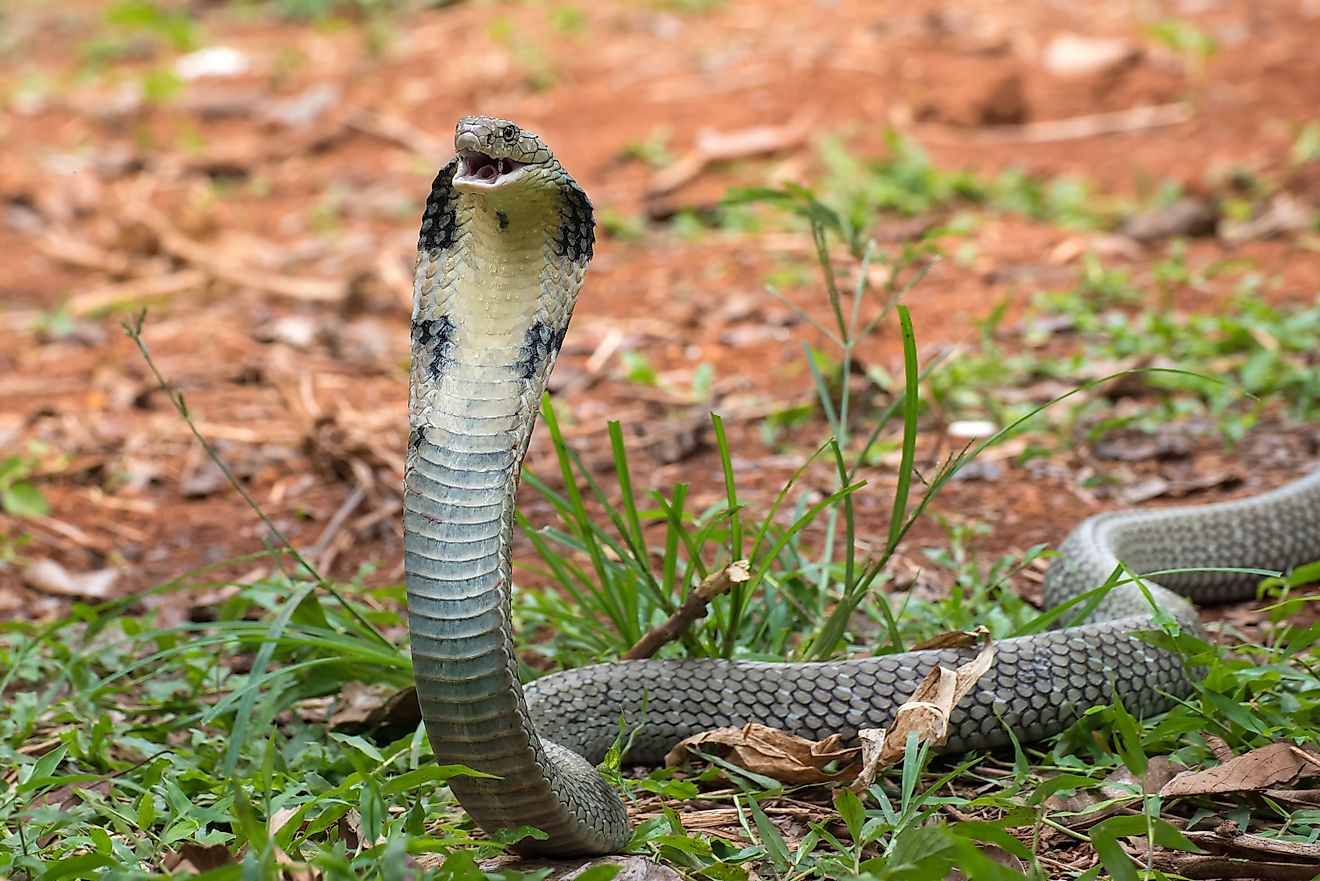
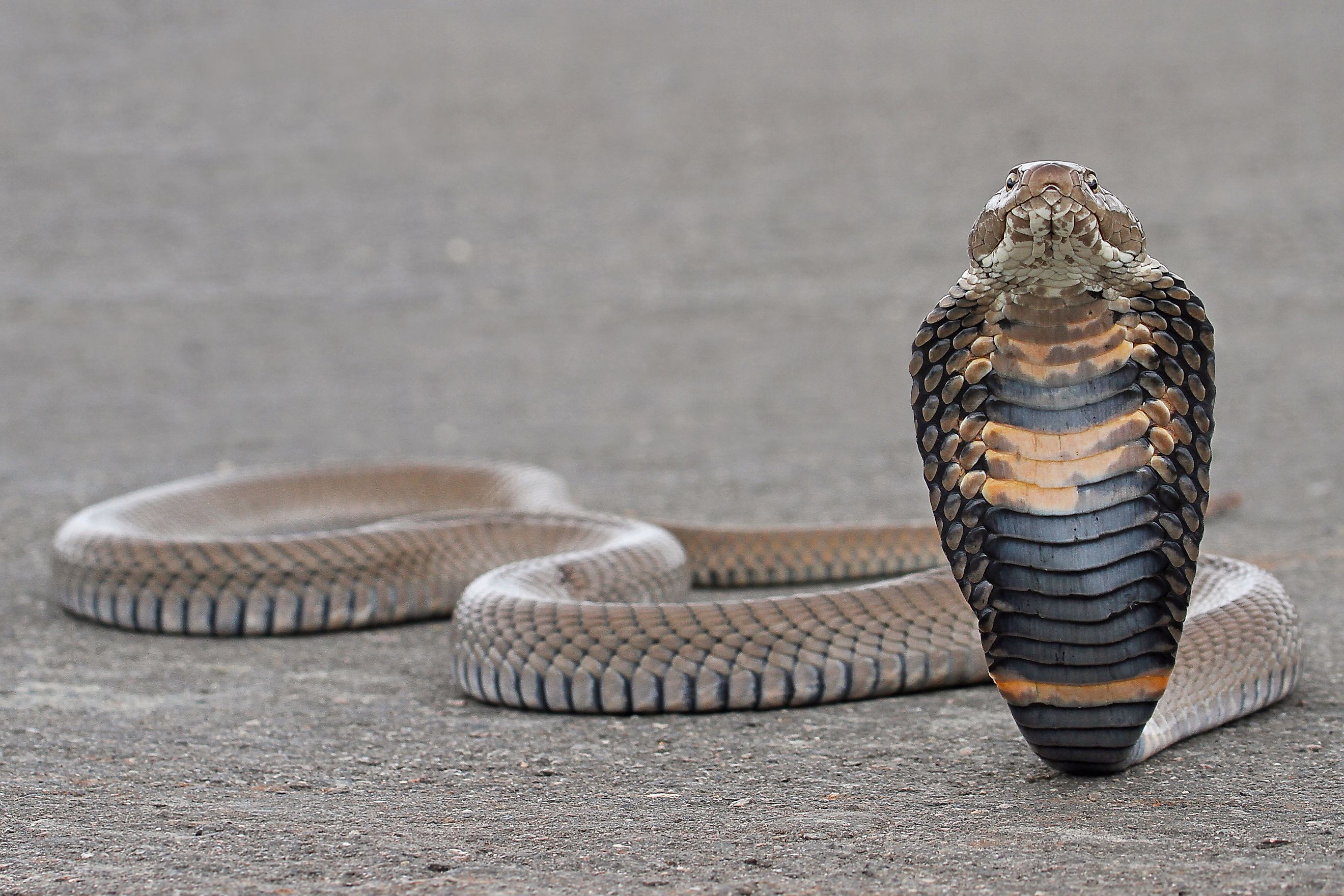
The upper body ranges in color from slate grey to blue-grey, olive, or a tawny brown that can look almost black. Individual scales often carry dark edging, which lends the snake a faintly netted appearance in good light. The underside tells a bolder story. It shades from salmon pink to a purplish yellow, and across the throat run heavy black bars that stand out sharply against the paler background. This ventral barring is one of the most dependable field marks for the species. Young snakes sometimes show pink or yellow bars on the throat that fade as they mature.
Like other cobras, it can flatten the ribs of its neck into a hood when threatened, though that hood is narrower than the broad shields of the larger forest and Egyptian cobras. Its fangs are fixed and permanently erect at the front of the mouth. In spitting cobras the venom channel inside each fang is modified so that venom can be forced out and forward as a spray rather than simply injected.
Range and Habitat

The Mozambique spitting cobra occupies a wide swath of southeastern Africa. Its range covers most of Mozambique, from which it takes its name, and reaches into Angola, Botswana, Malawi, Namibia, South Africa, Eswatini, Tanzania, Zambia, and Zimbabwe. In South Africa it extends as far south as the Durban area along the KwaZulu-Natal coast and occupies the lowveld regions of Mpumalanga and Limpopo.
This is fundamentally a snake of warm, low-lying savanna. It favors bushveld, coastal forest edges, and open woodland, and it shows a strong preference for ground close to water. Rivers, pans, marshy patches, and even garden ponds all pull it in, partly because such places teem with the frogs that make up much of its diet. When disturbed near water, it will often bolt straight into it.
That fondness for damp, productive habitat brings the snake into frequent contact with people. It settles readily around villages, farm buildings, outhouses, and homes, where it hunts rodents and amphibians and finds shelter in woodpiles, drains, and rubble.
Diet

The Mozambique spitting cobra is an opportunistic carnivore with a broad appetite. Frogs and toads form the core of its diet, which helps explain its attraction to wet ground and water margins. Beyond amphibians, it takes small mammals such as rodents, along with birds, eggs, and lizards.
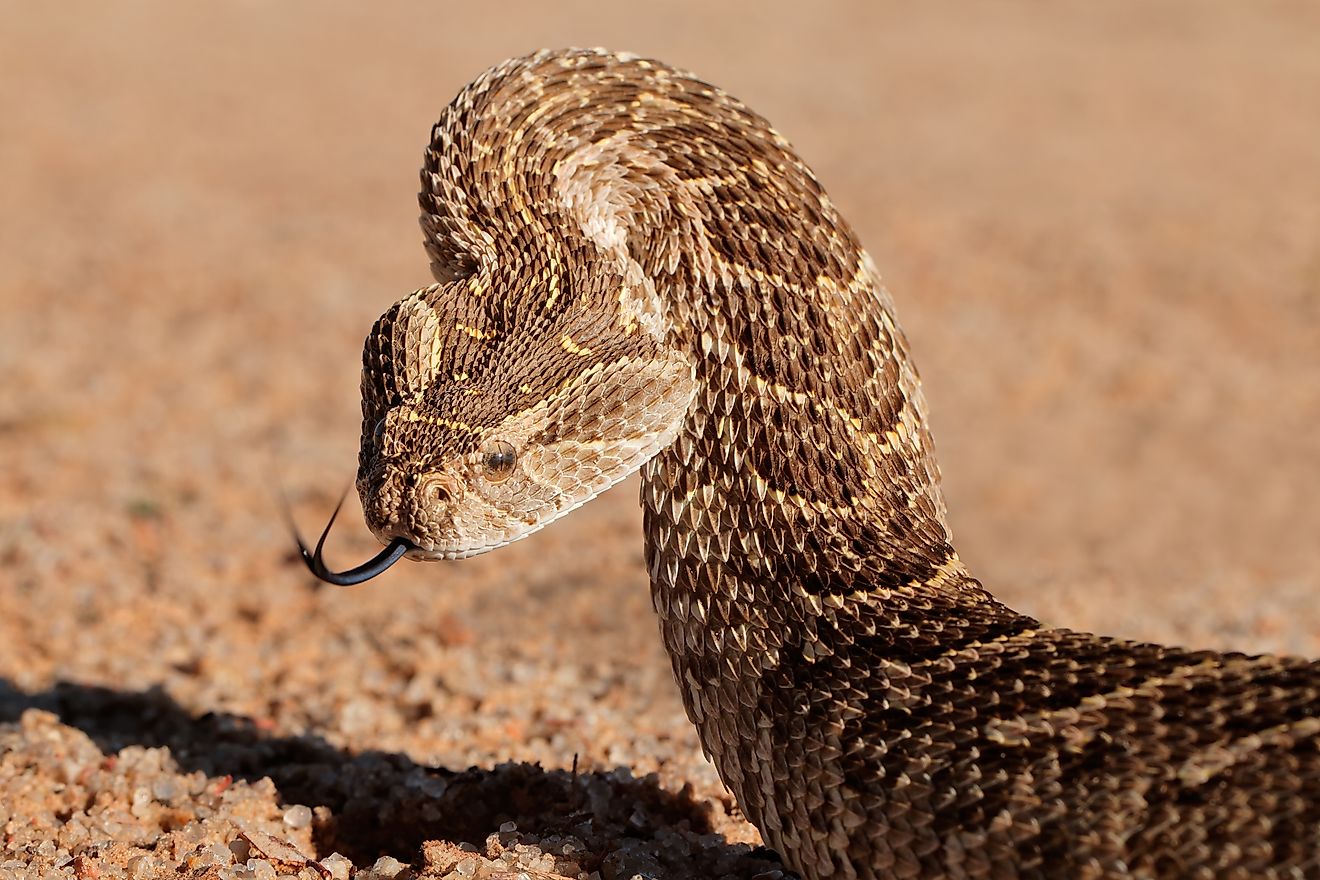
This cobra is also a notable eater of other snakes, venomous ones included. It has been recorded preying on the puff adder, a thickset viper responsible for many bites of its own, and even on the black mamba. Remarkably, the species appears to carry a degree of immunity to mamba venom, which lets it tackle prey that would kill most predators. It will also scavenge, and observers have watched it feed on carcasses well into decay, a habit unusual among snakes.
When hunting, it blends active foraging with ambush. It follows the scent of frogs and rodents into burrows and buildings, seizes prey in its jaws, and subdues it with a venomous bite rather than by spitting. Spitting is reserved almost entirely for defense.
Behavior

Much of the Mozambique spitting cobra's daily rhythm is shaped by heat and by the movement of its prey. It is largely terrestrial and tends to be most active in the cooler hours, foraging at night and on overcast days and sheltering through the hottest part of the afternoon in burrows, termite mounds, or piles of debris. Its habit of hunting after dark, paired with its taste for rodents around homes, means it sometimes enters houses and is found indoors. A number of bites happen when a sleeping person rolls onto a snake in the night.
The behavior that defines the species is its defensive spraying. When cornered, it lifts the front of its body, spreads a modest hood, and ejects venom through its fangs as a fine mist aimed at the eyes of the threat. It can repeat this with good accuracy out to roughly 6.5 to 10 feet (2 to 3 m). The tactic is purely defensive, meant to disable a large attacker rather than to capture food. Notably, the snake does not always raise a full hood before it spits.
If spraying fails or is not an option, the snake may bite, and it will sometimes flatten out and feign death to escape further harassment. Given a clear route away, though, it almost always chooses flight over a fight.
Reproduction

Like most cobras, the Mozambique spitting cobra reproduces by laying eggs rather than bearing live young. After mating, a female deposits a clutch that commonly numbers between 10 and 22 eggs, usually hidden in a moist, sheltered spot such as a burrow, a hollow log, or a termite mound where warmth and humidity stay stable.
The eggs incubate with no parental attention. Hatchlings emerge after roughly two to three months, the exact timing depending on temperature, and measure about 9 to 10 inches (230 to 250 mm) at birth. From the moment they hatch, young cobras are fully independent and already armed with working venom, able to hunt small prey and defend themselves without help from the adults. In captivity, individuals have been known to live around 15 to 20 years, and lifespans in the wild are thought to run shorter.
Venom and Danger to Humans

The venom of the Mozambique spitting cobra is dominated by cytotoxins, tissue-destroying compounds that account for the large majority of its venom proteins, alongside a smaller fraction of components that act on the nervous system. A bite typically brings intense local pain, swelling, and blistering, and in serious cases the death of skin and underlying tissue that can call for surgery and skin grafts. This snake is blamed for a large share of the serious snakebite cases in southern Africa.
Death from a bite is, thankfully, uncommon. The greater everyday hazard comes from the venom that never touches the skin. Sprayed into the eyes, it causes immediate burning pain and inflammation, and without prompt rinsing it can lead to lasting eye damage or even blindness. Anyone struck in the eyes is advised to flush them at once with large amounts of water and to seek medical care.
Antivenom exists and works against the species when given early and in adequate doses, and researchers continue to study the venom in the search for better treatments. For people who live within its range, the guidance is straightforward, give the snake room, do not try to catch or kill it, and keep homes and yards clear of the rodents and rubble that draw it in.
Importance to the World

For all the fear it inspires, the Mozambique spitting cobra plays a useful part in the ecosystems it occupies. As an abundant mid-sized predator, it helps hold down populations of frogs, rodents, and other small animals, and its appetite for rats and mice around farms and villages provides a measure of natural pest control. In turn, it serves as prey for birds of prey, larger snakes, and other hunters, tying small vertebrates to the animals higher up the food chain.
The species also carries practical value for medicine. Its venom is collected for the production of antivenom and studied by scientists interested in the biology of cytotoxins, and its proteins have drawn research attention for possible antimicrobial and other uses.
Threats and Conservation

The Mozambique spitting cobra is listed as Least Concern on the IUCN Red List, the category set aside for species that are widespread and not currently at risk. It is common across most of its range and faces no major threats at the population level. No overall population figure has been calculated, but the snake stays abundant in suitable habitat.
Its adaptability works in its favor. Because it tolerates human-altered landscapes and even profits from the rodents that gather around farms and settlements, it has avoided the declines seen in more specialized reptiles. The main risks it faces are local rather than global, chiefly persecution by people who kill it on sight and death on roads. For now, its future looks secure across the broad territory it holds.
Takeaway
The Mozambique spitting cobra is a remarkably adaptable snake that combines a relatively shy nature with a highly effective defense mechanism. Its cytotoxic bite and ability to spray venom toward an attacker's eyes have made it one of southern Africa's most medically significant snakes. Despite its reputation, however, it rarely kills people and generally prefers to escape rather than confront a threat. Its wide distribution and adaptability have helped it remain common, and with a conservation status of Least Concern, the species is not currently at risk of disappearing. For people living alongside it, recognizing the snake and keeping a safe distance is the best way to avoid conflict.
Fun Facts

- It aims for the eyes. Rather than waste venom on a bite it may not land, a cornered cobra sprays a fine mist straight at the eyes of a large threat and can strike its target from several feet away.
- It can eat one of Africa's deadliest snakes. The Mozambique spitting cobra preys on the black mamba and appears to carry partial immunity to mamba venom.
- One country named it, but nine host it. Peters described the snake from Mozambique in 1854, yet its range now spreads across at least nine African nations.
- It will play dead. When spraying and biting fail to end a standoff, the snake may go limp and feign death until the danger passes.
- It is a rare snake that scavenges. Unlike most snakes, which prefer live or freshly killed prey, this cobra will feed on carcasses that have already begun to rot.
Quick Facts
- Scientific name: Naja mossambica
- Family / order: Elapidae / Squamata
- Described by: Wilhelm Peters, 1854
- IUCN status: Least Concern
- Length: 3 to 3.5 feet (90 to 105 cm) on average, up to 5 feet (154 cm)
- Weight: light-bodied and slender, no standard published figure
- Lifespan: around 15 to 20 years in captivity, likely shorter in the wild
- Diet type: carnivore (frogs, rodents, birds, eggs, other snakes)
- Range: southeastern Africa across roughly nine countries, centered on Mozambique
- Notable trait: sprays cytotoxic venom at the eyes from up to 10 feet (3 m)