Monocled Cobra
The monocled cobra is one of Asia's most medically important snakes, and one of the leading causes of fatal snakebites in Thailand. It takes its name from the single circular mark on the back of its hood, a pale ring that resembles a monocle and sets it apart from its close relative the spectacled cobra, which wears a double loop instead.
Scientifically known as Naja kaouthia, this venomous elapid ranges across South and Southeast Asia, its distribution spanning eastern India, Vietnam, and the Malay Peninsula. It thrives in a remarkable variety of settings, including wet paddy fields, mangroves, grasslands, forests, and the edges of busy towns and cities.
That adaptability, combined with a potent neurotoxic venom and a readiness to defend itself, makes the monocled cobra both a common sight across its range and a serious public health concern. It is also a snake steeped in mythology and religion, revered in some traditions even as it is feared in others.
Taxonomic Classification

The monocled cobra belongs to the family Elapidae, the group that also contains kraits, coral snakes, mambas, and the other true cobras of the genus Naja. Within that genus it sits among the Asian cobras, closely related to the Indian cobra (Naja naja), the Chinese cobra, and several spitting cobras of the region.
The French naturalist René Lesson first described the species in 1831, naming it Naja kaouthia. The genus name Naja derives from the Sanskrit word for snake, while the species name kaouthia comes from a Bengali term meaning monocle, a nod to the animal's signature hood mark. For much of the twentieth century the monocled cobra was treated as a subspecies of the spectacled or Indian cobra, and populations across Southeast Asia were lumped together under a confusing tangle of names. Modern molecular work has since untangled that history and confirmed Naja kaouthia as a distinct species in its own right.
Physical Description

Adult monocled cobras typically measure 4.4 to 4.9 feet (1.35 to 1.5 m) in length, with a slender, muscular build and a tail of around 9 inches (23 cm). Larger individuals turn up occasionally, and exceptional specimens can stretch to about 7.5 feet (2.3 m), though snakes that big are rare. Most weigh in the region of 4 to 5 pounds (roughly 2 kg).
Coloration varies widely across the animal's huge range. Individuals may be pale yellow, golden brown, olive, gray, or an almost jet black, and some carry faint pale crossbands along the body while others are nearly uniform. This regional variation once fooled naturalists into describing the same animal several times over under different names.
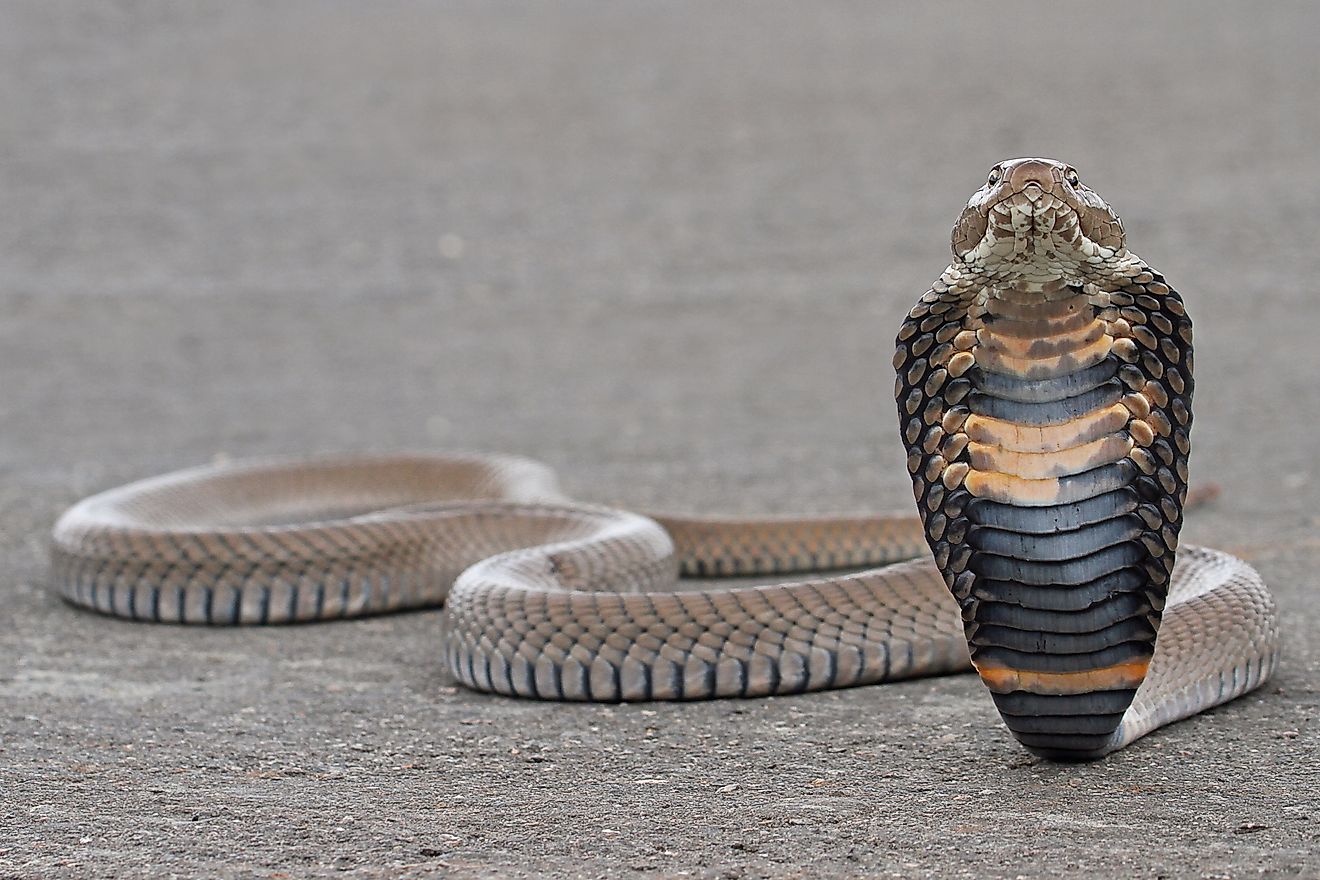
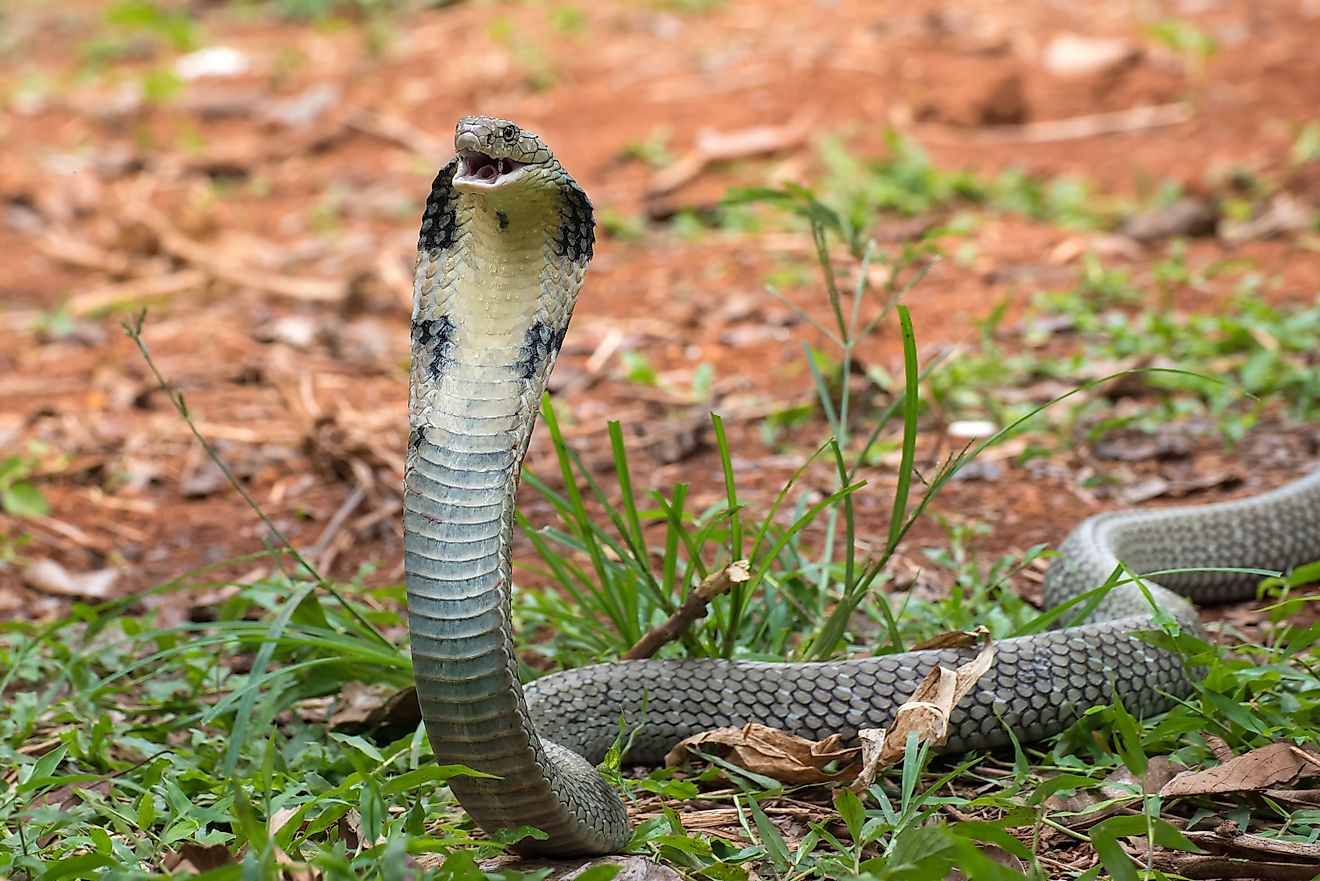
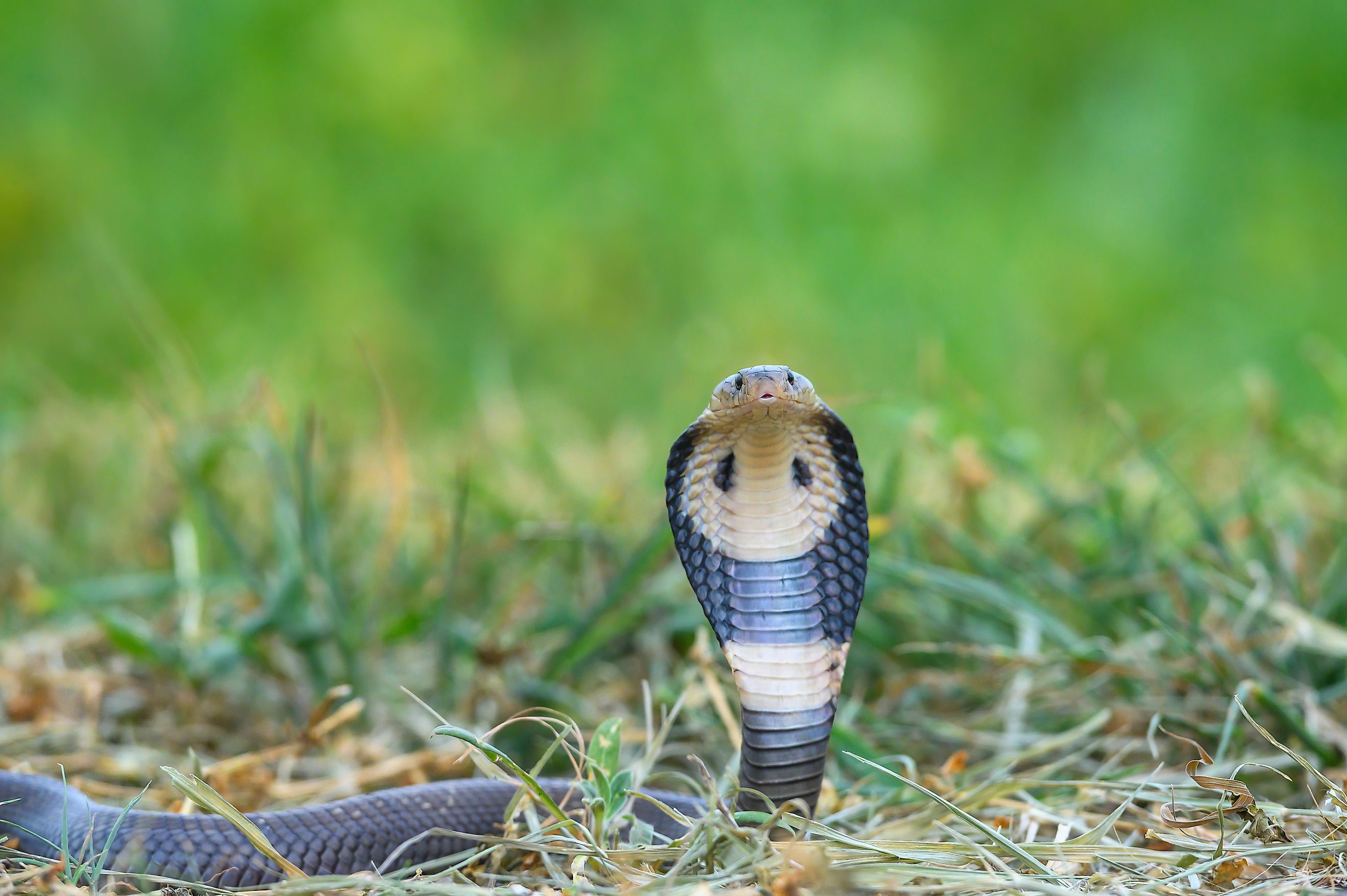
The most famous feature is of course the hood. Like all true cobras, Naja kaouthia can flatten and flare its neck by spreading a set of elongated ribs, transforming a narrow body into a broad, intimidating shield. On the back of that hood sits the single O-shaped monocle mark. The mark is variable, and it can appear as a crisp ring, a rough smudge, or occasionally be missing altogether. The fangs are short and fixed at the front of the mouth, the largest recorded example measuring under a third of an inch (6.78 mm), and in some populations the fangs are modified in ways that let the snake spray venom rather than only inject it.
Range and Habitat

The monocled cobra has one of the widest distributions of any cobra. Its range covers eastern and northeastern India, including West Bengal, and extends across Bangladesh, Bhutan, and Nepal. It continues through Myanmar, Thailand, Laos, Cambodia, and Vietnam into southern China and southeastern Tibet, and reaches south onto the Malay Peninsula. Few venomous snakes cover so much ground.
Within that vast territory the species shows a strong preference for habitats tied to water. Rice paddies, swamps, marshes, and mangroves are all favored, and the snake readily colonizes grasslands, shrublands, and forests as well. It reaches elevations of up to about 3,300 feet (1,000 m).
Crucially, the monocled cobra tolerates landscapes reshaped by people. It hunts across farmland and turns up in villages, town edges, and even cities, often sheltering in rodent burrows dug into the dykes between flooded fields. In rice-growing country it can become semi-aquatic, moving easily through the wet terrain in search of prey. This comfort around human settlement is a large part of why the snake and people so often come into dangerous contact.
Diet

A generalist hunter, the monocled cobra eats a broad menu of small animals. Rodents make up much of that diet, which draws the snake into close orbit around farms and grain stores where rats and mice gather. Beyond rodents it takes frogs and toads, fish, lizards, and other snakes, and it will raid poultry and snatch eels from waterways where it can.
This flexible appetite suits its equally flexible choice of habitat. In wetland and paddy environments amphibians and fish feature heavily, while in drier or more settled areas small mammals dominate. Like other elapids, the monocled cobra subdues prey with its venom, delivering a bite that quickly immobilizes the target before the snake swallows it whole.
Behavior

Monocled cobras are chiefly active at dusk and after dark, though in cooler weather or disturbed surroundings they may shift toward daytime activity. They are terrestrial and largely solitary, spending daylight hours hidden in burrows, tree hollows, termite mounds, or piles of debris.
When it comes to defense, the snake's first choice is usually escape. A disturbed monocled cobra will often try to flee rather than fight. Cornered or provoked, however, it puts on the classic cobra display, rearing up the front third of its body, spreading its hood to show off the monocle, hissing loudly, and striking to drive off the threat. The animal is fast-moving and can cover ground quickly.
Some populations add another layer to that defense. Their fangs are moderately adapted for spitting, allowing them to project venom toward the eyes of an aggressor. The behavior is not as pronounced as in the dedicated African spitting cobras, and monocled cobras were long regarded as reluctant spitters, but documented cases of venom sprayed into human eyes confirm that the capability is real.
Reproduction

The monocled cobra is oviparous, meaning it lays eggs rather than giving birth to live young. Egg-laying generally takes place between January and March. A female produces a sizable clutch of 16 to 33 eggs, which she then guards through the incubation period, an unusual degree of parental attention among snakes.
Incubation lasts roughly 55 to 73 days before the hatchlings emerge, already equipped with functional venom and fully capable of defending themselves. Monocled cobras are thought to live somewhere in the range of 13 to 20 years, with captive individuals commonly reaching the upper end of that span. Wild lifespans are presumably shorter, cut down by predation and by conflict with people.
Venom

The monocled cobra carries a potent, primarily neurotoxic venom, and it ranks among the most medically important venomous snakes in Asia. The chief active ingredient is a long postsynaptic neurotoxin called alpha-cobratoxin, which binds to receptors at the junction between nerve and muscle and blocks the signal that tells muscles to contract. The result is a flaccid paralysis that, left untreated, can progress to failure of the muscles used in breathing.
The venom is not purely neurotoxic. It also contains cytotoxins and cardiotoxins that damage tissue, so a serious bite often produces marked local swelling and necrosis around the wound in addition to systemic effects. Early signs of envenomation can include drowsiness, drooping eyelids, and other neurological symptoms, sometimes followed within hours by falling blood pressure, widespread paralysis, and difficulty breathing.
An average bite delivers a large dose, on the order of 263 mg of venom by dry weight, and the venom's potency varies noticeably from one region to another. The monocled cobra ranks among the leading causes of fatal snakebites in Thailand, which underlines why prompt medical care and the correct antivenom matter so much after any bite. Where venom reaches the eyes through spitting, it can cause intense pain, inflammation, and lasting damage to the cornea if it is not flushed and treated quickly.
Importance to the World

For all the danger it poses, the monocled cobra plays a valuable ecological role. As a prolific hunter of rats and mice, it acts as natural pest control across farmland, helping to check rodent populations that would otherwise damage crops and stored grain. It also serves as prey for larger predators, tying it into the wider food web of the wetlands and forests it inhabits.
The species' presence in religion and folklore is just as striking as its presence in the natural world. In a well-known Buddhist story, the great serpent Mucalinda, often pictured as a monocled cobra, rises and spreads its hood to shelter the meditating Buddha from a storm, an image common across mainland Southeast Asia. In Bengal and Bangladesh the snake goddess Manasa is worshipped for protection against snakebite, particularly in regions where this cobra is abundant. Its venom is also of scientific value, studied both for antivenom production and, more recently, for cytotoxins that researchers are examining for possible anticancer properties.
Threats and Conservation

The IUCN Red List assesses the monocled cobra as Least Concern, a reflection of its enormous range, its tolerance of altered landscapes, and its overall abundance. No single threat appears to be pushing the species toward decline across the board, and it remains common and widespread.
That broad security does not mean the snake faces no pressure. Monocled cobras are harvested for their skin and meat and for use in traditional medicine, and many are killed out of fear where they appear near homes and fields. Habitat loss and deliberate hunting have driven local declines in parts of the range even as the species as a whole holds steady. In India the snake receives legal protection under wildlife law, and its presence within protected areas offers some additional safeguard. For now the outlook is stable, though the animal's fortunes remain closely tied to how the people who share its landscape choose to treat it.
Takeaway
Overall, the monocled cobra is an adaptable snake that has managed to thrive in close proximity to people despite being one of the most dangerous species in its range. Its distinctive hood markings, powerful neurotoxic venom, and unusual habit of guarding its eggs make it one of the most recognizable reptiles in South and Southeast Asia. Yet the traits that make it dangerous also give it an important ecological role, as it helps control rats around farms and grain stores and contributes to the balance of the environments it shares with people.
Fun Facts

- A name that means monocle. The species name kaouthia comes from a Bengali word for monocle, describing the single ring on the hood, while Naja traces back to the Sanskrit word for snake.
- It sheltered the Buddha. In Buddhist tradition the serpent-king Mucalinda, widely depicted as a monocled cobra, spread its hood over the meditating Buddha to protect him from a storm.
- A leading cause of snakebite deaths. In Thailand, the monocled cobra is among the snakes responsible for the most fatal bites.
- A reluctant spitter. Although long considered a non-spitter, some populations can spray venom toward an attacker's eyes, and verified cases of eye envenomation exist.
- Venom against cancer. Scientists are studying cytotoxins from monocled cobra venom for their potential to kill cancer cells, a rare upside to one of Asia's most dangerous reptiles.
- A protective mother. Unlike most snakes, the female stays coiled around her clutch of up to 33 eggs, guarding them through the whole incubation period.
Quick Facts
- Scientific name: Naja kaouthia
- Family: Elapidae
- Order: Squamata (suborder Serpentes)
- IUCN status: Least Concern
- Length: 4.4 to 4.9 ft (1.35 to 1.5 m), maximum about 7.5 ft (2.3 m)
- Weight: about 4 to 5 lb (roughly 2 kg)
- Lifespan: 13 to 20 years
- Diet: Carnivore, taking rodents, frogs, fish, lizards, and other snakes
- Range: South and Southeast Asia, across eastern India, Vietnam, and the Malay Peninsula
- Venom: Potent neurotoxin (alpha-cobratoxin) with cytotoxic effects