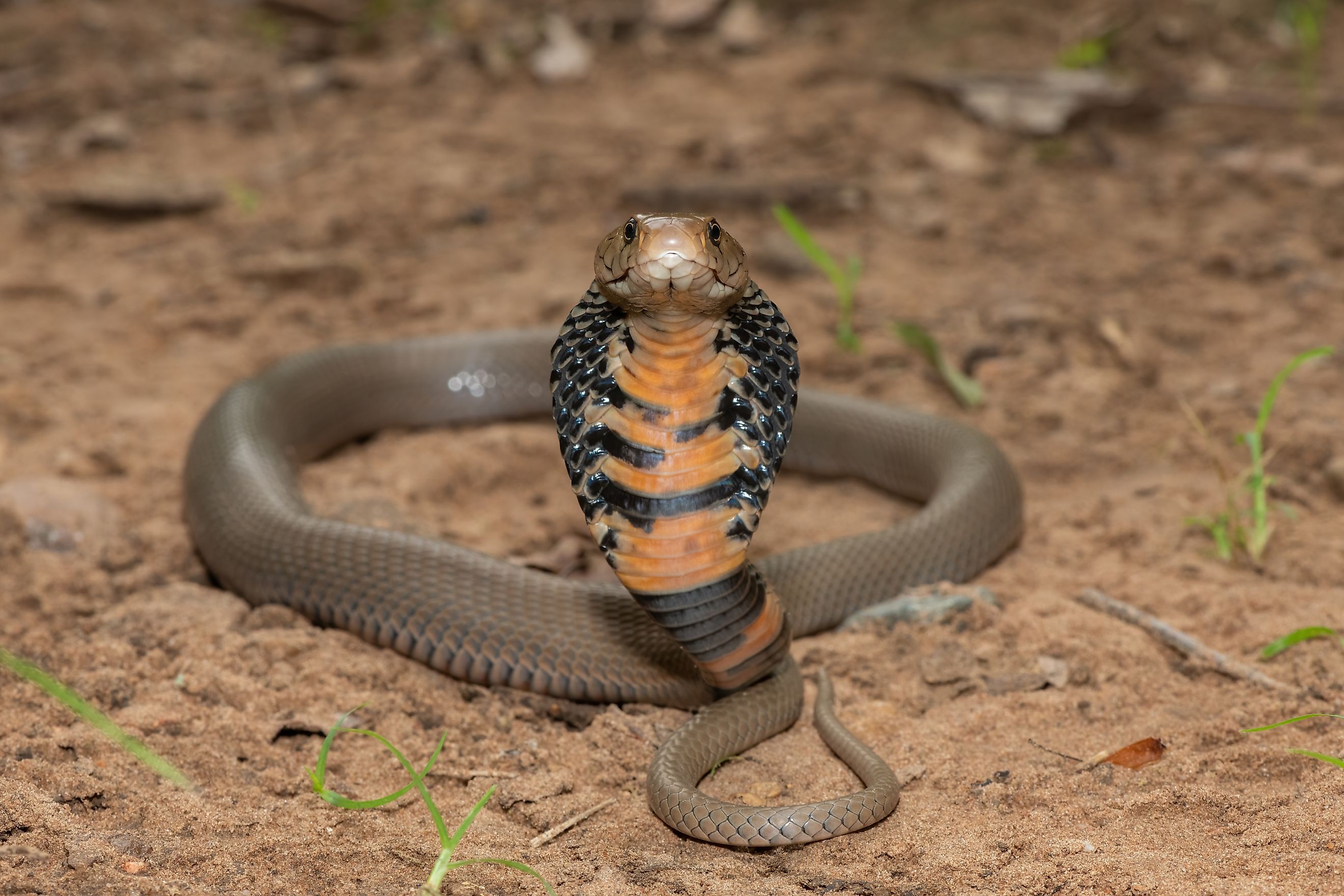
Spitting Cobra
A spitting cobra can put venom in your eyes from the length of a small room, and it will do it before you ever get close enough to step on one. That is the trait that names the group and sets it apart from every other snake. No other serpent has a long-distance defense that reaches for the eyes. The habit is not confined to one species either, but spread across a dozen or more cobras in Africa and Asia. Stranger still, the group holds a piece of natural history that points back at us, a defense that may have been shaped, in part, by our own ancestors.
Taxonomic Classification

A spitting cobra is not one species. They sit in the genus Naja, family Elapidae, the front-fanged snakes that also include mambas, kraits, and coral snakes. Within Naja, the spitters are divided into two lines: the African spitting cobras, placed in the subgenus Afronaja, and a group of Asian spitters within the subgenus Naja. Somewhere over a dozen species carry the habit. In Africa they include the black-necked spitting cobra (Naja nigricollis), the Mozambique spitting cobra (N. mossambica), the red spitting cobra (N. pallida), the zebra spitting cobra (N. nigricincta), and Ashe's spitting cobra (N. ashei), described as a separate species only in 2007. In Asia they include the equatorial (N. sumatrana), the Javan (N. sputatrix), and the Indochinese (N. siamensis). A third spitting lineage, the rinkhals (Hemachatus haemachatus) of southern Africa, sits in its own genus and is not a true Naja.
The line between species keeps moving. Genetic work in 2007 split populations long lumped under N. nigricollis, and study of the African spitters continues. Identification in the field often comes down to hood pattern and locale, not a clean checklist.
Physical Description

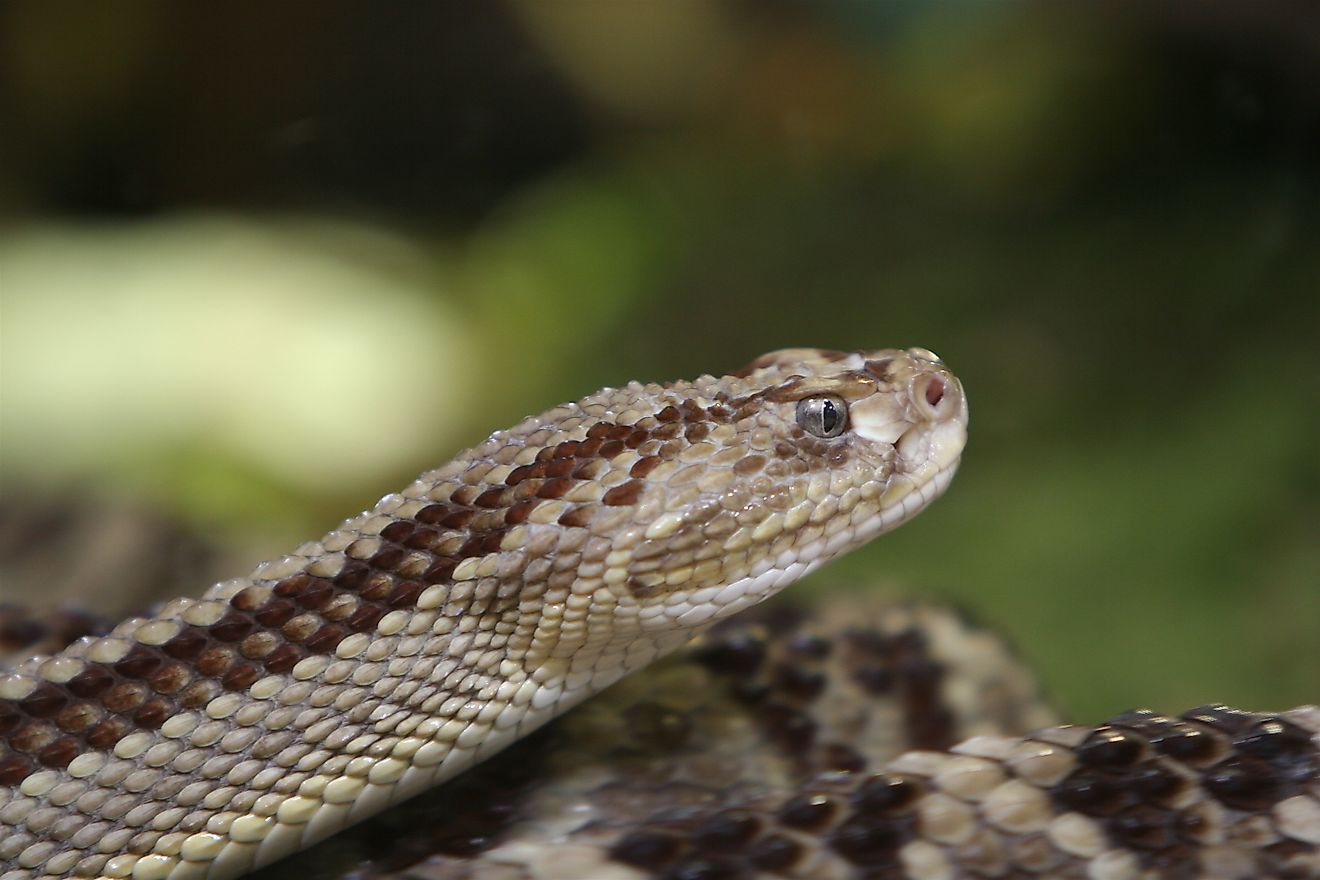
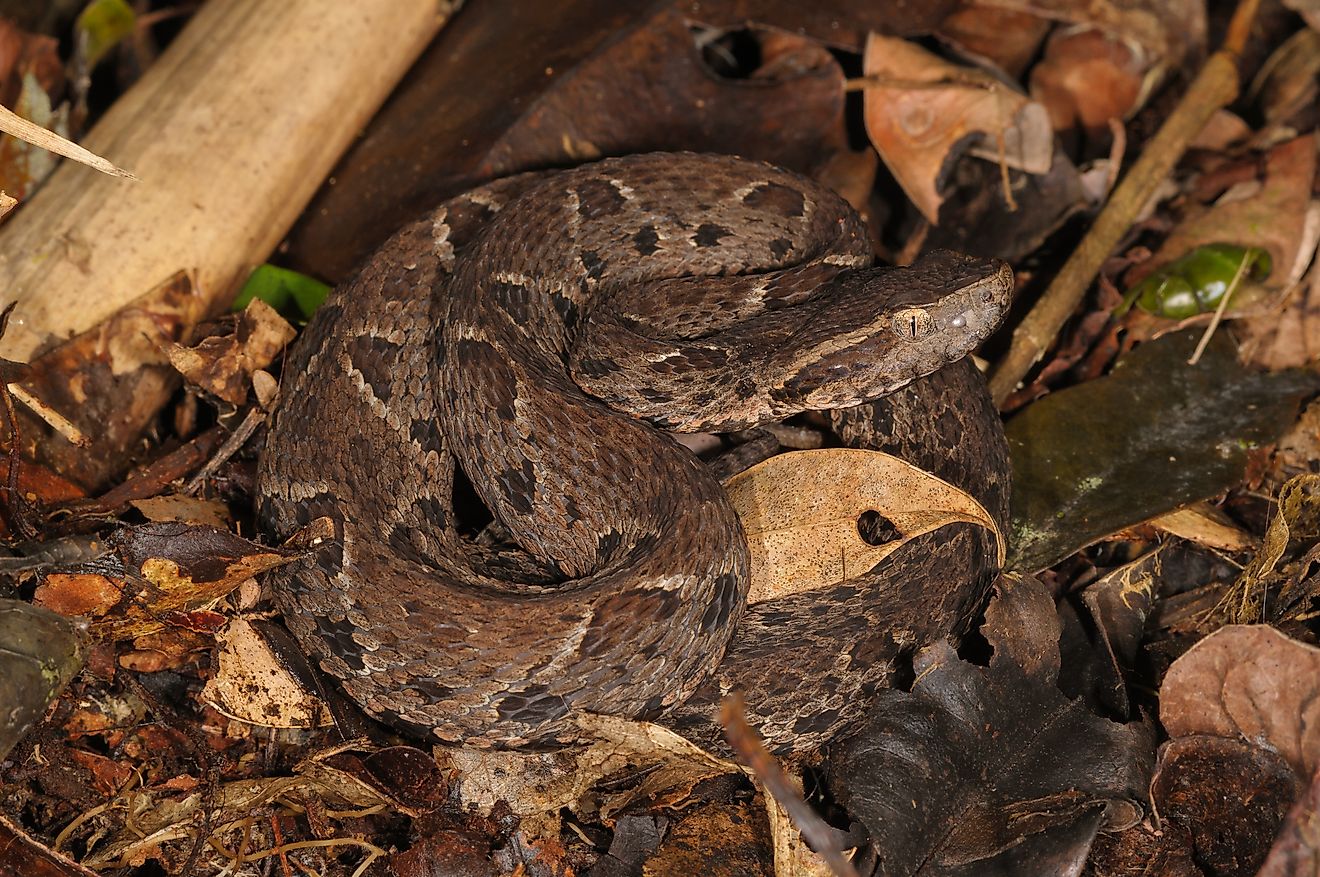
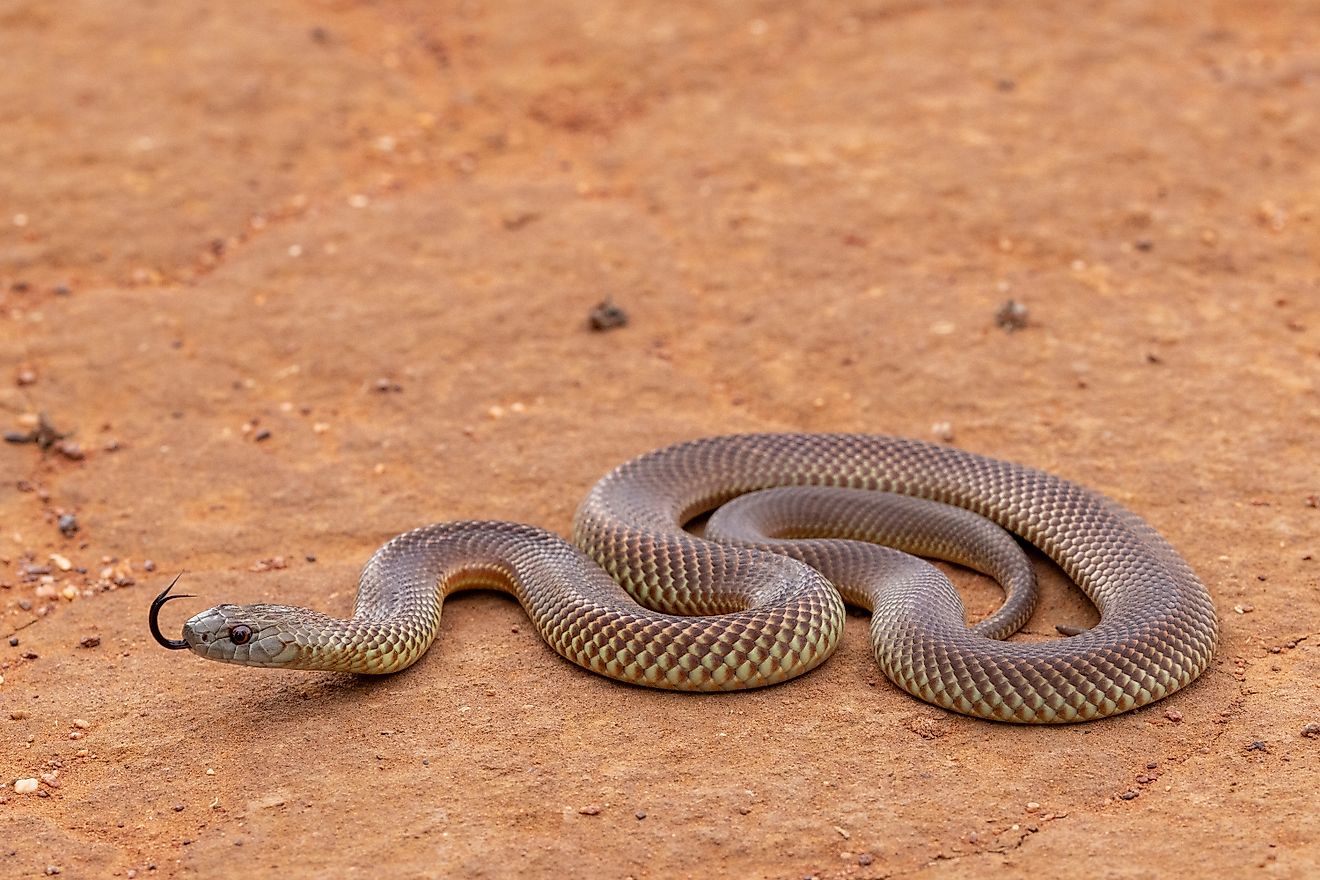
Most spitting cobras measure 1 to 2 meters. Ashe's is the largest, commonly over 2 meters on the Kenyan coast and recorded to about 2.7. Color runs plain, with shades of brown, gray, olive, and brick red in the red spitting cobra, while several species also display dark neck bands.The build is heavy in the big ones and the head is broad. The spread hood is a defensive display, not a fixed feature. The working detail is in the fangs. A spitting cobra's fangs carry small openings near the tip that point forward, not the downward slit of a snake that only bites. Muscle pressure on the venom gland forces a fine spray out through those holes, and the snake can throw it in bursts.
Range And Habitat

The African species range across sub-Saharan Africa, holding to the dry lowlands of Kenya, Somalia, and Ethiopia and reaching the savannas and semi-deserts of the south. Ashe's cobra holds to hot lowlands in northern and coastal Kenya and into neighboring Somalia and Ethiopia. The black-necked spitting cobra covers the widest ground, across much of the sub-Saharan belt. The Asian spitters run through Southeast Asia and the islands: Sumatra, Java, Borneo, the Malay Peninsula, mainland Indochina. Most favor open ground, scrub, and the edges of farmland. They do well near people. A grain store or a chicken run draws rats, and rats draw cobras.
Food

They forage mostly for small mammals, and rats and mice make up the bulk of it. They also feed on birds, lizards, frogs, and other snakes. Bigger species eat bigger prey. One Ashe's cobra examined at a Kenyan snake farm had swallowed a monitor lizard about 75 centimeters long, and on another record, a puff adder close to a meter and a half. Prey is killed by the bite, not by the spray. Spitting is for defense only and plays no part in catching food.
Behavior

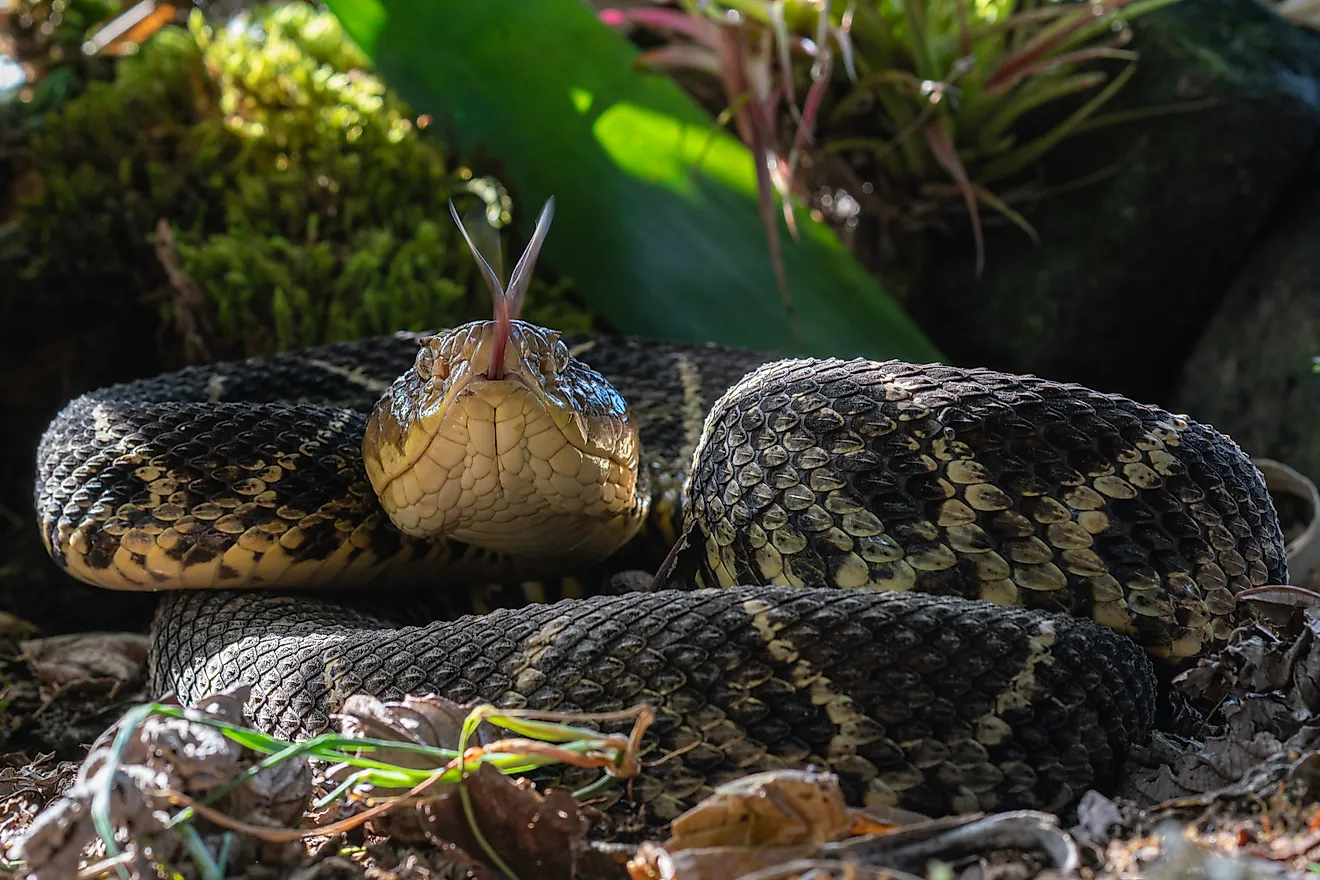
A cornered spitting cobra does not wait to be touched. It lifts the front third of its body, spreads a hood, and sprays venom toward the face of whatever stands in front of it. The spray carries about 2.5 meters, the length of a small room, and the target is the eyes. The snake will hit a face at 2 meters and corrects to the movement of the eyes, and the biggest species stay accurate past that. Venom in the eyes brings hard pain and swelling, and without a fast rinse it can scar the cornea and cost the sight. First aid is plain water and plenty of it, at once. The spray does no harm on intact skin, though it should be washed off. These are ground snakes for the most part, active by day and into the evening in hot weather, and they retreat to holes, termite mounds, and rock cracks.
Reproduction

All spitting cobras lay eggs. The black-necked spitting cobra drops clutches of roughly 10 to 22, with similar numbers across the group, laid in a burrow, a termite mound, or under cover that stays warm. Incubation takes about two months at ground temperatures near 28 to 30 degrees Celsius. Hatchlings come out around 20 to 25 centimeters, fully venomous, and can spit from the first day. There is little or no care after laying. The young hunt and defend themselves from the start.
Importance To The World

As predators they hold down rodents around farms and villages, which is real work where rats spoil stored grain and carry disease. The larger story is in the venom. In 2021 a team working across Africa and Asia showed that venom spitting evolved three separate times in this group, twice in Africa and once in Asia, and each time the venom shifted the same way. More of a pain-driving compound, a phospholipase called PLA2, layered onto the cell-killing toxins already present, tuned to hurt the eyes, not to kill.
The timeline is especially interesting. African spitting cobras appear to have diverged around 7 million years ago, roughly when the human lineage split from that of chimpanzees and bonobos. Asian spitting cobras emerged much later, around 2.5 million years ago, about the time Homo erectus reached Asia. The researchers suggest that the ability to spit venom accurately at an opponent's eyes may have evolved as a defense against upright, tool-using hominins rather than hoofed mammals, whose eye position makes such a strategy less effective. They are careful to emphasize that this idea remains a hypothesis rather than a proven fact. Even so, the same defensive adaptation evolved independently in three separate lineages, and the timing of each origin closely matches key stages in human evolution, making the pattern difficult to ignore.
Threats

The sharpest danger runs the other way, snake to person. The World Health Organization estimates snakes envenom as many as 2.7 million people a year and kill on the order of 100,000, most of them rural, and African spitting cobras are part of that count. Their bites tend to kill tissue around the wound more than they shut down the nerves, and the necrosis can be severe. Antivenom is thin and uneven across the range, and some products neutralize this venom poorly.
For the snakes themselves, the pressures are ordinary ones. The widespread species are listed as Least Concern, and they tolerate disturbed and farmed land better than most snakes do. What thins them locally is habitat cleared for crops, roads, and killing on sight by people who fear them. Some collection for skin and the pet trade adds to it. No widespread species is now considered at risk of extinction. The more likely trend is the opposite, with land clearing drawing rodents into human areas and giving rat-eating snakes that tolerate human activity more room to survive.
The Takeaway
The spitting cobra earns its attention twice over. On the ground it is a rat-catcher that keeps its distance from anything too big to eat, and the spray does the keeping. In the fossil record it is a rare case of a snake's venom shaped for defense instead of the hunt, and the timing points a finger back at the primates who learned to throw stones. Most of these snakes are in no trouble, and where people clear land and keep grain, they hold their ground. If you encounter one, simply keep your distance, and if you were too slow to avoid its spit, rinse the affected area thoroughly.