Japanese Giant Salamander
The Japanese giant salamander is one of the largest amphibians alive today, a slab-bodied river dweller that can stretch to nearly the length of a grown adult lying down. Wrinkled, mottled, and almost prehistoric in appearance, it has haunted the cold mountain streams of Japan for millions of years with a body plan that has changed remarkably little. Scientists know it as Andrias japonicus, and it belongs to a small, ancient family of creatures often called living fossils.
Endemic to Japan, it lives only in the clear, fast-flowing rivers of the country's western regions. It is fully aquatic, spending its entire life in water, and it is rarely seen because it hunts under cover of darkness and hides beneath rocks and submerged logs by day. For an animal this size, it is astonishingly elusive.
What makes it worth knowing goes beyond its bulk. This salamander breathes through its skin, can live for decades, and sits at the top of its stream ecosystem as a quiet apex predator. It is also woven deep into Japanese folklore and protected as a national treasure.
Taxonomic Classification

The Japanese giant salamander belongs to the family Cryptobranchidae, a lineage of giant salamanders whose ancestry reaches back tens of millions of years. Within that family sits the genus Andrias, which contains the largest living amphibians on Earth. The species was formally described by the Dutch zoologist Coenraad Jacob Temminck in 1836, though Europeans first encountered a living specimen a few years earlier when the physician Philipp Franz von Siebold captured one near Nagasaki and shipped it to the Netherlands.
Its closest relatives are the Chinese giant salamander (Andrias davidianus) and the South China giant salamander (Andrias sligoi), both native to mainland China, along with the smaller hellbender (Cryptobranchus alleganiensis) of the eastern United States. For many years the Japanese species was ranked as the second-largest salamander in the world. Recent genetic work that split the Chinese giant salamander into more than one species has nudged it to third place in most reckonings, though it remains one of the true giants of its class.
Physical Description

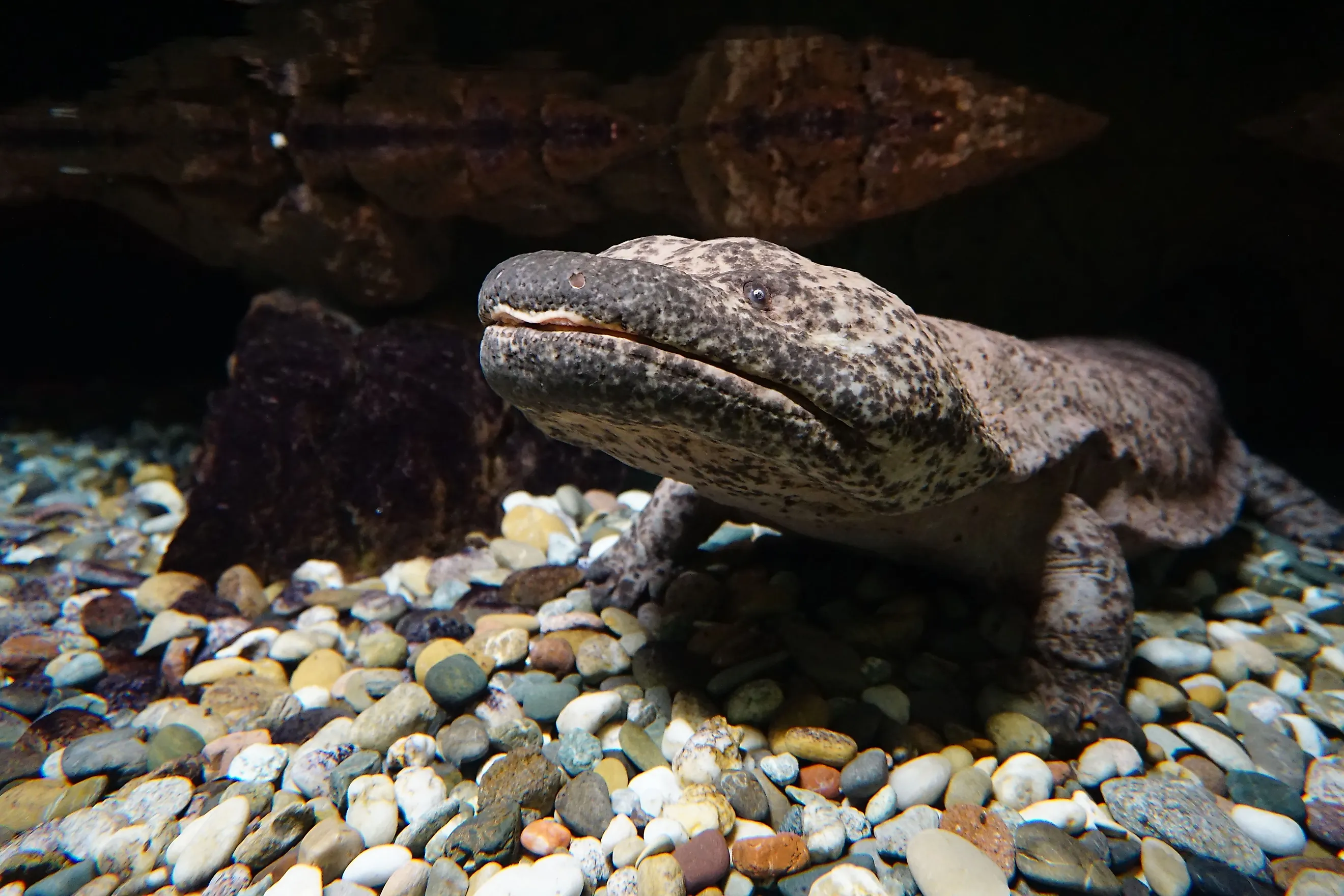
Adults commonly reach around 5 feet (1.5 m) in length and can weigh as much as 55 pounds (25 kg), making this one of the heaviest amphibians on the planet. The body is broad and flattened, built to press against the streambed and resist the pull of a swift current. A long, laterally compressed tail drives the animal forward, and two pairs of short, sturdy legs of similar size let it clamber over rocks.
The skin is the salamander's most important organ, and its most striking feature. Mottled in grey, brown, and black, it provides near-perfect camouflage against a rocky river bottom. Loose, wrinkled folds hang along the flanks and neck, and these are not incidental. They dramatically increase the animal's surface area, which matters because the Japanese giant salamander breathes almost entirely through its skin. Its lungs are vestigial and serve mainly for buoyancy rather than gas exchange, so oxygen diffuses directly across the moist epidermis from the cold, well-aerated water around it.
Its head is wide and flat, with a mouth that stretches across the full width of the skull and can gape nearly as wide as the body. The eyes are tiny, lidless, and set on top of the head, and eyesight is poor. To compensate, the animal relies on a system of sensory nodes across its head and body that detect changes in water pressure, allowing it to sense movement in the dark. It also keeps the teeth of its larval stage throughout life.
Range and Habitat

The species is found only in Japan, across the western part of Honshu and parts of Shikoku and Kyushu. It favors cold, clear, fast-moving mountain streams and rivers, generally at elevations between about 590 and 4,430 feet (180 and 1,350 m). These waters are rich in dissolved oxygen, a requirement for an animal that breathes through its skin, and the salamander is highly sensitive to any drop in water quality or flow.
Within these rivers it seeks out cover, sheltering under large rocks, in undercut banks, and among submerged logs. A healthy population is often read as a sign of a clean, well-functioning river, which makes the animal a useful indicator species for the condition of Japan's freshwater systems. Because it almost never leaves the water, it is acutely vulnerable when streams shrink, warm, or become fragmented.
Diet

The Japanese giant salamander is a patient ambush predator. Rather than chasing prey, it lies still on the riverbed and waits, then lunges with a sudden sideways snap of its enormous mouth, creating a suction that pulls victims inward. Its broad gape lets it take surprisingly large items for a slow-moving animal.
Its diet is varied and opportunistic. Crustaceans such as crabs and shrimp make up a large share, alongside fish, aquatic insects, worms, and the occasional small mammal or amphibian that strays too close. A notably slow metabolism means the salamander does not need to eat often. It can go for weeks, and sometimes longer, without a meal, drawing on stored energy between feeds. As one of the largest predators in its stream, it sits near the top of the local food chain and helps regulate the populations of the smaller animals it hunts.
Behavior

This is a solitary and largely nocturnal animal. Through the day it stays hidden in a den or beneath a rock, emerging after dark to forage along the riverbed. It moves slowly, walking or crawling across the bottom more often than swimming, and it rarely ventures far from its chosen stretch of river.
Adults, especially males, can be territorial, defending favored shelters and stretches of riverbed against rivals. When threatened or handled, the salamander secretes a sticky, milky substance from its skin that carries a sharp odor. This defensive secretion gives the animal one of its Japanese names, which references the scent of Japanese pepper. Communication is thought to rely heavily on smell and on the pressure-sensing system in the skin, since vision plays so small a role in its world.
Reproduction

Breeding takes place in late summer, usually from August into September. As the season arrives, mature males compete for burrows dug into riverbanks, and the successful holder of a nest is sometimes called a den-master. A female enters a chosen burrow and lays a long string of several hundred eggs, often numbering four to five hundred, which the male then fertilizes externally.
The male's role does not end there. He remains in the burrow to guard the developing clutch, fanning the eggs to keep fresh, oxygen-rich water flowing over them and driving off intruders that might eat them. The eggs hatch in winter, roughly twelve to fifteen weeks after fertilization. The larvae are small and possess external gills, which they gradually lose as they grow, though metamorphosis is incomplete and adults retain certain larval traits. Growth is slow. Sexual maturity may take eight years or more, and individuals continue to grow throughout their long lives.
Importance to the World

As a large predator in cold, clean rivers, the Japanese giant salamander plays an important ecological role in keeping stream communities in balance. By preying on fish, crustaceans, and insects, it helps shape the structure of the ecosystems it inhabits, and its presence signals water clean enough to support a demanding, oxygen-hungry animal.
Its cultural weight in Japan is equally significant. The species has appeared in local legend for centuries and is widely thought to have inspired aspects of the kappa, a water-dwelling creature of Japanese folklore. Japan recognized the salamander as a Special Natural Monument in 1952, granting it strong legal protection, and it remains a beloved emblem of the country's mountain rivers. Conservation-minded festivals and community efforts in some regions celebrate the animal and support the streams it depends on.
Threats

Despite its protected status, the Japanese giant salamander is in trouble. The IUCN Red List classifies it as Vulnerable, and researchers estimate that the population has fallen by roughly a third to a half over the past several decades. The animal is also listed on Appendix I of CITES, the strictest tier of international trade protection.
The pressures are mostly human in origin. Dams, weirs, and the concrete channelization of rivers block the salamander's movements and cut populations off from one another, while also destroying the gravel banks it needs for nesting. Pollution and warming waters degrade the cold, oxygen-rich habitat it cannot live without. A newer and especially insidious threat comes from hybridization. Chinese giant salamanders, introduced to Japan and released into the wild, interbreed with the native species, and in some rivers, notably around Kyoto, hybrids now outnumber pure-blooded Japanese salamanders. Conservation work today focuses on protecting river habitat, building passages around barriers, and identifying and safeguarding genetically pure populations before they are lost.
Takeaway
The Japanese giant salamander is a living remnant of an ancient amphibian lineage, having changed little while the world around it transformed. It breathes through wrinkled skin, hunts in darkness, guards its young with unusual devotion, and can outlive many of the people who study it. However, the same traits that sustained it for millions of years now make it vulnerable. The species depends on cold, clean, connected rivers, many of which have been altered by dams and other human development. Protecting this ancient giant therefore requires preserving the river systems it inhabits, along with the conditions that allow them to remain healthy and connected.
Fun Facts

- A living fossil. The salamander's body plan has stayed remarkably stable for tens of millions of years, so a modern individual looks much like its ancient ancestors.
- It breathes without working lungs. Nearly all of its oxygen passes directly through its skin, which is why the loose, wrinkled folds along its body matter so much.
- The pepper fish. When alarmed it exudes a milky secretion said to smell like Japanese pepper, which gave rise to its native name, Ōsanshōuo.
- A possible monster origin. Many believe this salamander helped inspire the kappa, a mischievous water spirit of Japanese folklore.
- A very long life. Individuals can live for many decades, with one captive salamander recorded at more than fifty years of age.
- Devoted fathers. Males guard the eggs inside their burrows and fan fresh water over them until the young hatch in winter.
Quick Facts
- Scientific name: Andrias japonicus
- Family: Cryptobranchidae
- Order: Urodela (Caudata)
- IUCN status: Vulnerable (population decreasing)
- Length: up to about 5 feet (1.5 m)
- Weight: up to about 55 pounds (25 kg)
- Lifespan: several decades, commonly up to around 50 years
- Diet type: carnivore (fish, crustaceans, insects, worms, small vertebrates)
- Range: western Japan (Honshu, Shikoku, and Kyushu)
- Habitat: cold, fast-flowing mountain streams and rivers