Goliath Grouper
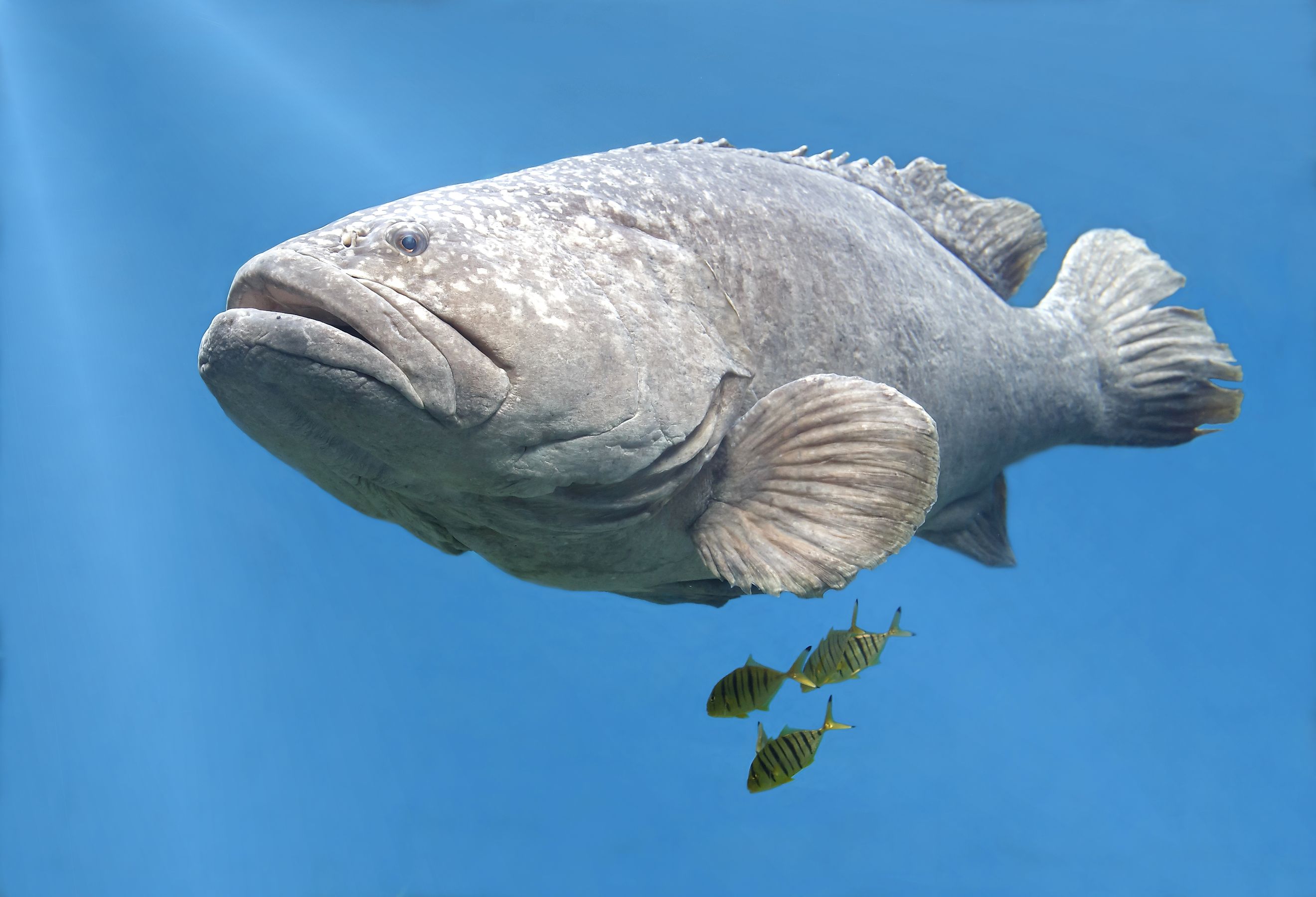
The goliath grouper (Epinephelus itajara) is the largest grouper in the Atlantic Ocean and one of the biggest bony fishes on Earth. Mature adults can stretch to 8 feet (2.5 m) and weigh more than 800 pounds (363 kg), roughly the mass of a grand piano. Divers who meet one on a Florida shipwreck often describe the encounter as coming face to face with a curious, slow moving giant that has a cavernous mouth and small, watchful eyes.
This reef heavyweight ranges through the warm coastal waters of the western Atlantic, reaching as far south as Brazil, and it holds an outsized place in both marine ecosystems and conservation history. Once fished to the brink of collapse, the goliath grouper became a symbol of overexploitation and, later, of recovery after the United States banned its harvest in 1990.
What makes this fish worth a closer look is not only its bulk. It broadcasts booming sounds through the water, gathers by the dozens to spawn under the summer new moon, and swallows crabs and fish whole with a vacuum like gulp. It is a species whose size is matched by its strangeness.
Taxonomic Classification

The goliath grouper belongs to the animal kingdom, phylum Chordata, and class Actinopterygii, the ray finned fishes. Within that class it sits in the order Perciformes and the family Epinephelidae, the true groupers, a lineage that many older references folded into the sea bass family Serranidae. Its genus is Epinephelus, and its full scientific name, Epinephelus itajara, was assigned by the German naturalist Martin Lichtenstein in 1822.
For most of the twentieth century this species was known in the United States by the common name "jewfish." The American Fisheries Society formally replaced that name with "goliath grouper" in 2001, and the new name is now standard across both scientific and popular writing.
Modern genetic work has sharpened the picture of the goliath grouper's relatives. Populations once lumped together on either side of the Americas are now recognized as two separate species. The Atlantic goliath grouper (Epinephelus itajara) is distinct from the Pacific goliath grouper (Epinephelus quinquefasciatus), which lives along the eastern Pacific coast between the Gulf of California and Peru.
Physical Description

Size is the goliath grouper's defining feature. The largest confirmed individuals reach about 8 feet (2.5 m) in length and weigh in excess of 800 pounds (363 kg), with some records citing weights approaching 1,000 pounds (454 kg). That heft makes it the heaviest grouper in the Atlantic and one of the largest reef fishes anywhere in the world.
The body is thick, elongated, and robust rather than streamlined, built for short bursts and ambush rather than sustained speed. Coloration varies between yellowish brown and grayish green, mottled with dark blotches and small spots that break up the fish's outline against reef and rock. This pattern can shift subtly with mood and surroundings. The head is broad with a rounded snout, the eyes are strikingly small for the size of the animal, and the fins are rounded, including a broad, fan shaped tail.
Adults carry an enormous mouth lined with several rows of small teeth. Those teeth are not built for slicing. Instead the fish relies on a powerful suction feeding action, opening its jaws so quickly that water and prey are drawn in together. Thick skin and dense musculature round out a body plan suited to life among hard structure, where a goliath grouper can wedge itself into ledges and wrecks.
Range and Habitat

In the western Atlantic, the goliath grouper occurs off Florida and the northern Gulf of Mexico, ranges through the Caribbean Sea, and reaches its southern limit at the state of Paraná in southern Brazil. Smaller populations live in the eastern Atlantic along the coast of West Africa, between Senegal and the Congo, with occasional records near the Canary Islands.
Habitat use changes dramatically over the fish's life. Juveniles spend roughly their first five to six years in mangrove lined estuaries, where the tangled roots offer shelter and abundant food. These nursery habitats matter so much that the loss of mangroves directly limits how many young groupers survive. Juveniles also tolerate the low salinity and murky water of coastal creeks far better than most reef fishes.
As they mature, goliath groupers move offshore to reefs, rocky ledges, bridge pilings, and shipwrecks, usually in relatively shallow water less than about 165 feet (50 m) deep. Adults show strong site fidelity, returning to the same wreck or ledge year after year. That predictability made them easy targets during the era of heavy fishing.
Diet

The goliath grouper is an opportunistic ambush predator with a broad appetite. Crustaceans form the core of its diet, especially crabs and spiny lobsters, supplemented by shrimp, a wide range of fishes, octopus, and even the occasional juvenile sea turtle or stingray.
Rather than chasing prey down, the fish waits near structure and strikes at close range. When a target comes within reach, the grouper flares its huge mouth and gill covers to create a sudden drop in pressure, pulling water and prey inside in a fraction of a second. Prey is swallowed whole. Despite their fearsome size, goliath groupers pose no meaningful danger to people and are not known to attack divers, though a large individual guarding a wreck can be an intimidating sight.
Behavior

Outside the breeding season, goliath groupers are largely solitary and territorial, with each adult holding a favored patch of reef or wreckage. They are most active during daylight and tend to settle near cover to rest.
One of the species' most remarkable habits is sound production. By contracting muscles against its gas filled swim bladder, a goliath grouper generates a deep, low frequency "boom" that carries a long way underwater. The fish uses this sound as a warning to intruders, often paired with an open mouthed display, and also to locate and keep contact with other groupers. Juveniles have even been observed producing pulses of sound while hunting small prey.
Reproduction

Goliath groupers grow slowly and mature late, a life history that shapes everything about their conservation. Males typically become reproductive at four to six years of age and lengths of 43 to 45 inches (110 to 115 cm), while females mature slightly later, at six to seven years and 47 to 53 inches (120 to 135 cm).
The species is widely thought to be a protogynous hermaphrodite, meaning that some individuals begin life as females and change to males as they grow, although direct evidence of the switch in this particular species remains limited.
Breeding centers on large spawning aggregations that form in summer, from June through October with a peak between July and September. Dozens of adults, historically around ten but now often twenty to forty at recovering sites, gather at predictable offshore reefs and wrecks, frequently spawning at night around the new moon. As pelagic spawners, they release eggs and sperm into the open water column, where fertilization takes place and the tiny larvae drift before settling into mangrove nurseries. Individuals may travel considerable distances to reach these traditional aggregation sites.
Importance to the World

As a large, long lived predator, the goliath grouper helps regulate the populations of the crustaceans and fishes it eats, contributing to the balance of reef and estuary communities. Researchers often describe the species as an ecosystem engineer, and studies have found positive associations between grouper presence and overall reef biodiversity, even if the exact mechanisms are still being worked out.
The goliath grouper also contributes to local economies through dive tourism. In Florida and the Caribbean, encounters with these large fish attract divers and support charter operators and ecotourism businesses. Their seasonal aggregations are particularly popular, drawing visitors who come specifically for the opportunity to observe the species in large numbers.
Threats and Conservation

The goliath grouper's biology made it exceptionally vulnerable to overfishing. Its large size, predictable aggregations, site fidelity, and fearless nature meant that spearfishers and anglers could remove many fish quickly, and its slow growth left populations unable to bounce back. By the 1980s the species was considered functionally extinct in Florida waters, and overall numbers had fallen by an estimated 80 percent.
In 1990 the United States banned all harvest of goliath grouper, and other nations enacted their own protections. The response was encouraging. Florida populations rebounded over the following decades, and in 2018 the International Union for Conservation of Nature reassessed the species from Critically Endangered to Vulnerable on its Red List, reflecting real recovery while acknowledging that the fish is far from secure.
Management continues to evolve. In 2022 Florida approved a limited and highly regulated recreational harvest in state waters, and the first season opened in 2023 after more than three decades of full closure. The program uses a random draw lottery, caps the total take at 200 fish per year, restricts anglers to smaller juveniles, and keeps harvest closed in federal waters and in key dive tourism areas. The measure remains controversial, with dive operators and some scientists urging caution given the species' slow reproduction.
Takeaway
With its enormous size and powerful suction feeding, the goliath grouper is a prominent predator of tropical reefs and mangrove habitats. Its feeding behavior helps it capture prey while its presence contributes to the structure of these ecosystems. The species also has a history of severe overfishing, with its large size, slow growth, and late maturity making recovery difficult once populations declined. Conservation measures have since allowed some populations to rebound, although the species remains dependent on healthy mangrove and reef habitats. Its recovery demonstrates what sustained protection can achieve, while also showing why continued management is important for a slow-growing fish.
Fun Facts

- It used to have a different name. Until 2001 the species was commonly called the "jewfish" in the United States, when the American Fisheries Society officially adopted the name "goliath grouper."
- It talks with its swim bladder. The deep booming call a goliath grouper makes is produced by muscles drumming against its swim bladder, and the low frequency sound can travel a long way underwater.
- It eats by vacuuming. Rather than biting and tearing, the fish opens its mouth explosively to suck in prey whole, crabs, lobsters, and fish alike.
- It returns home. Adults show strong site fidelity, often living on the same shipwreck or ledge for years and returning to the same spawning sites each summer.
- Its age is written in bone. Scientists estimate a goliath grouper's age by counting yearly growth rings in its ear bones and fin ray sections, much like reading the rings of a tree.
Quick Facts
- Common name: Goliath grouper (formerly jewfish)
- Scientific name: Epinephelus itajara
- Family: Epinephelidae
- Order: Perciformes
- IUCN status: Vulnerable (reassessed from Critically Endangered in 2018)
- Length: Up to 8 feet (2.5 m)
- Weight: Up to 800 pounds (363 kg), with reports approaching 1,000 pounds (454 kg)
- Lifespan: At least 37 years, possibly longer
- Diet: Crustaceans, fish, octopus, and the occasional sea turtle
- Range: Western Atlantic (Florida to Brazil), the Gulf of Mexico, the Caribbean, and West Africa
- Habitat: Mangrove estuaries as juveniles, reefs and shipwrecks as adults