What Animals Live in the Pacific Ocean?
The Pacific Ocean is the largest on Earth, sprawling across about 62.46 million square miles, roughly a third of the planet's surface. It runs from sunlit coastal shallows down to the Mariana Trench, which bottoms out around 35,797 feet below the surface, deep enough to swallow Mount Everest with a mile to spare. All that water, warm to freezing and shallow to crushing, makes room for an astonishing cast of animals, some of which live nowhere else. Here are fifteen of them.
Penguins

Several penguin species patrol the Pacific, including the Humboldt, the yellow-eyed, the Fiordland crested, and the rockhopper. The standout is the Galapagos penguin (Spheniscus mendiculus), the only penguin on Earth that lives north of the equator, riding the cold Humboldt Current to survive at the tropics where no penguin has any business being. It is also one of the smallest, standing under 20 inches tall. Cold upwelling water is the whole trick; without it, a penguin at the equator would simply overheat.
Dugong

The dugong (Dugong dugon) is a marine mammal that looks a great deal like its cousin the manatee, with one giveaway: a dolphin-like fluked tail rather than a rounded paddle. It is a committed herbivore, grazing sea grass on the sea floor so methodically that biologists call them "sea cows" without much irony. Adults typically weigh around 926 pounds and stretch about 9.8 feet, though a few heavyweights have topped 2,000 pounds and 13 feet. They favor the warm, shallow coastal waters of the western Pacific, rarely straying far from the sea-grass meadows that feed them.
Killer Whale

The killer whale, or orca (Orcinus orca), is the Pacific's apex predator and, despite the name, the largest member of the dolphin family. Males reach about 26 feet and 6.6 short tons, with the largest on record measuring 32 feet and roughly 11 tons. They hunt in tightly coordinated pods with strategies passed down through generations, which is how a pod can wear down prey many times its size. The densest orca populations in the Pacific gather in the north, around the Aleutian Islands, where the fishing is good.
Humpback Whale

The humpback whale (Megaptera novaeangliae) is a baleen whale that strains tiny krill from the water by the ton, concentrated most heavily in the North Pacific. Females run larger than males, averaging 28 to 33 short tons and about 52 feet. Its genus name, Megaptera, means "big wing," a nod to the enormous pectoral fins that can reach a third of the body's length. Humpbacks are champion travelers, covering up to 16,000 miles a year between polar feeding grounds and tropical breeding waters, one of the longest migrations of any mammal.
Fur Seal

"Fur seal" covers nine species in the subfamily Arctocephalinae, named for the dense underfur that once made them a target for hunters. They are close cousins of sea lions, and like sea lions they have visible external ear flaps, the easy way to tell an eared seal from a true seal. Fur seals grow to around 500 pounds and 79 inches, with some bulls reaching 660. Contrary to a common mix-up, most fur seal species actually live in the Southern Hemisphere; only the northern fur seal ranges widely across the cold North Pacific.
Elephant Seal

The elephant seal is the giant of Pacific seals, named for the male's enormous inflatable snout. The northern elephant seal (Mirounga angustirostris) hauls out along the North American coast, and the sexes are wildly mismatched: an average adult runs about 2,000 pounds, but a dominant bull can hit 6,000, roughly the weight of a pickup truck. Those bulls fight brutal battles for beach territory, which is a large part of why they grew so enormous in the first place.
Manta Ray

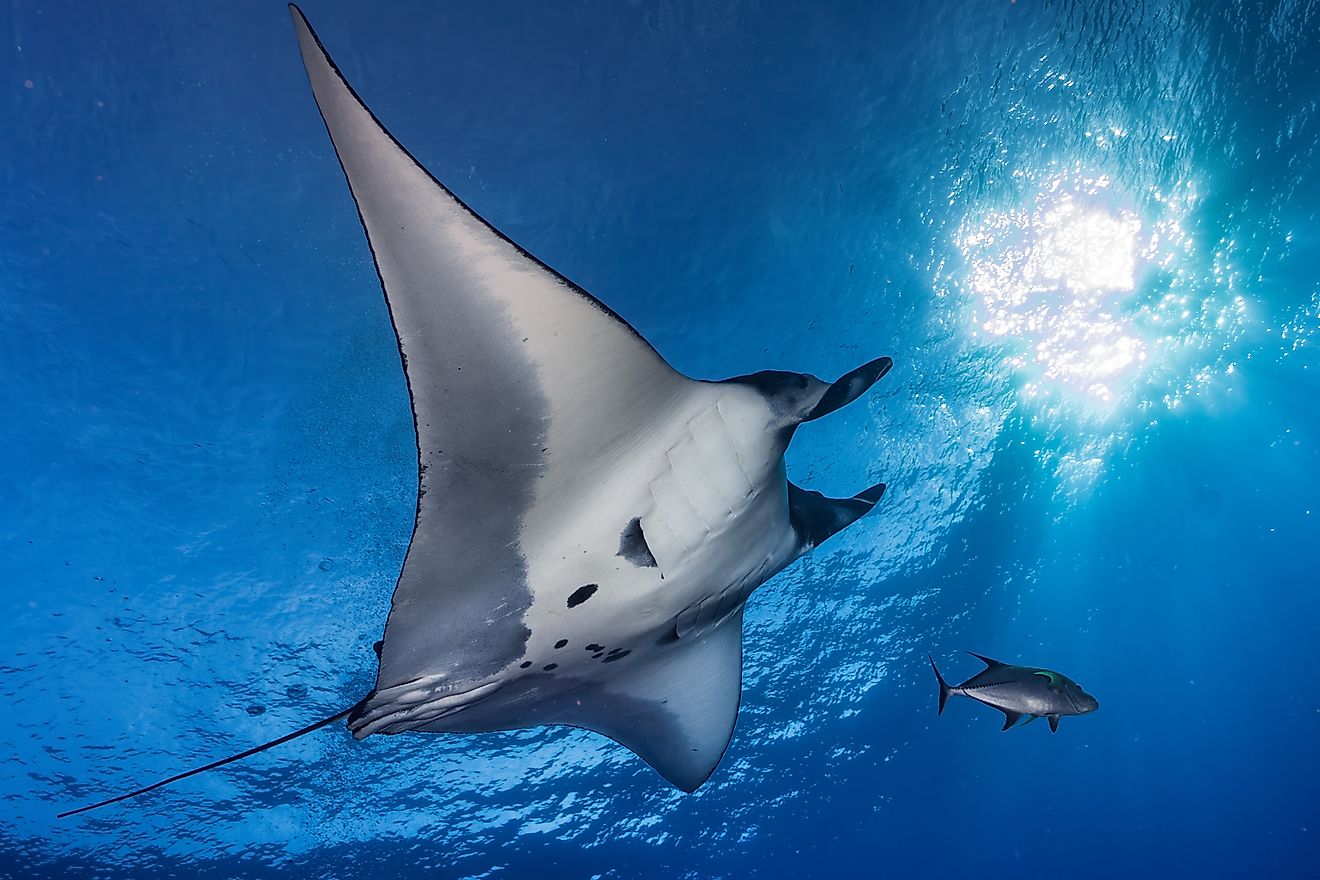
The giant manta ray (Mobula birostris) is the largest ray in the world, with a wingspan reaching up to 26 feet. For all that bulk, it is a gentle filter feeder, cruising with its mouth open to strain zooplankton from the water rather than hunting anything with a pulse. Mantas are docile, curious, and among the few fish thought to recognize themselves in a mirror, a sign of unusual intelligence. Their main natural threats are large sharks and killer whales, which is a short list for an animal this size.
Sea Otter

The sea otter (Enhydra lutris) is small for a marine mammal, maxing out around 100 pounds and 59 inches, yet it is still the heaviest member of the weasel family, Mustelidae. It makes up for its size with the densest fur of any animal on Earth, up to a million hairs per square inch, since it has no blubber to keep warm. Sea otters are also tool users, cracking open shellfish with rocks balanced on their chests, and they hold hands, or paws, while sleeping so they do not drift apart on the current.
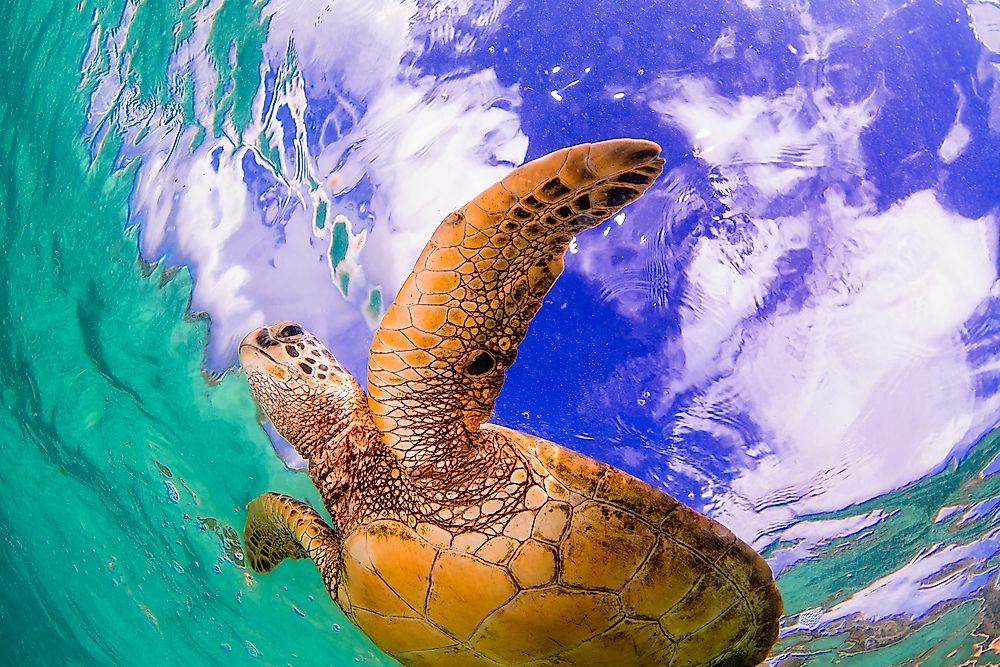
Sea Turtle

Seven species of sea turtle glide through the world's oceans, and most turn up in the Pacific: the leatherback, hawksbill, green, flatback, loggerhead, olive ridley, and Kemp's ridley. The leatherback (Dermochelys coriacea) is the giant of the group, averaging around 1,500 pounds and, unlike the others, carrying a leathery ridged back instead of a hard shell. Sea turtles are also remarkable navigators: females return to lay their eggs on the very beaches where they hatched, often crossing entire ocean basins to get there.
Sea Slug

"Sea slug" is a loose name for the nudibranchs and their gastropod lookalikes, and they are some of the most flamboyant animals on the reef. Many wear electric colors as a warning: quite a few can eat venomous prey like anemones and jellyfish, then recycle the stolen stingers into their own skin as borrowed weaponry. The feathery plumes on many of their backs are gills. For an animal often smaller than a thumb, the sea slug is doing a surprising amount.
Octopus

Octopuses are among the most abundant cephalopods in the Pacific, and the biggest of them all lives here: the giant Pacific octopus (Enteroctopus dofleini), which can weigh 150 pounds and span far wider with its arms. They are startlingly smart, with the largest brain-to-body ratio of any invertebrate and, remarkably, about two-thirds of their neurons distributed through their arms rather than their head. An octopus can, in a real sense, think with its limbs, taste with its skin, and squeeze its whole body through a gap the size of its eyeball.
Giant Squid

The giant squid (genus Architeuthis) is one of the ocean's great phantoms, so elusive that it was never filmed alive in its deep habitat until 2012. It ranks among the largest invertebrates on Earth, second only to the colossal squid, with adults reaching up to 43 feet and females outgrowing males. It also has the largest eyes in the animal kingdom, each about the size of a dinner plate, all the better for catching faint light in the deep waters off Japan and elsewhere in the North Pacific.
Pacific White-Sided Dolphin

The Pacific white-sided dolphin (Lagenorhynchus obliquidens) is a North Pacific native with a gray back and creamy white belly. Males reach about 440 pounds and 8.2 feet, females a bit smaller. They are famously acrobatic, riding bow waves and flipping clear of the water in big, boisterous groups that can number in the thousands. Their main predators are the same orcas that share their waters.
Steller Sea Lion

The Steller sea lion (Eumetopias jubatus) is the largest of all sea lions, named for the naturalist Georg Steller who first described it in 1742. Males average around 1,200 pounds but can grow to roughly 2,500, with a thick, lion-like mane around the neck. In early 2026 one especially enormous individual, nicknamed Chonkers and tipping the scales near 2,000 pounds, became a minor celebrity by hauling out on the docks at San Francisco's Pier 39. They range across the cold North Pacific, from California up around to Japan.
Hammerhead Shark

Few fish are as instantly recognizable as the hammerhead shark, whose flattened, wing-shaped head is not just for show. Spreading its eyes and sensory organs to the far edges of that "hammer" gives the shark a near 360-degree field of view and a sharpened ability to detect the faint electrical signals of buried prey. The great hammerhead, the largest of the group, can reach nearly 20 feet. In warmer months, scalloped hammerheads gather in the eastern Pacific in schools of hundreds, one of the more staggering sights the ocean has to offer.
An Ocean Full of Superlatives
The Pacific does not do anything by halves. It holds the largest ray, the largest octopus, the heaviest weasel, the only equator-crossing penguin, and an apex predator that hunts in family teams. That is what the biggest, deepest body of water on the planet buys you: room enough for the extremes of animal life, and cold, strange corners where some of them live nowhere else.