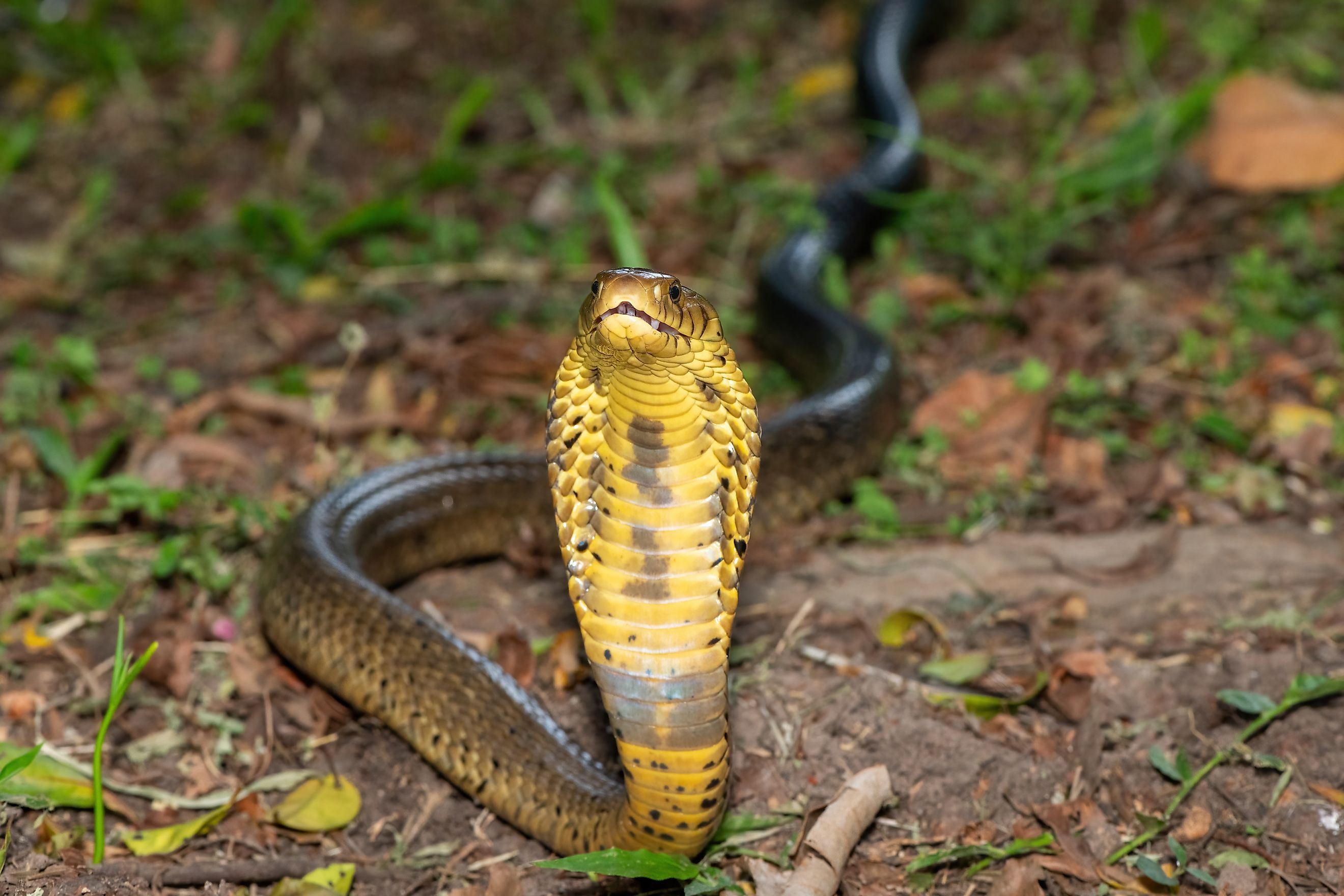
Forest Cobra
The forest cobra is the largest true cobra on Earth, a glossy, powerfully built serpent that regularly exceeds 8 feet (2.4 m) and, in rare cases, approaches 10 feet (3.1 m). Native to the humid forests and moist savannas of western and central Africa, it is a fast, alert predator that swims, climbs, and hunts across an unusually wide range of habitats. Few African snakes combine size, speed, and adaptability so completely.
Scientifically known as Naja melanoleuca, the forest cobra belongs to the elapid family, the group that also contains mambas, kraits, and coral snakes. Its venom is a potent neurotoxin, and a large adult can inject enough of it to kill a person, yet the snake bites people far less often than most of its cobra relatives because it tends to live away from human settlements. It is a formidable animal that mostly prefers to avoid a fight.
The forest cobra is also a lesson in how much remains unknown about familiar wildlife. In 2018 a team of herpetologists used DNA and anatomy to show that what everyone had called a single wide-ranging species is really a complex of five closely related species, hiding in plain sight across the African tropics. That discovery reshaped how scientists define this animal and where it is thought to occur.
Taxonomic Classification

The forest cobra sits in the kingdom Animalia, phylum Chordata, class Reptilia, and order Squamata, the order that holds all lizards and snakes. Within the snake family Elapidae, it belongs to the genus Naja, the true cobras, and to the subgenus Boulengerina, a group of forest and water cobras restricted to central and western Africa. American herpetologist Edward Hallowell first described the species in 1857, giving it the name Naja melanoleuca. The name comes from Greek roots meaning black and white, a nod to the barred lips and dark body of the classic form.
For more than a century Naja melanoleuca was treated as one variable species spread across sub-Saharan Africa. That changed in 2018, when Wolfgang Wüster and colleagues combined mitochondrial DNA, nuclear genes, and morphology and found deep genetic divisions inside the group. Their work split the old forest cobra into five species. Naja melanoleuca in the strict sense became the Central African forest cobra, while the brown forest cobra (Naja subfulva), the black forest cobra of the Upper Guinea forests (Naja guineensis), the banded forest cobra of the savanna mosaic (Naja savannula), and the island endemic Naja peroescobari of São Tomé were each recognized as distinct. Older references, and many photographs, still lump these forms together, so care is needed when reading anything published before the split.
Physical Description

The forest cobra's size is one of its most striking characteristics. The average adult measures 4.6 to 7.2 feet (1.4 to 2.2 m), and larger individuals regularly reach about 8.9 feet (2.7 m). Record lengths of roughly 10 feet (3.1 m) have been reported, which makes this the longest of the true cobras. Large, mature snakes can weigh up to about 7.9 pounds (3.6 kg). Unusually for snakes, males grow as large as females, a pattern thought to reflect the wrestling contests that males stage over mates.
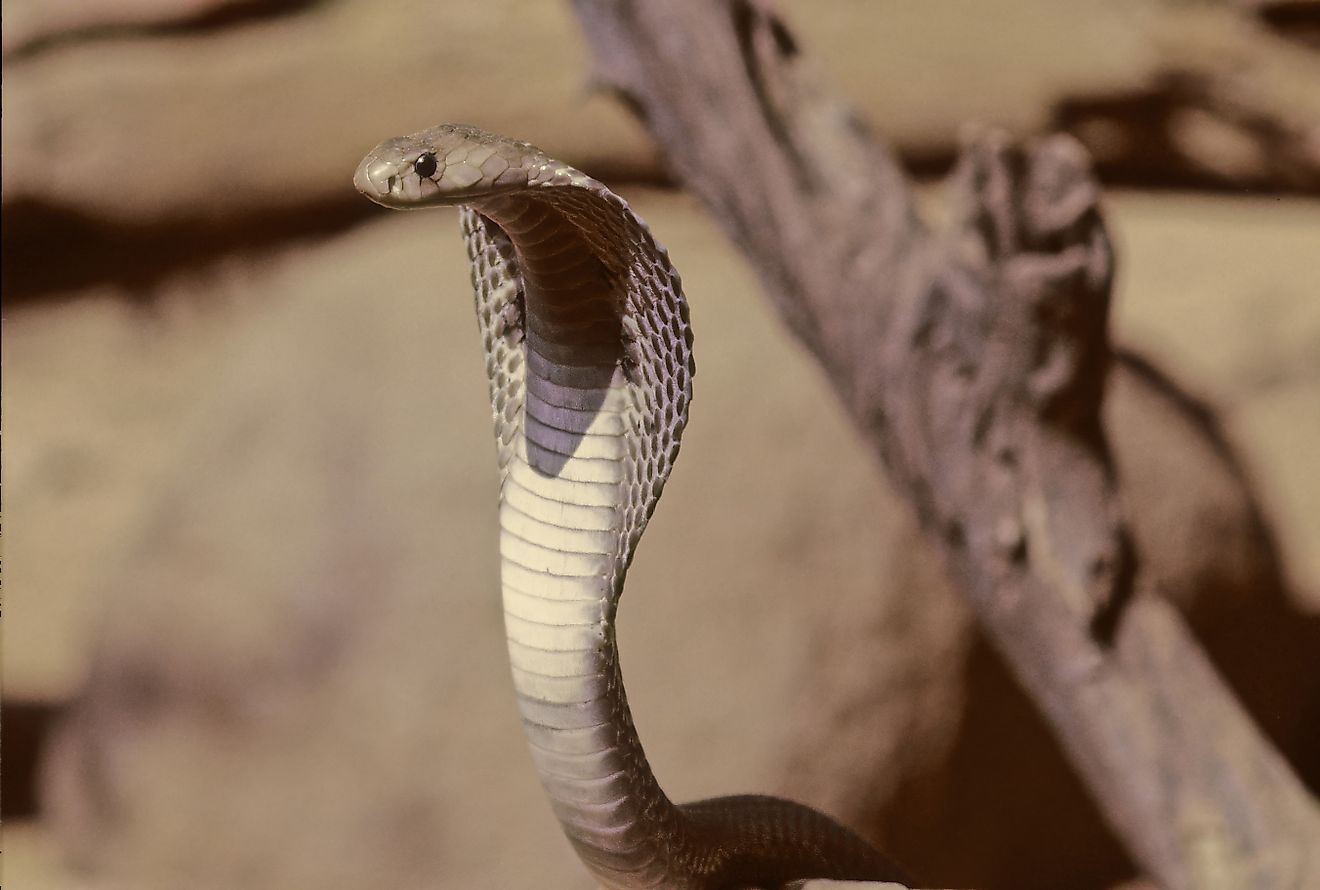
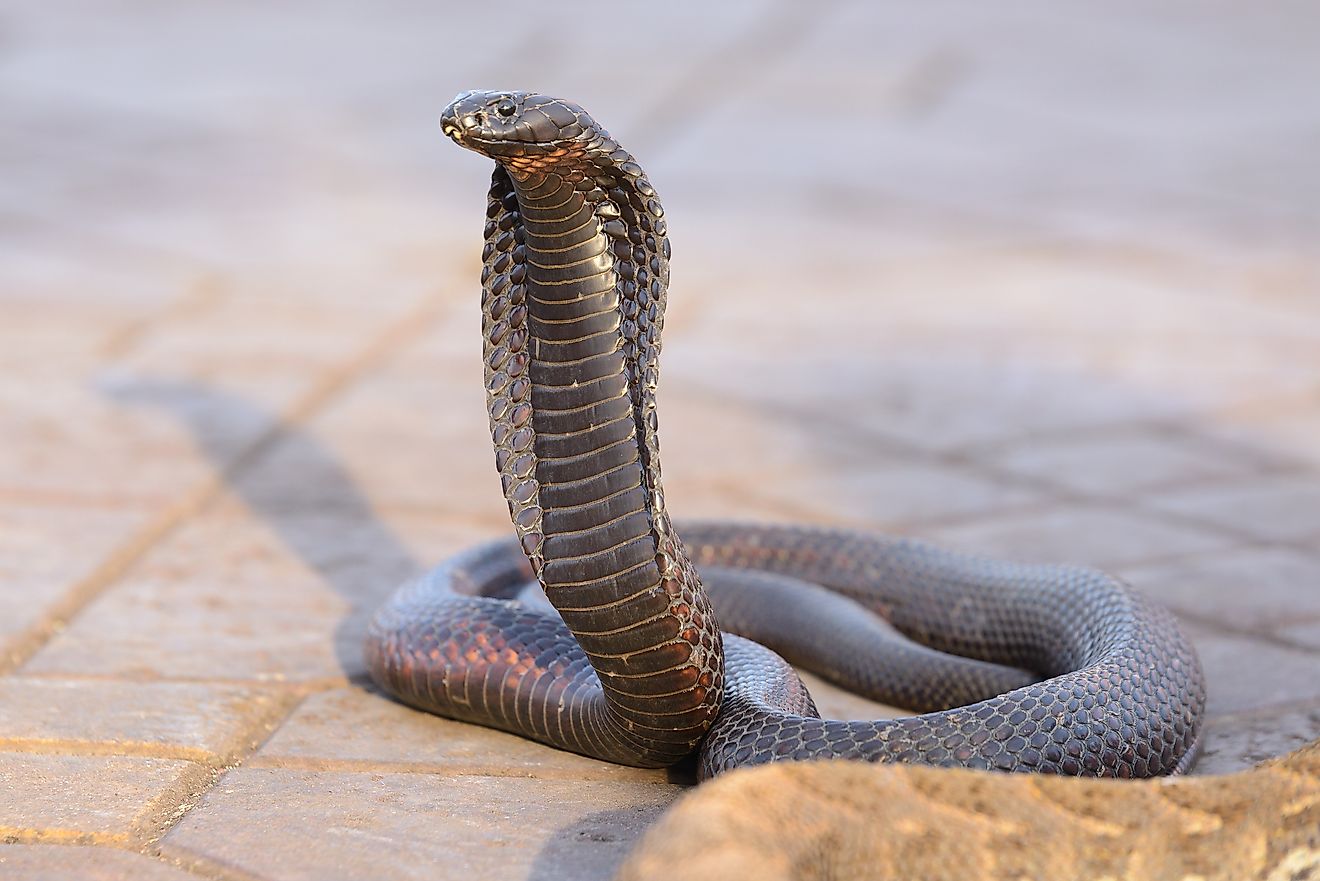
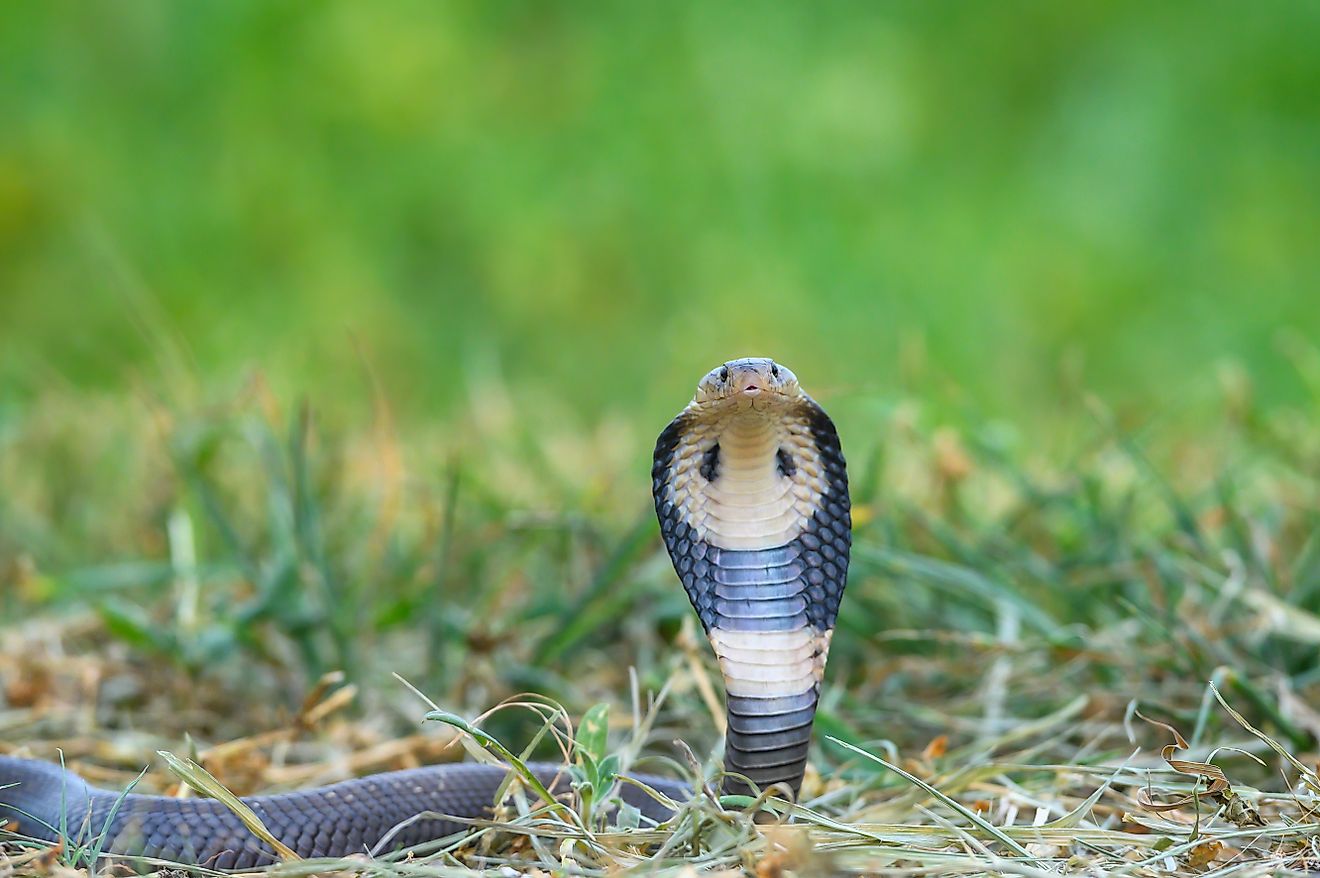
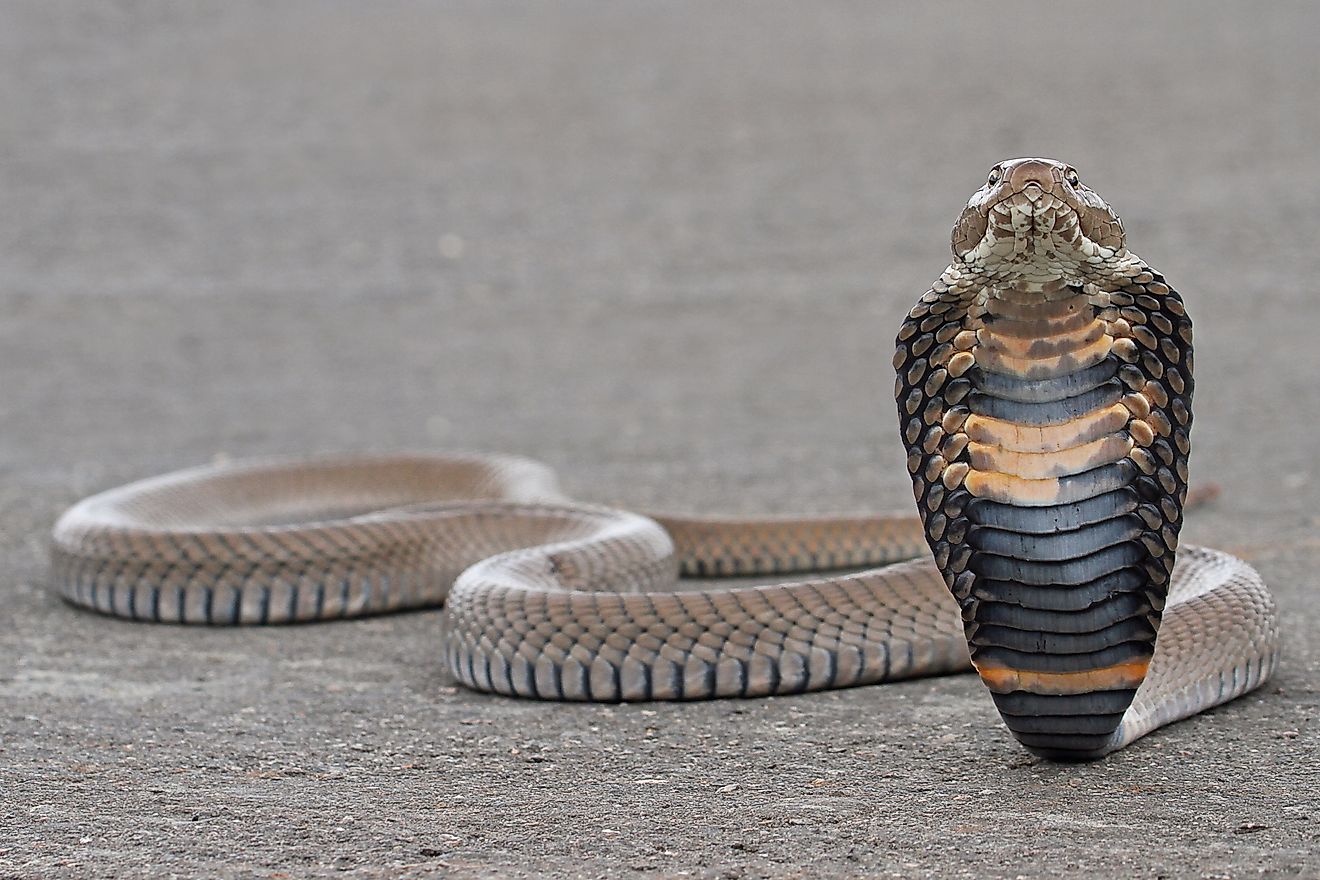
The body is thick and muscular with a slender tail, and the head is large, broad, and slightly flattened, only faintly set off from the neck. When alarmed, the snake spreads a narrow hood by fanning out long, hinged cervical ribs. Coloration varies across the range. In the West African savanna form the snake shows black and yellow bands, a black tail, and pale yellow lips, throat, and chin. Populations in the eastern coastal lowlands tend toward brown or blackish brown above with a cream or yellow belly. The barred black-and-white lips that give the animal its common names are a reliable field mark in the classic form.
Range and Habitat

The forest cobra and its close relatives occur widely across western and central Africa, and the broader species complex reaches much of sub-Saharan Africa. True to its name, the snake favors lowland rainforest and moist savanna, but it is remarkably adaptable and turns up in forest edges, plantations, riverbanks, and even drier country within its range. It is often found near water and is an excellent swimmer, so much so that biologists frequently describe it as semi-aquatic. It also climbs well and may be seen resting in low trees or hunting along forested lake shores.
That flexibility helps explain the animal's success. A snake that can forage on land, in water, and in the branches has access to far more prey and cover than a strict habitat specialist. It also brings the forest cobra into contact with people who farm, fish, and gather wood along the same forest margins and riverbanks.
Diet

The forest cobra is a generalist hunter with one of the broadest diets of any African snake. It preys on fish and amphibians, along with other snakes, lizards, monitor lizards, bird eggs, nestling birds, rodents, and other small mammals. Large insects round out the menu, especially for younger snakes. This variety lets the species act as both a secondary and a tertiary consumer, feeding on plant-eaters and on other predators alike. An active forager rather than a sit-and-wait ambusher, the forest cobra ranges widely in search of food, using its speed and keen eyesight to run down prey before subduing it with a venomous bite. Its willingness to enter water gives it access to fish and frogs that many terrestrial snakes cannot reach.
Behavior

Forest cobras are alert, fast-moving, and easily startled. During the day they are often active in shaded forest and along rivers, though in warmer lowlands they may shift some hunting to the night. Most of the time the snake is wary and retreats into dense cover when it senses a person. Cornered or surprised, it can turn strongly defensive. It rears the front of its body well off the ground, spreads its narrow hood, hisses loudly, and, if pressed, strikes with considerable speed. Unlike several African cobras, the Central African forest cobra does not spit its venom, so eye-targeted spray is not a typical risk from this species.
Despite its fearsome reputation, the forest cobra is one of the least frequent causes of snakebite among African cobras, largely because it lives away from dense human populations and prefers escape to confrontation. When a bite does happen, however, it is a medical emergency that calls for prompt treatment.
Reproduction

The forest cobra is oviparous, meaning it lays eggs rather than giving live birth. Mating typically occurs in the spring and is preceded by courtship in which a pair raises their heads and sways together, sometimes for an hour or more before mating. Rival males engage in combat, coiling around one another and wrestling until one gives way. A female usually lays a clutch of about 15 to 26 eggs, with reported ranges spanning roughly 10 to 30.
Hatchlings emerge fully independent, measuring around 10 inches (25 cm) and weighing near 22 grams. Their venom glands work from the start, so they can hunt and defend themselves at once, drawing on stored yolk energy for their first days. The first skin shed comes within seven to ten days of hatching. Growth is rapid until the snakes reach sexual maturity at two to four years, after which it slows sharply. In captivity forest cobras have lived roughly 20 to 30 years, though lifespan in the wild is poorly documented.
Importance to the World

As a large, abundant predator, the forest cobra helps regulate the animals it eats, and its heavy reliance on rodents makes it a natural check on pests that damage crops and carry disease. By preying on fish, frogs, and other snakes as well, it occupies an important middle position in forest and wetland food webs, both eating and being eaten. Mongooses, black mambas, birds of prey, crocodiles, and monitor lizards all take forest cobras, especially vulnerable juveniles, so the species also feeds the predators above it.
The snake matters to people in other ways too. Its potent venom is of interest to researchers studying neurotoxins and developing antivenoms, work that has real value for public health across a continent where snakebite is a serious cause of death and disability. Understanding exactly which species live where, a question the 2018 split brought into focus, directly affects how the right antivenom and medical advice reach the right regions.
Threats and Conservation

The forest cobra complex is currently listed as Least Concern on the IUCN Red List, reflecting a broad range and continued presence in many protected areas. Its worldwide population has not been counted and remains unknown. That reassuring status, however, comes with a caveat created by the recent taxonomy. When one wide-ranging species is divided into five, some of the newly recognized species have much smaller ranges than the old combined figure suggested, and a few could prove more vulnerable to forest loss and hunting than the single-species view implied.
The main pressures are familiar ones. Habitat destruction from logging and agriculture removes the forest and forest-edge cover the snakes depend on. Road deaths take a steady toll, and many snakes are killed on sight out of fear. Bushmeat hunting and the collection of snakes affect some populations as well. Where forest cobras occur inside national parks and reserves, site protection can reduce these threats locally, but legal safeguards vary widely by country. Sorting out the true range and status of each of the five species is now an urgent conservation task.
Takeaway
Despite its potent venom, the forest cobra generally avoids encounters with people. It moves through rivers, climbs into the canopy, and often disappears from open areas before anyone realizes it is nearby. What changed our understanding of the species was not a field observation but genetic research, which revealed that four other snakes had been classified under the forest cobra's name. This discovery has important conservation implications. A snake photographed along a West African riverbank may belong to a species with a much smaller range than previously believed, making accurate identification essential for understanding which populations are stable and which may be losing habitat.
Fun Facts

- Five snakes in one. Until 2018 the forest cobra was considered a single species. DNA evidence revealed five, including two that were entirely new to science.
- The biggest true cobra. With record lengths near 10 feet (3.1 m), it outmeasures every other member of the genus Naja.
- A swimming serpent. The forest cobra is such a strong swimmer that scientists often call it semi-aquatic, and it readily hunts fish and frogs in the water.
- Born ready. Hatchlings arrive with fully functional venom glands and can hunt and defend themselves the day they leave the egg.
- A rare biter. Despite its size and toxicity, it causes fewer human bites than almost any other African cobra because it avoids populated areas.
- No spitting here. Unlike some of its cobra cousins, the Central African forest cobra cannot spray venom and relies on a fast, decisive bite instead.
Quick Facts
- Scientific name: Naja melanoleuca
- Family and order: Elapidae, order Squamata
- IUCN status: Least Concern (species complex)
- Length: 4.6 to 7.2 feet (1.4 to 2.2 m) average, up to about 10 feet (3.1 m)
- Weight: up to about 7.9 pounds (3.6 kg)
- Lifespan: roughly 20 to 30 years in captivity
- Diet: carnivorous generalist (fish, amphibians, snakes, lizards, birds, eggs, rodents)
- Range: western and central Africa, broadly across sub-Saharan Africa