Eyelash Viper
The eyelash viper is one of the most visually distinctive venomous snakes in the American tropics. This small, arboreal pit viper has raised scales above each eye that resemble curled eyelashes and comes in a striking range of colors, including bright yellow, leaf green, rusty brown, and deep red. Its unusual appearance has made it a favorite among wildlife photographers and zoos, as well as one of the most recognizable pit vipers in the region.
Known to science as Bothriechis schlegelii, this species lives in the forests of Central America and northern South America, where it coils on branches and waits for prey to pass within reach. As a member of the pit viper group, it comes armed with heat-sensing organs and a fast, accurate strike.
Despite its fearsome reputation, the eyelash viper is a relatively small and generally calm snake that spends much of its time lying motionless. Its striking appearance, potent venom, and recent taxonomic debate over how many species it actually represents have all made it an intriguing subject for closer study.
Taxonomic Classification

The eyelash viper belongs to the family Viperidae and the subfamily Crotalinae, the group commonly called pit vipers. Its genus, Bothriechis, contains the arboreal palm-pitvipers of Central and South America, and the eyelash viper is the most widespread and familiar member of that group. Within the wider animal kingdom it sits in the class Reptilia, order Squamata, and suborder Serpentes.
The German naturalist Berthold formally described the species in 1846, originally placing it in the genus Trigonocephalus. The species name honors Hermann Schlegel, a German herpetologist of the nineteenth century. Over the years the snake has carried several common names, including eyelash palm-pitviper, Schlegel's viper, and horned palm viper.
Recent genetic work has stirred debate about the boundaries of this species. In 2024, a team led by Alejandro Arteaga proposed splitting the traditional Bothriechis schlegelii into several species and reviving older names, nearly doubling the count within the group. A later study challenged that conclusion and argued that only three species should stand. The disagreement remains unsettled, a reminder that even a well-studied snake can hold taxonomic surprises.
Physical Description

The eyelash viper is small by pit viper standards. Adults usually measure 22 to 32 inches (55 to 82 cm) in total length, and females tend to grow longer and heavier than males. A few individuals approach 3 feet (about 1 m), but most stay well under that mark. The light build suits an animal that lives among thin branches and vines, where a heavy body would be a liability.
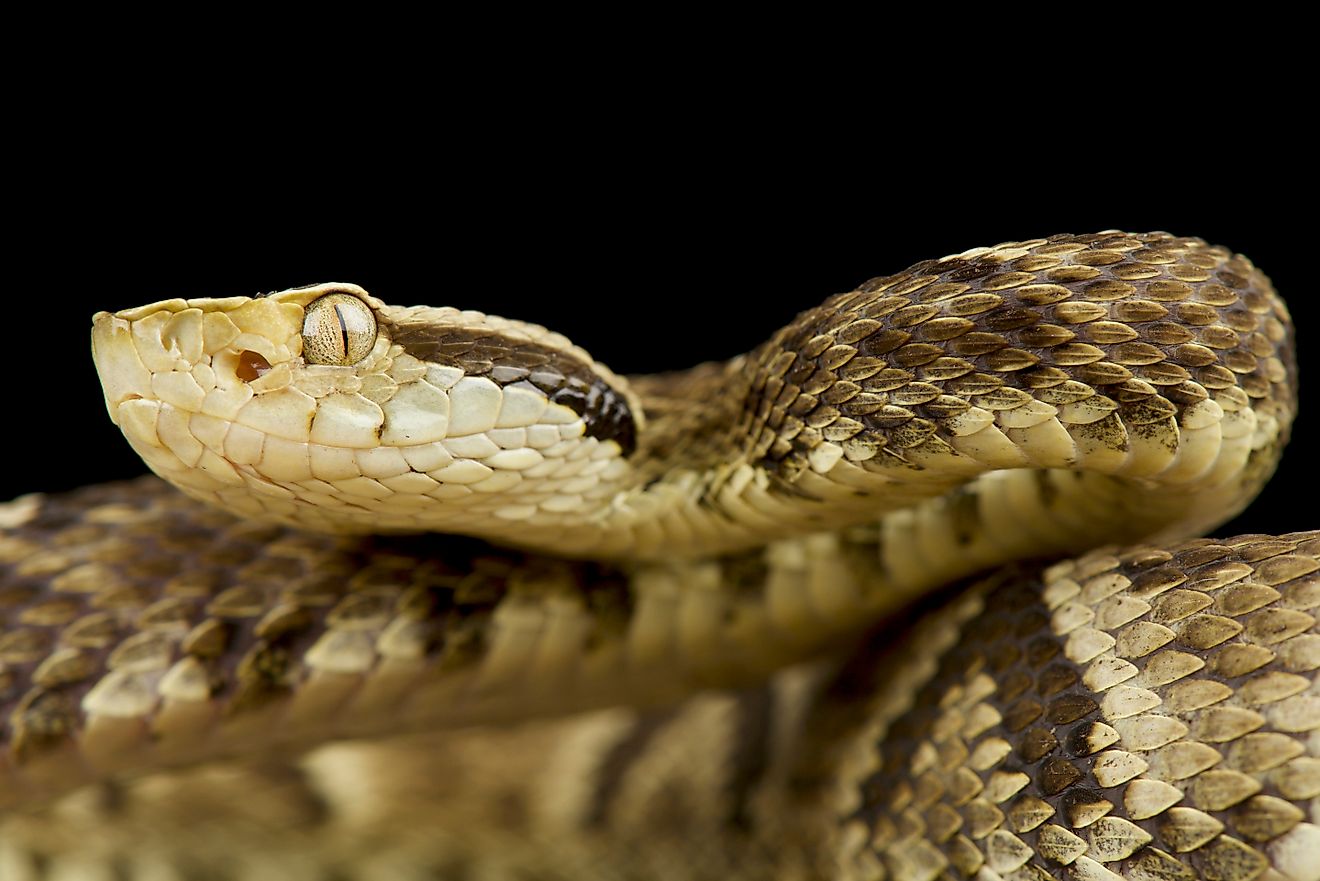
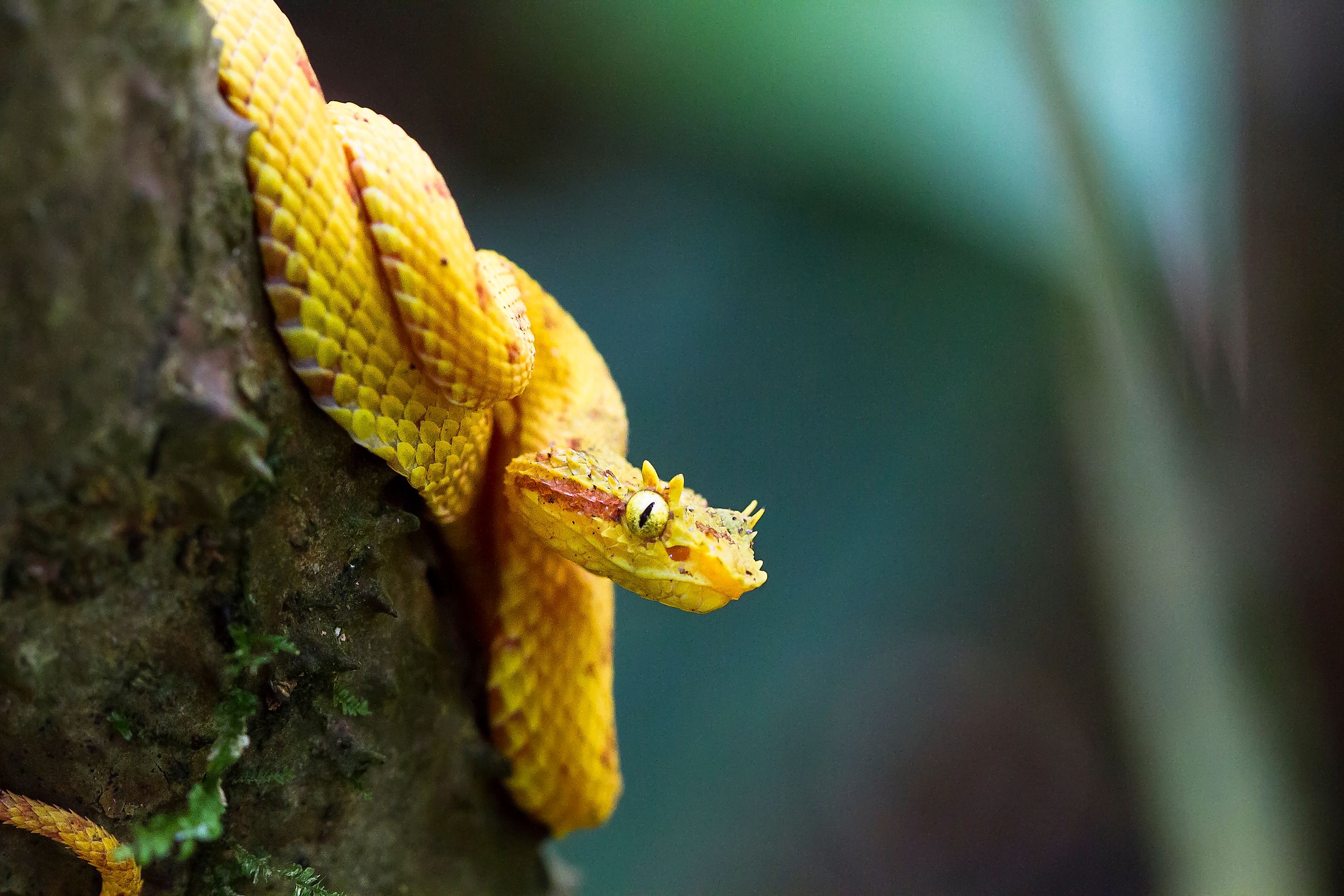
The feature that gives the snake its name is a cluster of raised, bristly scales above each eye. These modified superciliary scales resemble eyelashes or small horns. Their exact purpose is not settled, though researchers suspect they shield the eyes as the snake pushes through dense vegetation, and they may help break up the outline of the head to improve camouflage.
Color is where this species truly stands apart. Individuals can be green, yellow-gold, brown, orange, or red, often marked with darker spots or flecks. The vivid golden form, sometimes called oropel, is especially well known. This degree of color variation is unusual among pit vipers. The snake also carries the classic viper toolkit: a broad triangular head, vertical pupils, a heat-sensing loreal pit on each side of the face, long hinged fangs, and a prehensile tail that grips branches with ease.
Range and Habitat

The eyelash viper ranges across a wide band of the American tropics. Its distribution reaches from Chiapas in southern Mexico through the forests of Central America, including Costa Rica and Panama, and into northern South America, where it occurs in Colombia, Ecuador, Venezuela, and parts of Peru. This makes it one of the most widely distributed of all arboreal vipers.
Within that range the snake favors moist tropical and subtropical forest. It turns up in humid lowland rainforest, streamside vegetation, and higher cloud forest on mountain slopes. Records place it from near sea level up to elevations of around 8,200 feet (2,500 m). It shows a clear preference for areas close to water, where prey animals gather in greater numbers and variety.
The species also tolerates some disturbed and agricultural land, and it is sometimes found near banana and coffee plantations. That flexibility has helped it stay common across much of its range, even as forests have been cleared.
Diet

The eyelash viper is a carnivore and an ambush hunter. Rather than chasing prey, it settles onto a perch and waits, sometimes for days, until a suitable animal wanders within range. When the moment arrives, the strike is fast and precise, and the venom does the rest.
Its menu is broad for such a small snake. Adults take small rodents, lizards such as anoles, frogs, small birds, bats, and even other snakes. The heat-sensing pits on the face allow the snake to detect warm-blooded prey in darkness, which helps explain its success against mammals and birds. Diet also shifts with age, and young snakes rely more heavily on frogs and lizards than adults do.
One of its more remarkable feeding habits involves migratory birds. Eyelash vipers have been observed returning to the same ambush sites year after year, timed to the seasonal passage of birds through the region. The strike can be quick enough to seize a hovering hummingbird, a feat that hints at the speed hidden inside such a still-looking animal.
Behavior

For most of its life the eyelash viper does very little, and that is by design. It is an arboreal, largely nocturnal, and solitary snake that relies on stillness and camouflage to survive. During the day it usually rests coiled on a branch or among leaves, then becomes active at night to hunt.
Its patterned, variable coloring lets it blend into flowers, foliage, and moss-covered bark, so effectively that people have been bitten simply by reaching toward what looked like part of a plant. The snake is not considered aggressive, and it would rather stay hidden than confront a larger animal. When threatened or handled, though, it can deliver a rapid strike with little warning.
Young eyelash vipers add a clever trick to the ambush strategy. They practice caudal luring, wriggling a brightly tipped tail in a worm-like motion to draw curious frogs and lizards close enough to catch. This behavior fades as the snake matures and its diet shifts toward larger prey.
Reproduction

The eyelash viper gives birth to live young rather than laying eggs, a reproductive style known as viviparity that is common among vipers. After mating, the female carries the developing young internally and later delivers a litter of fully formed snakes.
Litters usually contain around 4 to 12 offspring, though larger broods of up to roughly 20 have been recorded. The newborns are independent from birth and receive no parental care. Each one arrives fully equipped with functional fangs and venom, ready to hunt small prey on its own.
In the wild, eyelash vipers are thought to live somewhere in the range of 10 to 15 years. In captivity, with steady food and no predators, individuals have reached 20 years or more.
Venom and Human Encounters

As a pit viper, the eyelash viper delivers its venom through long, hinged fangs that fold back against the roof of the mouth when not in use. The venom is mainly hemotoxic, meaning it attacks blood and tissue, and it contains compounds that disrupt clotting and damage blood vessels. Some studies note neurotoxic effects as well.
For its small prey, a bite means rapid immobilization. For humans, a bite is a serious medical event that can cause pain, swelling, bleeding problems, and tissue damage, though deaths are uncommon with prompt treatment. Because the snake lives in trees and shrubs, bites often land on the hands, arms, or head rather than the legs, which sets it apart from many ground-dwelling vipers.
People who work in plantations and forests face the greatest risk, usually by placing a hand near a hidden snake. The best protection is simple caution and awareness in eyelash viper country, since the animal is very willing to be left alone.
Importance to the World

Within its forest home, the eyelash viper plays a useful role as a predator of small animals. By feeding on rodents, frogs, lizards, and birds, it helps regulate the populations of these creatures and contributes to the balance of the tropical food web. In turn, it serves as prey for larger birds and mammals, linking several levels of the ecosystem.
Its venom is a subject of ongoing medical and scientific research, since snake venoms often contain compounds with potential value for medicine. The eyelash viper is also a draw for the ecotourism trade in Costa Rica and neighboring countries, where its color and photogenic looks pull wildlife watchers and photographers into the rainforest.
Threats and Conservation

On the IUCN Red List, Bothriechis schlegelii is currently listed as Least Concern, a reflection of its wide range, adaptability, and large overall population. It survives in many protected areas and can persist in farmland and forest edges, which buffers it against the habitat loss that pressures more specialized snakes.
That relatively secure status comes with a caveat. Much of the montane forest across parts of its range has already been cleared, and the recent proposal to split the species into several narrower ones would leave some of those populations far smaller and more vulnerable than the broad species appears. If those splits gain acceptance, conservation assessments may need revisiting.
For now, the eyelash viper remains a common and resilient snake. Continued forest protection across Central and South America is the surest way to keep it that way.
Takeaway
What makes the eyelash viper more than another pretty snake is how well a few simple traits work together. A small, light body lets it hunt where heavier vipers cannot, out on the thin branches and vines of the canopy. Camouflage and a sit-and-wait strategy let it feed without spending much energy, and a broad diet of rodents, frogs, lizards, birds, and bats means it rarely goes hungry in any one forest. Those same traits let it live alongside farms and plantations, which is a large part of why it stays common while pickier snakes decline.
The open question is no longer how the eyelash viper survives, but how many kinds of it there are. If the recent proposal to split the species holds, the wide, secure range that earns it a Least Concern rating would break into smaller pieces, some tied to shrinking patches of cloud forest. A snake that looks safe as a whole could turn out to contain populations that are not. For now it remains one of the most widespread and adaptable vipers in the Americas.
Fun Facts

- Those lashes are not for show. The raised scales above the eyes are modified superciliary scales, and scientists think they guard the eyes and help disguise the head rather than serve any decorative purpose.
- A rainbow in one species. Few snakes match its color range, which covers green, gold, brown, orange, and red, sometimes within a single population.
- It can snatch a hummingbird from the air. The strike is fast enough to catch hovering birds, and the snake often returns to favored perches in time for seasonal bird migrations.
- Baby vipers fish with their tails. Juveniles wave a brightly colored tail tip to lure frogs and lizards within striking distance, a behavior called caudal luring.
- It may be more than one snake. A 2024 study proposed splitting the eyelash viper into several species, though the idea remains contested among herpetologists.
Quick Facts
- Common name: Eyelash Viper
- Scientific name: Bothriechis schlegelii
- Family: Viperidae (subfamily Crotalinae, the pit vipers)
- IUCN status: Least Concern
- Length: 22 to 32 inches (55 to 82 cm), rarely up to about 3 feet (1 m)
- Weight: Light-bodied, typically well under 1 pound (under about 0.5 kg)
- Lifespan: Around 10 to 15 years in the wild, up to 20 years or more in captivity
- Diet: Carnivore, feeding on rodents, lizards, frogs, small birds, bats, and other snakes
- Range: Southern Mexico through Central America into Colombia, Ecuador, Venezuela, and Peru
- Habitat: Moist lowland rainforest and montane cloud forest, often near water