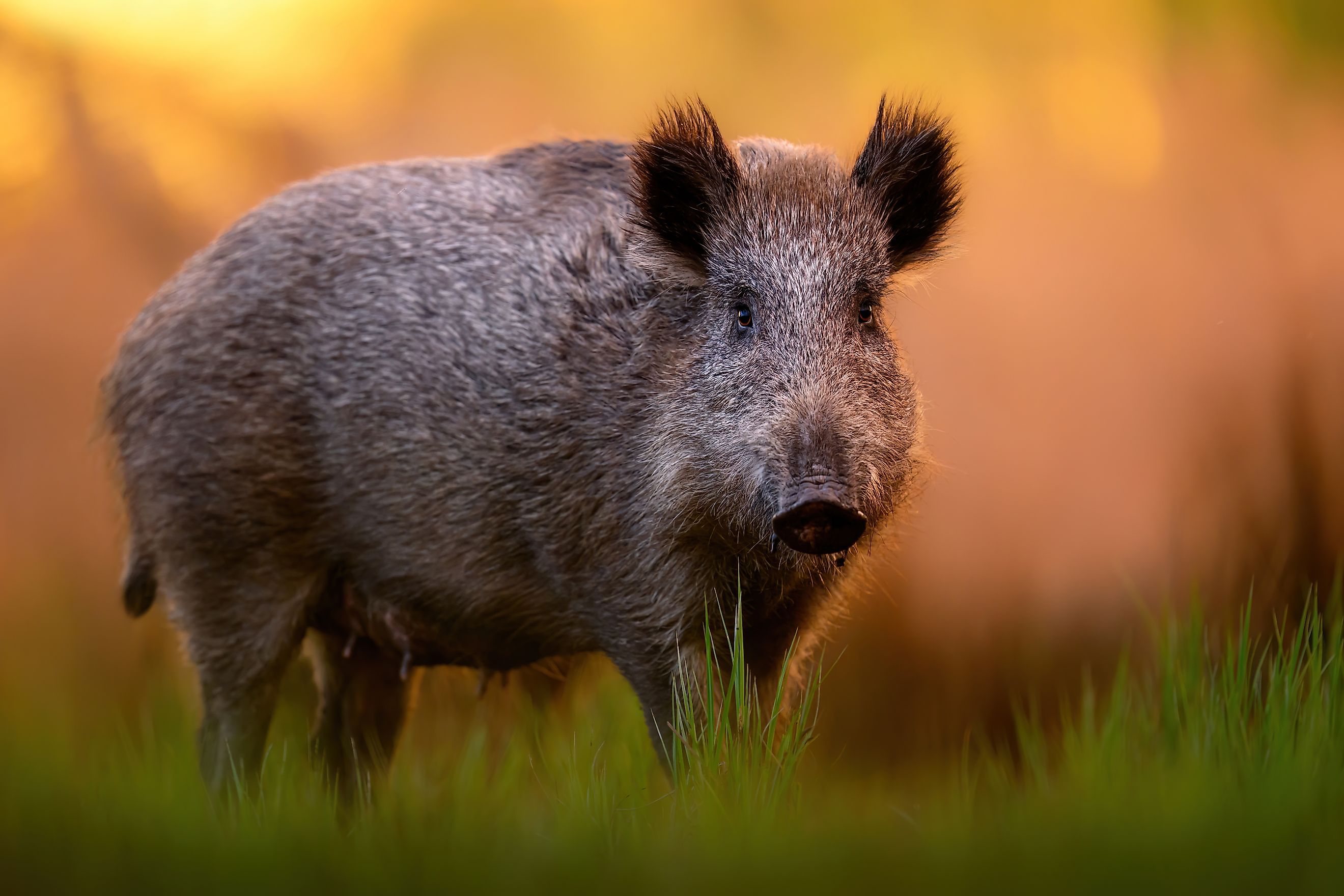
How Far North Wild Hogs Have Spread
Wild hogs move into new areas faster than almost any other large mammal, and their northern range has shifted within just one human lifetime. In Europe, they live as far north as 64 degrees, which runs across northern Fennoscandia and is the farthest north wild boar have ever been recorded. In North America, they haven't reached that far north, but they are spreading faster than ever before. By 2019, they had reached the Canadian prairies and started to cross into the area near the Canada-United States border.
All of these animals are the same species, Sus scrofa. Depending on the region, they are known as wild boars, feral hogs, feral swine, razorbacks or simply wild pigs. People introduced every northern population. Pigs aren't native to North America. Spanish colonists brought domestic pigs to the south in the 16th century, and later, hunters released Eurasian wild boar for sport. The two types mixed, so the pigs digging up a Texas ranch today have both backgrounds. They tear up vegetation like a rototiller and have taken over forests and parklands across their range. Other wild members of the pig family include the warthog, but no warthog can reproduce as quickly as a feral sow.
The North American Frontier

Nathan Snow and his team at the USDA National Wildlife Research Center studied how wild pigs spread from 1982 to 2012. In 2017, they reported that the pigs' northward expansion sped up from 6.5 to 12.6 kilometers (about 4 to 8 miles) a year. This means most counties in the continental United States could see wild pigs within 30 to 50 years. Snow and his co-authors found that the pigs mostly moved into areas much like their old range, with one striking exception. They pushed into colder northern country unlike anywhere they had lived before. Wild pigs are expensive pests. They cause at least 2.5 billion dollars in damage each year in the United States, with the heaviest losses in Texas and the Southeast. Since 2014, the federal government has run a national control program to fight a population that the Department of Agriculture estimates at six to nine million pigs in at least 35 states.
The Canadian story is more recent and unusual. In the late 1980s and early 1990s, farmers brought wild boar from Europe to add variety to their livestock and to stock hunting pens. When the market for boar meat dropped in the early 2000s, some farmers dealt with unsold animals by simply letting them go. That's how a livestock experiment became a continent-wide issue. Ruth Aschim and Ryan Brook from the University of Saskatchewan spent three years tracking where these pigs ended up. Their first national survey, published in May 2019, found wild pigs across 777,783 square kilometers (about 300,000 square miles) in Saskatchewan, Alberta, Manitoba, and beyond, with their range growing by about nine percent each year. Most sightings spread out from old boar farms, although it's hard to tell exactly which farm each group came from because trail-camera evidence is limited.
Most of these Canadian pigs are wild boar mixed with domestic pig, creating what the media calls a super pig. Some biologists don't like the term, but the science supports it. These hybrids can handle cold weather, have large litters, and grow bigger than their European ancestors. Brook's team once caught one that weighed over 600 pounds. In deep snow, the pigs dig tunnels and line them with cattails, making dens that researchers call pigloos. Only Atlantic Canada and the three northern territories don't have established herds yet. The pigs now live close enough to the 49th parallel that American agencies are starting to pay attention. Groups of pigs have been seen near the border, Montana officials have reported pigs coming down from the north, and Minnesota, which thought it was pig-free after a 2016 removal, has joined North Dakota and others in a reporting project called Squeal on Pigs. As Brook says, the border is a political line, not an ecological one.
The Native Range Holds The Northern Record

In 2022, Nikolay Markov and a group of Russian, Nordic, and Finnish researchers carefully reviewed the entire northern Eurasian range of wild boar. In Europe, wild boar reach as far north as 64 degrees, while in Asia they stop near 61 degrees. The northern edge of their range extends farther in the west than in the east. Finland is at the northernmost part of this range, and most of its wild boar have come from Russia across the southeastern border, with a few escapees from enclosures on both sides. Wild boar first appeared in Finland by the mid-20th century, stayed at low numbers for decades, and have only increased recently.
Sweden is a clear example of how people influence these boundaries. Hunters wiped out the native Swedish wild boar generations ago, but in 1987, parliament decided to recognize the species as native again. By that time, animals escaping from enclosures had already re-established wild boar in the country. Swedish hunters recorded about 161,000 wild boar taken in the 2020 to 2021 season, showing how much the population has recovered. In Norway, the northern limit seems to depend more on food than on cold. Researchers there believe that farmland and extra feeding, rather than just winter temperatures, determine how far north wild boar can live.
Why The Push Runs North

A few main factors are driving the pigs' spread, and researchers often point to the same ones. Pigs now survive winters that used to kill their young because there's less snow and fewer long, hard freezes. Snow's team found that in colder regions, pigs moved into new habitats instead of sticking to familiar ones. Farmers and hunters help them get through tough months by providing extra food. Northern hybrids can handle the cold and breed quickly, which gives them an advantage over pigs farther south. In much of the boreal north, big predators like brown bears and wolves are rare, since they no longer roam most of the farmland pigs like. People are still the main movers, and even though releasing pigs for hunting is illegal in many places, it still happens often. These releases have brought pigs into areas they might have reached much more slowly, if at all.
Danger Awareness And Practical Advice

If you walk, hunt, farm, or drive in areas where wild hogs have shown up, it's smart to respect them, but there's no need to be afraid. Attacks on people are rare and usually happen only when the animals feel threatened, like when a sow has piglets, a boar is cornered or hurt, or a dog causes trouble. Wild hogs can move quickly when startled, and their tusks can do real damage. The bigger risk is on the road. A 200-pound hog on a dark highway can wreck a car and injure the driver, and accidents become more common as hogs spread to new areas.
Disease is a less obvious but serious risk. Wild pigs can carry brucellosis, leptospirosis, and pseudorabies. They can spread these diseases to livestock, pets, and sometimes people. Farmers also worry about African swine fever, which hasn't reached North America yet but would be devastating if it did. The advice is simple. Keep your distance, let animals have a way to escape, never get between a sow and her piglets, wear gloves when handling carcasses, cook the meat thoroughly, slow down on rural roads at dawn and dusk, and report any sightings to your local wildlife authorities. Programs like Squeal on Pigs rely on early reports to stop new herds from settling. Usually, authorities only hear about hogs after they've already damaged crops, and the ones that arrive quietly are the ones that stick around.
The Bottom Line
Wild boar have reached their northern limit in parts of Fennoscandia, where populations have been recorded as far north as 64 degrees latitude. In North America, wild pigs are established across Canada's prairie provinces, and hybrids continue to spread south toward the 49th parallel and the US border. Neither frontier is purely natural. Human introductions helped establish wild pigs in Sweden, Finland, Canada and the United States during the 20th century, while milder winters and access to food have allowed them to survive in places that might once have limited their expansion. Their future range will depend partly on how much further people transport them and how winter temperatures change.