Egyptian Cobra
The Egyptian cobra (Naja haje) has a long and remarkable history alongside human civilization. Its image appears on the crowns of ancient Egyptian pharaohs, while tradition holds that it was the serpent responsible for Cleopatra's death. Beyond its place in history and legend, it is a large, adaptable, and highly venomous elapid that remains widespread across much of Africa.
Among Africa's cobras, it ranks second only to the forest cobra in overall size. When threatened, it spreads its broad, unmistakable hood and can deliver venom potent enough to kill an adult human. It is also an adaptable hunter, occupying deserts, savannas, farmland, and the areas near human settlements. Despite its long history of being feared and revered, the species remains widespread and locally abundant.
Taxonomic Classification

The Egyptian cobra belongs to the kingdom Animalia, phylum Chordata, class Reptilia, and order Squamata, which contains all snakes and lizards. Within the suborder Serpentes, it sits in the family Elapidae, the group of front-fanged venomous snakes that also includes mambas, kraits, coral snakes, and sea snakes. Its genus is Naja, the true cobras, and its species is Naja haje. Some taxonomists place it in the subgenus Uraeus, a name drawn from the very symbol it inspired in ancient Egypt.
Swedish zoologist Carl Linnaeus first described the species in 1758. The genus name naja is a Latinized form of the Sanskrit word for cobra, while the species name haje comes from the Arabic word for snake. Those two roots hint at how far the reputation of this animal has traveled.
Modern DNA work has reshaped the picture considerably. Several populations once treated as Egyptian cobra subspecies are now recognized as full species. The snouted cobra (Naja annulifera) and Anchieta's cobra (Naja anchietae) were split off from Naja haje, and a 2009 study separated the Arabian cobra (Naja arabica) and the West African savanna population, now named Naja senegalensis. More recently, in 2023, researchers described Naja obscura, a cobra endemic to Egypt. This means Naja haje occurs in Egypt alongside two other cobra species, a reminder that the "Egyptian cobra" of legend is one member of a more complicated group.
Physical Description

The Egyptian cobra is a large, heavy-bodied snake. Adults average roughly 4.6 feet (1.4 m) in length, and the longest reliably recorded specimen reached about 8.5 feet (2.59 m). That size places it firmly among the giants of the genus Naja.
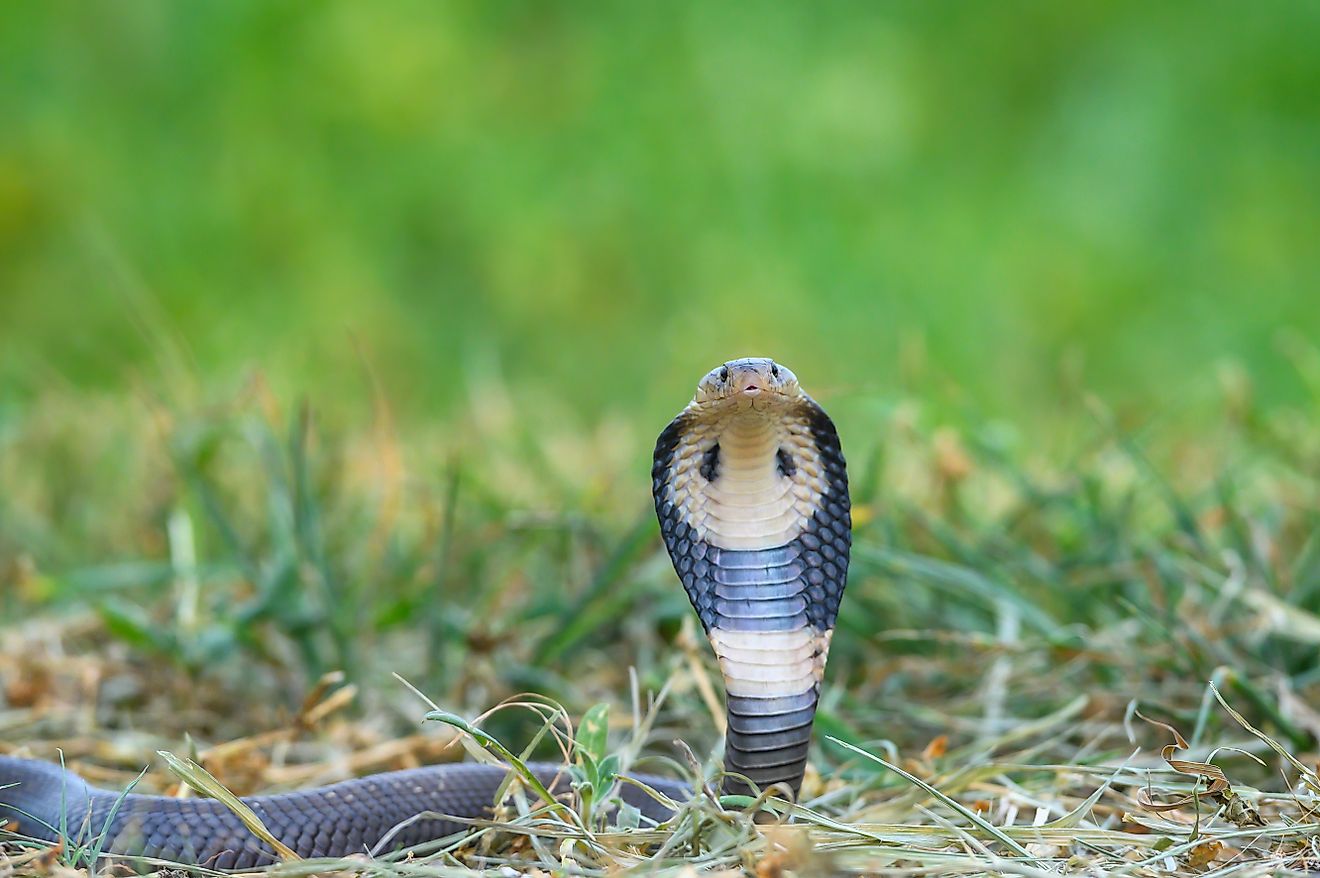
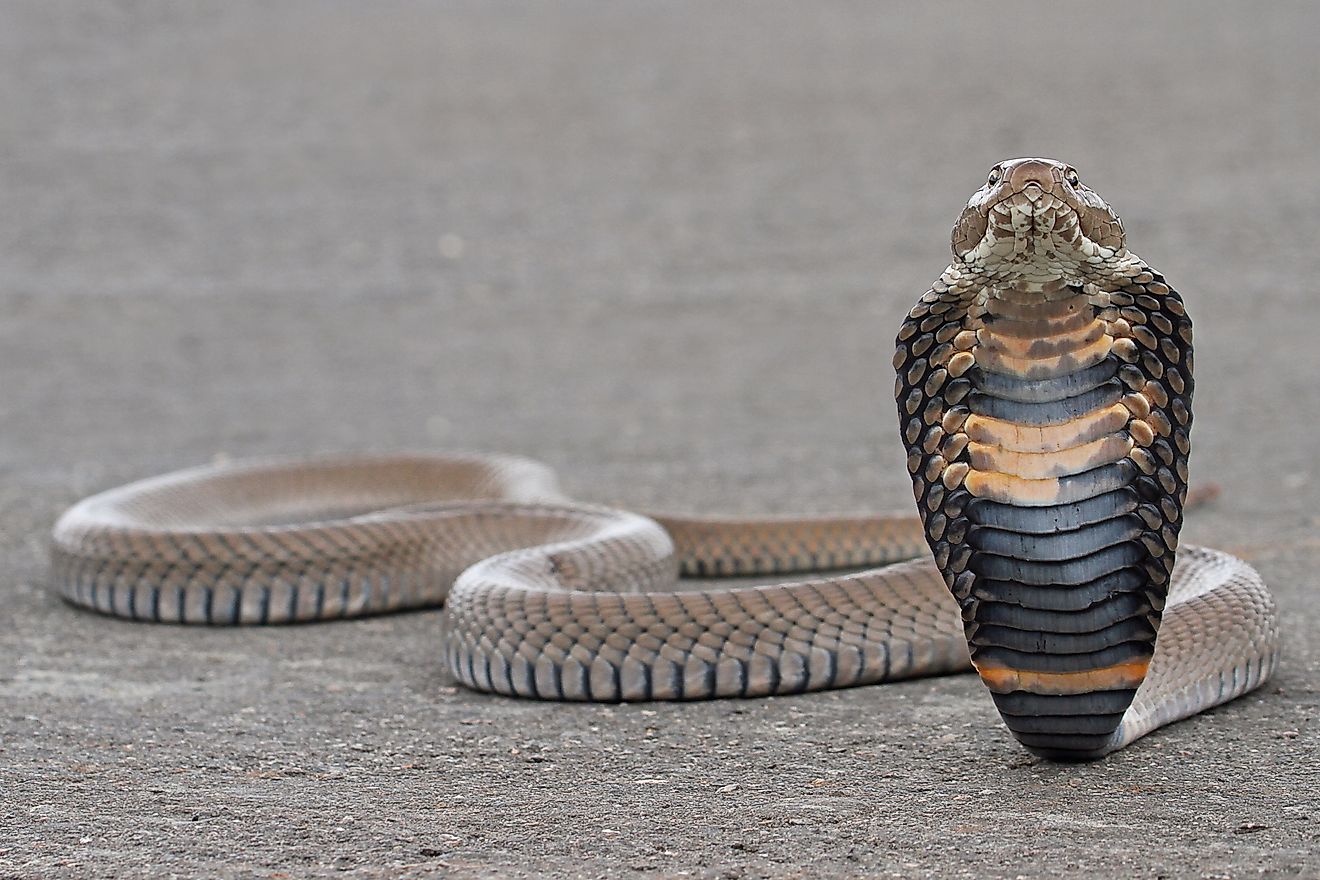
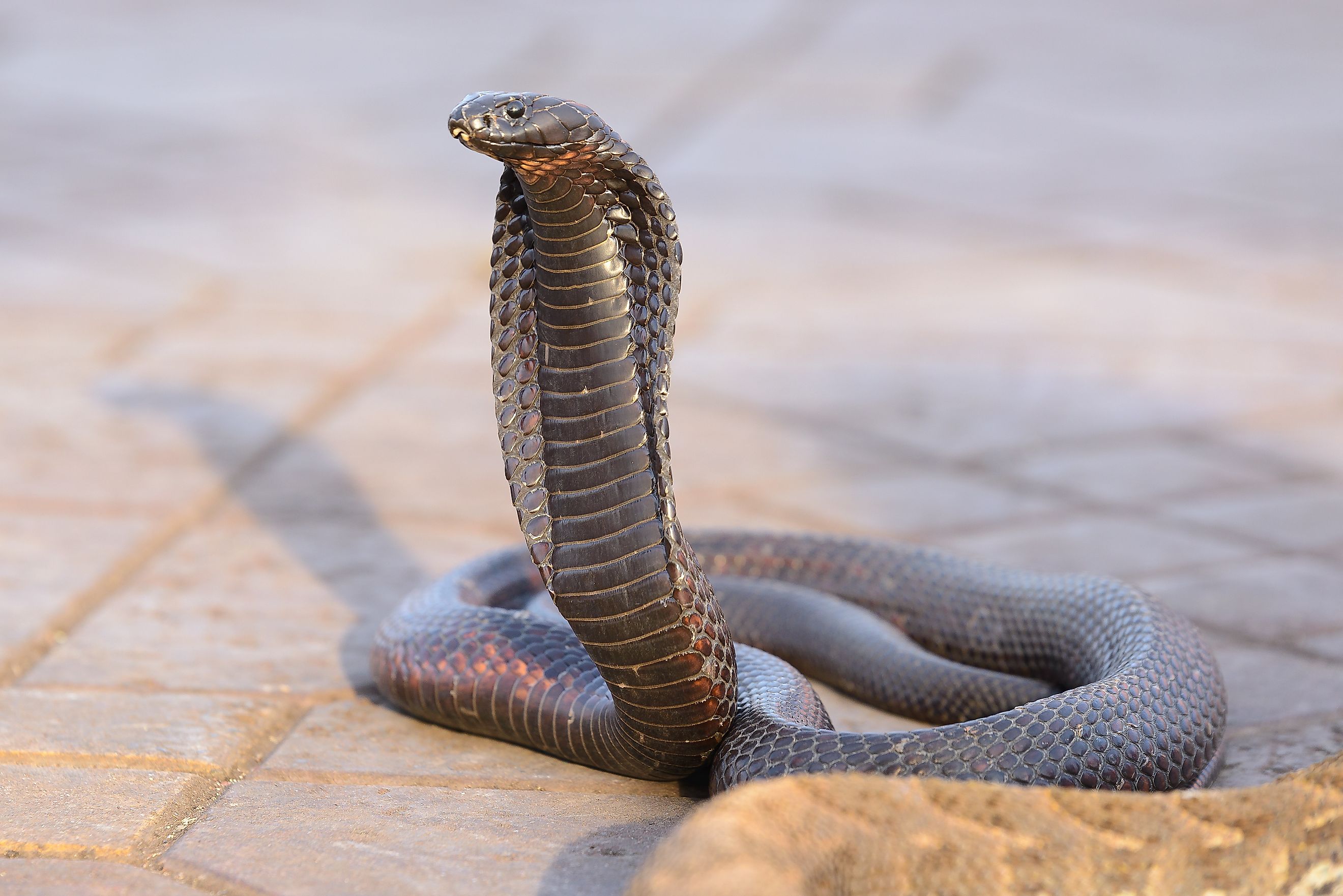
The head is broad and slightly flattened, set apart from the neck by a modest constriction, and the snout is rounded. The defining feature is the hood. Like all cobras, this species carries long, movable ribs in its neck that it can swing outward, stretching the loose skin into a wide, flattened display when the animal rears up. A hood spread can reach around 5 inches (13 cm) across, making a threatened cobra look far larger and more formidable than its resting form suggests.
Coloration varies widely across the range. Individuals may be yellowish, orange-brown, coppery, gray-brown, or almost entirely black. Many carry a dark band across the throat that becomes visible when the snake lifts its forebody. This variability helps the species blend into pale desert sand and darker cultivated soil alike. The scales are smooth, and the body tapers to a long tail, giving the animal a powerful yet streamlined build well suited to both ground hunting and swimming.
Range and Habitat

The Egyptian cobra ranges across northern, central, and eastern Africa and reaches into the western edge of the Arabian Peninsula. Its distribution takes in countries such as Egypt, Sudan, Ethiopia, Chad, Libya, Tunisia, and Algeria, among others, covering a broad band of the continent's drier regions.
Rather than clinging to a single habitat type, this snake is a generalist. It occupies semi-deserts, dry savannas, grasslands, arid scrub, and steppe, and it readily moves into agricultural land. This adaptability is one reason the species remains so successful. It is often found close to people, patrolling irrigated fields, ruins, oasis margins, and the outskirts of villages where rodents gather. The Egyptian cobra is also a capable swimmer and will use canals, wadis, and waterway corridors to move through otherwise dry terrain. It tends to avoid true rainforest and the harshest open sand, favoring places where cover, prey, and water intersect.
Diet

The Egyptian cobra is a broad and opportunistic predator. Its diet centers on small mammals, especially rodents, and extends to birds, lizards, amphibians such as toads, and other snakes. This flexible menu allows it to switch prey depending on what is locally available, which supports its wide range and its tolerance of human-modified landscapes.
The snake relies on its potent venom to subdue prey quickly. After a strike, the venom immobilizes the animal, and the cobra swallows it whole, its flexible jaws allowing it to take prey wider than its own head. Its habit of hunting rodents pulls the species toward farms, barns, and grain stores, which is both an ecological benefit and a source of dangerous encounters with humans. In arid country, prey animals also supply much of the moisture the cobra needs, an advantage in landscapes where standing water can be scarce.
Behavior

The Egyptian cobra is primarily nocturnal, doing most of its hunting through the cooler hours of the night, though it will sometimes bask in the early morning sun to raise its body temperature. It is a mostly solitary, terrestrial snake that spends the day sheltering in burrows, rock crevices, termite mounds, or abandoned animal dens.
By temperament it is often shy and prefers to retreat, sliding into the nearest cover when disturbed. When escape is not an option, its defensive display is dramatic. The snake raises the front third of its body well off the ground, spreads its hood, and faces the threat directly, ready to strike. Contrary to a common misconception, Naja haje is not a spitting cobra and cannot spray venom at an aggressor's eyes. It defends itself by biting, and its strike, while fast, is often more about display and warning than immediate attack. This combination of a bold warning posture and a reluctance to escalate is what allowed traditional snake charmers to work with the species for centuries.
Reproduction

Egyptian cobras are oviparous, meaning females lay eggs rather than giving live birth. Breeding is tied to favorable seasons, and a female typically deposits a clutch of about 8 to 20 eggs, with some larger clutches reported. She chooses a sheltered, humid spot for the nest, such as a burrow, a rock cavity, or a termite mound, where temperature and moisture stay relatively stable.
Incubation lasts roughly 48 to 70 days. The hatchlings emerge fully independent, already equipped with functional venom and the instincts to hunt, so they receive no parental care once they leave the egg. Young cobras reach sexual maturity at around two to four years of age. In the wild, Egyptian cobras commonly live 15 to 20 years, a long lifespan that reflects their position as well-defended predators with few natural enemies once fully grown.
Venom and Danger to Humans

The Egyptian cobra ranks among the most dangerous snakes in North Africa. Its venom is predominantly neurotoxic, attacking the nervous system by blocking the signals nerves send to muscles. As the venom takes hold, it can shut down the muscles that control breathing, and in severe untreated cases death results from respiratory failure. The venom also contains cytotoxic components that can cause local swelling, blistering, and tissue damage around the bite.
A single bite can deliver a large dose, with venom yields commonly reported in the range of 175 to 300 milligrams. Research indicates that populations from the northern part of the range, including Egypt and neighboring North African countries, tend to carry more potent venom than those farther south and west. Because the snake often lives close to people and hunts around homes and fields, bites do occur, and its size makes any envenomation a medical emergency. With prompt treatment and antivenom, however, fatalities are far less common than the animal's fearsome reputation suggests.
Cultural Importance

No snake is more deeply woven into ancient Egyptian civilization than this one. The rearing cobra, known as the uraeus, appeared on the brow of the pharaoh's crown as a symbol of sovereignty and divine protection. It represented the goddess Wadjet, guardian of Lower Egypt, and the image recurs throughout temple carvings, tomb art, jewelry, and royal regalia, including the famous golden mask of Tutankhamun. To display the uraeus was to claim the authority of the gods.
The species is also bound to one of history's most famous deaths. According to popular tradition, Cleopatra took her own life in 30 BC by allowing an "asp," widely interpreted as the Egyptian cobra, to bite her. Roman-era writers offered competing accounts, and modern historians debate whether a snake was involved at all, yet the story cemented the animal as a royal and deadly emblem of Egypt in the Western imagination. Whether myth or fact, the choice fit. For the last pharaoh to die by the sacred serpent of her ancestors carried an unmistakable symbolic power.
Threats and Conservation

The Egyptian cobra is currently listed as Least Concern on the IUCN Red List. It remains widespread and abundant across its large range, and its willingness to live alongside people and exploit farmland has helped it persist where more specialized snakes decline. The species occurs in a number of protected areas, and legal protections against unpermitted killing or capture vary by country.
That relatively secure status does not mean the animal faces no pressure. Deliberate killing out of fear is common wherever the cobra crosses paths with humans, and its scavenging habits regularly bring it into homes, barns, and fields. Habitat change and the collection of snakes for venom and the exotic trade add further local pressure. For now, though, the species holds its ground, an outcome that sets it apart from many large predators in decline.
Takeaway
The Egyptian cobra is far more than the villain of an ancient legend. It is a large, intelligent, and highly adaptable predator that has learned to thrive across deserts, grasslands, and the farmland at the edge of human life. Its potent, mostly neurotoxic venom and its towering hooded display make it one of the most formidable snakes in North Africa, yet the same traits that inspire fear also mark it as a keystone hunter that keeps rodent and pest populations in check.
What sets this cobra apart is the way biology and history meet in a single animal. The serpent that guarded the crowns of the pharaohs and entered the story of Cleopatra still glides through the fields of the same land today, widespread and abundant while so many other large predators retreat. In the Egyptian cobra, an emblem of ancient power remains a living, breathing success story, a reminder that some of the world's most feared creatures are also among its most enduring.
Fun Facts

- The face on the pharaoh's crown. The rearing uraeus cobra worn by Egyptian royalty was modeled on this species, marking it as a symbol of divine kingship for thousands of years.
- Cleopatra's legendary "asp." The snake blamed for the queen's death in 30 BC is most often identified as the Egyptian cobra, reportedly smuggled to her in a basket of figs.
- It cannot spit. Despite belonging to a family that includes several spitting cobras, Naja haje defends itself only by biting, not by spraying venom.
- A surprising swimmer. This desert-associated snake is a strong swimmer and has even been reported crossing stretches of open water, using its raised, hooded neck above the surface.
- One of three. Recent DNA studies revealed that Egypt is home to three distinct cobra species, so the true Egyptian cobra shares its homeland with close relatives once mistaken for the same animal.
Quick Facts
- Scientific name: Naja haje
- Family and order: Elapidae, Squamata
- IUCN status: Least Concern
- Length: Average about 4.6 feet (1.4 m), up to 8.5 feet (2.59 m)
- Hood spread: Around 5 inches (13 cm)
- Lifespan: Roughly 15 to 20 years in the wild
- Diet: Carnivore (rodents, birds, lizards, amphibians, other snakes)
- Venom: Predominantly neurotoxic with cytotoxic components, yield about 175 to 300 mg per bite
- Reproduction: Oviparous, roughly 8 to 20 eggs, incubation about 48 to 70 days
- Range: Northern, central, and eastern Africa and the western Arabian Peninsula