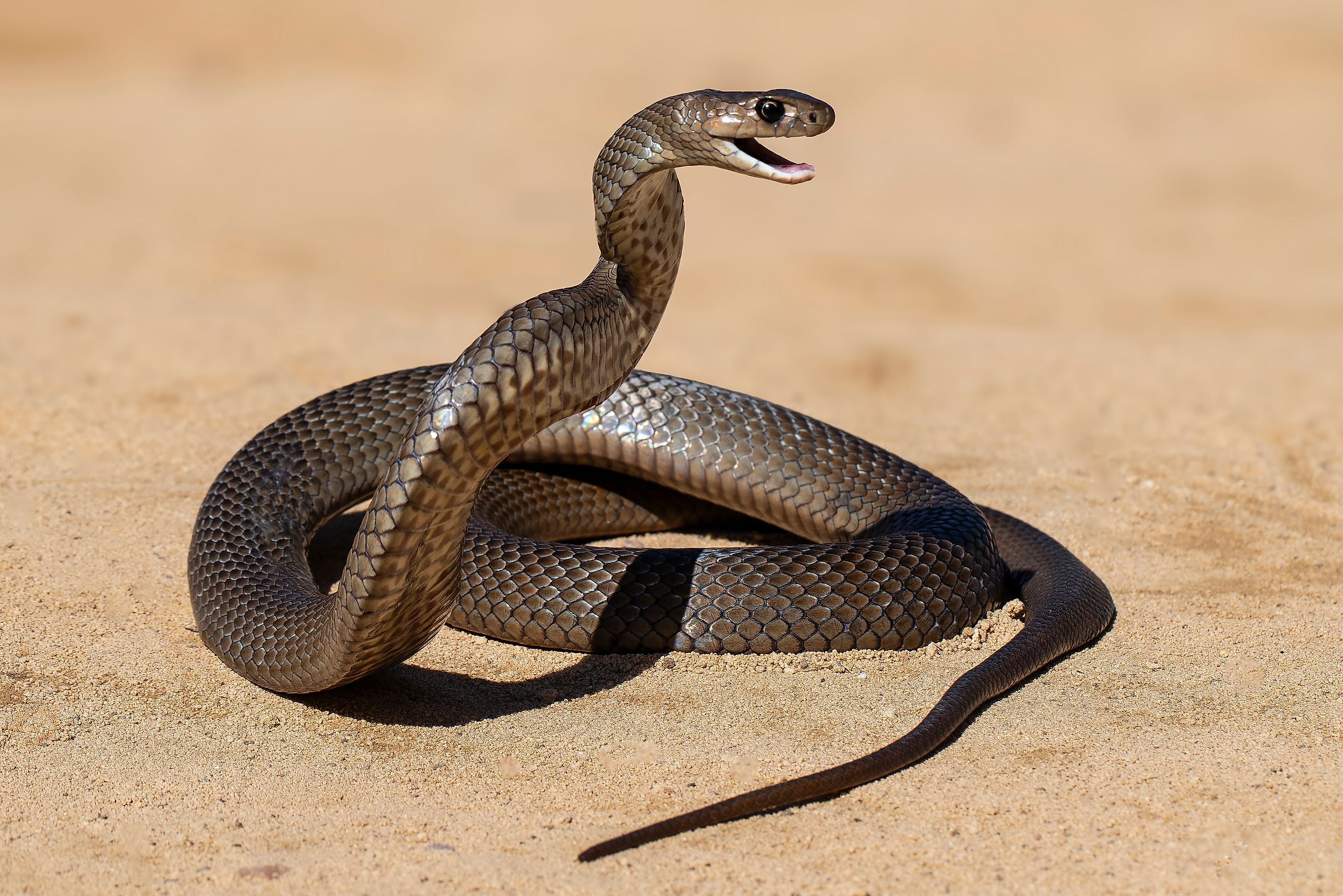
Eastern Brown Snake
Few animals command as much respect in the Australian bush as the eastern brown snake. Ranked as the second-most venomous land snake in the world by median lethal dose in mice, it is responsible for more human snakebite deaths in Australia than any other species, roughly 60 percent of the national total. Yet the animal behind that reputation is fast, alert, and far more interested in hunting mice than in confronting people.
The eastern brown snake (Pseudonaja textilis) is a slender, highly venomous elapid native to eastern and central Australia and southern New Guinea. It is a habitat generalist that has settled comfortably into farmland and the edges of towns, which is exactly why it crosses paths with humans so often. Despite its potency, it is not an aggressive hunter of people, and bites almost always follow a surprise encounter rather than pursuit.
Taxonomic Classification

The eastern brown snake sits within the kingdom Animalia, phylum Chordata, class Reptilia, and order Squamata, in the suborder Serpentes. It belongs to the family Elapidae, the front-fanged venomous snakes that also include cobras, mambas, and taipans. Its genus is Pseudonaja and its species is textilis, giving the accepted binomial Pseudonaja textilis. The species was formally described in 1854 by the French zoologists André Marie Constant Duméril, Gabriel Bibron, and Auguste Duméril.
Both parts of the name are descriptive. Pseudonaja combines the Greek for "false" with the species term for cobra, so it reads as "false cobra," a nod to the way the snake rears up and flattens its neck when threatened. The species name textilis is Latin for "woven," a reference to the fine net-like pattern seen on some individuals. Around nine species of brown snake are currently recognized within the genus, and the group has been revised repeatedly as DNA work refines the boundaries between closely related Australian elapids. Anyone curious about how such distinctions are drawn can explore how many snake species exist worldwide.
Physical Description

The eastern brown snake is a long, slim serpent with a narrow head that is barely distinct from the neck, large round eyes, and smooth, glossy scales. Adults typically measure 4.9 to 6.6 feet (1.5 to 2 m), and the largest confirmed specimens reach about 7.9 feet (2.4 m). A large individual may weigh up to roughly 5.5 pounds (2.5 kg), though most are considerably lighter, and the species keeps the whip-thin build that makes it so quick over open ground.
Its common name is only loosely accurate, because coloration is remarkably variable. The upper body ranges through tan, russet, olive, orange, grey, and almost black, sometimes with the fine reticulated pattern that inspired the name textilis. The underside is usually cream or pale yellow, frequently marked with orange spots and darker flecks. Juveniles can look strikingly different from adults, often hatching with a dark head, a dark band across the nape, and additional body markings that gradually fade as they mature. Sexual dimorphism is mild, with males tending to have longer tails and reaching slightly greater overall length.
As an elapid, the eastern brown snake carries short, fixed front fangs (proteroglyphous dentition) roughly a tenth of an inch (about 3 mm) long. These fangs deliver a comparatively small volume of venom, but the venom itself is extraordinarily potent, a trade-off that defines much of the snake's biology and its reputation among Australia's other venomous snakes.
Range and Habitat

The eastern brown snake occupies much of eastern and central mainland Australia. Its range runs down the eastern seaboard through Queensland, New South Wales, Victoria, and into South Australia, with populations reaching parts of central Australia and the far edges of Western Australia. Beyond the continent, the species also occurs in southern New Guinea.
Habitat is where this snake's adaptability really shows. It thrives in open woodland, grassland, scrub, and semi-arid country, and it does especially well on cleared agricultural land where introduced rodents are abundant. Farm buildings, grain stores, haystacks, and the grassy margins of towns all attract mice, and the eastern brown snake follows the food. That overlap with human settlement, rather than any tendency to seek people out, explains why it is the snake most often encountered across populated southeastern Australia. Its comfort in disturbed, human-modified landscapes sets it apart from shyer relatives such as the inland taipan, which keeps to remote semi-arid country.
Diet

The eastern brown snake is a carnivore that feeds mainly on small mammals, and it has developed a clear preference for introduced rats and mice. This taste for rodents is precisely what draws it to farms and outbuildings. Its diet also includes lizards and skinks, frogs, small birds, eggs, and even other snakes, giving juveniles in particular a broad menu while they grow.
Unlike ambush predators that wait in cover, the eastern brown is an active daytime forager that hunts largely by sight, moving quickly across open ground to run down prey. It strikes rapidly and may loop coils around larger prey to hold it while the venom takes effect. Because a single snake can clear a large number of rats and mice from a property over a season, the species does quiet, unglamorous work as a natural check on rodent numbers around Australian agriculture.
Behavior

Eastern brown snakes are diurnal and fast, two traits that shape almost every encounter with them. Given space, a brown snake will flee, and it spends most of its day hunting or basking rather than looking for trouble. When cornered or startled, however, it can switch to a dramatic defensive display, raising the front third of its body off the ground, sometimes into a distinctive S-shape, flattening its neck in a cobra-like posture, and striking repeatedly if the threat continues. That rearing display is the behavior that earned the genus its "false cobra" name.
The snakes are largely solitary and shelter in burrows, rock crevices, cracked soil, and under debris. Sensitivity to movement drives much of their reaction, so a person who stands still often prompts the animal to relax and move away. Interestingly, juveniles tend to be more active at night than adults, which may help them avoid predators and the daytime heat while they are small. In temperament and speed the eastern brown contrasts with slower, water-loving relatives like the tiger snake.
Reproduction

Eastern brown snakes reach sexual maturity at roughly two to three years of age. Breeding takes place in spring, when rival males engage in ritual combat, intertwining and wrestling in a contest often likened to a plaited rope as each tries to force the other's head to the ground. The dominant male then mates with local females, and a female may store sperm for some weeks before laying.
The species is oviparous. A female lays a clutch that commonly ranges from about 10 to 35 eggs, with an average nearer 15, and larger, older females tend to produce more. Eggs are deposited in a sheltered, humid spot such as an abandoned burrow, a hollow log, or a disused rabbit warren, and several females sometimes use the same communal site year after year. Incubation is temperature-dependent, taking roughly 36 days in warm conditions and up to about 95 days in cooler ones. Hatchlings emerge fully independent, already equipped with functional fangs and venom, and no parental care follows beyond the female occasionally remaining near the nest for a short time. In the wild, eastern brown snakes are thought to live around 10 to 15 years.
Importance to the World

Despite its fearsome reputation, the eastern brown snake plays a valuable ecological role. As an efficient rodent hunter across farmland and grassland, it helps control populations of introduced rats and mice that can damage crops and stored grain, providing natural pest control that benefits even the landowners who fear it most.
The snake is also an important link in the food web. Although it is an apex predator of small vertebrates, it is not immune to predation itself. Birds of prey such as the wedge-tailed eagle take adults from above, while larger snakes including the mulga snake and the carpet python prey on eastern browns, and introduced cats and foxes take juveniles and raid nests. Beyond its ecological importance, the species also has significant scientific value. Its potent, medically important venom has been studied extensively, contributing to antivenom development and research into blood-clotting disorders that extends well beyond herpetology.
Threats and Conservation

On the IUCN Red List, the eastern brown snake is assessed as Least Concern. It remains common and widespread, and in some respects it has benefited from agriculture, which boosts the rodent prey it depends on. Individual snakes still face several significant threats, including road mortality, deliberate killing by people who fear them, secondary poisoning from rodent baits, and predation of young by introduced cats and foxes. Like all Australian native snakes, the species is protected under state wildlife legislation, and killing or harming one is illegal.
Much of the snake's public profile comes down to its venom. The eastern brown's bite delivers a potent mix of presynaptic neurotoxins, procoagulants, cardiotoxins, and nephrotoxins. By LD50, a measure of the amount of venom required to kill 50 percent of a test population, it ranks as the second-most venomous land snake in the world, behind only the inland taipan. The initial bite is often nearly painless and easy to miss, yet envenomation can progress to serious clotting failure and paralysis, which is why the species accounts for the majority of Australian snakebite fatalities and features prominently on lists of the most venomous snakes in the world. The reassuring counterpoint is that actual deaths are rare, on the order of one or two per year nationwide, thanks to effective antivenom, pressure-immobilization first aid, and good hospital care.
Takeaway
The eastern brown snake owes its formidable reputation to a combination of traits, including venom that ranks second only to the inland taipan among land snakes, a fast and alert hunting style, and a strong preference for introduced rodents that thrive around farms and towns. That last point matters most because it is proximity to people, not aggression, that makes this the snake behind the majority of Australian snakebite cases. Its venom works mainly by disrupting blood clotting and nerve signaling, yet serious outcomes remain uncommon thanks to reliable antivenom and prompt first aid. Listed as Least Concern and protected across its range, it remains one of the most common and ecologically important snakes in Australia, keeping rodent numbers in check across the same farmland and grassland where people are most likely to encounter it.
Fun Facts

- Second, not first: By laboratory LD50 measurements, the eastern brown ranks as the second-most venomous land snake on Earth, behind the inland taipan, its fellow Australian.
- A false cobra: The genus name Pseudonaja means "false cobra," earned by the way the snake rears and flattens its neck when it feels cornered.
- Small fangs, big punch: Its fangs are only around a tenth of an inch (3 mm) long and inject little venom, but that venom's potency more than makes up for the modest dose.
- Rodent specialist: Its fondness for introduced rats and mice makes it a common, and useful, resident around farms and grain stores.
- Communal nurseries: Several females may lay eggs in the same sheltered burrow or old rabbit warren, returning to the same site across seasons.
Quick Facts
- Scientific name: Pseudonaja textilis
- Family / Order: Elapidae / Squamata
- IUCN status: Least Concern
- Length: Typically 4.9 to 6.6 ft (1.5 to 2 m); up to about 7.9 ft (2.4 m)
- Weight: Up to about 5.5 lb (2.5 kg)
- Lifespan: Roughly 10 to 15 years in the wild
- Diet: Carnivore: mainly rodents, plus lizards, frogs, birds, eggs, and other snakes
- Range: Eastern and central Australia; southern New Guinea