Blue Whale
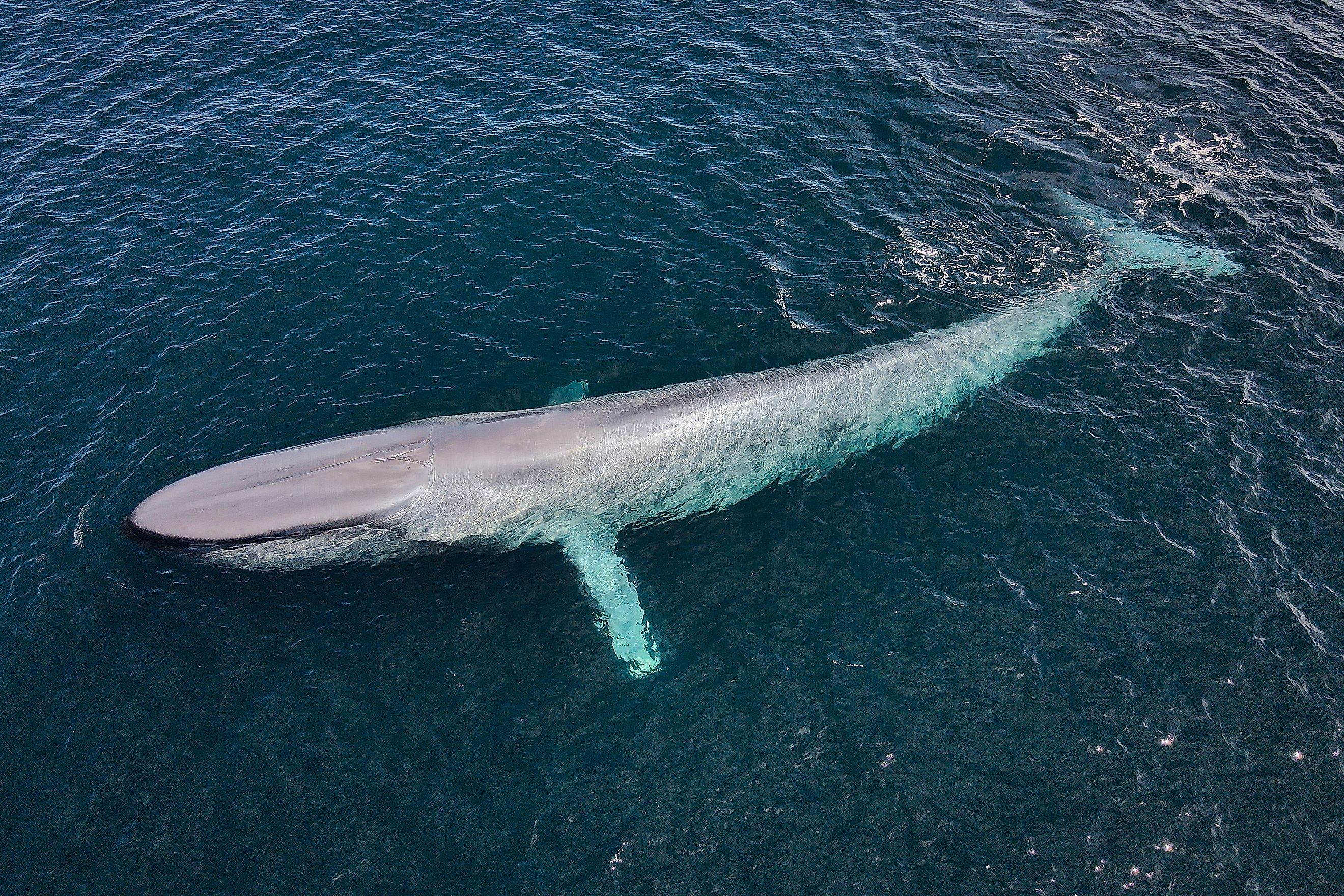
The blue whale (Balaenoptera musculus) is the largest animal known to have ever lived, outweighing even the biggest dinosaurs that walked the Earth. An adult can stretch nearly 100 feet (30 m) and reach up to 200 tons, a body so vast that its heart alone is about the size of a small car and its tongue matches the weight of an elephant.
This ocean giant is a baleen whale, a filter feeder that swims through every ocean except the Arctic and survives almost entirely on krill, one of the smallest animals in the sea. That contrast, the largest creature on the planet sustained by shrimp-like crustaceans only a few inches long, is part of what makes the blue whale worth understanding.
Once hunted to the brink of extinction during the twentieth century, blue whales have begun to recover, although they remain endangered and their populations are still well below historical levels. Their history reflects both the extraordinary nature of the species and the immense scale of the threats humans have posed to it.
Taxonomic Classification

The blue whale belongs to the family Balaenopteridae, the group of baleen whales known as rorquals, which also includes the fin whale, the humpback whale, and the minke whales. Its scientific name, Balaenoptera musculus, was assigned by Carl Linnaeus in 1758. The genus name means "winged whale," while the species name musculus can be read as "muscle" or as a diminutive meaning "little mouse," a play on words that has followed the species for centuries.
Several subspecies are recognized. The Antarctic blue whale (Balaenoptera musculus intermedia) is the largest and roams the Southern Ocean. The pygmy blue whale (Balaenoptera musculus brevicauda) is smaller and lives mainly in the Indian Ocean and the southern Pacific. Northern populations in the North Atlantic and North Pacific are usually grouped as Balaenoptera musculus musculus. Ongoing genetic research continues to refine how these populations relate to one another.
Physical Description

Size is the defining trait of the blue whale. Most adults measure 80 to 90 feet (24 to 27 m), though Antarctic individuals can reach roughly 110 feet (33 m). The longest reliably recorded animal, taken in the South Atlantic in 1909, measured close to 110 feet (33.5 m). Weights commonly climb to about 150 tons, and the heaviest individuals may approach 200 tons, making the blue whale heavier than any dinosaur known from the fossil record.
The body is long and streamlined, colored a mottled blue-gray that can look pale or silvery in sunlit water. A small dorsal fin sits far back on the body, and two blowholes on top of the head produce a vertical spray that can rise about 30 feet (9 m) when the animal surfaces. Beneath the exterior lies anatomy built on the same enormous scale. The heart weighs around 400 pounds (180 kg), and the main artery leaving it is wide enough for a small child to crawl through. The tongue can weigh close to 3 tons (2.7 tonnes).
Feeding drives much of this design. Blue whales carry between 270 and 400 baleen plates hanging from the upper jaw, made of keratin, the same material as human fingernails. Pleated grooves run along the throat and belly, allowing the mouth to balloon outward and take in an enormous volume of water during a feeding lunge.
Range and Habitat

Blue whales live in every ocean on the planet except the Arctic. They tend to follow a seasonal pattern, spending summers feeding in cold, productive waters near the poles and moving toward warmer temperate and equatorial waters in winter to breed. This annual movement can cover thousands of miles and ranks among the longest migrations of any mammal.
In the Northern Hemisphere, they appear regularly off Monterey and Baja California, in the Gulf of St. Lawrence, and around Iceland. In the Southern Hemisphere, they feed across the rich waters of the Southern Ocean and gather in areas such as the coast of Chile. They also concentrate in the northern Indian Ocean, in the waters off Sri Lanka. Rather than clustering in dense pods, blue whales are usually spread thinly across vast stretches of open water.
Diet

Krill make up almost the entire blue whale diet. These small, shrimp-like crustaceans, most no longer than a few inches, gather in dense swarms that the whale targets with precision. During peak feeding season, a single adult can eat around 4 tons of krill a day, and some estimates run as high as 8 tons. Measured another way, that intake can reach roughly 40 million individual krill in a single day.
The whale feeds by lunging into a swarm with its mouth open, engulfing a volume of water and prey that can exceed 50 tons in one gulp. The throat grooves expand to hold the mouthful, and then the whale pushes the water back out through its baleen plates using its massive tongue. The plates act as a sieve, trapping the krill while the water escapes. Curiously, despite the size of the mouth, the esophagus is only about 4 inches (10 cm) across, so the animal depends entirely on tiny prey.
Behavior

Blue whales are among the loudest animals on Earth. Their low-frequency calls can reach 188 decibels, louder than a jet engine, and travel for hundreds of miles underwater. Scientists believe these sounds help the whales stay in contact across great distances and may play a role in attracting mates. Much of this communication happens at frequencies too low for human ears to detect.
They are usually solitary or travel in small groups, and pairs are a common sight. When diving to feed, a blue whale can slow its heart to as few as 2 beats per minute to conserve oxygen, then raise it sharply on returning to the surface. Their movements are governed largely by the search for krill, which shapes both their daily activity and their long seasonal journeys.
Reproduction

Blue whales reach breeding age somewhere between 5 and 10 years old. Mating takes place in warmer waters during the winter months, and after a gestation of about 10 to 12 months, the female gives birth to a single calf. Even a newborn is enormous, measuring around 25 feet (7.6 m) and weighing close to 3 tons.
Calves grow at a startling rate. Nursing on milk rich in fat, a young blue whale can drink 50 to 150 gallons a day and put on roughly 200 pounds (90 kg) every 24 hours. After seven to eight months, the calf is weaned at a length of about 49 feet (15 m). In the wild, blue whales commonly live 80 to 90 years, and the oldest recorded individual was estimated at around 110 years old.
Importance to the World

The blue whale plays a role in ocean health that reaches far beyond its own survival. By feeding at depth and releasing nutrient-rich waste near the surface, blue whales help fertilize phytoplankton, the microscopic plants that form the base of marine food webs and produce a large share of the planet's oxygen. This process, sometimes called the whale pump, moves nutrients through the water in ways that support countless other species.
Because they sit near the top of the food chain and respond quickly to changes in krill supply, blue whales also serve as an indicator of ocean condition. Healthy blue whale populations tend to reflect a healthy ecosystem, while declines can signal trouble below the surface. Their only natural predator is the killer whale.
Threats

The blue whale is listed as Endangered on the IUCN Red List, based on the most recent global assessment. Commercial whaling in the nineteenth and twentieth centuries drove the species toward extinction, with the pre-whaling population estimated at around 350,000 animals. In the 1930 to 1931 season alone, whalers killed more than 29,000 blue whales. A moratorium on hunting them took effect in 1966.
Today the global population of mature blue whales is estimated at 5,000 to 15,000, with total numbers across all age classes placed at roughly 10,000 to 25,000. Encouragingly, the overall trend appears to be increasing. The recovery is uneven, though. The Antarctic subspecies remains Critically Endangered, sitting at only a few percent of its original abundance, while the pygmy blue whale is classified as Data Deficient because too little is known about its numbers.
Modern threats differ from the harpoons of the past but remain serious. Collisions with large ships kill and injure whales along busy shipping routes, entanglement in fishing gear can trap and drown them, and underwater noise pollution interferes with the calls they rely on to communicate. Climate change adds further pressure by altering the distribution and abundance of the krill they depend on. Conservation measures such as shipping-lane adjustments, vessel speed restrictions, and continued protection from whaling aim to give the population room to keep recovering.
Takeaway
The blue whale's story is closely tied to both its extraordinary biology and the dramatic changes humans have brought to the oceans. It is the largest animal ever known to have lived, yet it survives by feeding on some of the smallest organisms in the sea. Its enormous size, including a heart that can weigh hundreds of pounds and a tongue comparable in weight to an elephant, makes it unlike any other animal alive today. Yet despite its immense scale, its survival depends on the seasonal availability of tiny krill, leaving it vulnerable to changes in the marine environment.
That combination of power and dependence is what makes the animal so telling. The blue whale's slow return from the brink shows what sustained protection can achieve, and its recovery has become one of the clearer conservation successes to follow decades of near-total collapse. At the same time, ship strikes, entanglement, ocean noise, and a warming climate keep the outcome unsettled. The blue whale remains both a measure of how much damage industrial hunting once did and a reminder that the largest life on Earth still depends on choices people make today.
Fun Facts

- Louder than a jet. A blue whale's call can reach 188 decibels and carry for hundreds of miles through the ocean.
- A heart you could stand beside. The heart weighs about 400 pounds (180 kg) and is roughly the size of a small car.
- Elephant-sized tongue. A single blue whale tongue can weigh as much as an entire adult elephant.
- Born big. A newborn calf already stretches about 25 feet (7.6 m) and gains around 200 pounds (90 kg) a day.
- A narrow throat. Despite its vast mouth, the blue whale's esophagus is only about 4 inches (10 cm) wide, limiting it to tiny prey.
Quick Facts
- Scientific name: Balaenoptera musculus
- Family: Balaenopteridae (rorquals)
- Order: Cetacea
- IUCN status: Endangered (population increasing)
- Length: 80 to 90 feet (24 to 27 m), up to about 110 feet (33 m)
- Weight: up to about 200 tons (180 tonnes)
- Lifespan: 80 to 90 years, up to about 110
- Diet: Carnivore, feeding almost exclusively on krill
- Range: All oceans except the Arctic