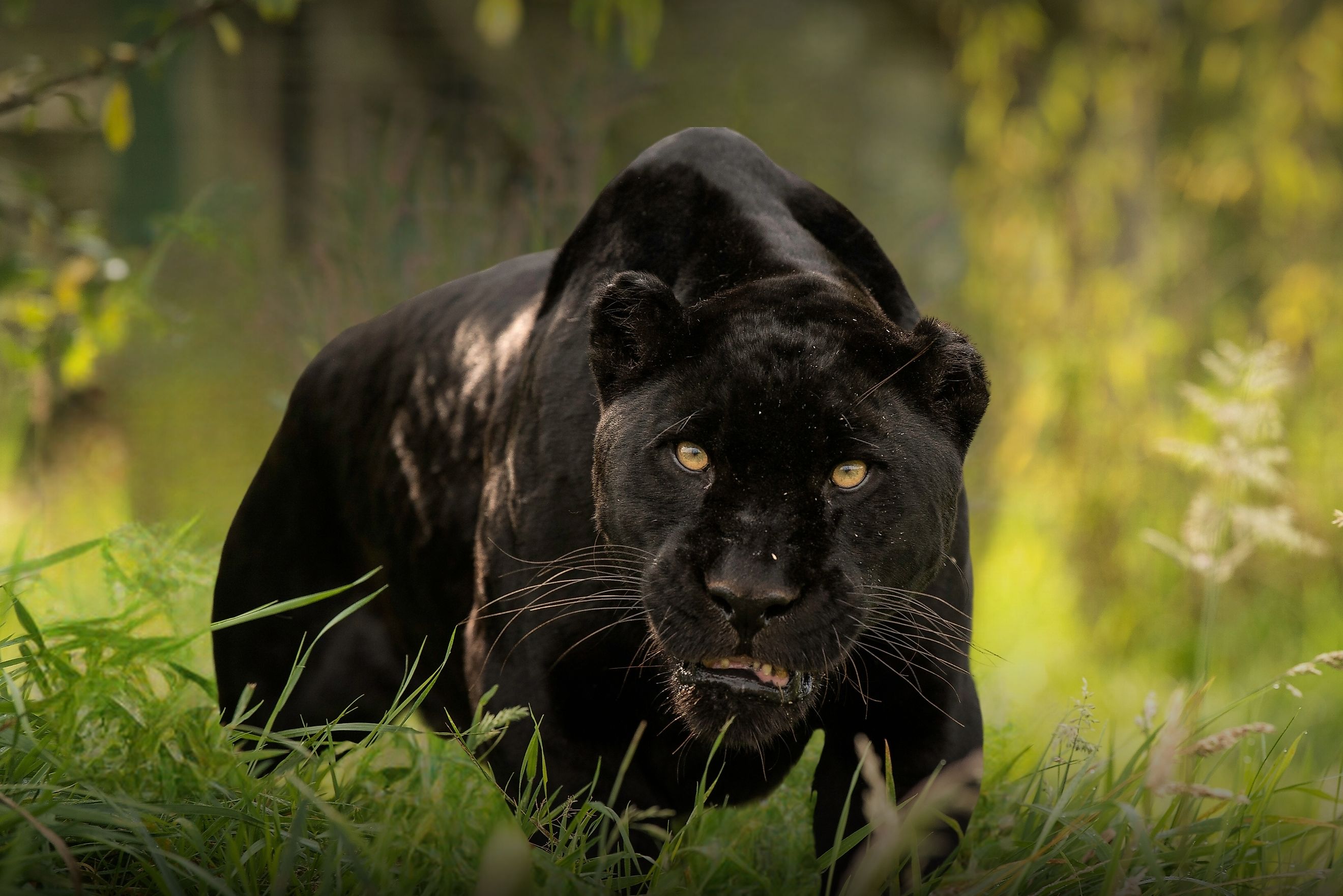
Black Panther
A black panther is one of the animal kingdom's great cases of mistaken identity. Despite the name, there is no single species called the black panther. The term refers to any big cat with an all-black, or melanistic, coat. In the wild, it describes one of two animals, the leopard (Panthera pardus) in Africa and Asia or the jaguar (Panthera onca) in the Americas. The dramatic dark coat is simply a color variant of an otherwise spotted cat, produced by a genetic quirk rather than a separate lineage.
That single fact reshapes almost everything people assume about the animal. A black panther prowling a rainforest in Brazil is a jaguar. One photographed in the forests of India or the highlands of Kenya is a leopard. They are the same species as their spotted relatives, capable of producing spotted and black cubs in the same litter, and they carry all the biology, range, and conservation concerns of the leopards and jaguars they belong to.
Taxonomic Classification

Classifying a black panther means classifying two different cats, because the name is a color description rather than a taxonomic rank. Both belong to the kingdom Animalia, the phylum Chordata, the class Mammalia, the order Carnivora, and the family Felidae, the group that contains all cats. Within Felidae, both fall in the subfamily Pantherinae and the genus Panthera, the "roaring cats," which also includes the lion, the tiger, and the snow leopard.
The species is where the two diverge. The leopard is Panthera pardus, and the jaguar is Panthera onca. Both were formally described by the Swedish naturalist Carl Linnaeus in 1758, in the landmark tenth edition of Systema Naturae, so each carries the authority "Linnaeus, 1758." A melanistic leopard is not a separate species or subspecies; it is simply an individual Panthera pardus or Panthera onca with a dark coat.
Subspecies is one area where the two species differ in modern treatment. The leopard is currently divided into eight recognized subspecies under the revised felid taxonomy, including the African, Indian, Amur, Arabian, and Javan leopards. The jaguar, by contrast, is now regarded as monotypic, meaning no subspecies are accepted; earlier schemes that named up to eight have been set aside as genetic and morphological work found the differences too small to justify them. Neither species has a separate taxonomic category for its black form, reinforcing the key point that a "black panther" is a coat variation, not a distinct clade.
What a Black Panther Really Is

The word "panther" has always been slippery. In different regions it has referred to leopards, jaguars, and even pumas, which is part of why the term causes so much confusion. In modern usage, a black panther is a melanistic individual of a big cat species, most often a leopard or a jaguar. The pigment that darkens the coat is melanin, and animals carrying an excess of it are called melanistic, the opposite of albino.
Crucially, melanism does not erase the animal's markings. Look at a black panther in the right light and the classic rosettes are still visible, faint dark shapes against a darker background often called "ghost markings." A jaguar's rosettes are large and broken edged, frequently with small spots inside, while a leopard's are smaller and tighter. In good light, the pattern gives away which species the black cat truly is.
Pumas (Puma concolor), sometimes called panthers in the southeastern United States, are a separate case. Despite persistent folklore about "black panthers" stalking North American woods, no verified melanistic puma has ever been documented. When people report a black panther in the United States or Europe, they are almost always describing an animal outside its natural range or a case of mistaken identification.
The Genetics of a Black Coat

Melanism in these cats comes down to a recessive or dominant gene, depending on the species. In leopards, the black coat is caused by a recessive mutation, so a cub must inherit the melanism allele from both parents to appear black. In jaguars, melanism is driven by a dominant allele, which is one reason black jaguars turn up more readily in some populations.
Because the trait is inherited, a spotted mother can give birth to both spotted and black cubs at once, and two black parents can still produce spotted young if the genetics line up. The black coat is a variation within the species, not a barrier between groups.
Scientists have long debated why melanism persists. One leading idea is that darker coats offer better camouflage in dense, shaded forest, which may explain why melanistic leopards appear more often in humid, closed-canopy regions such as the Malay Peninsula, where a large share of leopards are black. Other research points to links between the pigment genes and immune function, suggesting the trait may carry advantages beyond simple concealment. Thermoregulation has also been proposed, since darker surfaces absorb heat differently. No single explanation has settled the question, and the truth is likely a combination of factors that shift by habitat.
Physical Description

Since a black panther is a leopard or a jaguar, its size follows those species. Leopards are the more lightly built of the two. Males typically weigh between 80 and 165 pounds (36 to 75 kg) and measure roughly 3 to 6.25 feet (0.9 to 1.9 m) in head and body length, with a long tail added on top. Females are noticeably smaller. Leopards are famed for their strength relative to size, capable of hauling prey heavier than themselves up into trees.
Jaguars are stockier and more powerfully built, the largest cat in the Americas and the third largest in the world after tigers and lions. Males can weigh about 120 to 210 pounds (54 to 95 kg), and exceptional individuals in the Pantanal wetlands of Brazil grow larger still. The jaguar has an unusually broad head and short, muscular legs, and its bite is proportionally one of the most powerful of any cat, strong enough to punch through turtle shells and skull bone.
In both animals, the melanistic coat is a deep charcoal or rich brownish black, always overlaid with the faint rosette pattern. The eyes usually remain a striking gold or green, standing out against the dark fur.
Range and Habitat

Because two species are involved, the combined range of the black panther is enormous. Leopards occupy the widest distribution of any wild cat, spread across much of sub-Saharan Africa and into the Middle East, South Asia, Southeast Asia, and parts of East Asia. They tolerate an exceptional variety of habitats, including rainforest, savanna, mountains, and the edges of deserts. Melanistic leopards are most frequently reported from the dense tropical forests of Southeast Asia.
Jaguars inhabit the Americas. Historically their range ran across the southwestern United States, Mexico, Central America, and much of South America into northern Argentina. The stronghold of the species today is the Amazon Basin, along with the Pantanal. Black jaguars turn up across this range but are more common in some regions than others.
In both cases, the black panther is not found in a special habitat of its own. It lives wherever its species lives, favoring forest and cover where the dark coat may be least conspicuous.
Diet and Hunting

Black panthers are obligate carnivores and ambush hunters, relying on stealth rather than speed over distance. A leopard's diet is remarkably broad, taking beetles, birds, antelope, monkeys, and young livestock. This dietary flexibility is a major reason leopards survive close to human settlements where other big cats vanish. After a kill, leopards often drag the carcass into a tree to keep it from lions and hyenas.
Jaguars are more water associated and take larger, tougher prey. Capybara, peccary, deer, caiman, and even large reptiles feature on the menu, and jaguars are strong swimmers that hunt readily along rivers and wetlands. Their signature killing method is unusual among cats. Rather than relying on a throat bite, a jaguar can bite directly through the skull of its prey, a technique made possible by its exceptionally powerful jaws.
Both cats are opportunistic and solitary hunters, and a black individual hunts exactly as its spotted kin do.
Behavior and Reproduction

Leopards and jaguars are largely solitary and territorial, marking and defending home ranges that vary widely with prey density. Both are most active at night and in the twilight hours, resting through the heat of the day. They communicate through scent marks, scrapes, and vocalizations, including the sawing call of a leopard and the deep, coughing roar of a jaguar.
Reproduction does not follow a fixed season across most of the range. After a gestation of roughly 90 to 105 days, females give birth to a litter of one to four cubs in a sheltered den. Cubs are born blind and helpless, open their eyes within about ten days, and depend on their mother for many months while they learn to hunt. Young cats stay with the mother for one to two years before dispersing. In the wild, leopards and jaguars generally live around 12 to 15 years, with longer lifespans recorded in captivity.
Importance to the World

As apex or near apex predators, both leopards and jaguars help regulate the populations of the herbivores and smaller predators they hunt. By keeping prey numbers in check, they shape the structure of forests and grasslands, influencing vegetation patterns and even the spread of disease. The jaguar in particular is considered an umbrella species, meaning that protecting enough land for it also safeguards countless other plants and animals sharing its range.
Big cats can also bring substantial economic benefits to the regions where they live. Wildlife tourism built around big cats brings visitors and revenue to reserves across Africa, Asia, and South America, and a black individual is an especially strong draw for photographers. In Brazil's Pantanal, jaguar tourism has given ranchers a financial reason to tolerate a predator they once shot on sight, and the income it generates can help fund patrols, habitat protection, and compensation for livestock losses. That link between live cats and local livelihoods has become one of the more effective tools for keeping both.
Threats and Conservation

The conservation picture for the black panther is the conservation picture for its parent species. The leopard is listed as Vulnerable on the IUCN Red List, with a declining population driven by habitat loss, prey depletion, poaching, and conflict with people over livestock. Several leopard subspecies, including the Amur and Arabian leopards, are far more imperiled.
The jaguar is listed as Near Threatened, also with a declining trend. It has already been lost from roughly half of its historic range, and it faces deforestation, habitat fragmentation, retaliatory killing by ranchers, and a resurgent illegal trade in body parts. A global population estimate placed jaguar numbers near 173,000 in 2018, heavily concentrated in the Amazon.
Conservation efforts focus on protecting large, connected landscapes. Initiatives such as jaguar corridors aim to link core populations across national borders so that these wide ranging cats can move, breed, and maintain genetic health. Reducing conflict with farmers, curbing poaching, and preserving forest cover remain the central challenges for both species, and therefore for the black panther.
Takeaway
A black panther is simply a melanistic leopard or jaguar, with faint rosettes visible beneath its dark coat. Protecting black panthers therefore means protecting the leopard and jaguar populations they come from. What is less widely known is that the same trait is scattered across the cat family. Melanism has been recorded in at least 13 of the roughly 37 wild cat species, including servals, bobcats, the jaguarundi, Geoffroy's cat, oncilla, and Asian golden cat, and genetic studies show it arose independently several times through different mutations. Leopards and jaguars simply produce the most striking and best known version. Seen in that context, the black panther is not a biological rarity so much as the most famous example of a coat color that keeps reappearing across cats, most often in the dim, closed forests where a dark coat appears to pay off.
Fun Facts

- It is not a species. No animal is scientifically classified as a "black panther." The name describes melanistic leopards and jaguars.
- The spots never leave. Even the darkest black panther keeps its rosettes as faint "ghost markings," visible in the right light.
- Same litter, different coats. A spotted mother can give birth to both spotted and black cubs at the same time.
- No black pumas. Despite widespread folklore in North America, a genuinely melanistic puma has never been verified.
- Forest favorites. Melanistic leopards appear far more often in dense tropical forests, where a dark coat may aid concealment.
Quick Facts
- What it is: Melanistic (all-black) color variant of a big cat, not a distinct species
- Species involved: Leopard (Panthera pardus) in Africa and Asia; jaguar (Panthera onca) in the Americas
- Family / order: Felidae / Carnivora
- IUCN status: Leopard, Vulnerable (declining); jaguar, Near Threatened (declining)
- Cause of black coat: Melanism, recessive gene in leopards, dominant gene in jaguars
- Size: Leopard, 3 to 6.25 feet (0.9 to 1.9 m) body length, 80 to 165 pounds (36 to 75 kg); jaguar, larger and stockier, up to about 210 pounds (95 kg)
- Lifespan: Roughly 12 to 15 years in the wild
- Diet: Carnivore; broad prey range spanning small animals, large mammals, and reptiles
- Range: Sub-Saharan Africa and much of Asia (leopard); Mexico to northern Argentina (jaguar)
- Notable trait: Rosette pattern remains faintly visible beneath the dark coat