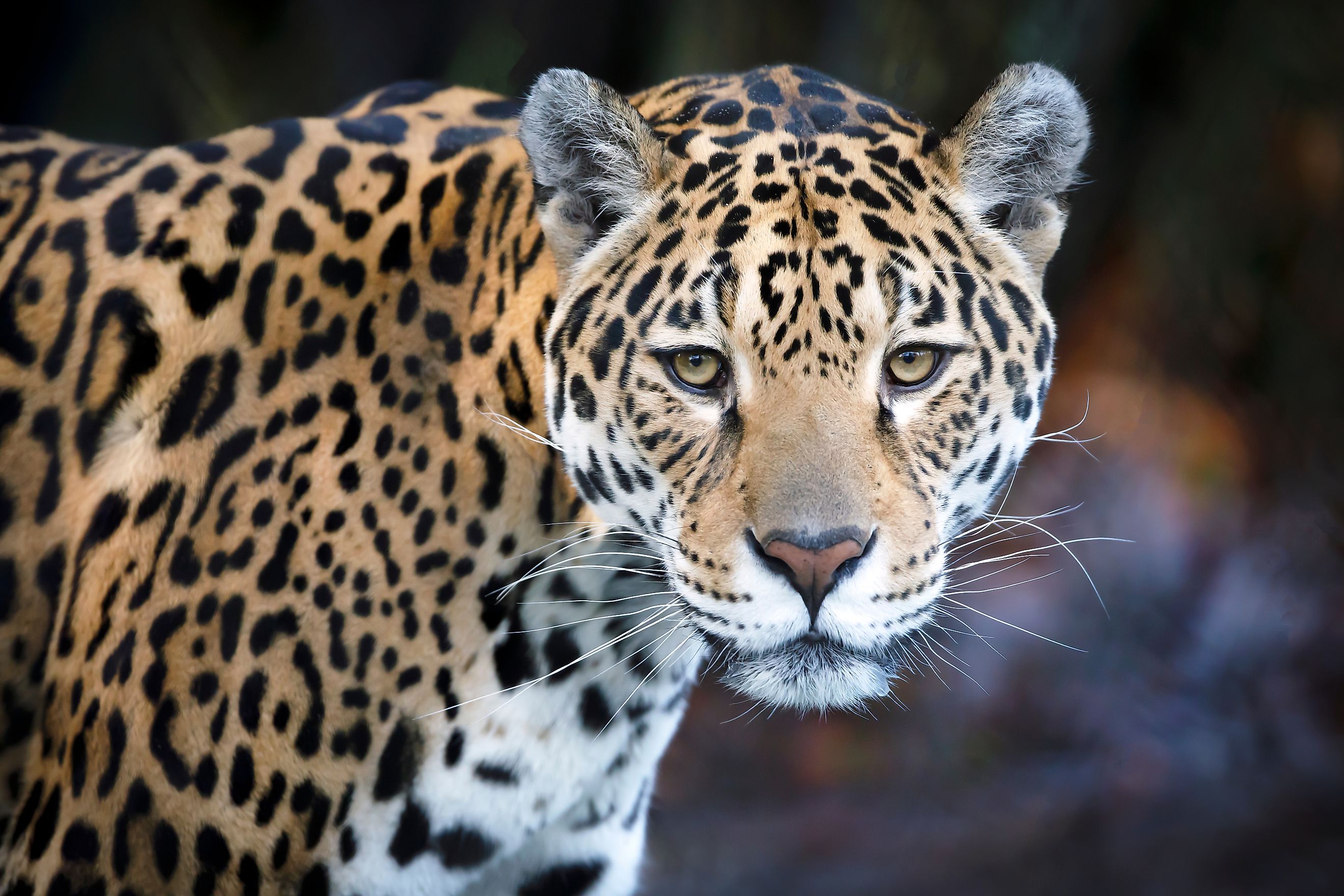
Jaguar
The jaguar (Panthera onca) bites down with more force relative to its size than any other big cat, driving its canines straight through the skulls of its prey and even the armored shells of turtles. It is the largest cat in the Americas and the third largest in the world, behind only the tiger and the lion. It is also the only member of the genus Panthera native to the Western Hemisphere, and the sole cat on the continent capable of a true roar.
A stocky, muscular ambush predator built for power rather than speed, the jaguar once ranged across roughly half of South America, all of Central America, and into the southwestern United States. Today, it occupies about 51 percent of that historic territory, holding on most securely in the Amazon Basin while thinning out or disappearing along the fragmented edges of its range.
Taxonomic Classification

The jaguar belongs to the order Carnivora, the family Felidae, the subfamily Pantherinae, and the genus Panthera, which it shares with the lion (Panthera leo), tiger (Panthera tigris), leopard (Panthera pardus), and snow leopard (Panthera uncia). Carl Linnaeus described the species in 1758 as Felis onca, and it was later moved to Panthera. Molecular studies place the jaguar as the sister lineage to the group containing the lion, leopard, and tiger, with the split estimated at roughly 3.6 to 4 million years ago. Despite a close physical resemblance to the leopard, the two are separated by an ocean and millions of years of divergence.
Historically, taxonomists split the jaguar into as many as nine subspecies based on geography and skull shape. Genetic work has not supported those divisions. In 2017 the Cat Classification Task Force of the IUCN reclassified the jaguar as a monotypic species, meaning it has no living subspecies. Instead, populations show a gradual north-to-south variation in size and build rather than distinct genetic groupings. Only two extinct fossil forms are still formally recognized. These are Panthera onca augusta, a larger Pleistocene jaguar from North America, and Panthera onca mesembrina, which lived in Patagonia. The common name traces to the Tupi-Guarani word yaguara, often translated as the beast that kills its prey in a single bound.
Physical Description

The jaguar has a compact, heavily muscled body, a broad head, a deep chest, and short, thick limbs. Among the pantherine cats, it has the shortest legs relative to its body, an adaptation suited to stalking through dense cover and swimming rather than long chases. Adults measure 3.7 to 6.1 feet (1.1 to 1.85 m) in head and body length, with a comparatively short tail of 18 to 30 inches (45 to 75 cm), the shortest of any big cat. Shoulder height runs 25 to 30 inches (63 to 76 cm).
Weight varies widely by region, and this is where the north-to-south cline is clearest. Most adults weigh between 126 and 249 pounds (57 to 113 kg), with males generally 10 to 20 percent heavier than females. The smallest jaguars live in equatorial forests, while the largest occur in open habitats such as Brazil's Pantanal and the Venezuelan Llanos, where abundant large prey supports heavier cats. The heaviest reliably recorded wild jaguar weighed about 330 pounds (150 kg).
The coat is pale yellow to reddish brown above and white on the belly, marked with dark rosettes. A jaguar's rosettes usually enclose one or more small central spots, which distinguishes them from the empty rosettes of the leopard. Roughly 6 percent of jaguars, and by some regional estimates up to 11 percent, are melanistic, appearing nearly black. These animals, popularly called black panthers, still carry rosettes visible in strong light. The melanism allele appears to be dominant, and melanistic jaguars are essentially absent north of Mexico's Isthmus of Tehuantepec. The species is distinguished by its short, broad, and heavily built skull and jaws. Its bite force quotient is estimated at around 118.6 at the canine tip, the highest recorded among big cats relative to body size.
Range and Habitat

Jaguars occur across 18 countries, ranging through Mexico, Central America, and much of South America as far south as northern Argentina. The largest and most stable populations are in the Amazon Basin, which holds an estimated 89 percent of all remaining jaguars. Outside the Amazon, populations tend to be small, isolated, and increasingly fragmented, particularly in northern Venezuela, the Atlantic Forest of eastern Brazil, and the Maya Forest of Mexico and Guatemala.
Although closely associated with lowland tropical rainforest, the jaguar is a habitat generalist. It thrives in seasonally flooded wetlands, savanna grasslands, dry scrub, and montane forest, and it tolerates semi-arid conditions at the northern edge of its range in Mexico. The one constant is a strong preference for water. Jaguars keep to floodplains, rivers, and swamps far more than most cats, and they are powerful swimmers. Their historic range extended into Arizona, New Mexico, and Texas, but no breeding population has persisted in the United States for more than 50 years, though lone males still occasionally cross the border from Mexico. Overall, the species has lost roughly 20 percent of its range in recent decades, and now occupies about 51 percent of the area it held before European contact.
Diet

The jaguar is an obligate carnivore with a remarkably diverse diet, with more than 85 prey species documented across its range. Preferred prey are large-bodied animals, especially capybara and peccaries, but the list extends to deer, tapir, armadillos, pacas, agoutis, monkeys, birds, fish, and reptiles including turtles and caiman.
Jaguars hunt by stalk and ambush rather than pursuit. They rely on cover and proximity, closing the distance quietly before a short, explosive rush, and they will launch attacks from riverbanks or even from the water. Where most big cats kill by clamping the throat to suffocate prey, the jaguar frequently delivers a single bite through the temporal bones of the skull, piercing the brain. This method, powered by its exceptional jaw strength, lets it dispatch prey quickly and crack open hard-shelled animals that other predators cannot. One jaguar was documented dragging a 75-pound (34 kg) sea turtle nearly 300 feet (91 m) into forest cover.
Behavior

Jaguars are solitary outside of mating and the period a female spends raising cubs. Both sexes hold territories that they mark with urine, scrapes, and tree scratches, and they announce their presence with roars, grunts, and coughing calls. A male's range typically overlaps those of several females and is defended against rival males, while female offspring may settle in or inherit territory adjacent to their mother's.
Long assumed to be strictly nocturnal, jaguars are now known to be active across the day and night, with activity peaks around dawn and dusk. They are strong climbers and, unusually for a cat, confident and frequent swimmers, readily crossing rivers and hunting in water. Built for power rather than endurance, a jaguar tires quickly and depends on ambush and short bursts rather than sustained speed. It is generally silent and reclusive, and it rarely poses a threat to humans.
Reproduction

Jaguars have no fixed breeding season across most of their tropical range, though populations at the northern and southern extremes tend to breed seasonally, with births often timed to the wet season when prey is plentiful. After a gestation of roughly 91 to 111 days, averaging about 100, a female gives birth in a sheltered den to a litter of one to four cubs, most often two. Newborns are blind and helpless, weighing around 1.5 to 2 pounds (0.7 to 0.9 kg), and open their eyes after about two weeks.
The mother raises her young alone. Cubs begin accompanying her on hunts at a few months old and remain dependent for one and a half to two years before dispersing to establish their own territories. Females reach sexual maturity at two to three years, males at three to four. In the wild, few jaguars live beyond 12 to 15 years, while individuals in managed care have reached their early twenties and, in exceptional cases, older.
Importance to the World

As an apex predator, the jaguar sits at the top of its food web and exerts top-down control on the animals below it. By keeping populations of capybara, peccaries, deer, and other herbivores in check, it helps prevent overgrazing and maintains the balance of plant and animal communities across forests and wetlands. Ecologists consider it both a keystone species, whose impact on its ecosystem exceeds what its numbers might suggest, and an umbrella species. Protecting the large, connected habitats jaguars need also helps protect countless smaller species that live within them.
The jaguar's importance is cultural as well as ecological. It held a central place in the belief systems of the Olmec, Maya, and Aztec civilizations, where it symbolized power, rulership, and the spirit world, and it remains a national and regional emblem across much of Latin America today.
Threats and Conservation

The IUCN Red List classifies the jaguar as Near Threatened, based on its 2017 assessment, with a population trend that is declining. The most cited rangewide estimate is about 173,000 individuals, from a 2018 study, the great majority in the Amazon. A finer-grained analysis of the species' 34 recognized subpopulations found that only the Amazonian population is secure, while most of the others qualify as Endangered or Critically Endangered on their own. The northern Argentine Chaco population, for example, has collapsed toward regional extinction.
The leading threats are habitat loss and fragmentation from deforestation, agriculture, and cattle ranching, which carve continuous forest into isolated pockets. Where ranching replaces habitat, jaguars sometimes prey on livestock and are killed in retaliation. Poaching is a growing pressure, driven partly by demand for jaguar teeth, claws, and other parts. Prey depletion compounds all of these. Escalating wildfires add another strain, with fire and habitat loss increasingly killing jaguars in the Amazon. International commercial trade in jaguars has been banned under CITES Appendix I since 1975. Conservation efforts now focus heavily on connectivity. Initiatives such as Panthera's Jaguar Corridor Initiative and the range-wide Jaguar 2030 Roadmap aim to connect core populations across national borders and prevent isolated groups from disappearing one by one.
Takeaway
The jaguar is the Americas' great cat, a powerful, water-loving ambush predator whose bone-crushing bite and position as an apex predator make it vital to the health of tropical forests and wetlands. Its adaptability once carried it across two continents, yet that range has been halved, and outside the Amazon most of its populations are small and imperiled. The species' survival now rests less on any single reserve than on keeping its remaining strongholds connected, so that the largest cat in the Western Hemisphere still has room to roam.
Fun Facts

- One-bite killer: The jaguar's name comes from a Tupi-Guarani word meaning the beast that kills in a single leap, a fitting description for a cat that can kill with one bite to the skull.
- Shell cracker: Its jaws are strong enough to punch through the shells of turtles and the bony hides of caiman, prey most predators avoid entirely.
- Water cat: Unlike most felines, jaguars seek out water, swim well, and often hunt fish, caiman, and turtles along rivers and in flooded forest.
- Black but not spotless: Melanistic black jaguars still have rosettes, faintly visible against the dark coat in good light.
- Roar of the New World: The jaguar is the only cat in the Americas that can roar, a trait it shares with the lion, tiger, and leopard but not the cougar.
Quick Facts
- Scientific name: Panthera onca
- Family / Order: Felidae / Carnivora
- IUCN status: Near Threatened (2017; population declining)
- Length (head-body): 3.7 to 6.1 ft (1.1 to 1.85 m); tail 18 to 30 in (45 to 75 cm)
- Shoulder height: 25 to 30 in (63 to 76 cm)
- Weight: 126 to 249 lb (57 to 113 kg); up to about 330 lb (150 kg)
- Lifespan: 12 to 15 years (wild); 20+ years (managed care)
- Diet: Carnivore (85+ prey species)
- Range: 18 countries, Mexico through Central and South America to northern Argentina