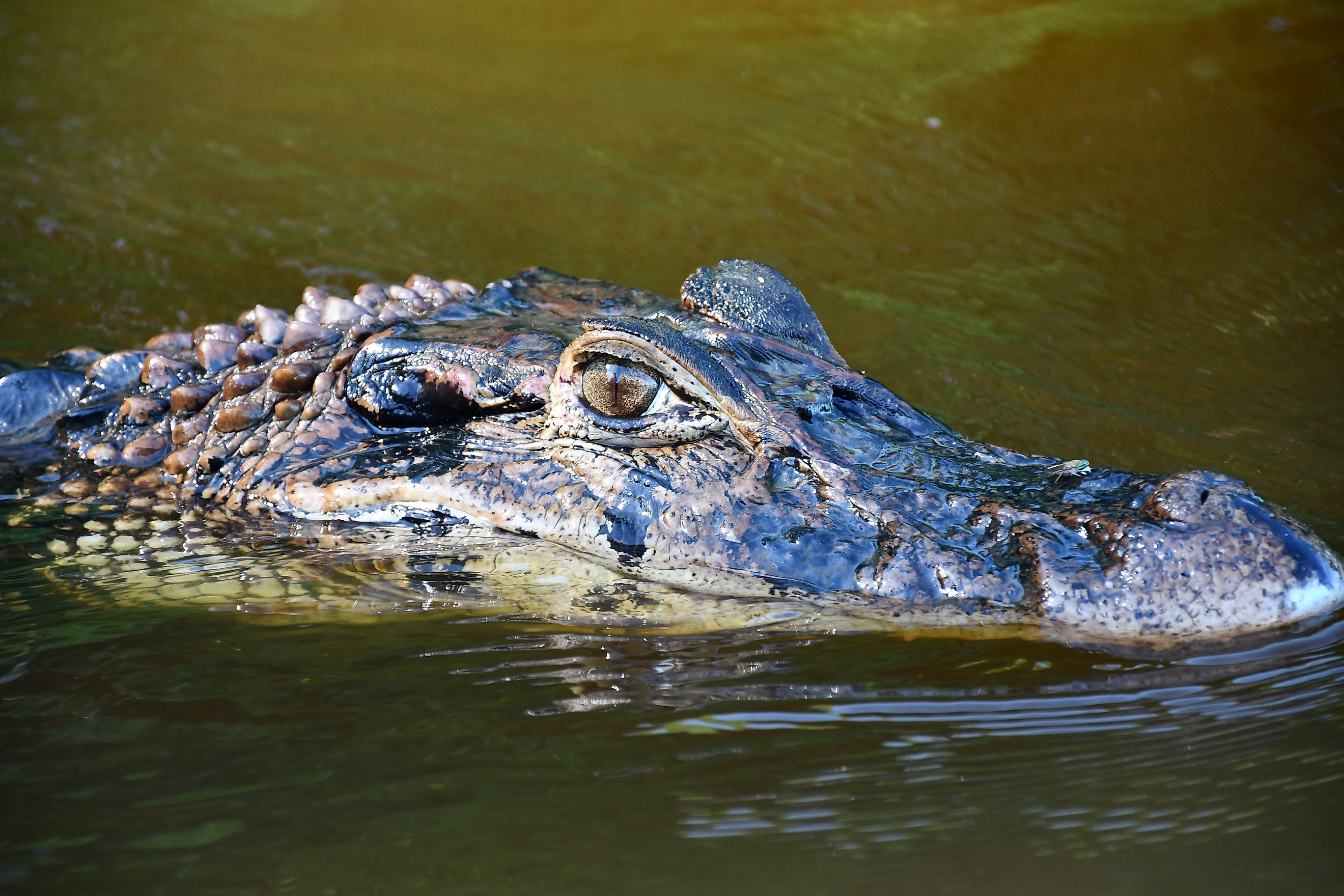
Black Caiman
No animal sits higher in the Amazon food web than the black caiman. It is the largest predator in the world's largest river basin and the biggest member of the alligator family, a dark, armored reptile that can stretch past 16 feet (5 m) and outweigh a grand piano. Melanosuchus niger hunts by night across the slow rivers, oxbow lakes, and flooded forests of northern and central South America, ambushing prey as small as piranhas and as large as capybaras, and its eyes glow an eerie red in torchlight. Healthy adults sit at the top of the food chain with no natural predators, and the animal is powerful enough to be genuinely dangerous to people.
That size and appetite give the black caiman an outsized role in its surroundings. As the apex predator of the basin it helps hold prey populations in check and is often described as a keystone species, one whose presence shapes the balance of life around it. Its body is built for the job, with pale flank bands that linger well into adulthood and pressure-sensitive skin that lets it track movement in murky water.
Its story is also one of the Amazon's clearest conservation turnarounds. Hunted to the edge of commercial extinction for its hide in the middle of the 20th century, the species has recovered across much of its range and now counts among the basin's real wildlife success stories.
Taxonomic Classification

The black caiman belongs to the kingdom Animalia, phylum Chordata, class Reptilia, and order Crocodilia. Within that order it sits in the family Alligatoridae and the subfamily Caimaninae, the group that contains all six living species of caiman. It is the only species in its genus, carrying the scientific name Melanosuchus niger. The German naturalist Johann Baptist von Spix described the species in 1825, and its name is a straightforward reference to its appearance. Melanosuchus combines Greek words meaning "black" and "crocodile," while the Latin niger means "black" as well.
Although caimans resemble alligators, they are a distinct New World lineage, and several skeletal features separate the two groups, as a closer look at the differences between a caiman and an alligator makes clear. Modern DNA studies have clarified the black caiman's place on the family tree. Molecular research now identifies it as the closest relative of the genus Caiman, which includes the spectacled, yacaré, and broad-snouted caimans. The crocodilian line as a whole is ancient, tracing back more than 200 million years, so the black caiman shares a distant common ancestor with the true crocodiles as well.
Physical Description

Size is the black caiman's headline trait. Adults commonly measure 13 to 16 feet (4 to 4.9 m), and the largest verified individuals approach 16 to 19 feet (5 to 5.8 m). Unconfirmed reports of animals near 20 feet (6 m) circulate, but they remain unverified. Large males can exceed 880 pounds (400 kg), and the heaviest individuals have been reported close to 1,100 pounds (500 kg). That bulk makes it the largest member of the family Alligatoridae and the largest predator in the Amazon Basin, and it earns a place among the largest reptiles in the world.
As the common and scientific names promise, adults are very dark, a deep greenish-black that can appear nearly jet-black. That dark coloration serves two purposes. It helps the animal absorb heat while basking and provides camouflage during nighttime hunts. The lower jaw carries grey to brown banding, and juveniles wear bold white or pale yellow bands along their flanks. Unusually among crocodilians, those juvenile markings persist well into adulthood, more so than in related species. The black caiman also has notably large eyes and a comparatively narrow snout, adaptations suited to hunting in low light. Its bite is formidable in proportion to its frame. A 10-foot (3 m) individual weighing 227 pounds (103 kg) was measured generating a bite force of roughly 4,310 newtons (about 970 pounds of force), enough to crush turtle shells.
Range and Habitat

The black caiman is native to the Amazon Basin of South America. Its range spans Brazil, eastern Ecuador, eastern Peru, northern Bolivia, southern Guyana, and eastern French Guiana, with a historical presence in Colombia and an uncertain status in Venezuela. Roughly 70 percent of the species' total range lies within Brazil, where it occurs across the Amazon, Tocantins, and Araguaia basins.
Within that range, the animal favors calm freshwater. It concentrates along the Amazon River and its tributaries, in oxbow lakes, blackwater swamps, and the seasonally flooded savannas and forests that define much of the basin. Steep, vegetated banks that offer both basking sites and cover are especially favored. The species tolerates the basin's dramatic wet and dry cycles, shifting between shrinking dry-season pools and the vast flooded forest that opens up when the rivers rise.
Diet

The black caiman is an apex carnivore that will take more or less any animal it can overpower. Fish form the backbone of the adult diet, including catfish and piranhas, along with a good share of molluscs. Beyond the water it hunts birds, turtles, snakes, and mammals, and a large caiman can bring down a capybara, a deer, or even a tapir. Juveniles start small, feeding on insects, crustaceans, and other invertebrates, then graduate to larger vertebrates as they grow.
Its teeth are built to grasp rather than slice, so the caiman typically drowns larger animals and swallows smaller ones whole. It hunts mostly at night, floating motionless with only its eyes and nostrils above the surface before striking, though it will also emerge to ambush prey on land. This flexible, opportunistic approach helps explain why it holds the top spot in a river system crowded with other capable hunters.
Behavior

Black caimans are largely nocturnal and mostly solitary outside the breeding season. Like all crocodilians, they are ectotherms, so much of their day is spent regulating body temperature. They bask on banks and logs to warm up, then retreat into the water to cool down. When night falls, the animal becomes an efficient ambush hunter. Its large eyes carry a reflective layer that improves low-light vision, and that same layer produces a distinctive effect for people on the water, since a black caiman's eyes glow red under torchlight. River guides and researchers use exactly this "eyeshine" to count animals after dark.
Sensory equipment beyond vision makes the caiman effective in murky water. Pressure-sensitive receptors on the face detect the faint ripples of moving prey, and acute hearing rounds out the toolkit. The species is dangerous to humans, and attacks, while uncommon, do occur, usually in low-light conditions or around fishing activity. That risk is one reason it features in accounts of the most dangerous animals of the Amazon rainforest.
Reproduction

Black caimans reach sexual maturity at around 8 years of age, or a body length near 6.5 feet (2 m). Breeding is tied to the dry season, when females build large mound nests of vegetation, mud, and soil close to the water, often about 5 feet (1.5 m) across. A clutch usually holds 30 to 65 eggs, which incubate for roughly two to three months. As in other crocodilians, nest temperature determines the sex of the hatchlings.
Parental care is a defining feature. The female guards the nest through incubation and helps her young break free of their shells when they hatch, gently cracking the eggs with her jaws. She then shepherds the hatchlings to shallow water and continues to watch over them for a period, though the young are largely independent and most do not survive to adulthood. Females typically breed only once every two to three years, a slow reproductive rate that made the species especially vulnerable to overhunting.
Importance to the World

As the top predator across the Amazon Basin, the black caiman helps hold its ecosystem together and is often described as a keystone species. By preying selectively on fish and other animals, it influences the balance of species below it in the food web. Historical declines illustrate the point. In areas where caiman numbers dropped, piranha and capybara populations were reported to increase, creating knock-on effects for fisheries and crops.
Its role extends beyond predation. Through feeding, moving between water bodies, and returning nutrients to the water and surrounding land, the black caiman contributes to nutrient cycling in a system where that recycling matters. Removing it would leave a gap that few other Amazonian animals could fill. The species also carries cultural weight for communities across the basin, and its recovery has become a reference point for what managed conservation can achieve.
Threats and Conservation

Healthy adult black caimans have no natural predators, but juveniles are vulnerable to green anacondas, jaguars, larger fish, and other caimans. The gravest historical threat, though, was human. From the 1950s through the 1970s, the species was hunted relentlessly for its dark, commercially valuable hide, and in heavily harvested areas, numbers fell by as much as 99 percent, pushing it close to commercial extinction.
The recovery since then has been substantial. Legal protection, controlled-trade regulation, and protected areas allowed populations to rebound across much of the range beginning in the 1990s. Having been listed as Endangered through the 1980s and 1990s, the species is now widely assessed as Least Concern on the International Union for Conservation of Nature (IUCN) Red List, and it is protected under CITES, which tightly restricts international commercial trade in the animal and its hide. Reliable range-wide population totals are still lacking, and published estimates vary widely, spanning tens of thousands up to figures approaching a million, but the trend is considered stable to increasing. Ongoing concerns include illegal hunting, habitat loss from deforestation and wetland conversion, competition from the more numerous spectacled caiman, and the use of caiman meat as bait in commercial fishing. Unlike several relatives that remain in trouble, the black caiman stands out as a species that has been pulled back from the edge.
Takeaway
The fate of the black caiman is closely tied to the health of the Amazon itself. When rivers remain clean and forests stay intact, the basin's largest reptile can thrive. As waterways become polluted and forests are cleared, its numbers decline. Its recovery after decades of heavy hunting shows that even a large, slow-breeding predator can rebound when protection and trade restrictions are effectively enforced. Keeping that progress going will require continued efforts to curb habitat loss and poaching. For now, Melanosuchus niger remains a top predator in the Amazon, playing an important role in one of the world's most complex river ecosystems.
Fun Facts

- A name that means "black" twice. Melanosuchus niger stacks the Greek for "black crocodile" on top of the Latin word for "black," a fitting label for the darkest of the caimans.
- Red eyes in the dark. A reflective layer behind the retina makes a black caiman's eyes shine red under torchlight, and spotters use that glow to census them at night.
- Lifelong stripes. The pale flank banding of juveniles fades slowly, lingering into adulthood far longer than in most other crocodilians.
- A crushing bite. A modest 10-foot (3 m) individual was recorded biting with about 4,310 newtons of force, strong enough to punch through a turtle's shell.
- A conservation comeback. After losing up to 99 percent of its numbers in some areas to the hide trade, the species recovered enough to be widely regarded as Least Concern.
Quick Facts
- Scientific name: Melanosuchus niger
- Family / Order: Alligatoridae (subfamily Caimaninae) / Crocodilia
- IUCN status: Least Concern
- Length: commonly 13-16 ft (4-4.9 m); largest verified up to 16-19 ft (5-5.8 m)
- Weight: up to ~880-1,100 lb (400-500 kg) in large males
- Lifespan: roughly 50-80 years
- Diet: Carnivore (fish, molluscs, mammals, reptiles, birds)
- Range: Amazon Basin of northern and central South America
- Habitat: Slow rivers, oxbow lakes, flooded forests, and seasonally flooded savannas