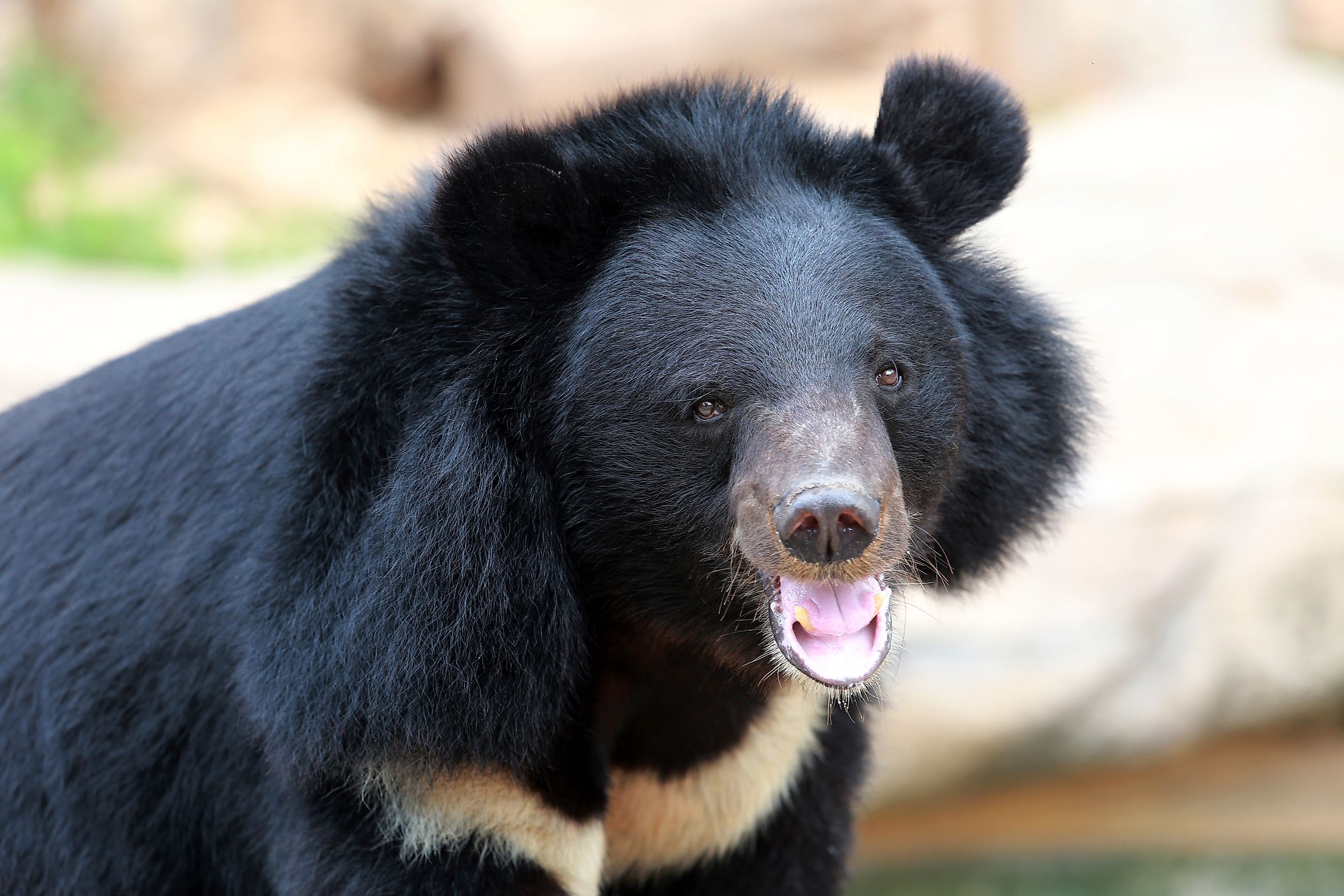
Asian Black Bear
The Asian black bear is best known for the pale, crescent-shaped patch on its chest, which stands out against its jet-black fur and has earned it the nickname "moon bear." Known scientifically as Ursus thibetanus, it is the most arboreal of the world's eight bear species, an agile climber that can spend up to half its life off the ground, feeding on nuts and fruit, resting on platforms it bends together from branches, and escaping threats by heading straight up a trunk.
It is a medium-sized bear, with males weighing around 220 to 440 pounds (100 to 200 kg) and females weighing roughly half as much. It claims one of the widest ranges of any bear, covering southeastern Iran, the Himalayas, and the forests of China, Korea, Japan, and Southeast Asia, spread across 18 countries and split into seven subspecies. Depending on where it lives, it may sleep through a northern winter in a den or stay active year-round in warmer southern forests.
That range is shrinking. Logging has stripped away much of the bear's forest, and a long-running trade in its gallbladder, bile, and paws continues to draw hunters into the hills. The species is now listed as Vulnerable on the IUCN Red List, its population estimated to have fallen by roughly a third over three decades.
Taxonomic Classification

The Asian black bear belongs to the family Ursidae, subfamily Ursinae, and the genus Ursus, placing it among the "true" or ursine bears alongside the brown bear, polar bear, American black bear, sun bear, and sloth bear. Its scientific name, Ursus thibetanus, was assigned by the French naturalist Georges Cuvier in 1823. The order is Carnivora, though like most bears the species is functionally omnivorous.
Scientists currently recognize seven subspecies, spread across the animal's vast geographic range and differing in size, coat, and skull shape. These include the Himalayan black bear, the Japanese black bear (U. t. japonicus), the Formosan black bear of Taiwan, and the Baluchistan black bear (U. t. gedrosianus), a small, isolated form of the arid southwest that is itself listed as Critically Endangered. The species carries 74 chromosomes, a karyotype nearly identical to the other ursine bears, and biologically it represents an early stage of the tree-climbing specialization taken further by the sun bear and sloth bear.
Physical Description

This is a medium-sized bear with a heavy body, thick legs, and broad paws built for climbing. Adults stand roughly 28 to 39 inches (70 to 100 cm) at the shoulder and measure about 47 to 75 inches (120 to 190 cm) in head-and-body length, with a short tail of around 4 inches (11 cm) that is barely visible beneath the coat.
The species is strongly sexually dimorphic. Males typically weigh 220 to 440 pounds (100 to 200 kg), while females weigh roughly half as much, about 110 to 275 pounds (50 to 125 kg). Weight also swings with the seasons, peaking in autumn as bears fatten for winter.
The coat is black in most populations, with a pale beige to white patch on the chest, often shaped like a crescent or a "V," a smaller mark on the throat, and a white blaze on the chin and muzzle. A ruff of long hair, up to about 6 inches (15 cm), frames the neck and shoulders in many bears and gives the head a broad, maned silhouette. Rare brown, blonde, and mixed color phases occur in parts of Southeast Asia. The ears are large, rounded, and set noticeably wider apart than those of the American black bear, and the claws are strong and curved, up to 2 inches (5 cm) long, ideal for gripping bark. Its eyesight is limited and its hearing is only average, but it has an excellent sense of smell.
Range and Habitat

Few bears cover as much ground. The Asian black bear ranges from southeastern Iran through Pakistan and northern Afghanistan, along the foothills of the Himalayas, into Myanmar, southern China, and mainland Southeast Asia. Robust populations survive in northeastern China and the Russian Far East, and the bear is present on the Japanese islands of Honshu and Shikoku, on Taiwan, and on Hainan. South Korea holds a small reintroduced population, established in Jirisan National Park beginning in 2004, that is slowly recovering. The species is notably absent from Malaysia, where the sun bear fills its ecological role.
The bear persists in all 18 of its historic range countries, but that continuity masks a steep contraction. Studies estimate the current range at roughly 7.85 million square kilometers, close to half the area it once occupied. It favors forested hills and mountains, climbing to elevations of about 11,800 feet (3,600 m) in summer and descending to warmer, lower ground, often below 5,000 feet (1,500 m), for the winter.
Diet

The Asian black bear is an opportunistic omnivore whose menu shifts with the calendar, though the bulk of it is plant matter. In spring, the bear takes a larger share of insects, including termites, bees, and beetle larvae, along with fresh green growth. Summer brings a heavy reliance on fruits and berries. Autumn brings an abundance of hard mast, including acorns, beechnuts, walnuts, hazelnuts, and chestnuts. These high-fat foods are consumed in large quantities as the bear builds the reserves it needs for winter.
Animal protein rounds out the diet where available, including small mammals, carrion, and the occasional larger prey, but this bear is no dedicated hunter. Its jaw and teeth suit a mixed diet rather than a strictly carnivorous or a strictly herbivorous one. Much of its foraging happens off the ground, and the bear will climb to reach fruit and nuts, sometimes dragging food up into a tree to feed in safety.
Behavior

More than any other bear, the Asian black bear lives in the trees. It is the most arboreal member of the family, capable of spending as much as half its time aloft, and it is among the largest tree-dwelling mammals on Earth. It climbs to feed, to rest, to sunbathe, and to escape threats, and it snaps off branches to wedge beneath itself while feeding, leaving conspicuous nest-like platforms high in the canopy that reveal its presence.
The species is generally solitary outside the breeding season and the bond between a mother and her cubs. Activity patterns are flexible, with bears in undisturbed areas tending to be active during the day while those living near people often shift their feeding activity to nighttime. Individuals communicate through scent, and they scratch, bite, and rub against prominent "signpost" trees to leave visual and chemical cues. Home ranges vary with the food supply and can exceed 40 square miles (100 sq km) for adult males in leaner habitat.
In the colder, northern reaches of the range, bears enter a period of winter dormancy from roughly November to April, sheltering in tree hollows, caves, or dug-out dens. Farther south, many bears skip dormancy altogether and simply move to lower elevations. Pregnant females are the main exception, as they almost always enter dens to give birth.
Reproduction

Asian black bears reach sexual maturity at three to four years of age. Mating takes place in the warm months, generally between June and August. As in many bears, development is drawn out by delayed implantation, so the effective gestation runs about six to eight months, timed so that cubs arrive in the security of the winter den.
Litters usually number two cubs, though one to four can occur. Newborns are tiny, blind, and helpless, weighing only about 13 ounces (370 g), and depend entirely on their mother's warmth and milk. They are weaned at around six months but stay with the mother for two to three years, learning where and how to forage before striking out alone. In the wild, Asian black bears rarely live past 25 years, though protected individuals in captivity have reached their early thirties.
Importance to the World

As a wide-ranging forager, the Asian black bear helps shape the forests it inhabits. By eating large volumes of fruit and moving through broad home ranges, it disperses seeds across the landscape, aiding the regeneration of the woodlands it depends on. Its appetite for insects and small animals lends a measure of natural pest control, and its foraging activity, whether digging or breaking branches, alters vegetation in ways that ripple through the local ecosystem.
The species has also left a lasting mark on modern medicine. The active compound in bear bile, ursodeoxycholic acid, was first identified in the early 1900s and takes its name from Ursus, the Latin word for bear. Manufactured synthetically since the 1970s, it is now an approved treatment for gallstones and cholestatic liver conditions such as primary biliary cholangitis, and it is prescribed around the world without any wild animal involved. That laboratory breakthrough has implications for conservation as well as health, because a made-to-order drug that matches the natural compound weakens the case for hunting and farming bears to harvest their bile.
Threats

The Asian black bear is listed as Vulnerable on the IUCN Red List, under the most recent global assessment, which concluded that the population had declined by roughly 31 percent over the previous 30 years, or about three bear generations. Reliable rangewide counts are scarce, but rough estimates suggest fewer than 60,000 animals remain worldwide, and the overall trend is downward.
The decline has several major causes, with habitat loss being one of the most serious. Logging and the expansion of farmland have reduced and fragmented the bear's range, particularly in China and Southeast Asia. Direct exploitation adds to the pressure, as bears are killed for their paws and skins and, most notably, for their gallbladders and bile, which remain part of an illegal wildlife trade. The demand also sustains bile farming, with thousands of bears held in captivity for extraction, an estimated 8,000 of them in China alone. The species is listed on Appendix I of CITES, and conservation efforts include protected areas, anti-poaching work, farm phase-outs, and reintroduction programs such as the one in South Korea. Where habitat is protected and hunting curbed, as in parts of Japan, some populations have stabilized or grown.
Takeaway
The moon bear's fate is bound to the forests that shaped it. The climbing skill, the seeds it scatters across Asian woodlands, and the folklore built up around it all trace back to canopy that logging keeps thinning. Protecting the forests these bears depend on and ending the trade in gallbladders, bile, and paws would go a long way toward reversing their decline. Neither is easy, but both are within reach, and the bears now recolonizing the slopes of Jirisan are proof that a population given room and protection can climb back. For the Asian black bear, survival is less a question of biology than of whether people choose to make space for it.
Fun Facts

- The moon on its chest names it. The pale crescent patch is why the animal is widely called the moon bear, a nickname it shares in spirit with the similarly marked sun bear.
- It is the tree champion of the bear world. No other bear is as arboreal, and few large mammals anywhere spend as much time in the canopy.
- It builds beds in the branches. The broken-branch platforms bears leave behind while feeding are a reliable field sign that moon bears are nearby.
- Cubs weigh less than a can of soup at birth. Newborns tip the scales at about 13 ounces (370 g) and are born blind and hairless.
- One rare subspecies is on the brink. The Baluchistan black bear of the arid southwest is classified as Critically Endangered, several notches above the species overall.
Quick Facts
- Common name: Asian black bear (also Asiatic black bear, moon bear, white-chested bear, Himalayan black bear)
- Scientific name: Ursus thibetanus
- Family / Order: Ursidae / Carnivora
- IUCN status: Vulnerable (population decreasing)
- Size: 47 to 75 inches (120 to 190 cm) in head-and-body length; 28 to 39 inches (70 to 100 cm) at the shoulder
- Weight: Males 220 to 440 pounds (100 to 200 kg); females 110 to 275 pounds (50 to 125 kg)
- Lifespan: About 25 years in the wild; up to the early thirties in captivity
- Diet: Omnivorous, largely herbivorous (fruit, nuts, insects, some animal matter)
- Range: Across Asia, from Iran and the Himalayas through China, Korea, the Russian Far East, Japan, Taiwan, and Southeast Asia
- Subspecies: Seven recognized