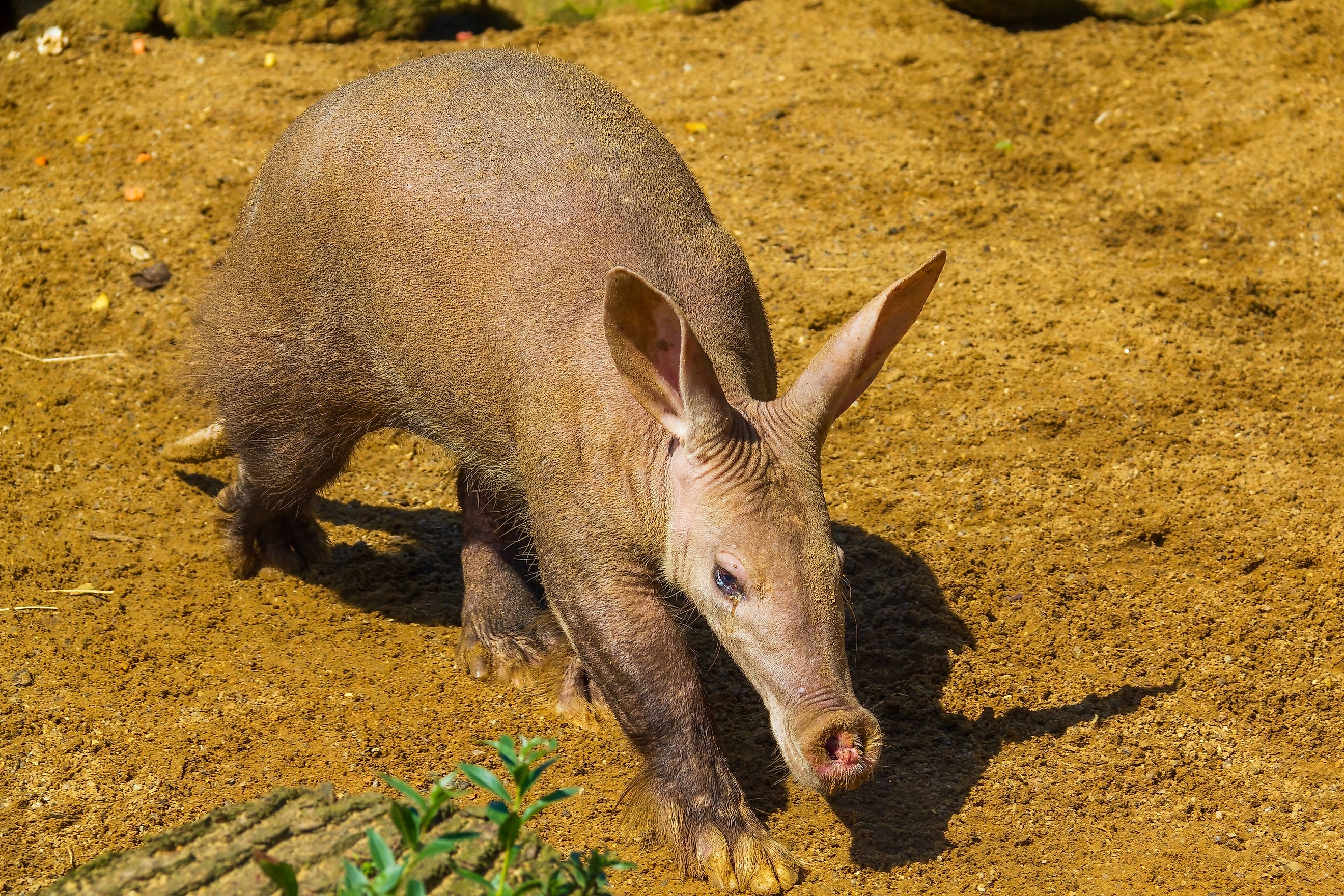
Aardvark
The aardvark is one of evolution's true originals, the last surviving member of an entire order of mammals that once ranged across Africa, Europe, and Asia. Its name comes from Afrikaans and means "earth pig," a nod to its stout body, arched back, and long snout. The resemblance to a pig ends at first glance, though. This nocturnal digger belongs to a lineage with no other living members, and its nearest relatives are not pigs or anteaters at all but elephants, hyraxes, and manatees.
Native to sub-Saharan Africa, the aardvark spends its nights hunting ants and termites across savannas, grasslands, and open woodland. It is rarely seen, travels alone, and vanishes underground by day. Even so, it reshapes the landscapes it lives in more than almost any other animal its size, because the burrows it digs and abandons become shelter for dozens of other species.
Few mammals pack so many unusual features into a single body. The aardvark has rabbit-like ears, a thick tapering tail, a tubular snout crowded with sensory tissue, and teeth found in no other creature alive.
Taxonomic Classification

The aardvark carries the scientific name Orycteropus afer, first described by the naturalist Peter Simon Pallas in 1766. The genus name Orycteropus comes from Greek and means "burrowing foot," while afer refers to Africa. In the full chain of classification, it sits in kingdom Animalia, phylum Chordata, class Mammalia, order Tubulidentata, family Orycteropodidae, and genus Orycteropus.
What makes the aardvark stand apart is its order. Tubulidentata contains exactly one living species, making the aardvark the sole survivor of a group that stretches back tens of millions of years. The order takes its name from the animal's strange teeth, which are built from many thin tubes of dentine rather than solid enamel. Early naturalists linked the aardvark to South American anteaters because both eat ants, but that resemblance is a case of convergent evolution rather than kinship. Molecular studies place the aardvark within Afrotheria, an ancient African radiation that also includes elephants, hyraxes, sea cows, and tenrecs. Several subspecies have been proposed across the animal's wide range, though their validity remains uncertain and ongoing research may reduce them to a single variable species.
Physical Description

An adult aardvark measures roughly 3.4 to 4.3 feet (105 to 130 cm) in body length, with a heavy, muscular tail adding another 18 to 25 inches (45 to 63 cm). Large individuals can reach about 7.2 feet (2.2 m) snout to tail tip and stand near 24 inches (60 cm) at the shoulder. Weight ranges from about 88 to 143 pounds (40 to 65 kg), giving the animal a low-slung, powerful build suited to a life of digging.
The coat is sparse and coarse, pale yellowish-gray in color, and often stained reddish-brown by the soil the animal works through. Beneath that thin hair lies thick, tough skin that shields the aardvark from the bites and stings of the insects it raids. The head narrows into a long, flexible snout tipped with a pig-like disc of a nose. Inside that snout, fleshy sensory structures and an acute sense of smell help the animal locate prey moving underground. Its ears are long and upright, reaching up to about 9.4 inches (24 cm), and can be folded back to keep out dirt during digging. The eyes are small, since sight matters little to a night forager that relies on scent and hearing.
The limbs are the aardvark's most important tools. The front feet carry four toes armed with strong, flattened, spade-like claws, while the hind feet have five toes. These claws let the animal tear into cement-hard termite mounds and shift large volumes of earth at surprising speed. The teeth, the feature that names the whole order, lack enamel and a pulp cavity, grow continuously through life, and are used to grind rather than bite.
Range and Habitat

The aardvark occurs widely across sub-Saharan Africa. Its range reaches Senegal in the west, Ethiopia in the east, and the Cape of Good Hope in the south, covering a broad band of the continent wherever suitable conditions exist. The animal favors savannas, grasslands, bushland, and open woodland, and it can also survive in semiarid country as long as ants and termites remain plentiful.
Soil matters as much as vegetation. The aardvark needs ground soft enough to dig, so it avoids very rocky terrain and areas prone to heavy flooding, which would drown its burrows. Rainforest interiors and true desert are generally unsuitable, the first because prey is patchy and the ground stays waterlogged, the second because food is too scarce. Within its preferred habitats, the aardvark lives at low densities and is nowhere common. One study in the Karoo region of South Africa estimated only around eight animals across every 4 square miles (10 square km), a reminder that a wide range does not always mean large numbers.
Diet

The aardvark is a dedicated insectivore whose diet consists almost entirely of ants and termites. It will occasionally take beetle larvae, and it eats one curious plant, the aardvark cucumber, which grows underground and depends on the animal to dig it up and spread its seeds. Beyond these exceptions, ants and termites make up nearly every meal.
Foraging begins after dusk. An aardvark leaves its burrow and ambles along familiar zigzag paths, swinging its snout close to the ground and sniffing for prey. Sensory tissue on the nasal septum is thought to detect the tiny movements of insects hidden below the surface. When the animal locates a nest or mound, it braces on its hind legs and tail and rips the structure open with its front claws, sealing its nostrils against the flying dust. A long, thin tongue coated in sticky saliva then extends up to about 12 inches (30 cm) to lap up the insects. A single aardvark can consume as many as 50,000 ants and termites in one night, and it may travel 6 to 19 miles (10 to 30 km) in search of enough food.
Behavior

The aardvark is nocturnal and almost entirely solitary. It emerges in the late afternoon or after sunset, forages through the night, and returns underground before the heat of day. Adults meet mainly to mate, and outside the breeding season each animal keeps to itself.
Digging defines the aardvark's life. It excavates several kinds of burrows. Shallow temporary refuges dot its home range, while deep, branching main burrows serve for sleeping and raising young. A large burrow system can run up to about 43 feet (13 m) long, carry several entrances, and hold multiple sleeping chambers. The animal digs at astonishing speed, able to break through soil far faster than a person with a shovel, and it frequently abandons old burrows to dig fresh ones. If threatened underground, an aardvark can wall off the tunnel behind it or turn and lash out with its powerful claws. Against predators such as lions, leopards, hyenas, hunting dogs, and pythons, a swift retreat below ground is its main defense.
Reproduction

Aardvarks have a slow reproductive rate, which leaves them sensitive to sharp declines when conditions turn against them. Females usually produce a single young once a year after a gestation of about seven months. The newborn weighs around 4.4 pounds (2 kg), is born nearly hairless and pink, and stays hidden in the safety of the burrow during its first weeks.
A young aardvark begins to accompany its mother above ground after roughly two weeks, starts eating termites at about 14 weeks, and is weaned near 16 weeks. By six months of age it can dig burrows of its own, yet it often remains with its mother until the next breeding season before striking out alone. In the wild, aardvarks are thought to live around 10 years, while individuals in human care have reached about 23 years.
Importance to the World

The aardvark is an ecosystem engineer, an animal whose activities reshape habitat in ways that benefit many others. Its abandoned burrows are quickly claimed by a long list of tenants, among them warthogs, porcupines, hyenas, jackals, small cats, bats, birds, reptiles, and the endangered African wild dog, which relies on such dens to raise its pups. In landscapes with few natural shelters, these ready-made refuges can shape which species are able to live there at all.
The animal's appetite also matters. By consuming vast numbers of ants and termites, the aardvark helps regulate insect populations that can damage vegetation and crops. Its digging turns over soil, mixing nutrients and creating microhabitats that other organisms exploit. In several African cultures, the aardvark features in folklore and traditional belief, valued for its diligence and its ability to move unseen through the night. Together, these ecological and cultural roles make a shy, seldom-observed mammal far more influential than its low profile suggests.
Threats and Conservation

The aardvark is currently listed as Least Concern on the IUCN Red List, an assessment last confirmed in 2016. The species is widespread, occurs across a large part of Africa, and is not thought to face an immediate risk of extinction. Its numbers are difficult to count given its nocturnal and burrowing habits, so no precise global population figure exists.
That stable status hides real local pressures. Habitat loss driven by the spread of agriculture and human settlement remains the leading threat, and deforestation in parts of central Africa such as the Democratic Republic of the Congo reduces suitable ground. Aardvarks are hunted in some regions for meat and for body parts used in traditional practices. Because the animal depends so heavily on ants and termites, it is also vulnerable to shifts in climate that alter the abundance of its prey, and prolonged drought has been linked to local declines and starvation. In densely settled areas the species can disappear entirely even while remaining common elsewhere. Continued protection of suitable habitat, rather than captive breeding, offers the surest path to keeping this ancient survivor secure.
Takeaway
The aardvark is one of those animals that rarely gets the attention it deserves. It is the last surviving member of an ancient mammalian order, with tube-shaped teeth, an unusual evolutionary relationship to elephants, and a powerful digging ability that make it unlike any other living mammal. It spends much of its time alone at night, feeding on huge numbers of ants and termites while turning over the soil and creating burrows that later provide shelter for many other animals. Few mammals of its size have such a noticeable effect on the landscape around them.
The aardvark remains widespread across much of sub-Saharan Africa, which is reflected in its current Least Concern status. Even so, its slow reproduction, specialized diet, and continued habitat loss caused by farming and settlement could create problems for local populations. Protecting the open savannas and woodlands it depends on will be key to keeping this unusual mammal digging through African nights for generations to come.
Fun Facts

- It is a living fossil. The aardvark is the only surviving species of the order Tubulidentata, a group whose ancestors date back tens of millions of years.
- Its closest relatives are elephants. Despite the pig-like name and anteater-like diet, the aardvark's kin are elephants, hyraxes, and manatees within the African clade Afrotheria.
- Its teeth never stop growing. Aardvark cheek teeth have no enamel, are made of hundreds of tiny dentine tubes, and keep growing throughout the animal's life.
- It eats a fruit named after itself. The aardvark cucumber grows underground and relies on the aardvark to dig it up and scatter its seeds.
- It can devour 50,000 insects in a night. A single foraging aardvark laps up tens of thousands of ants and termites with a sticky tongue about a foot long.
- It builds homes for a whole community. Abandoned aardvark burrows shelter warthogs, porcupines, reptiles, birds, and the endangered African wild dog.
Quick Facts
- Scientific name: Orycteropus afer
- Family: Orycteropodidae, order Tubulidentata
- IUCN status: Least Concern (assessed 2016)
- Length: about 3.4 to 4.3 feet (105 to 130 cm), plus an 18 to 25 inch (45 to 63 cm) tail
- Height: around 24 inches (60 cm) at the shoulder
- Weight: about 88 to 143 pounds (40 to 65 kg)
- Lifespan: roughly 10 years in the wild and up to about 23 years in human care
- Diet: insectivorous, feeding almost entirely on ants and termites
- Range: sub-Saharan Africa in savanna, grassland, bushland, and open woodland