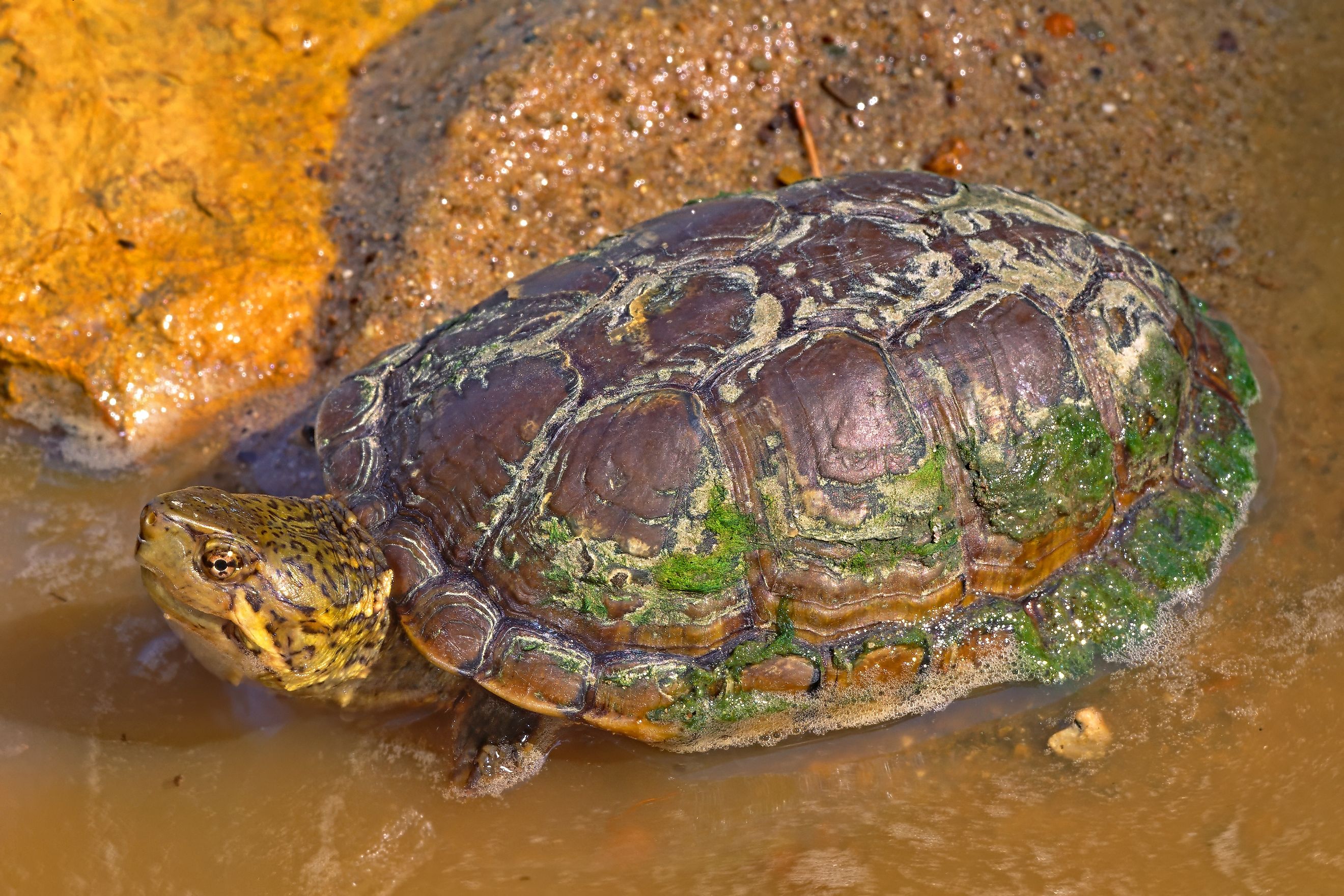
Why Native Freshwater Turtles Are So Rare In The Southwest
The American Southwest is often described as turtle-free desert country, but that is not entirely true. Native freshwater turtles are rare, but they can be found in some parts of Arizona and New Mexico, where persistent rivers, springs, and floodplain wetlands provide the water they require. The Sonoran mud turtle, for example, lives in streams and ponds across southern Arizona, southwestern New Mexico, and northern Mexico. The highly endangered Sonoyta mud turtle survives in the Quitobaquito Springs in Organ Pipe Cactus National Monument. What the region lacks is the broad, dependable network of lakes, marshes, and waterways that support more abundant turtle populations elsewhere in North America.
Not Completely Turtle-Free

Compared with the South or Midwest, the Southwest has few native freshwater turtles. Vast desert basins and high plateaus lack the long-term aquatic habitat turtles need. Where reliable water does exist, native turtles persist, sometimes in isolated populations that have become indicators of ecosystem health.
The Sonoran mud turtle occupies streams, springs, pools, and ponds. They can be found in the Sonoran Desert across much of Arizona, southwestern New Mexico, and northern Mexico, favoring desert waterways that retain water through dry periods. The Arizona mud turtle lives in a small section of southern Arizona and Sonora, Mexico, and spends much of the dry winter dormant underground. The yellow mud turtle ranges across multiple states, southeastern Arizona among them.
New Mexico supports native turtles in larger river corridors as well. The Rio Grande, or Rio Bravo, watershed contains species such as the Rio Grande cooter, and historical records document multiple aquatic turtle species in the state's Rio Grande drainage. There, the presence of freshwater turtles depends less on the surrounding desert than on whether a waterway stays connected, productive, and deep enough for feeding, breeding, overwintering, and refuge from heat.
Desert Water Is Scarce and Unpredictable

Freshwater turtles need more than occasional rainfall or a temporary puddle after a monsoon storm. Most species require dependable water for much of the year, along with food, underwater shelter, basking areas, and nearby soils suitable for nesting. The Southwest's climate works against all of it. High evaporation rates, long drought cycles, and intense summer heat mean that many desert waterways disappear for weeks, months, or years at a time.
A river on a map is not the same thing as continuous turtle habitat. In arid regions, some channels carry water only after storms and then dry out again. Desert wildlife adapts to this rhythm in different ways, but freshwater turtles have limits. A turtle might ride out a short dry spell by sheltering in damp soil or underground, but a population cannot last if pools vanish too often or if nesting habitat is cut off from water.
Researchers at Saguaro National Park found Sonoran mud turtles enduring dry spells by resting underground beneath cottonwood and ash roots after pools disappeared in Chimenea Creek. That behavior is an emergency strategy, not proof that water scarcity has no effect. Each prolonged drought cuts into feeding time, raises predation risk, and isolates individuals from potential mates. In the desert, a spring-fed pond functions like an island, and the turtles in it have no safe way across the dry, overheated terrain around it.
Rivers and Springs Create Turtle Refuges

Native freshwater turtles in the region concentrate around rare aquatic refuges, including perennial reaches of the Rio Grande, spring-fed desert streams, reservoirs, and isolated ponds. These places support the aquatic insects, fish, vegetation, and soft sediment turtles use for food and cover. Quitobaquito Springs is one of the clearest examples. The spring and its ponds are in the far southwestern corner of Arizona near the international border, within a monument better known for organ pipe cactus and open plains than for aquatic reptiles. This tiny wetland supports the only naturally occurring US population of the Sonoyta mud turtle.
The Sonoyta mud turtle depends on those streams and ponds for foraging, predator avoidance, mating, and basking, and on the moist soil and vegetation along the banks for its time on land. If the spring's water supply declines, the whole local ecosystem suffers. That level of dependence helps explain why freshwater turtle diversity stays low across the Southwest, where permanent wetland refuges are few.
Geography Limits Natural Expansion

North American freshwater turtles are not evenly spread across the continent. Their distributions developed over long periods in response to climate, river systems, and mountain barriers. In the Southwest, the Mojave Desert, Sonoran Desert, Chihuahuan Desert, Colorado Plateau, and a number of mountain systems act as major barriers, dividing watersheds and making it hard for aquatic animals to disperse between drainages.
Hundreds of miles of dry country often separate one river basin's turtles from the next. Unlike birds, turtles cannot cross deserts quickly or reliably in search of a new wetland, and even a short journey exposes them to dehydration and predators. As a result, Southwestern turtle populations tend to stay tied to individual drainages or spring systems for generations.
The western pond turtle shows how drainage patterns shape turtle distribution. It lives mainly in streams that drain toward the Pacific Ocean, although isolated populations occur in the Great Basin and Mojave Desert. One population is tied to the Mojave River, and another has been documented at Piute Ponds, a terminal wetland complex associated with Amargosa Creek on Edwards Air Force Base. These desert outliers do not mean turtles are widespread across the Mojave. They show that persistent water and historical connections let a population hang on in otherwise harsh country.
Native Turtles Face Modern Water Pressures

Natural desert conditions already limit freshwater turtle habitat, and modern water use makes the problem worse. Groundwater pumping, irrigation, municipal demand, and drought reduce spring flow and shrink the ponds and channels turtles depend on. Because many Southwestern populations already occupy small, isolated habitats, they have little room to recover after a major decline. The Sonoyta mud turtle shows this vulnerability clearly. Additional populations survive in Mexico, but its US range is limited to Quitobaquito Springs and Pond, and its Arizona critical habitat amounts to about 12.3 acres within Organ Pipe Cactus National Monument. The US Fish and Wildlife Service identifies water loss as the primary long-term threat to the subspecies.
Invasive animals add another challenge. Nonnative turtles and other species prey on native turtles, compete for food, and alter the aquatic communities native species require. The Sonoran mud turtle faces threats from nonnative bullfrogs, largemouth bass, and crayfish. Conservation efforts have to protect both water quantity and water quality, since restoring a pond without controlling invasive predators or excess sediment is not always enough to sustain a native turtle population.
Tortoises Are Often Mistaken for Freshwater Turtles

Native tortoises add confusion to any discussion of desert turtles. All tortoises are technically turtles in the broad zoological sense because they have shells and backbones, but they are land-dwelling reptiles rather than freshwater species. Unlike freshwater turtles, tortoises do not need permanent ponds or streams to complete their life cycles. They get much of their moisture from native plants and spend long periods in underground burrows that protect them from summer heat and drought, an adaptation that lets them live where an aquatic turtle could not survive.
Nonnative or human-introduced turtles turn up in ponds, canals, golf course water features, and urban lakes too. A red-eared slider or spiny softshell in an Arizona waterway does not necessarily represent a native desert turtle population. Arizona Game and Fish lists the introduced spiny softshell among species that anglers can pursue or possess under a fishing license, a clear sign that it is not protected native wildlife. Identifying a turtle by location, habitat, and species is more reliable than assuming every shelled reptile near water belongs in the Southwest naturally.
Responsible Wildlife Viewing

The best chances of seeing native freshwater turtles come at protected springs and established wildlife-viewing areas. Organ Pipe Cactus National Monument, Saguaro National Park, and waterways along the Rio Grande are strong examples of desert biodiversity, even when the turtles stay hidden beneath vegetation, mud, or shallow water. Sonoran mud turtles are hard to spot, because their algae-coated shells and shy behavior help them blend into pond bottoms and stream edges.
Turtles are best watched from a distance, without handling, moving, or feeding them, and pet turtles never belong in natural water. Handling can stress wildlife or spread pathogens, and released pets introduce competition, disease, and predators into fragile desert wetlands. Photos are best taken quietly from a trail, boardwalk, or shoreline rather than by approaching a basking animal.
Freshwater turtles in the Southwest are not absent, but they depend heavily on water, the region's rarest resource. Every protected spring, flowing creek, and healthy river supports a web of life. Protecting those waters preserves turtles along with native fish, snails, birds, plants, and the cultural landscapes that have drawn people to the region for thousands of years.