The Western Edge Of Water Moccasin Country
If you follow the cottonmouth west, you'll see its range narrows to a clear boundary, which surprises many people given the snake's reputation. In Texas, Agkistrodon piscivorus is found mostly in the eastern third of the state, sticking to the Pineywoods, bottomland sloughs, oxbows, and the lower Hill Country. According to John Werler and James Dixon's 2000 field study Texas Snakes, this covers about a quarter of Texas. It's the only venomous semiaquatic snake in North America and needs permanent water much like a fish. West of the Balcones Escarpment, where creeks often dry up for months, the cottonmouth disappears. The Neches basin in deep East Texas has some of the densest populations before the landscape turns dry, and herpetologists have long marked the western edge of its range at about that longitude.
Where The Country Gives Out

If you follow that line north, it leaves Oklahoma, crosses into Missouri, clips the southeast corner of Nebraska, and reaches a disputed spot in Kansas, where records are scarce. The Center for North American Herpetology lists the cottonmouth as a Kansas species based on just two specimens found in 1991, and nothing since has confirmed if a breeding population ever existed there. To the east, the snake moves up the Mississippi into southern Illinois and Indiana, and along the Gulf it stretches from southern Alabama eastward. These are its northern and southern limits. The western boundary is different, shaped more by drought than cold, and it's where mistaken sightings are common. People often use the name water moccasin for many snakes, even when the real animal isn't there. Out here, mapping where the snake supposedly lives is also a way of mapping which wetland snakes scare people.
A Name Older Than The Map Of It

The cottonmouth first appeared in scientific literature in 1789, when Bernard Germain de Lacépède described it as Crotalus piscivorus from a specimen said to be from Carolina. Later, in 1953, Karl Schmidt narrowed this location to Charleston. In 1836, Gerard Troost, Tennessee's state geologist, gave the western animal its own name, Acontias leucostoma, based on a specimen from the western part of the state. This Latin name stuck with the western cottonmouth for nearly two centuries. For many years, field guides divided the species into eastern, western, and Florida types. So, someone standing by the water in the west could easily think the snake they saw was leucostoma, Troost's moccasin, and different from its eastern relatives.
But when genetic studies came along, things got complicated. In research from 2008 and 2015, Frank Burbrink and Timothy Guiher found no real genetic difference between the eastern and western forms. As a result, the two subspecies were combined, and Lacépède's older name became the standard. Now, the northern cottonmouth is recognized across the range between Virginia and Texas, with a separate Florida cottonmouth in the southeast, and there is no longer a western subspecies. This means the snake in the west lost the name that once set it apart, so a Texas field guide and a sign at a Texas lake might disagree by a generation, even though both are based on real science. The snake itself has handled these changes better than its scientific classification. Its closest relative, the copperhead that shares much of this ground, has gone through similar renaming.
The Numbers, And One Hard Case

Each year in the United States, venomous snakes bite between 7,000 and 8,000 people. A national study using emergency department records between 2001 and 2015 found about 137,800 treated snakebites during that time, with an average of six deaths per year, ranging between two and twelve. Cottonmouths are responsible for about 10 to 15 percent of venomous bites and less than one percent of deaths, so they are more of a hazard to be respected than a deadly threat. Around a quarter of pit viper bites are dry and do not inject venom. In a 2014 analysis, Frank Walter and his team reviewed twenty-nine years of poison control reports and found that harmless cottonmouth bites became less common, while moderate cases increased by just over two percent each year. The authors suggest this is due to better reporting and wider use of the antivenom CroFab, not because of any change in the snakes themselves.
There are few recorded fatalities in this region, and the cases are rarely straightforward. For example, on May 23, 2015, Gilbert De Leon, age thirty-seven, was bitten on both legs while wading in the James River near Nixa in southwestern Missouri, close to the northwestern edge of the snake's range. The county coroner could not determine the exact cause of death because De Leon also had a lethal amount of oxycodone and alcohol in his system. Even the most clear-cut recent death in this area remains uncertain for statisticians.
The Snake And Its Imposters

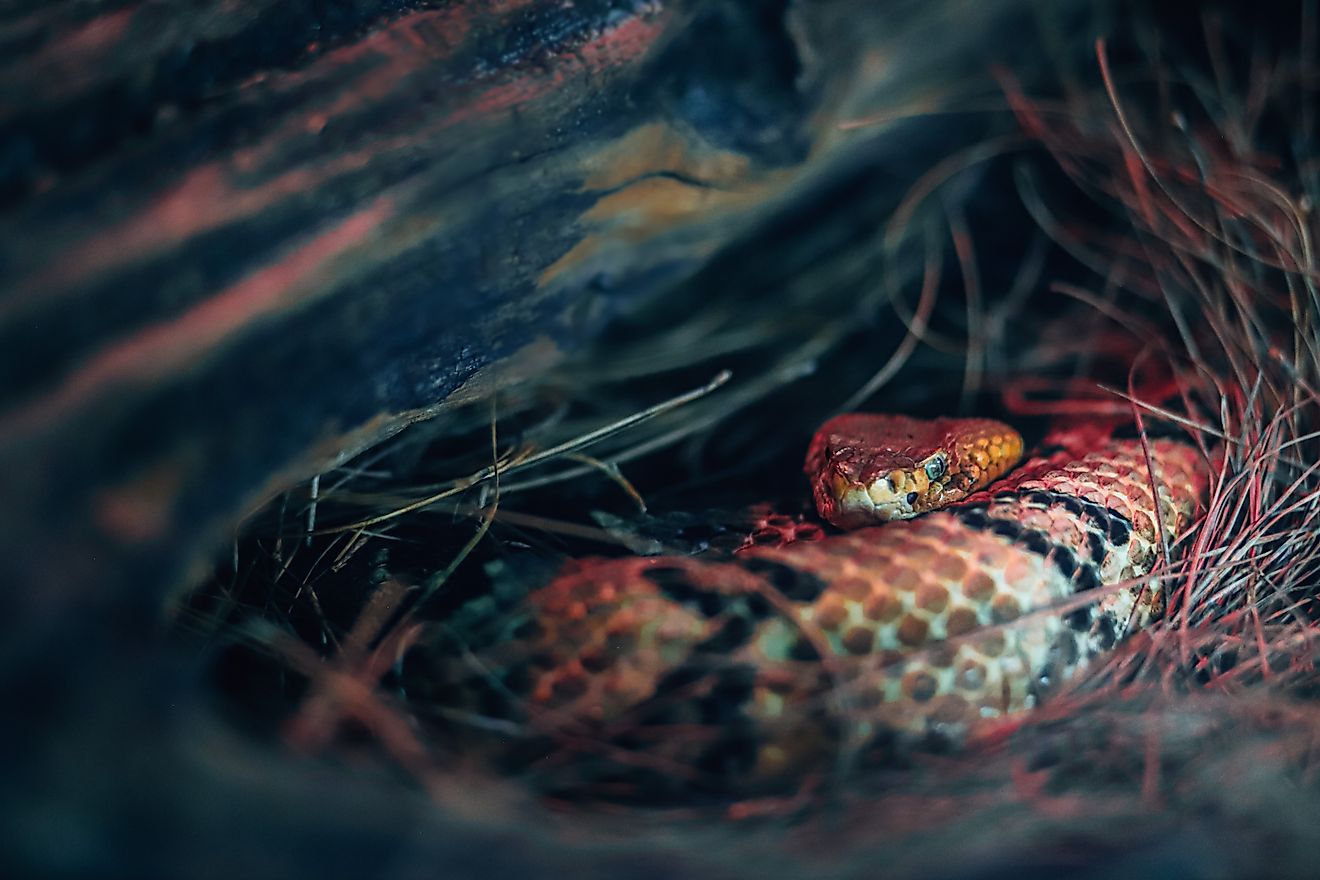
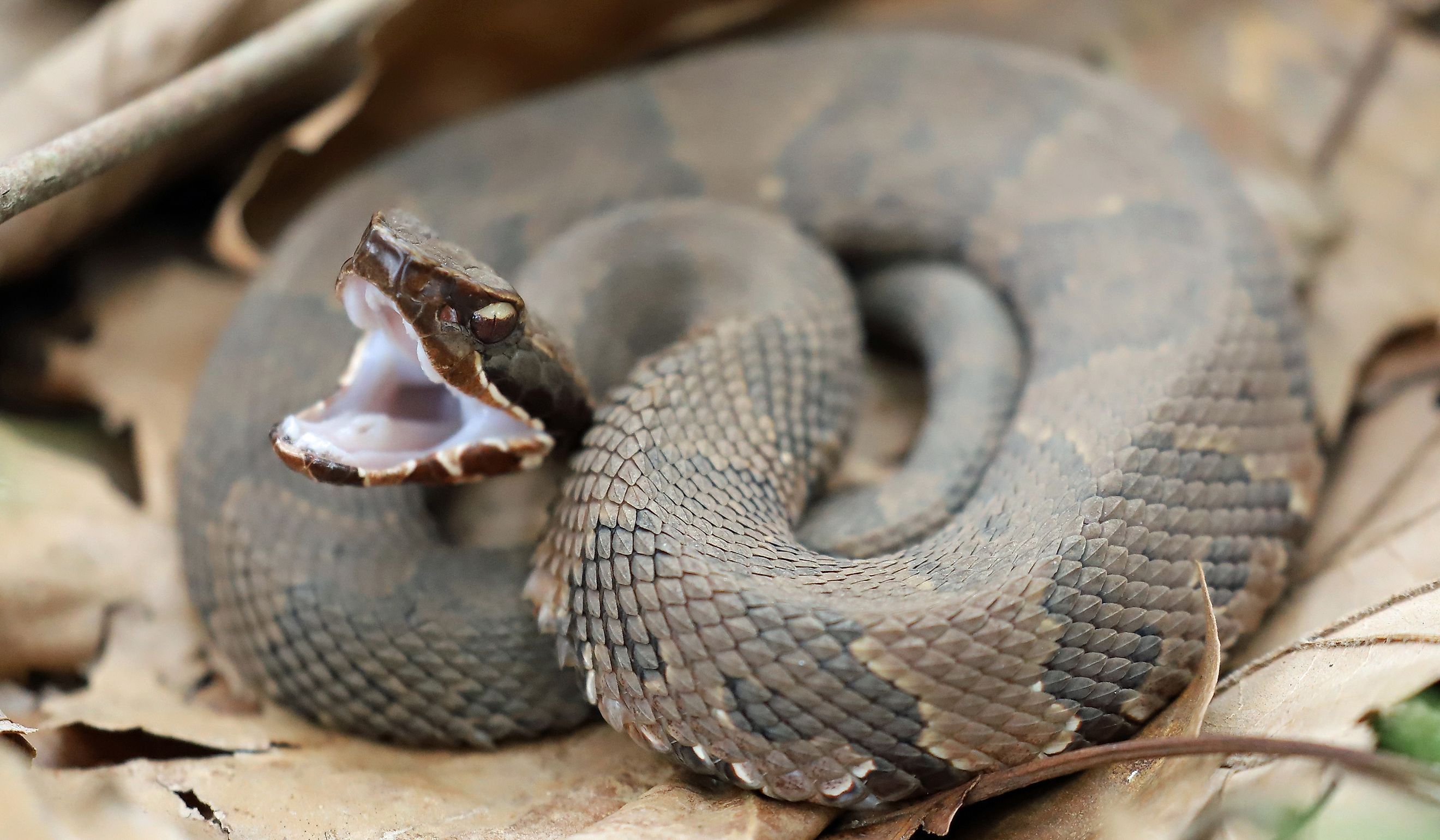
Most snakes people call water moccasins on the western edge aren't actually cottonmouths. Nonvenomous watersnakes in the genus Nerodia, particularly the diamondback watersnake, are widespread across Texas. They occur even in the arid western regions and the Panhandle, where cottonmouths are absent. Wherever these snakes swim, they pick up the same folk name. Every year, many harmless snakes are killed just for being wet, dark, and thick-bodied. It's worth learning how to tell them apart. Cottonmouths swim high in the water, with their whole body on the surface and their head and neck raised. Watersnakes swim mostly underwater, showing only their head. Cottonmouths have a blocky head, a heat-sensing pit between the eye and nostril, a vertical pupil, and a single row of scales under the tail. Watersnakes have round pupils, no facial pit, a double row of scales, and vertical bars on their lips. As for their reputation, studies where researchers approached or even stood on wild cottonmouths found the snakes were much more likely to open their white mouths and back away than to strike. Despite its fearsome reputation as the "swamp lion," the animal is generally reclusive, and research supports the view that it avoids confrontation with people.
Standing In Its Country

The safest response to a watersnake is to leave it alone. Most will retreat if given space, while attempts to kill or handle them create unnecessary opportunities for a bite. Nearly half of venomous snakebites affect the foot or lower leg, and about a quarter involve people who were not wearing shoes. Boots and long trousers offer added protection when walking through wet vegetation, while extra care around fallen logs, undercut banks and shallow water can prevent accidental encounters.
If a bite occurs, remain calm, keep the affected limb still and seek emergency medical care immediately. Remove rings, watches and other tight items before swelling develops. Do not cut the wound, attempt to remove venom by suction, apply ice or use a tourniquet. These measures can cause further injury and delay proper treatment. Knowing how to distinguish watersnakes from cottonmouths is equally important, particularly in areas where their ranges overlap. Both are best observed from a distance. Understanding where these snakes live, how to recognize them and how to avoid disturbing them is far more useful than trying to confront one.
What The Edge Comes Down To
The western limit of the cottonmouth's range is shaped less by geography than by its dependence on permanent water. In Texas, the boundary follows the Balcones Escarpment before becoming less distinct farther north through Oklahoma and Missouri. Reports from Kansas remain particularly sparse, resting on just two specimens collected in 1991. Confusion over the snake's name and changing scientific classifications have added to the uncertainty, allowing reports of cottonmouths to persist well beyond their documented range. Knowing where the species actually occurs, how to distinguish it from harmless watersnakes and why it depends on reliable water sources helps clear up that confusion. It also serves a more practical purpose. A snake mistaken for a cottonmouth is often killed unnecessarily, even when it poses no threat.