Where Black Bears And Grizzlies Overlap In The US
Anyone who spends a summer on western trails will probably meet a black bear, because Ursus americanus lives in roughly 40 states, but only a short list of American places requires a hiker to decide which of two bear species has just stepped onto the path ahead. Black bears and grizzlies share ground across most of mainland Alaska, and in the lower 48 states they share it only in parts of Montana, Wyoming, Idaho, and Washington, where the Interagency Grizzly Bear Committee counts roughly 2,200 grizzlies against black bear numbers in the tens of thousands. The distinction matters for reasons beyond field-guide pride, because the two species tend to hurt people for different reasons, and the response that works best against one can make an encounter with the other worse.
How The Overlap Shrank

Settlers, bounty hunters, and stockmen shaped today's grizzly bear range, mostly by force. Grizzlies once lived from the Pacific coast across the Great Plains and down into Mexico. The Lewis and Clark expedition saw them often along the upper Missouri River. On May 11, 1805, Meriwether Lewis wrote in his journal that he did not like the animals and would rather face almost any other challenge. Three days later, six hunters from the expedition shot repeatedly at a single grizzly. The bear chased two men into the Missouri River before the group finally killed it.
After the Civil War, ranchers brought large herds of cattle and sheep west, and by the 1920s, they and the hunters they hired had wiped out grizzlies across most of the West. In California, people shot the last known wild grizzly in Tulare County in 1922, and the last credible sighting was in 1924. This left California with a grizzly on its state flag, adopted in 1911, but none left in the Sierra Nevada. When the U.S. Fish and Wildlife Service listed grizzlies in the lower 48 states as threatened in 1975, the bears survived in only about 2 percent of their former range. Black bears, which are smaller, more tolerant of people, and live in forests across most of the continent, including Florida and Maine, survived in many more places. Today, the areas where grizzlies and black bears overlap show the few refuges where grizzlies survived, along with the places they have returned to since then.
The Greater Yellowstone Ecosystem

Frank and John Craighead, twin brothers and wildlife biologists, started studying the grizzlies of Yellowstone National Park in 1959 and were among the first to use radio collars on them. Back then, hundreds of bears ate from open garbage dumps in the park. When the National Park Service closed these dumps between 1968 and 1971, despite the Craigheads' advice to do it gradually, the bears moved into campgrounds and nearby towns. Over the next several years, more than 200 grizzlies were killed by people in the area. For decades, the Park Service had taught bears to associate people with food, so suddenly taking that food away led to problems that could have been expected.
In the early 1980s, biologists estimated there were about 250 grizzly bears. By 2024, the Interagency Grizzly Bear Study Team put the number at 1,050, the highest ever recorded. With more bears, there have been more encounters with people. In 2025, the study team recorded 72 grizzly deaths in the area, tying the annual record. People were responsible for 50 of these deaths, mostly through management actions, car accidents, and self-defense. Grizzlies now live well beyond the official monitoring area, and in 2025, Montana Fish, Wildlife and Parks handled 106 incidents with grizzlies or black bears in Carbon County alone.
On May 4, 2026, a female grizzly with cubs attacked two brothers, one a teenager and the other 28 years old, on the Mystic Falls Trail near Old Faithful. Both were flown by helicopter to a hospital in Idaho Falls and survived after surgery. This was the park's first bear attack since September 2025, when a bear injured a 29-year-old man on the Turbid Lake Trail. The last time a grizzly killed someone in the park was in 2015 near Lake Village. Outside the park, the situation has been worse. In July 2023, a grizzly killed a woman on a trail near West Yellowstone in what investigators called a surprise encounter.
Glacier National Park And The Northern Continental Divide

Montana's Northern Continental Divide Ecosystem has the largest grizzly population in the lower 48 states. This area includes Glacier National Park, the Bob Marshall Wilderness, and parts of the Blackfeet and Flathead reservations. Federal biologists estimated there were 1,163 grizzlies in this region in 2023. In 2022, researchers found that these bears covered 21,487 square miles, which is more than double their range from the early 1980s. Federal models show that the edge of this range is only 61 miles from the Yellowstone grizzly population, a distance a young male grizzly can easily travel. Black bears also live throughout this area, so hikers in Glacier might see either species on the same trail.
Montana saw several close calls with bears in 2025. On May 21, a female grizzly with her yearling charged two landowners picking mushrooms about a mile north of Choteau, on the prairie side of the Rocky Mountain Front. On June 3 and July 10, men near Condon and Kalispell shot grizzlies that charged after the bears raided livestock pens and a chicken coop. Many of these incidents started with a coop, a bird feeder, or an unfenced garbage can. People who left these attractants out often ended up with bear problems, whether they realized it or not.
The Small Populations And The Empty Zones

Two smaller grizzly populations live along the Canadian border in the northwest. Biologists estimated 60 to 65 grizzlies in the Cabinet-Yaak Ecosystem of northwest Montana and the Idaho Panhandle in 2024, and 80 to 90 in the Selkirk Mountains of northern Idaho and northeastern Washington, a count that includes bears on the British Columbia side of the line.
The Bitterroot Ecosystem in central Idaho and western Montana is a federal recovery zone, but there are almost no grizzlies there. The first confirmed grizzly in decades appeared in September 2007, when a black bear hunter in the Kelly Creek area of the Clearwater National Forest shot it after mistaking it for a black bear.
The last confirmed sighting of a grizzly on the American side of Washington's North Cascades was in 1996, but black bears are still common there. On April 25, 2024, the National Park Service and the Fish and Wildlife Service agreed to bring grizzlies back to the area. However, by August 2025, park officials said they did not have a timeline for moving the bears, and a Washington congressman tried to block the funding. For now, hikers in the North Cascades are likely to see black bears, but almost no grizzlies.
Alaska

In Alaska, bear habitats often overlap. The Alaska Department of Fish and Game estimates there are about 30,000 brown bears and 100,000 black bears in the state, and both species share most of the forested mainland. People in Alaska usually call the coastal bears brown bears and the ones living inland grizzlies, but biologists consider them the same species, Ursus arctos. This is the same bear you might see fishing at Katmai National Park. Black bears stick to the forests, so only brown bears are found on the open tundra of the North Slope and much of western Alaska.
One of the strangest patterns appears in Southeast Alaska. Admiralty, Baranof, and Chichagof islands have only brown bears, while Prince of Wales, Kuiu, and Mitkof islands have only black bears. Biologists are still debating why this happened, but most think it has to do with which species arrived first after the last ice age and how they competed with each other. The bears ended up dividing the islands more neatly than any land office ever sorted homestead claims. Kodiak and the nearby islands are home only to brown bears.
Alaska and Canada also account for most fatal black bear attacks. Stephen Herrero and his colleagues found that 49 of the 63 deaths from black bear attacks recorded across North America between 1900 and 2009 occurred in Canada and Alaska, where the bears have less contact with people and, the authors suggested, face more periods of food stress.
Telling The Two Apart

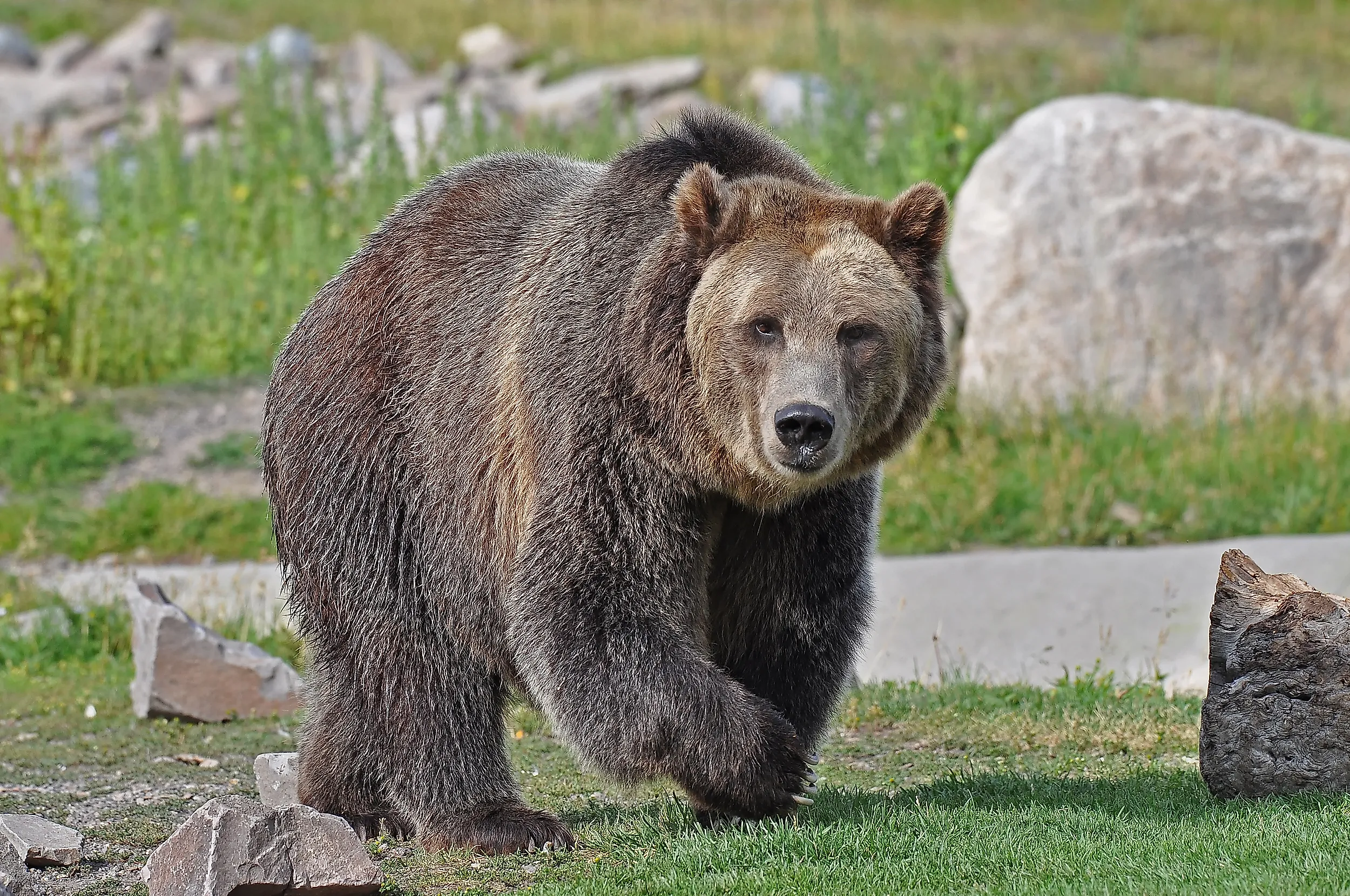
Color is not a good way for hikers to tell bears apart, since many western black bears can be brown, cinnamon, or blond, and some grizzlies can look almost black. Instead, look for the grizzly's muscular shoulder hump, a face that curves inward, short rounded ears, and long pale front claws that are usually 2 to 4 inches long. Black bears have a straight face, taller pointed ears, a rump higher than their shoulders, and short curved claws that help them climb trees. In Montana, every black bear hunter must pass a bear identification test before getting a license. The state made this rule because hunters often made mistakes.
Staying Safe Where Both Species Live

Stephen Herrero, a biologist at the University of Calgary, spent his career studying bear attacks. In his book Bear Attacks, first published in 1985 and updated in 2002, he found that most serious grizzly injuries happen after a surprise encounter at close range, often when a female is protecting her cubs. In contrast, his 2011 study on fatal black bear attacks showed that 88 percent involved a bear acting as a predator, and 92 percent of those were males. A 2019 global review of brown bear attacks by Giulia Bombieri and her team found similar results to Herrero's work. Many incidents involved surprised bears or females with young, and most happened during hikes or other outdoor activities.
Bear spray remains the first line of defense for both species. Tom Smith, Herrero, and two coauthors reviewed Alaskan spray incidents. They found that the spray stopped unwanted bear behavior in 92 percent of brown bear encounters and 90 percent of black bear encounters. Almost everyone who used it was not injured. If you're hiking in bear country, keep your spray on a belt or chest harness, travel in groups of at least three, make noise near streams and thick brush, store food in bear-proof containers, and stay at least 100 yards from any bear in Yellowstone, as the park requires. Never run from a bear. Many hikers carry bear spray all summer, but some keep it at the bottom of their pack, which is about as useful as leaving it in the car.

How you respond to a bear attack depends on the type of bear. If a grizzly attacks after a surprise encounter, the National Park Service says to lie flat on your stomach, lace your hands behind your neck, spread your legs, and stay still until the bear leaves. If a black bear attacks, you should do the opposite and fight back with your fists, rocks, or anything you can use. If any bear stalks you, follows you for a long time, or breaks into your tent at night, you should always fight back, no matter the species.
Grizzlies are expanding their range a bit more each year. In 2023, wildlife officials confirmed a grizzly sighting in the Pryor Mountains. In 2024, they removed a grizzly that attacked livestock in the southern Bighorn Mountains of Wyoming. In 2025, a man shot a grizzly in self-defense in Montana's Bears Paw Mountains. These are all places where grizzlies hadn't been seen for over a century. If you're visiting the northern Rockies and only prepare for one type of bear, you're not ready for today's reality. The national forests with the most black bears and the grizzly strongholds near Yellowstone and Glacier are now closer together than they've been since the bears were first listed.
Preparing For Both Bears
For most Americans, a bear encountered on the trail will be a black bear, while hikers in Alaska and parts of Montana, Wyoming, Idaho, and Washington may need to account for both species. That overlap is expanding as grizzlies return to areas they disappeared from more than a century ago, making it increasingly important for hikers in the northern Rockies to know which bear they might encounter. Before heading out, learn which species occur in your destination and how to recognize differences in the hump, face, and claws, and keep bear spray within easy reach where it is legal and appropriate. Most encounters in areas where people and bears share habitat end without injury, and preparing before reaching the trailhead can help keep it that way.