What Animals Live In The Amazon Rainforest?
The Amazon rainforest remains one of Earth's final sanctuaries for rare wildlife such as jaguars, harpy eagles, and pink river dolphins, and serves as a habitat for diverse creatures including sloths, black spider monkeys, and poison dart frogs.
Remarkably, the Amazon hosts approximately 10% of all known species worldwide, encompassing 40,000 plant species, around 3,000 freshwater fish species, and over 370 reptile species. Since 1999, scientists have identified more than 2,000 new plant and vertebrate species, among them a unique monkey known for its cat-like purr. The current model shows that the Amazon Rainforest is home to 427 mammal species, 1,300 bird species, 378 species of reptiles, and more than 400 species of amphibians. The following is a list of some of the most iconic and curious creatures one can find in the Amazon.

The estimated land area of the Amazon rainforest is 2.1 million square miles, drained by the Amazon River and covering around 40% of South America across eight countries, Brazil, Colombia, Peru, Venezuela, Ecuador, Bolivia, Guyana, and Suriname, plus the French overseas territory of French Guiana.
Jaguar

The jaguar's preternatural beauty and affiliated terror cause admirers and prey to freeze in their tracks. The stand-out spots are similar to the leopards of Africa and Asia, but a small dot in the center is the key point of differentiation. The jaguar (Panthera onca) is the biggest cat in the Americas and the third biggest in the world (behind lions and tigers). These magnificent carnivores are solitary but effective night hunters, both on land and water. They have even been known to attack caimans. Jaguars are classified as "Near Threatened" (NT) on the International Union for Conservation of Nature's Red List. Since the 1880s, they have lost nearly half of their territory, now mostly relying on the Amazon Basin and some parts of Central America. They also face threats from poachers and retaliatory killings by cattle ranchers.
Sloth

These loveable slow-pokes also mostly keep to the rainforest canopy. They tend to sleep between 15 to 20 hours a day, and when it is time to feed, they cover a whopping 40 yards, collecting leaves, twigs, and buds along the way. Despite their morose movements, sloths always seem to have a smile on their face. They even enjoy a leisurely swim from time to time, putting those long, tree-hanging arms to secondary use. There are two different types of sloths, two-toed and three-toed, and six species (all of which are found within the tropical rain forests of Central and South America). Of these, the pygmy three-toed sloth (Bradypus pygmaeus), is listed as "Critically Endangered" (CR), and the maned sloth (Bradypus torquatus) is classified as "Vulnerable" (VU).
Pink Amazon River Dolphin

The Amazon River Dolphin (Inia geoffrensis) is also known as the Pink River Dolphin for its pretty hue. This freshwater mammal is found throughout the Amazon and Orinoco river basins. These cute and curious creatures can grow up to 9.2 feet and weigh upwards of 352 pounds. Once considered relatively secure, the species has been listed as "Endangered" (EN) on the IUCN Red List since 2018, as dams fragment its populations and the contamination of waterways takes its toll, particularly mercury pollution from gold mining in Bolivia.
Macaw

These brightly-colored birds belong to the parrot family (Psittacidae). Their plumage is well-matched to their habitat of green trees, tasty fruits, and pretty flowers. Macaws are omnivorous, using their beaks to crack nuts and seeds and their tongues, which are specially designed with an interior bone, to tap into nutritious fruits. They also use their gripping toes to catch insects and snails. These birds are intelligent and highly vocal. They typically congregate in flocks of 10 to 30, calling out loudly to communicate. Famously, some species are known to mimic human speech. There are 17 documented species of macaws. The red-fronted and blue-throated species are seriously at risk, while the glaucous macaw is possibly extinct in the wild, and the Spix's macaw vanished from the wild entirely before a reintroduction program began returning captive-bred birds to Brazil in 2022. Pressures on the macaw relate to habitat destruction and their popularity as pets, which causes them to be captured and traded illegally.
Poison Dart Frog

The poison dart frog (family Dendrobatidae) is another particularly colorful creature on this list. The intricate patterns on their bodies further enhance their beauty. These overt displays are an evolutionary tactic to warn off potential predators (a phenomenon called aposematic coloration). As the name would suggest, poison dart frogs are toxic and, in some cases, exceptionally so. The hunters of the indigenous Emberá people of Colombia capitalized on this fact by applying the poison to the tip of their blowgun darts. Interestingly, poison dart frogs raised in captivity never develop their poison, which suggests that it is something they have to acquire, through alkaloids assimilated from the ants, termites, and beetles that make up part of their carnivorous diet.
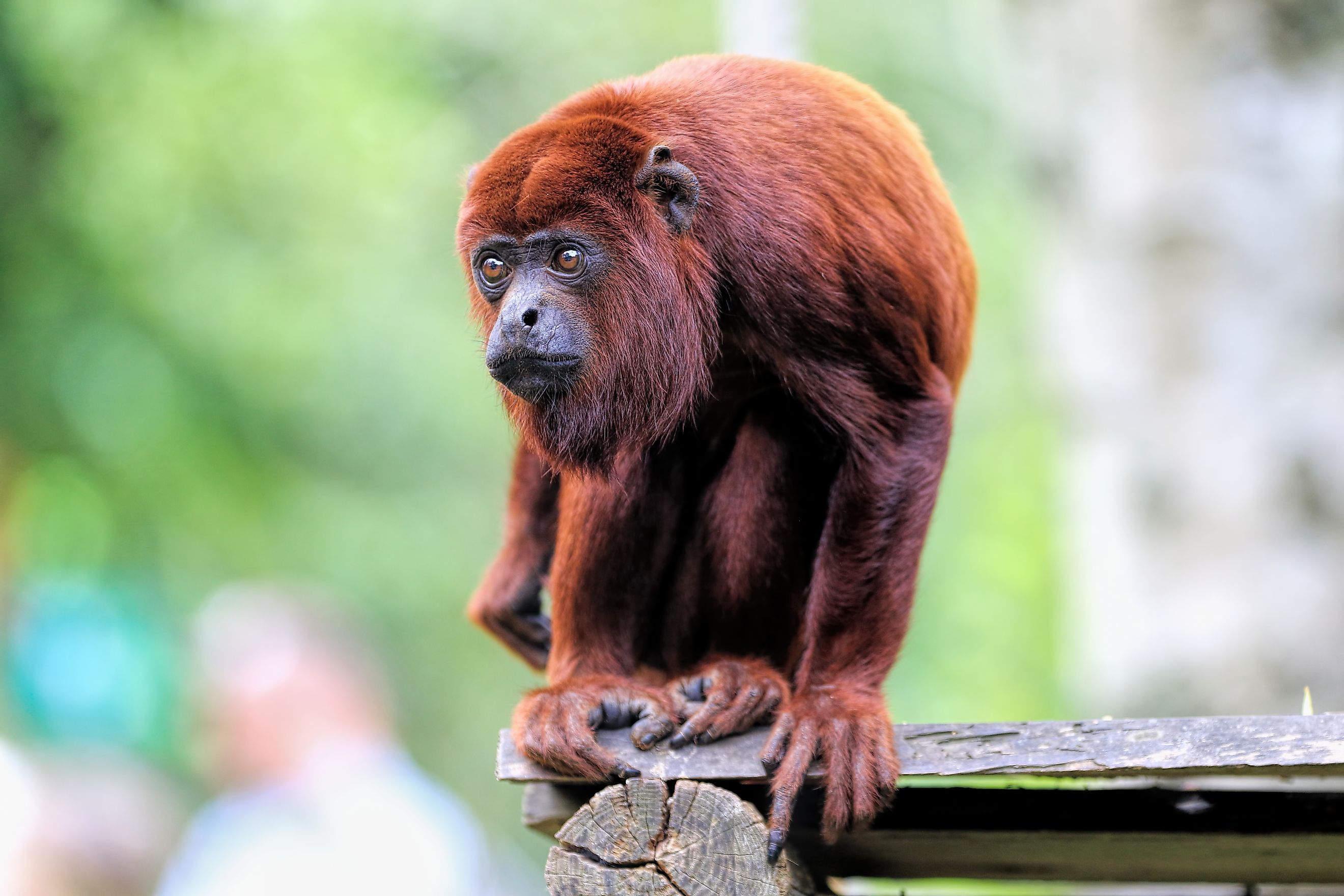
Red Howler Monkey

You can hear this guy's ominous call from a mile away, 3 miles away, actually. Those brave enough to seek the source of the demonic wail will spot the large canopy-dwellers by their dark red fur and swollen throats (owing to an enlarged hyoid bone at the base of the tongue). The males are larger and have darker beards. Red howlers (Alouatta seniculus) assume the role of rainforest roosters, waking up the jungle bright and early. They do this again before going to bed, in both cases, as a signal to males in other groups to define their distinct territories. Though they sound frightening, red howlers predominantly subsist on flowers, leaves, and fruit. The population is declining, but the IUCN Red List still classifies red howlers as "Least Concern" (LC).
Black Caiman

The Black caiman (Melanosuchus niger) is the largest predator in the Amazon Basin. It is also the largest member of the alligator family, typically ranging from 9 to 14 feet, but able to grow as long as 20 feet and often weighing well over 600 pounds. Aside from its impressive size, the Black caiman also differs from the American alligator because of its dark-colored, armored skin (hence the name). This adaptive trait improves the nocturnal hunter's camouflage and may also help absorb heat during the day. If left to their own devices, these alligators can live upwards of 80 years. However, in the past century, this species was reduced by about 99%, mostly due to heavy hunting to produce black leather. Currently, the IUCN Red List classifies the Black caiman as "Least Concern" (LC).
Green Anaconda

Overall, this member of the boa family is the largest snake in the world. Reliably measured individuals approach and occasionally exceed 20 feet, with a diameter of 12 inches, and weigh upwards of 550 pounds, alongside persistent but unverified reports of far larger specimens. The reticulated python can grow slightly longer, but the green anaconda (Eunectes murinus), which some researchers now propose splitting into two species, is still nearly twice as heavy. They reach these astounding girths through a diet of wild pigs, deer, birds, capybaras, even caimans, and, on rare occasions, jaguars. These non-venomous snakes constrict and asphyxiate their prey before swallowing it whole. After a big meal, anacondas can go months without food. Because of their size, anacondas are slow-moving on land but surprisingly mobile in the water. They mainly live in the Amazon and Orinoco basins, though exact population data and status of the species are unknown.
Giant Monkey Frog

The giant monkey frog (Phyllomedusa bicolor), also known as the bicolored tree frog, derives its name from its bright green backside and cream-colored belly and its unusual, monkey-like way of moving: rather than hopping, it walks and clambers hand over hand through the branches, using its large body to bridge the gaps. Acaté is yet another name given to this frog by the Matsés tribes of the Amazon Rainforest (between Peru and Brazil). The Matsés shamans use the frog's secretions in hunting rituals and as a way to transmit knowledge through the mind-altering medium. The frogs use this waxy coating to protect themselves from the sun. The secretion contains peptides reported to be about 40 times more potent than traditional morphine, which has drawn the attention of painkiller researchers.
Harpy Eagle

The Harpy eagle (Harpia harpyja) is one of the largest eagles in the world and easily the largest and most dominant raptor in the Amazon rainforest. This carnivorous predator has a wingspan of 69 to 88 inches, the largest talons of any living eagle, the ability to lift prey equal to their body weight (9 to 20 pounds), and can reach a top speed of 50 miles per hour. It uses these tools to hunt a wide array of animals, including sloths, monkeys, porcupines, squirrels, anteaters, iguanas, snakes, and other birds (and their eggs), such as the macaw, and many more. Harpy eagles have a vast territory, spanning from Mexico down to Argentina, but their numbers are declining, and the IUCN uplisted the species to "Vulnerable" (VU) in 2021.
Capybara

The capybara (Hydrochoerus hydrochaeris) is the largest rodent in the world, a barrel-shaped grazer that can weigh up to 150 pounds, and it is built for the Amazon's water margins: its eyes, ears, and nostrils sit high on its head so it can submerge almost entirely, and its partially webbed feet make it a strong swimmer. Capybaras live in social groups of 10 to 20, grazing on grasses and aquatic plants along riverbanks and wetlands throughout the basin.
That placid lifestyle comes at a price, because nearly every large predator in this article eats capybara: jaguars ambush them on land, green anacondas take them at the water's edge, black caimans pull them under, and harpy eagles carry off the young. Despite serving as the rainforest's most dependable entree, the species breeds quickly enough that the IUCN lists it as "Least Concern" (LC).
Black Spider Monkey

The red-faced spider monkey (Ateles paniscus), native to northern South America's rainforests, is identified by its black fur, red or pink face, and long prehensile tail. Slight sexual dimorphism exists, with males slightly larger than females. This species lives in large social groups exhibiting a fission-fusion structure and consumes an omnivorous diet, including fruits, insects, and vegetation. Found primarily in undisturbed rainforest canopies, the species faces threats from habitat destruction and hunting. Classified as Vulnerable by the IUCN, it benefits from protected habitats across its range. In captivity, these monkeys can live up to 33 years and mature slowly.
A Menagerie Worth Keeping
The Amazon Rainforest naturally creates adoration and yet requires great attention and care. It is gigantic but dwindling, bafflingly biodiverse, but an untold number of species are regularly going extinct. Let us appreciate these magnificent animals while they are here and do what we can to preserve them.