Where Snow Geese Gather In The Winter
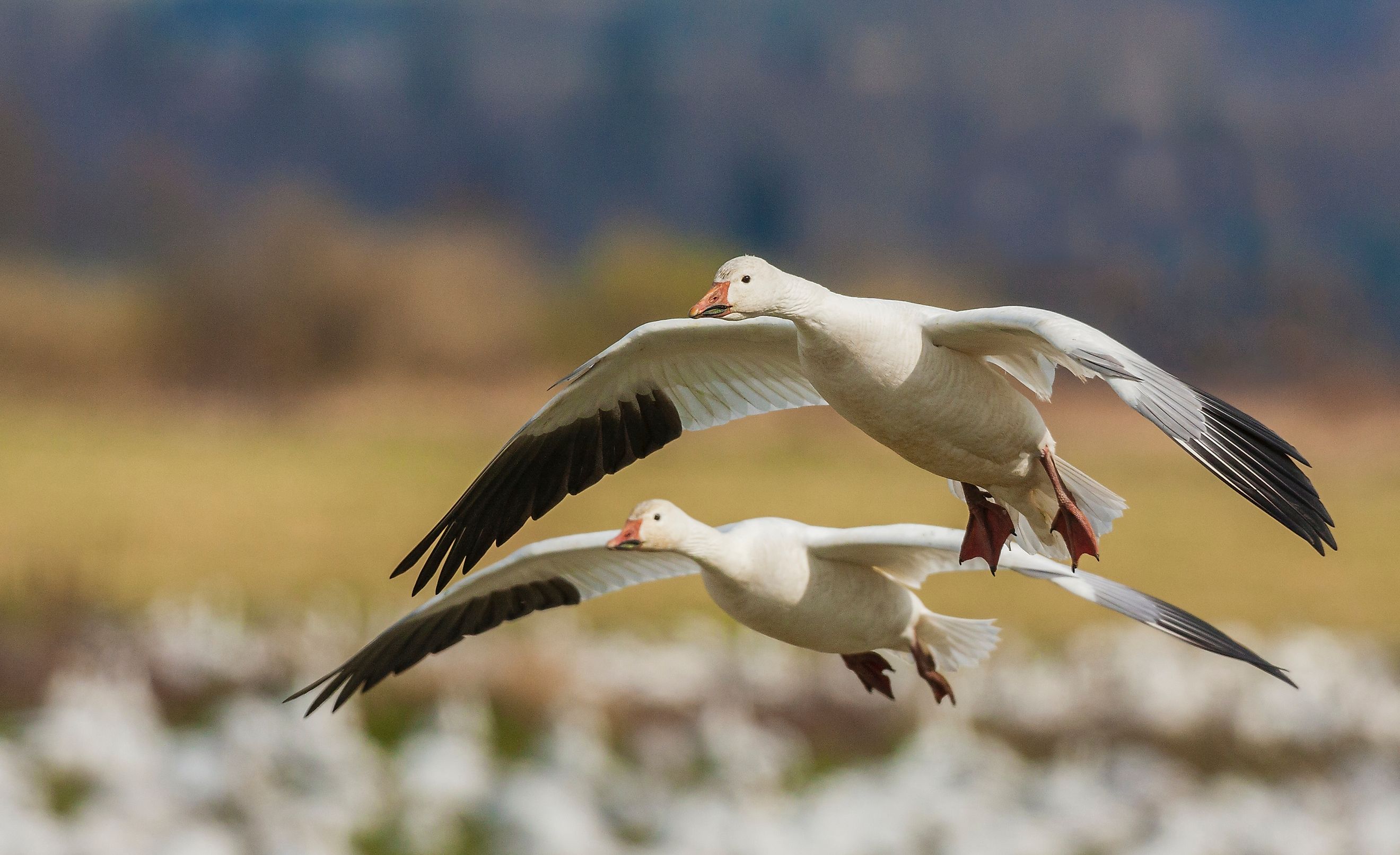
Snow geese spend their summers in the high Arctic, nesting in scattered colonies on Wrangel Island off Russia, across the tundra of northern Canada and Alaska, and along the northwest edge of Greenland. When the brief Arctic summer is over, almost the entire species heads south to just a few crowded wintering spots, most of them in North America. So a bird that nests in four countries spends the winter mostly in one.
The flocks don't spread out evenly. Snow geese gather in a few favorite basins and coastlines, sometimes in groups of tens or even hundreds of thousands. This makes them some of the most abundant waterfowl in the world, but also some of the least often seen by people living nearby. To find out where they end up in January, it helps to look at how biologists first mapped their migration routes.
The Map That Four Flyways Drew

In 1935, ornithologist Frederick C. Lincoln published a short federal circular called The Waterfowl Flyways of North America. He divided the continent's duck and goose migration into four broad lanes running north to south: the Atlantic, the Mississippi, the Central, and the Pacific. During the 1920s, Lincoln built the national bird-banding program. The records from banded birds found far from where they were tagged showed that waterfowl stick to their traditional routes with impressive loyalty. In 1947, the United States Fish and Wildlife Service made these four flyways official administrative units. In the mid-1960s, Frank C. Bellrose from the Illinois Natural History Survey used radar and aerial surveys to refine the flyways into narrower corridors. Snow geese use all four flyways, and each regional group returns to about the same wintering areas every year. Today's map of where the birds gather is basically Lincoln's map, now updated with goose population numbers.
The Central And Mississippi Flyways, Where The Millions Go

Most snow geese, specifically the lesser snow goose of the midcontinent, spend the winter in the middle of North America, across the central states, the Gulf coast, and the high plains of northern Mexico. Their route south follows the broad valley of the Mississippi River and the plains to its west. In Texas and Louisiana, these birds used to feed almost only in coastal marshes, but now they gather in rice prairies, eating leftover grain from harvested fields all winter. West along the Rio Grande in New Mexico, the Bosque del Apache National Wildlife Refuge, which was established in 1939, usually hosts thirty to fifty thousand snow geese on its managed ponds each year. Photographers come to the refuge to witness the pre-dawn blast-off, when an entire flock suddenly lifts off the water together. This impressive sight often starts with something as simple as a coyote walking on the dike or a sudden gust of wind.
The Atlantic Coast And The Greater Snow Goose

Along the eastern seaboard, a second and larger subspecies, the greater snow goose, spends the winter on the salt marshes and farm fields of the mid-Atlantic. The biggest flocks gather on the bays near Delaware and the Chesapeake, with their winter range taking in the New Jersey coast and reaching south to North Carolina. This group is a single population with a rare, detailed written record, since every spring and fall, all the greater snow geese pass through one part of the St. Lawrence estuary in Canada. In the early 1900s, market hunting and habitat loss reduced their numbers to about three thousand birds. The tidal bulrush marsh at Cap Tourmente, just downstream from Quebec City, became their crucial stopover and was protected as a national wildlife area by the Canadian government on April 28, 1978. Biologists counted fewer than 50,000 greater snow geese in the late 1960s, about 700,000 by the late 1990s, and close to a million in recent years. The birds dig up the starchy roots of American bulrush from the mud to get the energy they need for the last stretch north, and by the time they reach the Arctic, most have stopped at this one marsh.
The Pacific Flyway And The Geese From Wrangel Island

Some of the westernmost snow geese spend part of their lives in another country. The lesser snow geese that nest on Wrangel Island, home to Asia's last major snow goose colony, cross the Bering Sea and travel down the Pacific coast each autumn to two main wintering areas. One is the Fraser and Skagit river deltas, along the border between British Columbia and Washington. The other is California's Central Valley, roughly a thousand kilometers farther south. Russia made Wrangel Island a nature preserve in 1976, when the colony had dropped to around 50,000 birds. Recent counts show it now has about 300,000.
The places where these birds spend the winter have changed in recent decades. In the 1960s, most of the Wrangel flock flew past the Skagit and continued on to California. Later in the twentieth century, habitat restoration along the Skagit, carried out mainly to benefit other waterfowl, also made the delta far more suitable for snow geese than anyone had anticipated. Since 2000, surveys have always found at least 50,000 geese wintering there, compared to earlier numbers that ranged from about 20,000 to 50,000. Sean Boyd, a wildlife biologist who has studied the Fraser-Skagit birds for thirty years, estimates there are now about 200,000, with more than half of the Wrangel population staying in the Salish Sea region instead of heading to California. If this was a mistake, it was a generous one.
The Cost Of Abundance

Not every story about a recovered species is reassuring. The midcontinent lesser snow goose population grew rapidly in the late twentieth century, thanks to an almost endless supply of waste grain from industrial farms during migration and winter. By the 1990s, these flocks were stripping their Arctic and subarctic breeding marshes faster than the plants could regrow in the short season. A thorough study by the Arctic Goose Habitat Working Group, led by waterfowl biologist Bruce Batt in 1997, warned that the birds were turning productive coastal tundra into bare mudflats and pushing out other nesting species. In response, the United States created the Light Goose Conservation Order in 1999. This measure lifted the usual limits on snow goose hunting, allowed electronic calls and unplugged shotguns, and opened a long spring season to reduce the adult population. Since then, hunters have taken more than half a million light geese each year.
The order was based on a population estimate that later proved seriously inaccurate. When the program began in 1999, biologists had underestimated the midcontinent flock by at least five million birds, a substantial error for a management plan built around population numbers. The tundra damage ended up being less severe than the worst predictions. In another twist, the midcontinent population has dropped sharply over the past decade. Ducks Unlimited reported that lesser snow and Ross's goose numbers were at their lowest in thirty years in the mid-2020s, and federal surveys put the midcontinent index down about twelve percent in 2025 from the year before. It's unclear if this is a lasting change or just a normal fluctuation, and the biologists who track these flocks aren't ready to say yet.
For anyone who wants to watch them, the patterns of the flyways still hold true. Greater snow geese fill the mid-Atlantic bays and the St. Lawrence marshes. The midcontinent flocks settle across the Gulf rice fields and the Rio Grande refuges. Wrangel birds gather in the Skagit and the Central Valley. Each flock returns to the same basin their ancestors used. The best time to see them is from late autumn through February, before they head north to the tundra.
A Map People Keep Redrawing
The snow goose's migration patterns reflect a long history of adaptation to both natural conditions and human activity. Generations of birds have followed established flyways, while habitat projects, protected wintering grounds and the expansion of industrial agriculture have changed where they feed and gather. The work of Frederick C. Lincoln in mapping the flyways in 1935 helped establish a clearer picture of their movements, but later developments continued to reshape the landscape along those routes. Today, the midcontinent flock is considerably smaller than it was at its peak, although it remains uncertain whether the decline of the 2020s will continue. The birds still return to the same handful of wintering basins each year, even as the numbers using each one rise and fall. How those populations fare in the coming decades will depend not only on their ability to adapt, but also on how people manage the habitats they rely on.