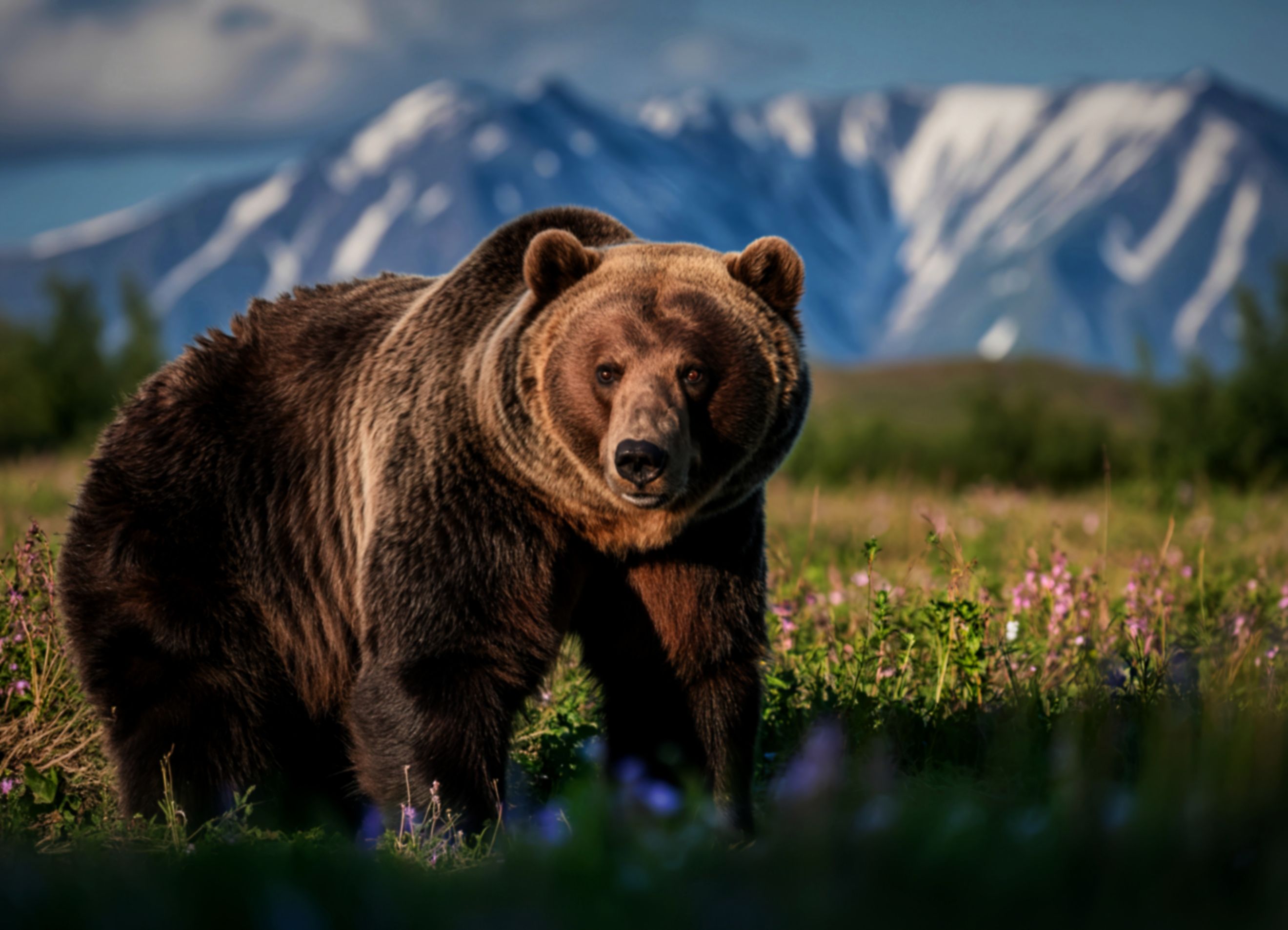
How Far Grizzlies Have Spread Beyond Yellowstone
Grizzly bears used to roam much of the western United States, the Great Plains, and the mountains of Mexico. Around 1800, there were about 50,000 grizzlies in the Lower 48. By 1975, when the federal government listed them as threatened under the Endangered Species Act, only about 136 remained near Yellowstone, and the species occupied just two percent of its original range. The bears returning to these areas today are why this story is still unfolding.
The grizzly is a subspecies of the brown bear, Ursus arctos horribilis, and is related to brown bears found in northern Europe and Asia. Its main stronghold in the lower 48 states is in and around Yellowstone, where Wyoming, Montana, and Idaho meet. Over the past fifty years, this population has grown, rising from a few hundred bears to an estimated 1,055 in 2025, according to Matthew Gould, director of the Interagency Grizzly Bear Study Team. As these bears have moved into valleys, foothills, and farmland, people in all three states have had to adjust to seeing them in new places.
The Map Redrawn In Two Years

In December 2025, the Interagency Grizzly Bear Committee published its first report showing where grizzlies live across the Lower 48 states. Cecily Costello from Montana Fish, Wildlife and Parks, the lead author, found mixed results. Grizzlies regained about four percent more habitat over two years, adding roughly 2,250 square miles overall. However, bears in the Yellowstone area went against this trend. Their range shrank by about four percent and now covers around 26,100 square miles, with almost two thirds in Wyoming. Most of the growth happened farther north, in the Northern Continental Divide population. This group, centered around the Bob Marshall Wilderness and the area between Glacier National Park and Missoula, expanded its range by about 2,500 square miles, nearly a twelve percent increase, to more than 24,000 square miles. Costello explained that when a group of bears moves down a river corridor, the mapping can quickly extend the range line. The way the data is smoothed can also make it seem like bears have reclaimed large areas they have barely entered. This shows that a range map reflects the mapping method as much as the bears themselves.
Why The Yellowstone Bears Stopped Spreading

The shrinking area around Yellowstone did not surprise the scientists who monitor it. About ten years ago, Frank van Manen, who led the study team before Gould, predicted that the Greater Yellowstone bear population would level off as the bears filled all the available habitat. Recent numbers show that this plateau has now been reached. Gould said the area the bears occupy grew, then stayed steady, and now has started to decline a bit. Several factors are putting pressure on the edges. New housing developments have filled valleys where bears once roamed freely. In this part of the country, many western forests have lost their large predators, and bears that wander into ranches or farms usually do not survive. Grizzlies died at a record rate in 2024 and 2025, with about seventy known deaths each year in the ecosystem. Most of these deaths were caused by people, including conflicts with livestock, car accidents, and self-defense shootings. At least nine grizzlies were hit and killed by drivers in 2025, many of them near the roads leading into Yellowstone and Grand Teton. The population near the parks has basically reached the limit of where people are willing to have them.
The Gap Between Two Populations

One of the most closely watched areas in grizzly country is the stretch of open land that separates the Greater Yellowstone bears from the Northern Continental Divide bears to the north. These two groups have not had any natural genetic exchange for at least 100 years, and biologists are concerned that this isolation makes the smaller southern group more vulnerable. Costello's report showed that the gap between the populations shrank from 61 miles to 45 miles in just two years as northern bears moved south and east into the Sapphire Range and the Boulder and Big Belt mountains. Managers decided not to wait for the bears to connect on their own. In 2024, biologists captured a female bear called 1126F and a male called 1129M in the Northern Continental Divide and relocated them to the Greater Yellowstone Ecosystem. This hands-on approach aimed to bring new genetic diversity to a southern population that has been isolated for about a century. It was a solution to a problem that had been building for a hundred years, tackled two bears at a time.
Beyond The Rockies

Grizzlies now live in only a small part of the area they once roamed along the Rocky Mountains. In 1993, a federal recovery plan identified six ecosystems for grizzly recovery, but today, only Greater Yellowstone and the Northern Continental Divide have strong populations. The Bitterroot region along the Idaho-Montana border has not had a breeding population since grizzlies were wiped out there in the 1950s, though bears from the north may eventually move in. Further west, the North Cascades in Washington had no known resident grizzlies for decades, and efforts to reintroduce them began in 2024. The story also includes places where grizzlies are now gone. They once lived throughout California, which still features a grizzly on its state flag, but the last confirmed California grizzly was seen in 1924. Today, about 55,000 grizzlies survive in North America, most of them in Alaska and Canada, showing how few remain in the lower 48 states. There are only a few records of grizzly sightings in the West. For example, a photo taken in the North Cascades in 2010 was thought to show a grizzly, but later review suggested it was actually a black bear.
Sharing The Trail

For people who hike, camp, or hunt in bear country, grizzlies are now showing up in places where only black bears lived a generation ago. It's especially important to tell the two apart where their ranges overlap. In September 2025, a solo hiker in Yellowstone's Pelican Valley was injured by a bear he thought was a black bear. Investigators found a carcass and grizzly tracks nearby and concluded it was probably a grizzly defending food. That was the first bear injury in the park since 2021, and the last fatal one in Yellowstone happened in 2015. The following spring, on May 4, 2026, a female grizzly with two or three cubs injured two hikers northwest of Old Faithful. Farther north in Glacier, a hiker named Anthony Pollio was killed on the Mount Brown Lookout trail on May 3, 2026. The official review found he had used all his bear spray during the attack, a reminder that while bear spray helps, it doesn't guarantee safety.
Research still strongly supports using bear spray. In a 2008 study in the Journal of Wildlife Management, Tom Smith from Brigham Young University and Stephen Herrero from the University of Calgary looked at twenty years of Alaska encounters. They found that bear spray stopped aggressive bears about ninety percent of the time, usually at a distance of around twelve feet, and wind was less of a problem than many hikers thought. Smith's research also flagged a common mistake. People who sprayed their tents and gear to keep bears away actually attracted them, as bears rolled in the residue. Park biologists' advice has stayed the same. Carry bear spray on a belt or chest holster where you can grab it quickly, and practice using it before your trip. Hike in groups, make noise at blind corners and in thick brush, and keep at least 100 yards away from any bear. Store food and anything with a scent where bears can't get to it, and watch for fresh tracks, scat, or torn-up logs that show recent feeding. If you encounter a bear at close range, remain where you are and use bear spray if necessary. Do not run, as this can trigger a chase response. Counties on the edge of bear range are already adapting, especially in states with the most bears. In 2025, Montana wildlife officers handled 106 bear conflicts and complaints in Carbon County alone, a big jump from the year before, in an area that hadn't thought of itself as grizzly country.
What Comes Next
The grizzly bear's recovery from around 136 animals in 1975 to more than a thousand today shows how much conservation efforts can achieve, but its future remains uncertain. Costello's team's December 2025 map points to a population expanding northward while reaching the limits of available habitat in parts of the south. Whether the northern bears eventually connect with the Yellowstone population, and whether grizzlies return to the Bitterroot and North Cascades, will help determine how much further their range can grow. That expansion also brings the species into closer contact with people, making coexistence an increasingly important part of its recovery. For anyone living or traveling through grizzly country, carrying bear spray, making noise on trails, and securing food are simple precautions that can help protect both people and bears.