Why Squirrels Forget Where They Bury Their Nuts
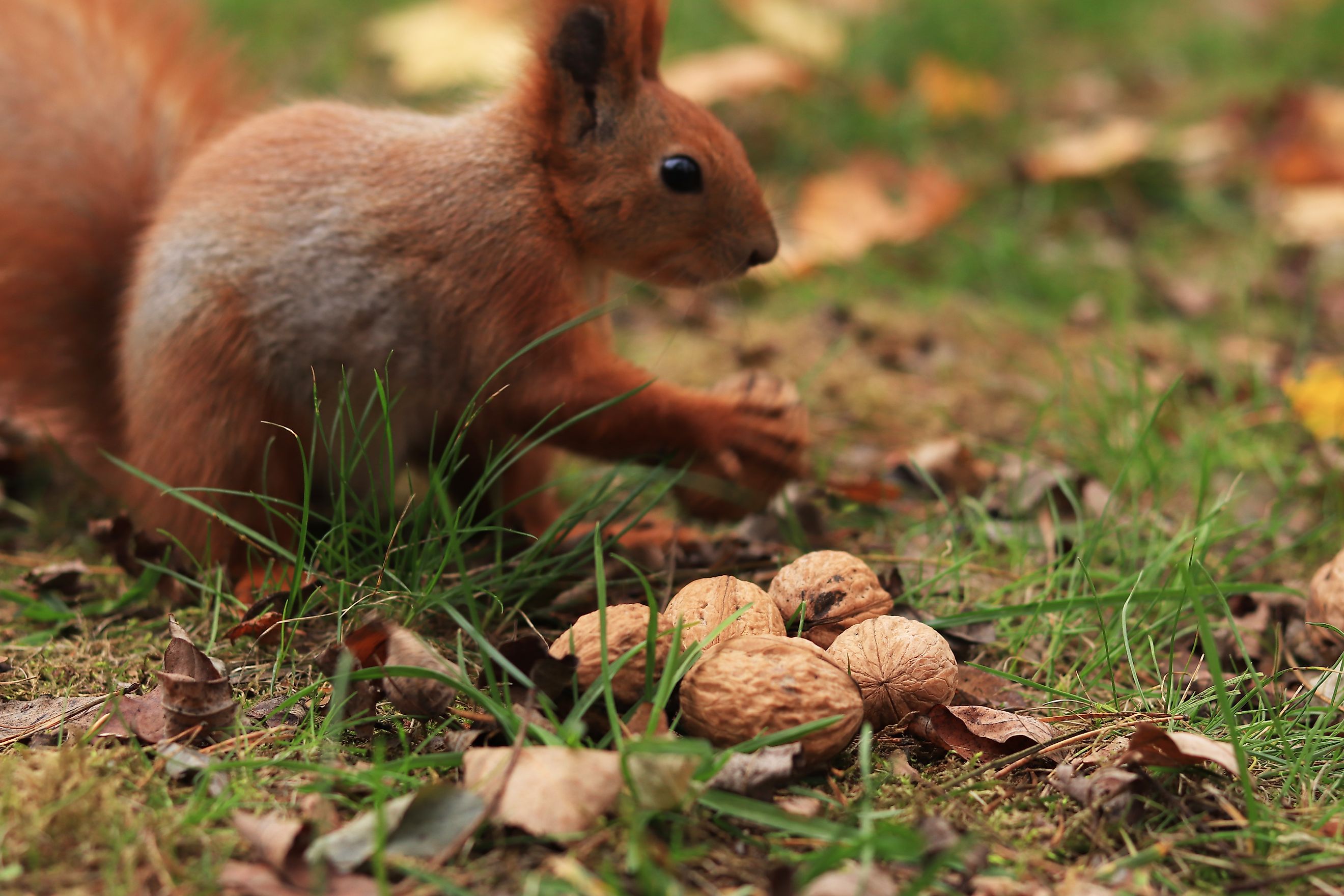
People have long believed that squirrels spend autumn burying thousands of nuts, only to forget most of them by spring. This idea is simple, but it is mostly wrong. When biologists started testing how well squirrels could find their buried food, beginning with a Princeton experiment in 1991, they found that squirrels are much better at remembering their caches than folklore suggests. The real puzzle is why so many nuts remain underground even when the squirrel knows exactly where they are. Most of this research focuses on tree squirrels native to eastern North America, which were later introduced to England. Now, the gray squirrel is common there too, so the same pattern of burying and losing nuts happens on both continents.
The Belief And The Test

Lucia Jacobs and Emily Liman challenged the old belief about squirrels in a study they published in Animal Behaviour in 1991, while both were at Princeton University in New Jersey. They gave captive gray squirrels, Sciurus carolinensis, a common backyard animal in the eastern United States, hazelnuts to bury in a shared arena. After waiting between two and twelve days, they watched to see which nuts each squirrel would dig up. If the squirrels relied only on smell, they would have found their neighbors' nuts as often as their own. But each squirrel found nearly twice as many of its own nuts compared to those hidden by others, which suggests they remembered the exact spots. The idea that squirrels forget had stuck around for decades, mostly because it was more amusing than the truth.
How The Map Gets Built

At the University of California, Berkeley, Mikel Delgado and Jacobs studied 45 wild fox squirrels, Sciurus niger, using GPS. In a 2017 report in Royal Society Open Science, they found that the squirrels sorted their nut caches by type. When the researchers handed the squirrels a mix of nut species, each squirrel buried one kind in its own cluster of sites and kept another kind in a separate cluster. The researchers call this method spatial chunking, which helps the animal remember less at any one time. This sorting is important because, according to Berkeley's estimate, a single fox squirrel in California buries between 3,000 and 10,000 nuts each year. Clearly, the squirrel does not remember all of them at once.
Squirrels remember their caches for longer than people might think. A study at the University of Exeter in 1993 and 1994 found that gray squirrels could find up to two dozen hidden nuts as long as sixty-two days after burying them. This is impressive for an animal weighing only about half a kilogram (roughly one pound). The reason lies partly in the brain. The hippocampus, which manages spatial memory, grows larger in squirrels during the autumn caching season instead of staying the same size all year. Squirrels do not rely on a single mental map that stays fixed across the whole caching season. They return to their sites, dig, re-bury, and check the ground every day, constantly updating their map as the leaves fall.
Theft, Not Forgetfulness

If squirrels are not simply forgetting where they buried their acorns, then something else must explain the missing stores. In many cases, the answer is theft. To investigate, Michael Steele and his team attached tiny transponders to acorns in an area of Pennsylvania with a dense gray squirrel population. They found that a buried acorn usually didn't last long. Often, it was gone within a day and rarely survived more than five days, usually taken by other squirrels searching the same area. When the researchers trapped and removed the squirrel that had made the caches, simulating what a hawk or fox might do, those caches stayed untouched for up to twenty-seven days. This showed that the nuts were being stolen by other squirrels, not forgotten by their owner. The squirrel has an advantage over its competitors, and the story of the disappearing cache is really about living in a crowded neighborhood.
To protect their food from thieves, squirrels sometimes put on a show. In 2008, Steele and his coauthors reported in Animal Behaviour that after more than five hundred caching trials in Pennsylvania and New England, they saw gray squirrels pretend to bury a nut when a rival was watching. The squirrel would dig a hole, act like it was hiding the nut, cover the empty spot, and then take the nut somewhere else to hide it for real. These fake burials happened in about one out of every eight caching events and were more common when another squirrel was within about twenty meters (around sixty-five feet). When researchers looked for the real caches afterward, they found them much less often. The authors called this the first experimental evidence of behavioral deception in a wild rodent, but they were careful not to overstate it. Pretending to bury a nut is not the same as understanding what another squirrel is thinking, and there isn't much evidence for that more complex behavior.
What The Lost Nuts Become

Where a squirrel buries an acorn is a deliberate choice rather than a random one. In a 2014 study published in Behavioral Ecology, Steele's team found that gray squirrels carried larger, more valuable acorns farther from the tree, often beyond its canopy into open ground where other squirrels were less likely to steal them. Smaller acorns were buried closer to the trunk, where cover offered better protection. This behavior also has consequences for oak regeneration. Acorns buried in open, sunlit areas have a better chance of developing into seedlings, and squirrels bury far more than they eventually eat. Some caches are stolen, while others are simply never recovered. Those forgotten acorns can germinate and grow into new trees, making the gray squirrel both a consumer of oak seeds and an important agent of their dispersal.
Tree squirrels do not hibernate, so their winter survival depends on the food they store and their ability to find it again. The gray squirrel, which features in much of the research on caching behavior, is just one of many squirrel species that rely on this strategy. Across these species, burying, remembering and protecting food are essential parts of preparing for winter, but not every cache is recovered. Some acorns are stolen by other animals, while others remain buried long enough to germinate. These forgotten stores are an important part of how oaks spread, making squirrels not only consumers of tree seeds but also contributors to the forests they inhabit.
The Bottom Line
Squirrels are far better at remembering their food stores than popular folklore suggests. Research by Jacobs and Liman in 1991, followed by later studies from Delgado, Steele and their colleagues, has shown that squirrels organize their caches, remember their locations and recover much of what they bury. Many missing nuts are stolen by other animals, while others remain underground simply because squirrels store more food than they can eat. Those unrecovered acorns can eventually germinate and grow into new oak trees. The familiar image of the forgetful squirrel may be misleading, but it points to an important part of forest regeneration, as the seeds squirrels leave behind help shape the next generation of woodland.