Why Moose Lose Their Antlers Every Winter
In the northern forests of North America and northern Eurasia, a bull moose, Alces alces, that carried antlers as wide as a doorway during the autumn rut will be bare-headed by the start of the new year. The antlers don't wear down or break off in fights. Instead, the moose sheds them, often losing one side at a time and sometimes days apart. The biggest bulls usually finish shedding by late December, while younger bulls might keep their smaller antlers into February or even March. Only males grow and shed antlers, so female moose go through the whole winter without them. The reason isn't the cold or the snow. It's a hormone, and the same hormone that made the antlers grow is the one that, when it drops, causes them to fall off.
The Hormone That Grows The Antler Also Lets It Fall

Antlers are made of bone, not horn, and that difference is important. Horns, like those on goats or bison, are permanent and have a keratin sheath over a bony core that lasts a lifetime. Antlers, on the other hand, are bare bone that grow anew each year from a base on the skull called the pedicle. They reach full size in just one summer before being shed. Moose antlers are among the fastest-growing tissues in any mammal, sometimes adding up to two centimetres, or nearly an inch, a day at their peak, a growth rate more often seen in tumours than in normal bone.
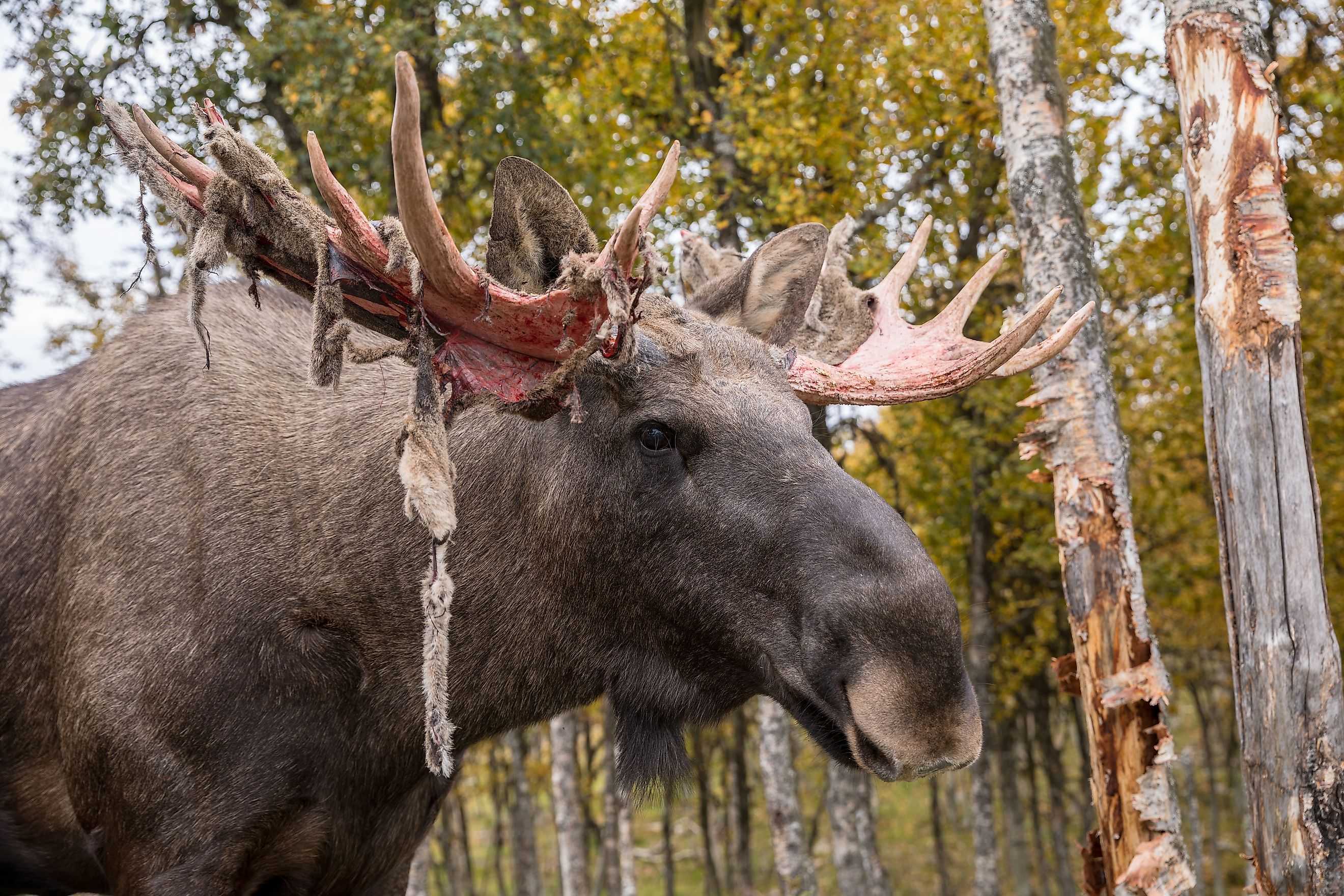
Daylight controls how antlers grow. As spring days get longer, the increased light is sensed by the pineal gland, and a short burst of testosterone triggers antler growth from the pedicle. During the growing season, the bone is covered in velvet, a skin full of blood vessels that nourishes the antler while testosterone levels stay low. When testosterone rises again in the fall, usually in September and October, the blood supply to the velvet stops, the antler hardens into dead bone, and the bull rubs off the drying velvet on saplings. During the rut, high testosterone keeps the antler firmly attached to the pedicle, just when the bull needs it most for fighting rivals and defending territory.
After the rut, testosterone levels drop and the hormone that kept the antlers in place fades away. This drop triggers casting, which starts when testosterone falls below about one nanogram per milliliter of blood, according to studies. The decrease activates cells called osteoclasts at the seam between the dead antler and the living pedicle. These cells dissolve the bone at that spot until the antler detaches. The break is clean, the animal does not expect it, and a bull can lose an antler while eating without missing a step. Biologist Richard Goss, who summarized decades of research in 1983, explained that if a bull is given extra testosterone, it will not shed its antlers. Take away the hormone and the antler falls off. A castrated buck shows the same rule from the other side. With no testosterone, it casts the hard antler it already has, then grows a replacement that never dries out of velvet and is never shed, which is why such animals carry the same misshapen rack year after year.
Why A Bull Gives Up Such Costly Bone

Growing a new set of antlers each year is costly, which is the main reason a bull gets rid of the old ones. Big antlers use up calcium and phosphorus faster than a bull can get them from food, so he takes minerals from his own bones to finish growing them and then spends the rest of the year making up for it. On the largest Alaskan bulls, the antlers can weigh nearly eighteen kilograms, or about forty pounds of bone on the head. After the rut, that weight doesn't help a bull until the next autumn, but he still has to carry it through the toughest months, when a moose in the deep snow of interior Canada or Alaska is already using up energy faster than he can replace it by eating. Dropping the antlers gets rid of that extra weight, and the skeleton has the winter to recover before the cycle starts again.
That is the main explanation, but it's not the only one. In 2019, another idea suggested that losing and regrowing antlers each year gives every bull a new display for each breeding season, a bit bigger and more branched than before, so age is shown clearly in the antlers. Both ideas could be true, and there isn't much evidence about which was more important when this trait first appeared.
What a bull gives up is stranger than just losing weight. In 2008, George Bubenik from the University of Guelph and his son Peter Bubenik, a mathematician at Cleveland State University, reported in the European Journal of Wildlife Research that a moose's broad antlers act like a parabolic reflector for sound. They put the antlers of an Alaskan bull on a stand, placed an artificial ear between them, and played a standard tone from a speaker ten metres away. When the ear faced the bowl of the antler, the sound pressure increased by about a fifth compared to facing straight ahead. The palms direct sound into the ears much like a cupped hand, and this boost is enough that a bull hears a calling cow better with antlers than without. For years, people thought those big palms were just for show, but the speaker-and-microphone test showed otherwise. When a bull sheds his antlers in December, he loses that hearing aid along with the weight, which shows just how much the benefits of dropping the antlers outweigh the costs in the off-season.
The Same Drop, On A Different Clock For Every Bull

Shedding happens on its own schedule for each animal, which is why you might see one bull with a full rack and another already bare on the same winter walk. Age is a big factor. Bulls in their prime that put the most effort into the rut experience the biggest hormonal changes and usually drop their antlers first, often by late December. Younger bulls with smaller antlers might keep theirs into late winter. An animal's health and physical condition also play a role. A well-nourished bull is more likely to retain its antlers longer than one weakened by illness or poor nutrition. The oldest bulls, those over ten or twelve years, start to grow back antlers that look misshapen. Where the bull lives also affects timing. The same daylight cues that trigger antler growth in spring tell the bull when to shed, so those living far north in longer darkness tend to shed earlier than those near Minnesota or at the southern edge of their range.
Moose live across a huge range, and they change depending on where they are found. They are the largest members of the deer family, found in the forests of Maine and Wyoming, through northern Europe and Asia, and across Siberia. In Sweden, Norway, Finland, and Russia, people call the same animal elk. This has led to centuries of confusion, since North Americans use the word elk for a different deer that Europeans call wapiti. Even today, travelers and writers sometimes mix them up. The animals themselves also differ. North American moose usually have broader antler palms than their Scandinavian and east Siberian relatives, but all of them respond to the same winter hormone.
Where The Cast Antlers Go

A cast antler doesn't last long on the forest floor, which is one reason this process remained a mystery for so long. For centuries, naturalists struggled to explain why antlers were shed at all, partly because the evidence kept vanishing. Shed antlers are much rarer than their numbers would suggest. The answer turns out to be simple. Mice, voles, squirrels, and porcupines chew on cast antlers to get the calcium and phosphorus inside. Within a few seasons, a dropped antler is gnawed away, and the minerals a bull once used return to the soil and help the next generation of rodents. People also search for these sheds, and in moose country, looking for dropped antlers in late winter has become a hobby for anyone willing to walk through the cold.
Shedding antlers also changes the moose you might see in winter. A bull you meet in January usually has no antlers, but even without them, it's still one of the largest land animals around. Moose can stand taller than a person at the shoulder and move quickly through the trees. They aren't territorial toward people and don't hunt them. If you give a moose space, it will usually just walk away. The greater risk comes at other times of year, when bulls may become aggressive during the autumn rut and cows may charge to defend their calves in spring. If a moose lays its ears back or raises the hair on its hump, it's best to put something solid, like a tree or a vehicle, between you and the animal and let it go by. In winter, though, moose are calmer, with low hormone levels and their antlers hidden under the snow, waiting for rodents to find them before spring.
A Loss Written Into The Calendar
For a bull moose, shedding its antlers is a normal part of the annual cycle, not a sign of injury or declining condition. Once the autumn rut is over, the antlers have served their purpose, and the animal no longer needs to carry their weight through winter. The pedicles remain, allowing a new set to grow as daylight increases in spring. By the following autumn, the moose will have another fully developed rack, ready for the next breeding season. This cycle of growth and shedding repeats throughout the animal's adult life, with each winter marking the end of one set and the beginning of another.