Titan Triggerfish
The titan triggerfish is the largest triggerfish across most of its range, a heavy-bodied reef fish that can grow to about 30 inches (75 cm). It patrols tropical coral reefs and lagoons throughout the Indo-Pacific, and it has earned a reputation among divers that few other reef fish can match. During the breeding season, a nesting female will charge at almost anything that drifts too close, including people.
That combination of size, strong jaws, and fearless temperament makes the titan triggerfish one of the more talked-about animals on a reef. Yet the fish is far more than a diving hazard. It is a working part of the reef, an animal that reshapes the seabed, controls populations of coral-eating pests, and opens up food for smaller species that follow it around. Understanding what it does helps explain why reef ecosystems depend on fish that most swimmers would rather avoid.
Taxonomic Classification

The titan triggerfish belongs to the family Balistidae, the triggerfishes, a group of about 40 species known for their oval bodies and locking dorsal spines. The order that contains it, Tetraodontiformes, also holds the pufferfishes, filefishes, and boxfishes, all of them unusual in shape and in the way they swim. The accepted scientific name of the species is Balistoides viridescens, described by Bloch and Schneider in 1801. The genus name is drawn from a Latin word for a crossbow, a nod to the spring-loaded spine that defines the family.
Several common names attach to the same animal, among them giant triggerfish, mustache triggerfish, and yellowmargin triggerfish. Within the genus Balistoides the titan sits beside the clown triggerfish, Balistoides conspicillum, a smaller and more vividly marked relative popular in home aquariums. The titan is by far the larger of the two and the biggest triggerfish across most of its wide range, although a separate species found off the Pacific coast of the Americas, the stone triggerfish, grows larger still.
Physical Description

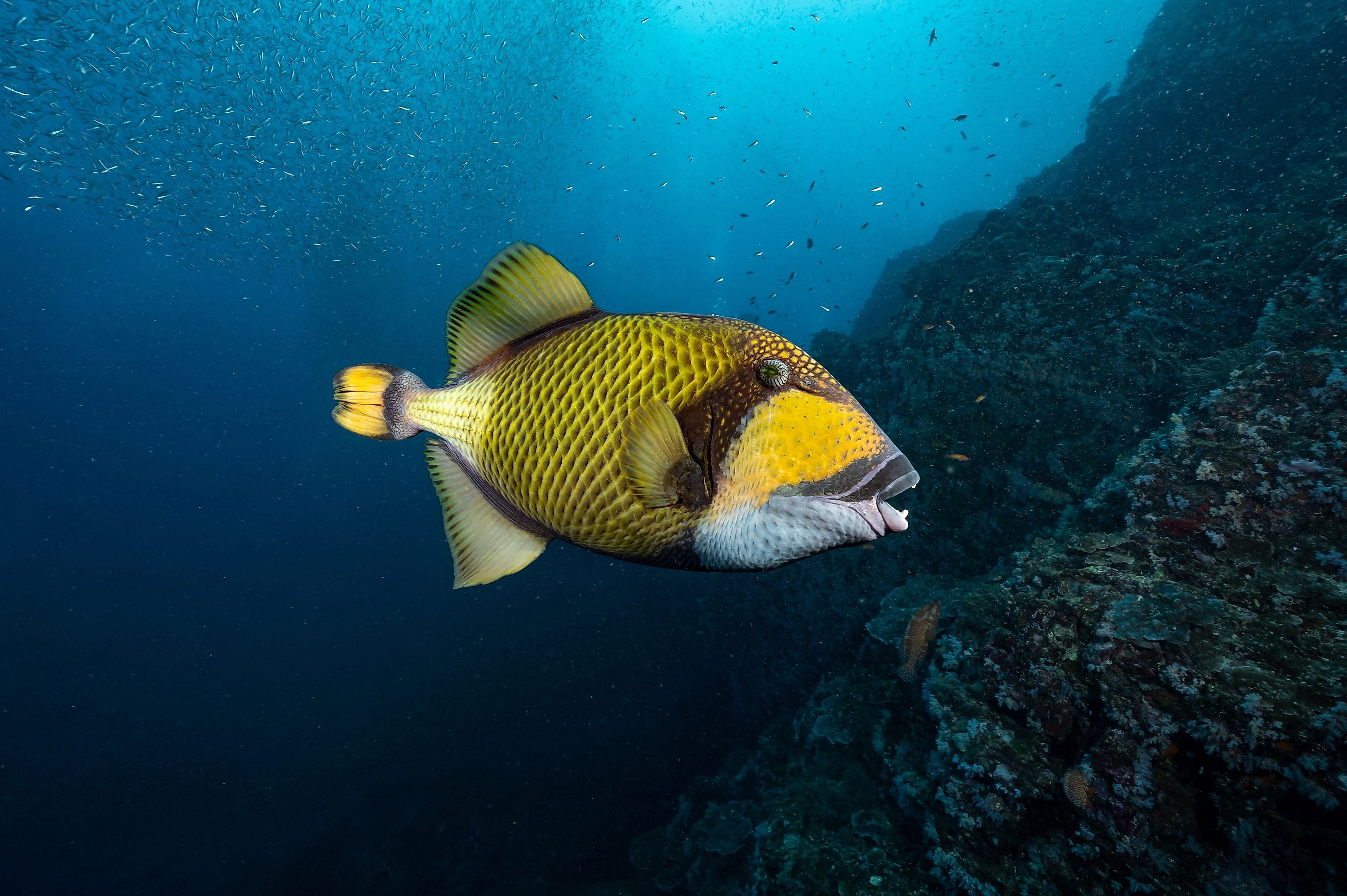
A titan triggerfish is built like a flattened oval, deep-bodied and strongly compressed side to side. Large adults reach about 30 inches (75 cm) in length, which makes them bulky animals by reef standards, and their heavy heads taper to a small mouth packed with strong teeth. The body is heavily scaled, and each scale carries a dark center over a paler background that can look white, yellow, or pale orange depending on the individual and the light. The overall effect is a crosshatched pattern that breaks up the outline of the fish against a busy reef.
Two field marks make the species easy to name. A black patch dotted with small yellow spots covers each eye and reaches back toward the base of the pectoral fin, and a bare strip around the mouth is bordered by a dark line that looks like a mustache, which is where one of the common names comes from. The dorsal, pectoral, and anal fins are edged in black. Males and females look broadly alike, so color and markings do not reliably separate the sexes.
The family trait that gives these fish their name is the trigger. The first dorsal fin carries a stout spine that can be locked upright by a second, smaller spine behind it. When the fish wedges itself into a crevice and raises that spine, it jams itself in place and becomes very hard to pull out, a defense against predators and a problem for anything trying to dislodge it. The same spine is raised in threat displays. Triggerfish also swim in an unusual way, rippling the soft dorsal and anal fins to hover and maneuver with precision and saving the tail for quick bursts of speed.
Range and Habitat

The titan triggerfish has one of the widest ranges of any reef fish. It lives across the Indo-Pacific, from the Red Sea and the coast of East Africa in the west, eastward through the warm reefs of tropical Asia and out across the central Pacific. It ranges north to southern Japan and south to northern Australia and New Caledonia, reaching islands as remote as the Line and Tuamotu groups far out in the ocean. One gap stands out. The species is absent from Hawaii, even though suitable reef habitat exists there.
Within that enormous range the fish keeps to warm, shallow water. It lives on coral reefs, reef flats, and sheltered lagoons, usually within easy diving depth but sometimes down to about 160 feet (50 meters). It is a common sight on well-known reef systems, including the Great Barrier Reef off Australia and the atolls of the Maldives, and it turns up throughout the reefs of Indonesia and along the Red Sea coast of Egypt. These are warm-water reefs for a reason. Reef-building corals need heat and light, which is why coral reefs cannot grow in cold water, and why the titan triggerfish stays in the tropics.
The species spans two great ocean basins, the warm reaches of the Indian Ocean and the tropical Pacific Ocean, and it is one of many large animals that make these reef zones so productive.
Diet

The titan triggerfish is an omnivore with a taste for hard, armored prey that many reef fish cannot handle. Its diet is built around sea urchins, coral, crabs, mollusks, and tube worms, and its powerful jaws and chisel-like teeth let it bite straight through material that would defeat a softer-mouthed fish. A hungry titan will tear off chunks of live coral, crush the shells of mollusks, and flip sea urchins over to reach the softer underside while avoiding the protective spines on top.
Much of its feeding reshapes the seabed. The fish uses its mouth and a jet of water to turn over rocks and rubble, and it will overturn stones far larger than its head to dig out hidden prey. This habit scatters loose food and sediment, which is why smaller fish so often trail a foraging titan triggerfish and dart in to grab morsels it exposes. The species is also one of the few reef fish that will attack and eat the crown-of-thorns starfish, a spiny, coral-devouring predator that can strip a reef when its numbers explode.
Behavior

Outside the breeding season, the titan triggerfish is a solitary, daytime animal. It spends the daylight hours cruising the reef and feeding, then retreats into a crevice at night, wedging itself in with its raised dorsal spine so that predators cannot drag it out. Individuals hold loose feeding territories and will chase off other fish that crowd their patch.
The behavior that makes the species famous appears when a female is guarding eggs. She prepares and defends a nest on the open seabed, and she treats the water above it as her own. The defended zone is shaped roughly like an upturned cone, narrow at the nest on the bottom and widening toward the surface, so a diver who rises straight up to escape only moves deeper into the guarded space. The safer response is to swim away horizontally, low over the reef, out of the cone rather than up through it.
A defending female advertises her mood before she strikes. She faces the intruder head on, raises that first dorsal spine, and may roll onto her side to keep the threat in view. If the warning is ignored she will charge, and with strong teeth set in heavy jaws she can deliver a serious bite to a fin, a mask strap, or exposed skin. The fish does not always follow through, and often simply escorts a swimmer out of the area, but the risk is real enough that experienced divers give nesting titans a wide berth.
Reproduction

Breeding follows a monthly rhythm tied to the moon. For roughly a week each month, timed to the days around the full or new moon depending on the population, titan triggerfish pair up and spawn. A female clears a shallow nest in a flat, sandy patch of the reef and lays her eggs there, then stays close to tend and guard them. The eggs are fanned and defended against the many reef animals that would eat them, and that duty is the reason behind the species' aggressive reputation.
Because the female commits so heavily to a fixed nest, she cannot simply flee from danger, so she drives threats away instead. Once the eggs hatch, the tiny larvae drift in open water as plankton before settling onto a reef to grow. Precise figures for maturity age and lifespan in the wild are not well documented for this species, although related triggerfish are known to live for several years and sometimes beyond a decade.
Importance to the World

The titan triggerfish earns its keep on the reef. As a heavy-jawed predator of hard-shelled animals, it helps keep populations of sea urchins and other grazers in check, which matters because unchecked urchin numbers can scour a reef of the algae and coral that other species need. Its willingness to eat crown-of-thorns starfish adds a further layer of natural control over one of the most destructive pests a coral reef can face.
Its digging also plays a role. By overturning rubble and biting into coral and rock, the fish exposes hidden prey and recycles sediment, and the smaller species that follow it benefit from the scraps it leaves behind. In this sense the titan triggerfish works as a kind of reef engineer, altering the physical structure of the seabed as it feeds, and losing predators of this size tends to throw a reef off balance. The fish does carry one caution for people. Its flesh can be ciguatoxic, meaning it sometimes stores a natural toxin that causes ciguatera poisoning, so it is not a reliably safe fish to eat.
Threats and Conservation

The titan triggerfish is not currently at risk. The International Union for Conservation of Nature lists the species as Least Concern on its Red List, based on an assessment published in 2022, because the fish is widespread, common across its enormous range, and not heavily targeted by fisheries. It is caught and eaten in some regions and appears in the aquarium trade, but neither pressure threatens the species as a whole.
The larger concern is the state of the reefs themselves. Coral reefs across the tropics face warming seas, bleaching, pollution, coastal development, and destructive fishing, and a reef predator is only as secure as the habitat that feeds it. The biggest threats to coral reefs fall hardest on the corals and invertebrates at the base of the food web, and a decline there would eventually reach animals like the titan triggerfish. For now the species remains a common and healthy part of Indo-Pacific reef life, but its long-term outlook is tied to the survival of the reefs it helps maintain.
Takeaway
The titan triggerfish has a reputation that often overshadows its ecological role. Its size and aggressive defense of its nest make it a fish divers need to treat with caution, but its feeding habits also help maintain the reef. It breaks apart hard-shelled prey, feeds on invertebrates that can damage coral, and disturbs the seabed, making food available to smaller fish. The species is currently classified as Least Concern, but it still depends on healthy tropical reefs to survive. The future of those habitats matters not only for the titan triggerfish but for the many species that share its environment.
Fun Facts
- The name points to a crossbow. The genus Balistoides comes from a Latin word for a crossbowman, a reference to the spring-loaded dorsal spine the whole family shares.
- It can lock itself in place. By raising its first dorsal spine and bracing a smaller spine behind it, the fish can wedge into a crevice so tightly that a predator cannot pull it free.
- Swimming straight up from a nest is the wrong move. Because the guarded zone is cone-shaped and widens toward the surface, divers are told to swim away sideways rather than upward.
- It hunts one of the reef's worst pests. The titan triggerfish is one of the few fish that will attack and eat the coral-killing crown-of-thorns starfish.
- Other fish treat it as a dinner bell. Smaller species follow foraging titans to grab food stirred up when the big fish overturns rocks and coral.
- Eating one can be risky. The flesh of the titan triggerfish is sometimes ciguatoxic, so it can cause ciguatera poisoning in people.
Quick Facts
- Common name: Titan triggerfish (also giant, mustache, or yellowmargin triggerfish)
- Scientific name: Balistoides viridescens
- Family: Balistidae (triggerfishes)
- Order: Tetraodontiformes
- IUCN Red List status: Least Concern (assessed 2022)
- Maximum length: About 30 inches (75 cm)
- Depth range: Surface to about 160 feet (50 meters), occasionally deeper
- Diet: Omnivorous, feeding on coral, sea urchins, crabs, mollusks, and tube worms
- Range: Indo-Pacific, from the Red Sea and East Africa to New Caledonia and southern Japan
- Habitat: Coral reefs, reef flats, and lagoons
- Lifespan: Not well documented in the wild