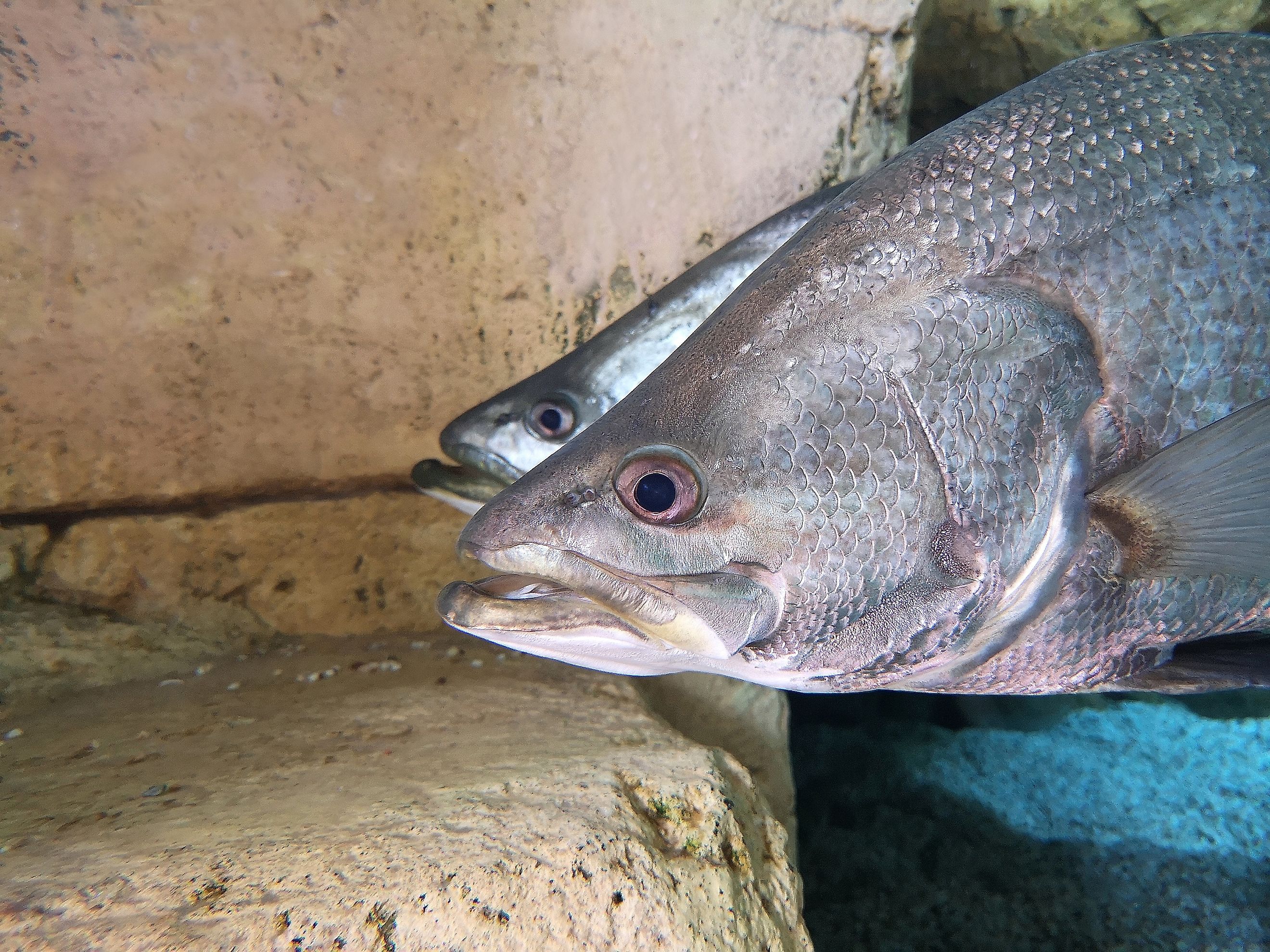
Nile Perch
The Nile perch (Lates niloticus) ranks among the largest freshwater fish in all of Africa, a silver giant that can stretch to roughly 6.5 feet (2 m) in length and tip the scales at more than 400 pounds (180 kg). It is a formidable apex predator, built for ambushing smaller fish in warm, slow rivers and vast tropical lakes.
Native to many of the continent's great waterways, the Nile perch is prized by commercial fisheries and sport anglers alike. Yet the same traits that make it a valued catch, a voracious appetite and rapid growth, have also made it one of the most notorious introduced predators on Earth. Few fish carry such a double reputation as both an economic treasure and an ecological warning.
Taxonomic Classification

The Nile perch belongs to the kingdom Animalia and the class Actinopterygii, the ray-finned fishes that make up the vast majority of living fish species. Within that class it sits in the family Latidae, often called the lates perches, a group of large predatory fish that was once lumped into the snook family Centropomidae before being recognized on its own. Older references place the family in the order Perciformes, though recent molecular studies have reshuffled its higher placement.
The species carries the scientific name Lates niloticus, with the genus Lates capitalized and the species name in lowercase. It was first described by the Swedish naturalist Carl Linnaeus in 1758, originally under the name Labrus niloticus, a nod to its home in the Nile. Several close relatives share the genus, among them the Lake Tanganyika perches, which shows how this lineage has diversified across African waters over millions of years.
Physical Description
Size is the first thing most people notice about the Nile perch. The largest individuals reach about 6.5 feet (2 m) in length, and the heaviest documented specimens have weighed close to 440 pounds (200 kg), placing the species among the biggest freshwater fish anywhere. Most adults caught today are smaller than those record animals, since heavy fishing tends to remove the oldest and largest fish from a population.
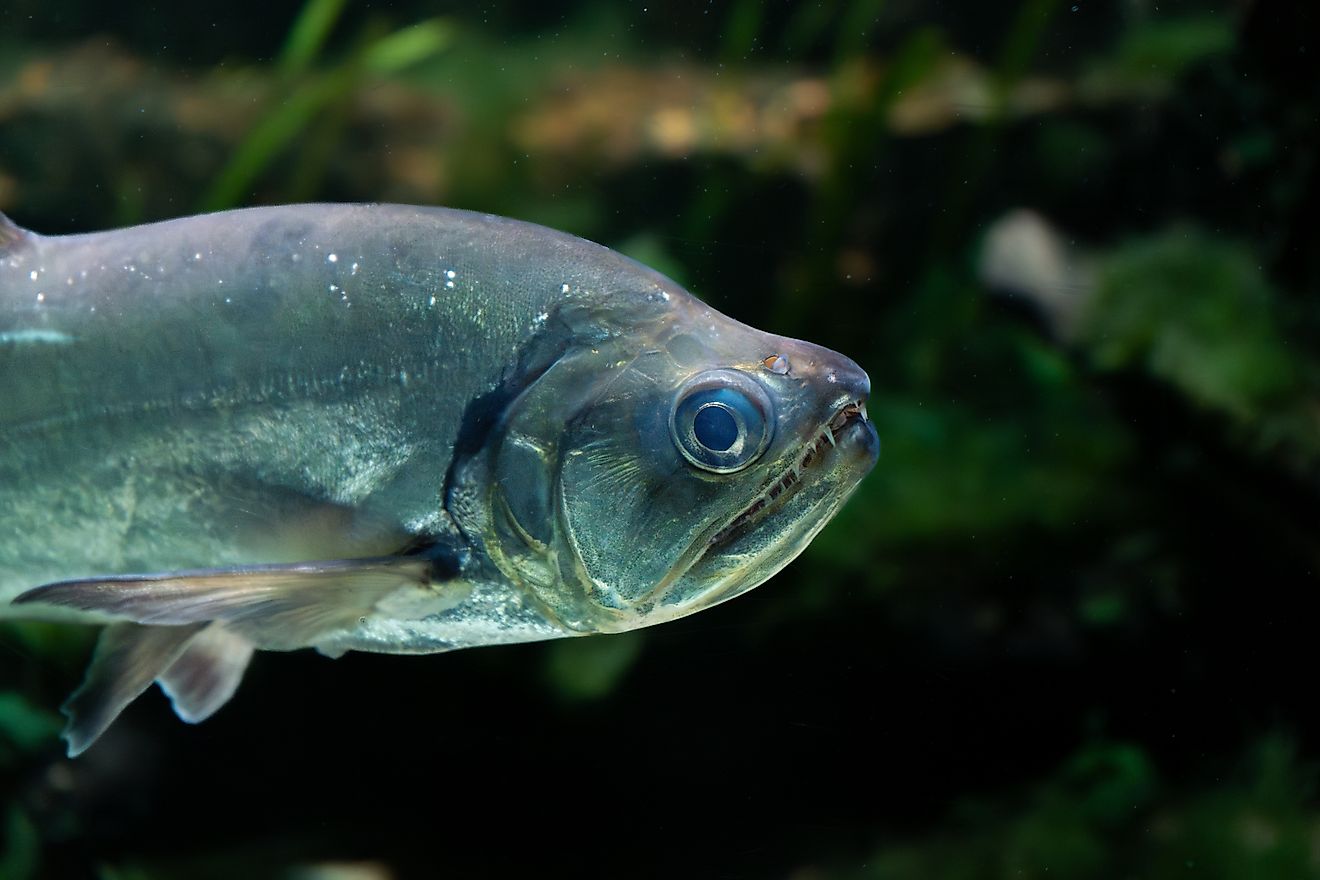
The body is deep, stout, and slightly compressed laterally, tapering to a rounded tail. Coloration is a polished silver, often washed with a blue or greenish sheen across the back that fades to a paler belly. One of the species' most distinctive features is the eye, which glows with a bright yellow outer ring around a dark center, a marker that helps separate it from many other large fish at a glance.
A protruding lower jaw and a wide mouth lined with small teeth mark the Nile perch as a predator built for seizing prey whole. Two dorsal fins run along the back, the first spiny and the second soft rayed. Males and females look broadly alike, though females grow larger and account for nearly all of the truly giant individuals.
Range and Habitat
The Nile perch is naturally widespread across tropical Africa. Its native range covers the basins of the Nile River, the Congo, the Niger, the Volta, and the Senegal, along with the Lake Chad and Lake Turkana systems. Across this range it occurs in countries including Egypt, Sudan, Ethiopia, Chad, and Senegal.
The species favors warm, well-oxygenated fresh water and thrives in large rivers, floodplains, and lakes. Juveniles tend to stay in shallow, sheltered margins, while adults move into deeper open water. The Nile perch tolerates a fairly wide range of conditions, a flexibility that helps explain how readily it has spread when given the chance.
That chance came in the mid twentieth century, when the fish was deliberately introduced to Lake Victoria, the enormous lake shared by Tanzania, Uganda, and Kenya. Stocked during the 1950s and 1960s to boost fisheries, the predator found a lake full of easy prey and few rivals, and it transformed the waterbody in ways no one had planned.
Diet
The Nile perch is a committed carnivore and sits at the top of the food web wherever it lives. Young fish start small, feeding on zooplankton, insect larvae, and tiny crustaceans in sheltered shallows. As they grow, their diet shifts almost entirely to other fish.
Adults are powerful piscivores that will take nearly any fish they can swallow, and larger individuals readily eat smaller members of their own kind when other prey runs short. This cannibalism can help a population persist even after it has thinned out the species it originally fed on. The predator hunts by lunging from cover or open water and engulfing prey in a single gulp, using its wide mouth and expandable throat. Alongside fish, it will also take crustaceans and insects when they are abundant, giving it a broad and opportunistic menu.
Behavior

Nile perch are active hunters rather than sluggish ambushers, though they rely on bursts of speed to close the final distance to prey. Juveniles often gather in loose groups along vegetated edges, which offers some protection from larger predators, including adult Nile perch. With age the fish become more solitary and range into deeper, cooler layers of a lake or river.
Movement follows the water. During floods and seasonal rises the fish disperse across newly covered ground to feed, then retreat as levels drop. Temperature and oxygen shape their daily positions, pushing them shallow or deep depending on conditions. For a fish of its size, the Nile perch leaves a surprisingly light behavioral record, since much of its life plays out unseen in murky, open water.
Reproduction
The Nile perch is built to reproduce in staggering numbers. Individuals reach maturity within a few years of hatching, and spawning is often tied to the warm, wet season when food is plentiful for young fish. The species is a broadcast spawner, releasing eggs and sperm into open water rather than guarding a nest.
A single large female is extraordinarily fecund and can release millions of eggs in one spawning event, with the very largest females producing figures estimated in the range of several million. Fertilization happens externally, and the eggs and resulting larvae drift without parental care. Most do not survive to adulthood, but the sheer volume of eggs means that even a small survival rate yields enormous numbers of young. Adults can live for well over a decade under good conditions, giving large females many chances to spawn across their lives.
Importance to the World
Few fish have had a larger economic footprint on a single region than the Nile perch has on the Lake Victoria basin. After the introduced population exploded, it became the backbone of a major commercial fishery, supporting processing plants, export businesses, and the livelihoods of millions of people around the lake. Frozen and chilled fillets are shipped to Europe, the Middle East, and beyond, generating hundreds of millions of dollars in trade.
That boom came with hard tradeoffs, a story told vividly in the documentary film "Darwin's Nightmare," which examined the social and economic ripples of the trade. Within its native range the Nile perch has long been an important food fish and a natural part of the aquatic food web, where it helps regulate populations of smaller species. The contrast between its stabilizing role at home and its disruptive role abroad is a textbook lesson in how context shapes a species' impact.
Threats and Conservation

On the global stage the Nile perch is not an endangered animal. The International Union for Conservation of Nature lists it as a species of Least Concern, reflecting its wide distribution, large populations, and the enormous numbers now present in waters where it was introduced. Its overall population trend is considered stable.
The more serious conservation story runs the other way, because the Nile perch has itself driven dramatic losses among other fish. Its arrival in Lake Victoria is linked to the decline and disappearance of a remarkable community of native cichlids, the small, diverse fish that had evolved in the lake over a short span of geological time. Hundreds of these endemic species declined sharply, and many are thought to have been lost, in what is often described as one of the most severe vertebrate extinction episodes of modern times. The cichlids that remain, along with the broader web of life of the Nile River's animals, show how introduced predators can reshape an entire ecosystem.
The Nile perch population does face local pressures of its own. Heavy fishing has reduced stocks in parts of Lake Victoria, and pollution along with nutrient runoff has degraded water quality in places. Management efforts now focus on controlling catch, protecting breeding stock, and limiting the further spread of the fish into waters where it could repeat the Lake Victoria pattern.
Takeaway
The Nile perch has a very different impact depending on where it lives. In its native African rivers and lakes, it is a major predator and an important source of food for local communities. Introduced to unfamiliar waters, however, it has caused severe ecological damage, particularly in Lake Victoria, where it contributed to the decline of many native fish species. The fish is easy to recognize by its enormous size, powerful build and yellow-ringed eyes. Its history also offers a clear lesson in conservation. A species that plays a natural role in one ecosystem can cause lasting damage when introduced into another. Understanding the Nile perch means looking at both its place in African fisheries and the consequences of moving it beyond its native range.
Fun Facts
- A freshwater heavyweight. The Nile perch is one of the largest freshwater fish in Africa, with the biggest individuals weighing close to 440 pounds (200 kg).
- A film all its own. The species inspired the acclaimed documentary "Darwin's Nightmare," which traced the human and environmental cost of the Lake Victoria fishery.
- Millions of eggs. A single large female can release millions of eggs in one spawning, which helped the introduced population spread with astonishing speed.
- The glowing eye. Its bright yellow eye ring is a quick field mark that sets it apart from many other big fish.
- A perch that is no small panfish. Despite sharing a common name with the little backyard-pond perch, this member of the world's many unusual freshwater fish grows larger than a grown person.
Quick Facts
- Common name: Nile perch
- Scientific name: Lates niloticus
- Family: Latidae (order traditionally Perciformes)
- IUCN status: Least Concern
- Length: up to about 6.5 feet (2 m)
- Weight: up to about 440 pounds (200 kg)
- Lifespan: commonly well over a decade
- Diet type: carnivorous, an apex fish-eating predator
- Range: native across tropical Africa, widely introduced to Lake Victoria