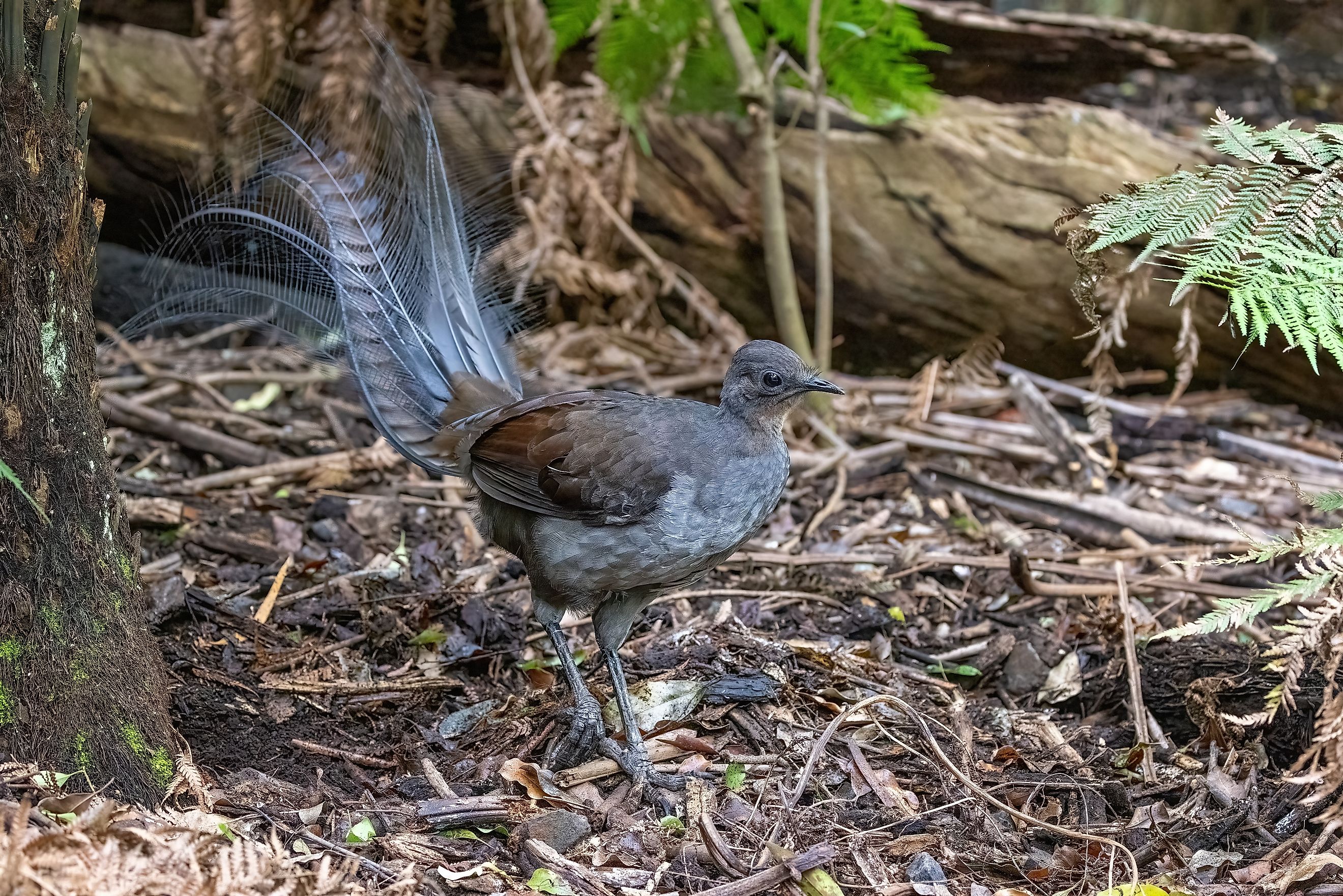
Lyrebird
The superb lyrebird is one of Australia's most extraordinary vocal mimics. When a male throws his shimmering tail forward over his head and begins to sing, he can reproduce the calls of a dozen other species, the click of a camera shutter, and even the growl of a distant chainsaw, weaving them into one continuous performance. These large, ground-dwelling songbirds are found only in Australia and rank among the most accomplished vocal mimics in the animal kingdom.
The name covers just two living species, the superb lyrebird and the rarer Albert's lyrebird. Both belong to an ancient Australian lineage that split away from other songbirds tens of millions of years ago. Together they form one of the smallest and oldest bird families in the world, a lineage entirely their own.
Taxonomic Classification

Lyrebirds make up the family Menuridae, a small group that contains a single genus, Menura. Only two species survive today. The superb lyrebird (Menura novaehollandiae) was described by the English ornithologist John Latham in 1801. The much rarer Albert's lyrebird (Menura alberti) was formally named in 1850 in honor of Prince Albert, the husband of Queen Victoria, after specimens reached Europe.
Both species sit within the order Passeriformes, the perching birds or songbirds, which makes them distant relatives of sparrows, crows, and thrushes. Their lineage is old, and lyrebirds are frequently described as one of the most ancient branches of the songbird tree. That deep ancestry, combined with an unusual body plan and an extraordinary voice, has long fascinated scientists studying how birdsong first evolved.
Physical Description

The superb lyrebird is one of the largest songbirds on Earth. Among all passerines it ranks third in size, behind only the thick-billed raven and the common raven. Adults measure roughly 31 to 39 inches (80 to 100 cm) in length including the tail, and males are noticeably larger than females. A male weighs around 2.4 pounds (1.1 kg) and a female around 2.0 pounds (0.9 kg).
Plumage in both species is understated. The body is brown above with a warm coppery tint across the wings, fading to a paler grey below. The legs and feet are dark and powerfully built, ending in long claws suited to digging. What draws the eye is the male superb lyrebird's tail, a fan of sixteen feathers that gives the family its name. Two broad outer feathers curve like the frame of a lyre, an ancient Greek stringed instrument. Between them sit two slender guard plumes and twelve fine, wiry filamentary feathers that shimmer like silvery gauze when raised. Females and juveniles carry plainer tails without the ornamental outer feathers, and young males take several years of annual moults to grow their full display.
Albert's lyrebird is slightly smaller and lacks the pronounced lyre-shaped outer feathers, though it still spreads the same fanned tail during courtship. Both sexes of that species wear a richer chestnut tone across the body.
Range and Habitat

Lyrebirds live nowhere in the world outside Australia. The superb lyrebird occupies a broad band of wet forest along the southeast, running from southern Victoria north through New South Wales into the extreme southeast of Queensland, largely following the spine of the Great Dividing Range. It ranges from near sea level up into high mountain country, and in 1934 a population was deliberately introduced to Tasmania out of concern that the species might one day face extinction on the mainland. That Tasmanian population is now thriving and expanding.
Albert's lyrebird has one of the smallest distributions of any Australian bird. It is confined to a patch of mountainous subtropical rainforest on the border of New South Wales and Queensland, an area of only about 580 square miles (1,500 square km). Within that pocket the birds favour dense, shaded understory with deep leaf litter, usually above 1,000 feet (300 m) in elevation. Both species depend on moist, complex forest, and neither strays far from the cover it provides.
Diet

Lyrebirds are foragers of the forest floor. Using strong legs and hooked claws, a bird rakes through leaf litter, rotting logs, and loose soil to expose the small animals hidden beneath. The diet is built around invertebrates, including insects and their larvae, spiders, earthworms, ants, and beetle grubs, with the occasional frog, lizard, or land snail taken as well.
This constant scratching amounts to far more than a simple feeding habit. A single superb lyrebird works over a huge area of ground in the course of a year, and its steady search for food ends up reshaping the very soil it feeds on, a point returned to below in the section on importance.
Behavior

The lyrebird's fame rests on its voice. A displaying male can imitate the songs of many other birds in sequence, and both wild and captive individuals have been recorded copying human-made sounds such as camera shutters, car alarms, and chainsaws. A full song can run for as long as twenty minutes, blending the bird's own territorial calls with borrowed material handed down through generations of local birds.
Males perform on cleared earthen mounds, building and tending as many as fifteen display platforms across a single home territory. Standing on a mound, the male sweeps his tail forward into a silvery canopy over his back and sings while stepping and shivering in rhythm. The species is polygynous, which means one male mates with several females while taking no part at all in raising the young.
For all their vocal energy, lyrebirds are shy and hard to approach, and Albert's lyrebird is especially elusive. They are poor fliers that spend almost all of their lives on the ground, relying on short bursts of downhill gliding rather than true sustained flight to slip away from danger.
Reproduction

Breeding takes place in the depths of the Australian winter, roughly May through August, when the male's displays reach their peak. After mating, the female handles every remaining task alone. She builds a bulky domed nest of sticks lined with moss, ferns, and her own shed feathers, tucking it against a rock, a tree stump, a fern, or a stream bank.
She lays a single egg and incubates it for around fifty days, one of the longest incubation periods of any songbird. Because she has to leave the nest for several hours each day to feed herself, the developing egg cools during her absence, which helps explain why incubation stretches out so far. The chick is then fed by the mother for weeks and stays dependent on her for months after it fledges. Lyrebirds mature slowly, with females ready to breed at six or seven years of age and males not until seven to nine. In exchange for that slow start they are notably long-lived, and wild birds may survive well past twenty or even thirty years.
Importance to the World

Lyrebirds are among Australia's most effective ecosystem engineers. As a bird scratches for food it displaces a striking quantity of leaf litter and soil, and researchers estimate that a single lyrebird can move many tonnes of material per hectare every year, more than almost any other animal in its forest. This churning speeds the breakdown of dead leaves, folds nutrients back into the ground, and shapes the structure of the whole forest floor.
The effect even reaches the risk of fire. By clearing and turning over litter, lyrebirds reduce the amount of dry fuel lying on the ground, which can lower the intensity of bushfires in the forests they occupy. The bird also holds a firm place in Australian culture. It features in Aboriginal stories and art, and the superb lyrebird has appeared on the Australian ten-cent coin for decades.
Threats

Both lyrebird species are currently listed as Least Concern on the IUCN Red List. That fairly secure label hides some real pressures. The superb lyrebird remains common across its wide range, yet its overall population trend is suspected to be slowly declining, and its numbers are thought to exceed ten thousand mature birds rather than being precisely counted.
The main threats are habitat loss through logging and urban expansion, predation by introduced red foxes and cats, and severe bushfires. The catastrophic fires of 2019 and 2020 burned through large stretches of lyrebird habitat and prompted much closer study of how quickly the species can recover. Albert's lyrebird is far more vulnerable simply because so few of them exist, with an estimated 3,500 breeding birds packed into one tiny range, a concentration that leaves the species exposed to any disturbance in that single corner of the continent.
Takeaway
The lyrebird is a plain brown bird capable of one of the most elaborate vocal performances in nature, and a timid forest dweller whose daily digging quietly shapes entire woodlands. Its mimicry has made it famous around the world, but its role as a tireless gardener of the forest floor may prove to be its most lasting contribution. For now both species endure, though the rarity of Albert's lyrebird and the slow decline suspected in the superb serve as reminders that even a bird this resourceful still depends on the survival of the ancient Australian forests it calls home.
Fun Facts

- A living sound recorder. Wild lyrebirds have been documented imitating chainsaws, camera shutters, car alarms, and even crying babies, folding these noises straight into their courtship songs.
- On the money. The superb lyrebird appears on the Australian ten-cent coin, a small national tribute to one of the country's most distinctive birds.
- Third-largest songbird. Of all the world's perching birds, only the two largest ravens outsize the superb lyrebird.
- A marathon incubation. The female incubates her single egg for roughly fifty days, one of the longest incubation stretches recorded for any songbird.
- Forest firefighters. By raking away dry leaf litter as they forage, lyrebirds can reduce the fuel load that helps bushfires spread.
Quick Facts
- Common name: Lyrebird
- Scientific names: Menura novaehollandiae (superb lyrebird), Menura alberti (Albert's lyrebird)
- Family: Menuridae
- Order: Passeriformes
- IUCN status: Least Concern (both species)
- Length: 31 to 39 inches (80 to 100 cm), including the tail
- Weight: about 2.0 to 2.4 pounds (0.9 to 1.1 kg)
- Lifespan: often 20 to 30 years or more in the wild
- Diet: insectivore and invertebrate feeder (insects, spiders, worms, grubs, and small vertebrates)
- Range: eastern and southeastern Australia, with an introduced population in Tasmania