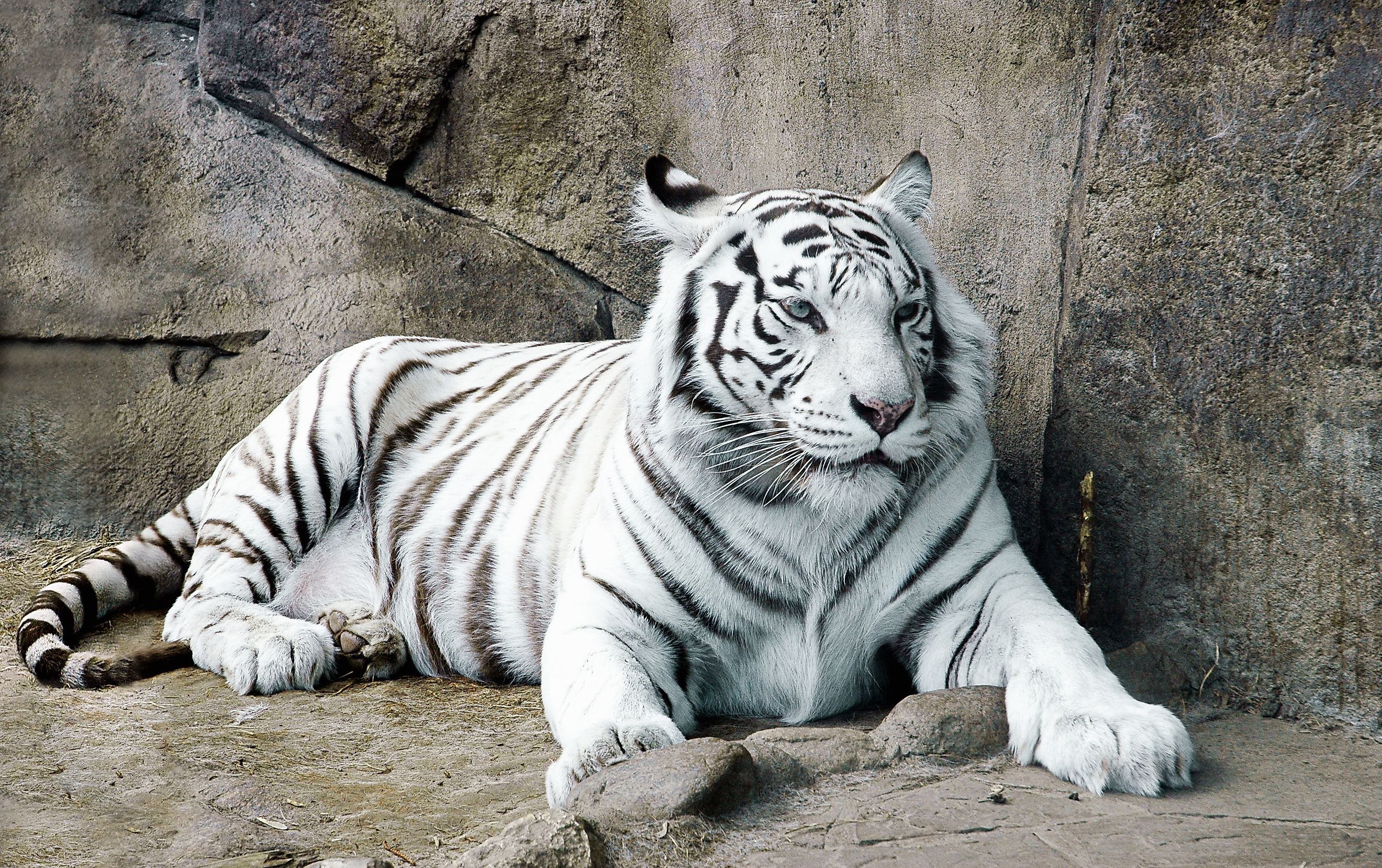
White Tiger
White tigers are a mutation of the Bengal tiger species, which gives them distinctive white fur amid black stripes. This has made them highly valuable to breeders and entertainers due to their unique appearance. The white tiger itself no longer exists in the wild, but is found in captivity. Most of those in captivity today can trace their lineage back to one source: a captive cub from India. Read below to learn about what causes this genetic mutation, and why its existence in captivity raises ethical concerns.
Taxonomy

The white tiger is primarily found in one species of tiger: the Bengal tiger, known as Panthera tigris tigris. It is also, at times, developed through crossbreeding with the Siberian tiger, Panthera tigris altaica.
Panthera is a genus within the family of cats called Felidae. It encompasses many types of large cats, including lions, tigers, leopards, and jaguars. The term Panthera is often confused with black panthers, a leopard, or a jaguar with black fur.
Of the tigris species, there are six currently extant subspecies that live throughout Asia. The Bengal tiger, sometimes referred to as the Indian tiger, makes up the largest tiger subspecies at between 2,500 and 3,750 members. The subspecies name Altaica for the Siberian Tigers refers to the Altai Mountains, which are located at the border between Russia, Mongolia, China, and Kazakhstan.
Physical Traits

These tigers' white fur is a result of a genetic mutation known as leucism. It is an exceedingly rare mutation, occurring in one in 10,000 tigers in the wild. Despite popular misconceptions, white tigers are not albino, but rather have significantly reduced pigmentation.
The gene that causes leucism is recessive, meaning it will only emerge when two parents who both have the gene mate. The source of this mutation has been hotly debated, with one research paper called "The genetic basis of white tigers" arguing the mutation comes from an amino acid change known as A477V within a transporter protein. This amino acid may partially obstruct the transporter channel cavity and, in turn, impact melanin, giving the tiger its white fur and blue or green eyes.
The study notes, "Our results identify the basis of the longstanding white tiger mystery as the same gene underlying color variation in humans, horses, and chickens and highlight its significance as part of the species' natural polymorphism that is viable in the wild."

As for its other physical traits, it shares much in common with Bengal or Siberian tigers, including dark stripes, which are unique to the individual tiger. Their weight and height vary, but tend to fall somewhere between the Siberian and Bengal tigers, from 440 to 510 pounds and up to 10 feet in length.
Unfortunately, white tigers often have genetic defects due in part to inbreeding and their natural genes. For example, the gene that causes white fur also causes white tigers to be cross-eyed, making it difficult for them to see. White tigers suffer from cleft palates, organ issues, hip dysplasia, and kidney failure. In many cases, inbred white tiger cubs die before reaching adulthood.
In the wild, a white tiger's fur is a liability, as it makes it unable to blend in with their surroundings. This is another factor in why most white tigers do not reach adulthood in the wild.
Range and Habitat

White tigers are currently not found in the wild. The last known White tiger in the wild was killed in Bihar, India, in 1958. There are reports of white tigers dating back to the 1500s in India. White Siberian tigers, meanwhile, never existed in the wild, as White Siberian tigers are made through crossbreeding in captivity. The last known wild white tiger cub, Mohan, was taken into captivity by the Indian Royalty in 1951, and he is the genetic forefather of most subsequent White tigers.
The original wild White tigers were Bengal tigers found in India, Bangladesh, Nepal, and Bhutan. The range itself is fragmented due to human activity, with small pockets of populations spread throughout northern, central, and southern India. The Bengal tiger has been a symbol for India dating back millennia and is the official animal of India today.

The vast majority of Bengal tigers live in India, with over 2,200 members, compared to less than 200 each in Nepal, Bhutan, and Bangladesh. They live in tropical jungles, marshlands, and mangrove forests, which are trees and shrubs that grow in coastal wetlands. The mangrove forests of the Sundarbans are home to a group of Bengal tigers that have evolved to be able to drink salty water.
The Siberian tiger, meanwhile, lives in the Amur River valley in the far eastern corner of Russia, along with a small portion of northeastern China. Although they used to live in Korea, they are now extinct on the peninsula, save for isolated reports of tigers wandering close to the border between North Korea and China.
Their primary habitat is the Russian taiga, a coniferous, scrub oak, and birch boreal forest in Siberia. These consist of both evergreen trees and mixed forests. Unlike the Bengal tiger, which is suited for the hot climates below the equator, Siberian tigers are optimized for cold weather and snow.
Ethical Concerns

White tigers are only located in captivity, with some estimates putting their number at around 200. There is a good deal of controversy over the ethics of breeding and whether or not these creatures should be released into the wild.
First off, there is a large economic incentive to breed these animals, as they are highly popular in zoos and at shows, as was demonstrated by the Siegfried & Roy magicians who popularized white tigers in their Las Vegas show. To meet this need, companies that are not regulated by zoo associations have interbred these tigers, leaving them with shorter life spans and health issues.
These companies are often called pseudo sanctuaries due to their tendency to present themselves as animal sanctuaries while breeding tigers for profit. In these centers, more than 80% of cubs die not long after birth. In the U.S., all white tigers can be traced back to one white tiger male.
Animal conservation experts believe that these tigers have no true conservation value since they do not exist naturally in the wild and are bred only for entertainment purposes in captivity. Some have argued that white tigers should be released into the wild, as white Bengal tigers did exist up till the 1950s, but genetic difficulties, poor eyesight, and lack of camouflage would make survival a challenge.
Should you go see a white tiger?
Due to the history of white tiger breeding and their not being present in the wild, it can be an ethical dilemma whether to go see one or not. Some organizations and wildlife refuges provide medical care and safe environments for white tigers without breeding them. These organizations also work to end exotic animal trades and unethical breeding practices, such as the Turpentine Creek Wildlife Refuge in Eureka Springs, Arkansas. They have 18 white tigers on site that are available to see. Conservationists recommend only going to ethical refuges and zoos to see white tigers.