Warthog
Warthogs are pigs who live in open and semi-open habitats, including in some arid regions. Some interesting facts about these creatures are that there are two species that were formerly considered under their scientifically assigned name. Warthogs also derive their name from the facial wattles that are covered over their faces, with the males' wattles being more prominent. Other unique characteristics about these creatures include their flexible herbivore diet, their multi-purpose tusks, and even their love of being groomed regularly. Here are some more fascinating details about these oddly cute animals.
Taxonomic Classification

The name warthog refers to two living species, the common warthog and the desert warthog. The common warthog, or simply warthog, is known scientifically as Phacochoerus africanus, while the desert warthog is Phacochoerus aethiopicus. Both belong to the genus Phacochoerus in the family Suidae, the family that includes pigs, hogs, and swine. The two were once considered a single species under the name Phacochoerus aethiopicus. As time went on, the desert warthog became far more limited, while the common warthog became more widely known and widespread, keeping the name Phacochoerus africanus.
Beyond those names, there are variations of those names based on the region where the warthog is found. Warthogs found further north are referred to as Nolan warthogs, for example.
Range And Habitat
Warthogs prefer open and semi-open habitats the most, which is why you'll find most warthogs in the savannah of Sub-Saharan Africa. Generally speaking, they'll make their stomping grounds around Senegal all the way over to Ethiopia and down to South Africa. In South Africa they'll largely be avoiding any heavily forested or desert areas.
Meanwhile, the desert warthog continues to persist, but in much smaller areas. They're largely packed in northern Kenya and Somalia. There could also be some rare spottings in Djibouti, Eritrea, and Ethiopia.
Food

Warthogs are largely herbivorous creatures. However, like most suids, they do opportunistically eat small animals and bugs. They could also be seen at times scavenging on carrion left by other predators.
Getting into the specifics, a large chunk of their diet is exclusively grass. According to reported findings from the San Diego Zoo Wildlife Alliance, warthogs consume up to 34 species of grass.
On smaller scales, they can also be seen eating shoots, roots, and seeds, though those depend on the season. Warthogs will go for green shoots the most and only during the rainy seasons. They'll also eat rhizomes, or rootstalks, during the long dry seasons in southern Africa. Furthermore, in the more arid regions, warthogs will also be eating fruits and doum palm fruits to ensure survival in those areas.
Physical Description

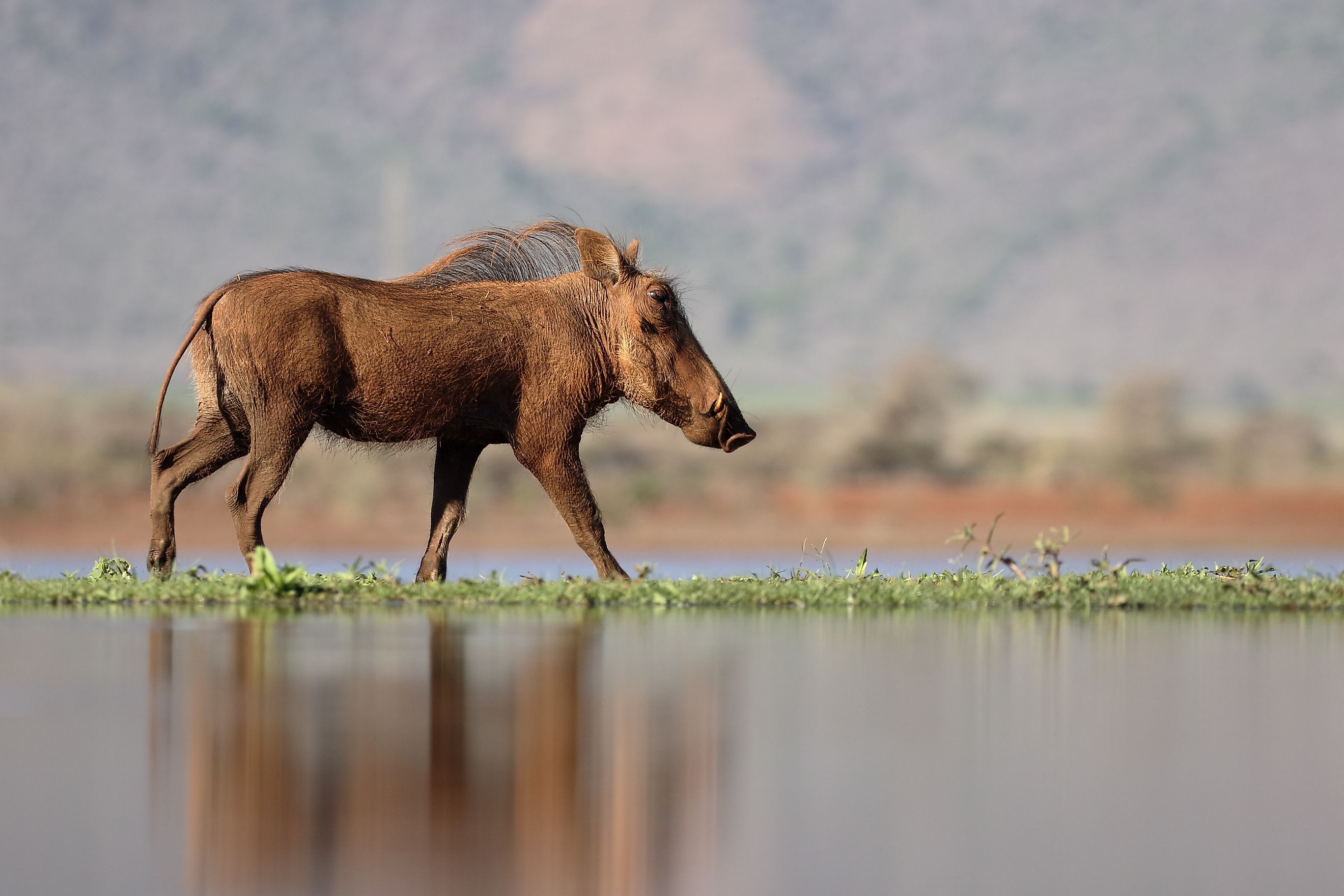
While they are covered in bristly hairs, their body and head are largely void of those hairs. They have a crest of hair and some more that runs along their back alongside some tufts on their face and tail.
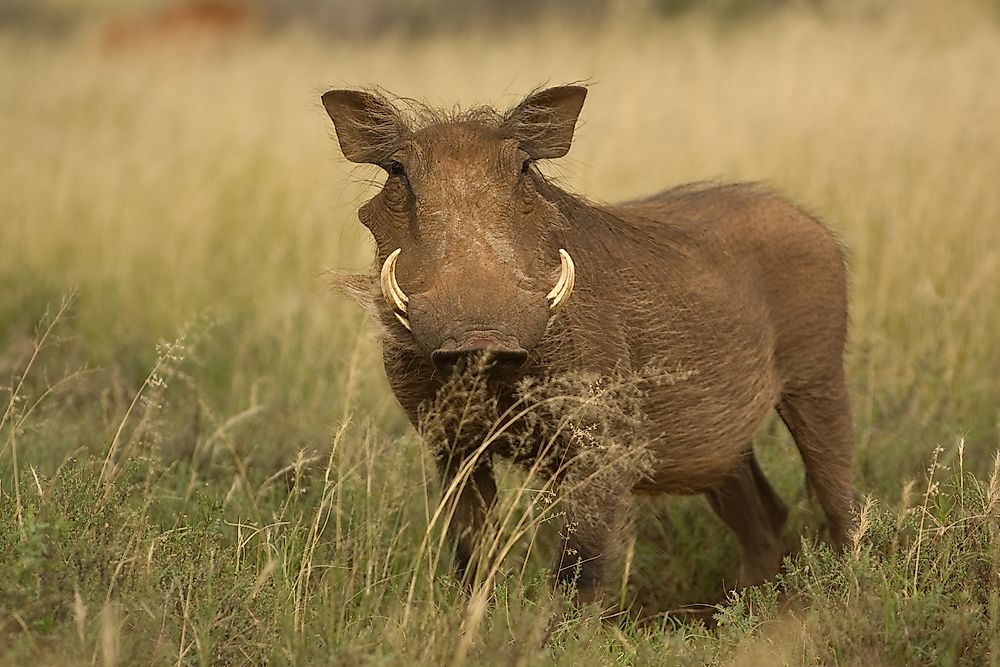
It's on their face where they get their namesake title of "warthog" due to the several "warts," called wattles, that appear over their faces. The male wattles are particularly distinct, likely due to attracting potential mates during mating season.
Another unmistakable feature is the tusks that warthogs sport. The male warthogs have very prominent tusks, which can reach a length of 10 to 25 inches (25 to 64 centimeters), while females' tusks are smaller.
Behavior

Warthogs are diurnal in nature, that is, they are active during the daytime. The vast majority of their activity consists of feeding, with the remaining portion being resting in bushes or burrows. Warthogs will often peak in the early morning and late afternoon as a result of this, while female warthogs will be feeding for longer periods of time than males.
When it's time to rest, warthogs will often do so during the midday to avoid the heat and possible rainy weather during the rainy season. That being said, like other pigs, warthogs do enjoy wallowing in mud, particularly when temperatures are high.
By the nighttime, they largely remain in their burrows at this time. Similar to why they enter them during the midday, these burrows shelter them from the cold or rain as well as potential predators. Another interesting part of a warthog's behavior is that they are picky about the kinds of burrows that they use, in addition to them frequently changing burrows.
To a male warthog, their ideal burrow is short, with wide entrances, and ideally in areas that are close to water with lower burrow densities. Meanwhile, females become highly selective when it is time to give birth, leaving the group to farrow in a separate burrow that shelters the piglets and helps regulate their body temperature.
Reproduction

Reproduction of warthogs is straightforward in process, and it begins with male behaviors smelling females' urine to determine reproductive status.
It's then followed by fighting other males during their seasonal rut, with the victor being the one to mate. The fighting itself doesn't play out as some might expect, though, as male warthogs don't use their tusks at all. In fact, they lower them so they're not used to slash or stab. Instead, they butt heads and attempt to push the other off balance, with their facial warts cushioning blows and protecting their eyes from any potential damage.
Once a victor is determined, after about a minute of fighting, the male warthog will strut and then pursue the female with a springy, hip-rolling gait with its tail out and bent. Once caught, it'll rest its chin on the female's back or hind end.
Depending on the region the warthog is from, the seasonal reproduction will vary. In eastern and southern Africa, it's more common to see the mating season happen near the end of the wet season and birth coincide with the start of the following rainy season.
Importance to the World

Despite warthogs persisting in enclosed areas in the world, their role is no less important or significant. For the African savannahs and grasslands, warthogs are able to keep those areas in check naturally in order to prevent overgrowth of those areas. Furthermore, they forage using their snouts, which in turn aerate the soil, supporting the growth of plants.
Beyond that, because of how they tend to abandon burrows so often, those serve as natural shelters for other creatures like bugs. Meanwhile, what little hair they have does tend to attract all kinds of parasites and bugs, which are valuable food sources for other animals like birds, monkeys, and banded mongooses. They have a symbiotic relationship with these creatures, as they readily offer up valuable food services while those other animals help in keeping a warthog groomed, a big preference of theirs.
Threats
Being lower on the food chain and being related to pigs while living in Africa, warthogs are premium sources of meat to a wide variety of predator animals, including lions, leopards, hyenas, and wild dogs. They are premium largely because warthogs are also challenging to catch as well. Top speeds for warthogs go upwards to 48 kilometers per hour, allowing them to get away from predators or even charge at people with incredible speeds.
Beyond natural predators, there is also the risk of them being threatened via poaching or their grazing areas being hit with droughts or them losing their habitat through other causes. Poaching or hunting efforts largely seem to be for sport, as there are little to no levels of trade of live warthogs or warthog products.
Despite those other risks, warthogs aren't endangered, with the IUCN assessing the species as least concern due to the species being widespread and locally abundant, having a high reproductive rate, and expanding their range in South Africa. Excessive hunting or extreme droughts can still lead to localized extinctions and to population declines in some areas.