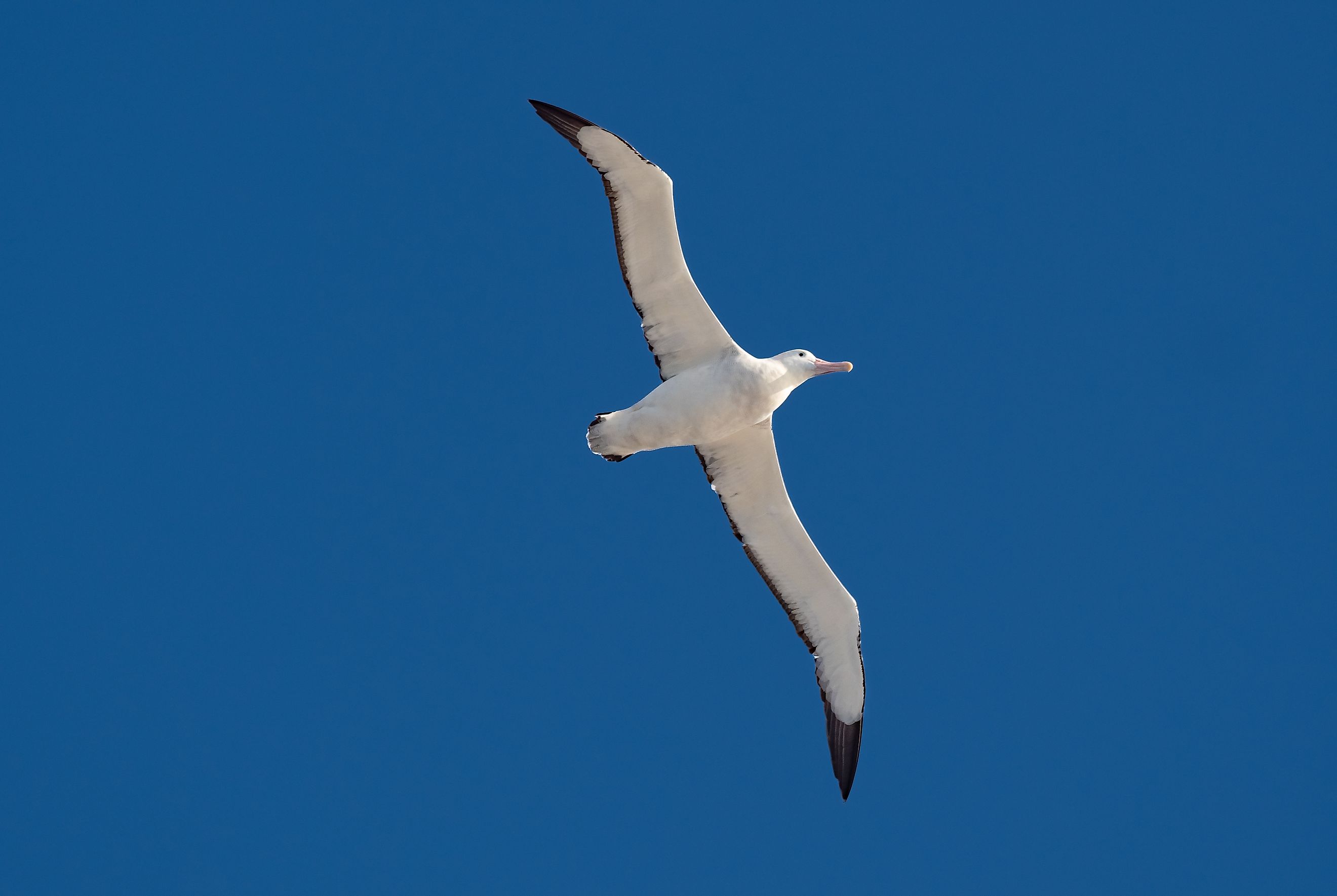
Wandering Albatross
The wandering albatross carries the widest wingspan of any living bird, a span that can stretch to 11.5 feet (3.5 m) and carry the animal across entire oceans with barely a wingbeat. It is a seabird of the Southern Ocean built almost completely for flight, and it spends the overwhelming majority of its life airborne over open water, far from any coast.
Known to science as Diomedea exulans, the species ranges over the seas that circle Antarctica and comes ashore only to breed on a scattering of remote subantarctic islands. Its Latin name, exulans, means exile or wanderer, and the bird earns it. A single foraging trip can cover thousands of miles and run for weeks before the animal returns to land.
Few creatures show the physics of flight as plainly as this one. The wandering albatross has turned wind and ocean swell into nearly free energy, gliding for hours at a stretch and covering hundreds of miles a day at very little metabolic cost. What follows is a closer look at how it lives, feeds, and breeds, and why its future has grown uncertain.
Taxonomic Classification

The wandering albatross belongs to the order Procellariiformes, the tubenoses, a group that also holds petrels and shearwaters. Within that order it sits in the family Diomedeidae, the albatrosses, and in the genus Diomedea, which contains the great albatrosses, the largest members of the family. Carl Linnaeus formally described the species in 1758, giving it the name it still carries, Diomedea exulans. English speakers also call it the snowy albatross, the white-winged albatross, or the goonie.
Its classification has shifted in recent decades as genetic work has reshaped the group. Several forms once treated as subspecies of the wandering albatross are now widely recognized as separate species, among them the Antipodean albatross (Diomedea antipodensis), the Amsterdam albatross (Diomedea amsterdamensis), and the Tristan albatross (Diomedea dabbenena). Not every authority agrees on where the lines fall, so the exact makeup of the wandering albatross complex remains under active review. The core species, Diomedea exulans, breeds mainly on South Georgia and the islands of the southern Indian Ocean.
Physical Description

Size defines this animal. The wingspan averages around 10 feet 2 inches (3.1 m) and can reach roughly 11.5 feet (3.5 m), the greatest verified span of any bird alive today, with larger but unconfirmed measurements reported by sailors over the years. The body itself runs 42 to 53 inches long (107 to 135 cm), and adults weigh between 18 and 26 pounds (8.2 to 11.9 kg). Males are noticeably larger than females.
The wings are long, narrow, and stiff, an arrangement suited to gliding rather than flapping. Adult plumage is mostly white with black flight feathers, and the underwing is white with a dark trailing edge. The large hooked bill is pink or yellowish pink. Coloration changes with age in a way that helps observers judge how old a bird is. Juveniles start out chocolate brown and whiten gradually over years, so that the whitest birds are the oldest. Reaching full adult plumage can take up to nine years.
Like other seabirds that drink saltwater, the wandering albatross carries a salt gland above its nasal passage that filters excess salt from its blood and excretes it as a concentrated solution, often visible as a stain near the bill. This adaptation frees the bird from any need for fresh water and lets it stay at sea indefinitely.
Range and Habitat

The wandering albatross has a circumpolar range across the Southern Ocean, the band of cold, wind-driven water that surrounds Antarctica. Outside the breeding season it is a wholly pelagic bird, living on the open sea and touching land only to nest. Its wanderings carry it as far north as southern Brazil and central Chile in the Atlantic and Pacific, and to southern Namibia, Mozambique, New Zealand, and southern Australia elsewhere. The North Atlantic is the one major ocean it does not reach.
Breeding is confined to a small set of remote subantarctic islands, including South Georgia, the Prince Edward Islands, the Crozet Islands, the Kerguelen Islands, and Macquarie Island. South Georgia alone holds roughly a quarter of the global population. On these islands the birds nest in exposed, windy sites on plateaus, ridges, and open slopes covered in tussock grass, where the steady breeze helps them take off and land. The wind that makes these islands harsh for most life is exactly what the albatross needs.
Diet

The wandering albatross is a carnivore that feeds mainly on cephalopods, especially squid, along with fish such as toothfish, plus crustaceans and jellyfish. It also scavenges readily, taking carrion from dead penguins and seals and following ships to snatch offal and discards thrown overboard. An unusually strong sense of smell, backed by a large olfactory system, helps it locate scattered food across huge stretches of empty ocean.
It feeds mostly by sitting on the surface and seizing prey within reach, or by making shallow plunges, and unlike many seabirds it can forage at night as well as by day. Meals can be enormous. A bird may swallow up to a quarter of its own body mass in a single feeding, sometimes leaving it too heavy to lift off. When that happens the albatross rests on the water until it digests, or lightens itself by regurgitating part of the load before trying to fly again.
Behavior

The defining behavior of this species is dynamic soaring, a technique that lets it fly for hours without flapping. The bird exploits the difference in wind speed between the sluggish air right at the wave surface and the faster air just above it, repeatedly climbing into the wind and then diving back down to gain speed. Working the swell this way, a wandering albatross can travel around 590 miles (950 km) in a day at little energetic cost, and long foraging trips may cover 6,000 miles (10,000 km) over one to three weeks.
At sea the bird is largely solitary, crossing vast distances alone or in loose, temporary groups that gather around food such as a fishing vessel or a carcass. On land during breeding it becomes far more social and vocal, producing croaks, bill-clapping, trumpeting, and braying calls. It sleeps on the ocean surface between flights and can remain at sea for years at a stretch when young.
Reproduction

Wandering albatrosses are monogamous and form pair bonds that usually last for life. Courtship is elaborate, with partners spreading their wings, rapping their bills together, throwing back their heads, and calling in coordinated displays that reinforce the bond year after year. Males reach the breeding islands first and return to the same nest site, with females arriving over the following weeks.
The species breeds on a two-year cycle, one of the slowest reproductive rhythms of any bird. A pair raises a single egg per attempt, laid in December or January in a mound-shaped nest of mud and vegetation. Incubation lasts roughly 11 weeks, shared by both parents, and the chick then takes around nine to ten months to fledge, longer than almost any other bird. Both parents feed it regurgitated squid and fish, alternating long foraging trips. Because the chick develops so slowly, a successful pair can breed only every other year. Young birds do not return to breed until they are about 9 to 11 years old, and adults often live beyond 50 years.
Importance to the World

As a wide-ranging predator and scavenger, the wandering albatross helps shape the ecology of the Southern Ocean, feeding on squid and fish and cleaning up carrion across an immense area. Its slow life history, with late maturity and a single chick every two years, makes it a sensitive indicator of the health of the seas it depends on. When albatross numbers fall, they often signal trouble in the wider marine system, including changes in fish stocks and fishing pressure.
The bird also carries deep cultural weight. It has long stood in the minds of sailors as a symbol of the open ocean and of good or ill fortune, most famously in the poetry of the age of sail. Today it anchors a growing wildlife-tourism trade on southern expedition voyages, where its size and relative fearlessness of people make it a prime draw for travelers and researchers alike.
Threats

The wandering albatross is listed as Vulnerable on the IUCN Red List. Recent assessments put the population at roughly 20,100 mature individuals, equal to about 6,100 breeding pairs, and the overall number is decreasing. The population is thought to have fallen by around 30 percent over roughly 70 years, about three generations for such a long-lived bird.
The single largest threat is bycatch in longline fisheries. Birds diving for baited hooks behind fishing vessels become snagged and drown, and because the species reproduces so slowly, even modest losses among breeding adults can drag the population down. Chicks face additional hazards, including plastic and other debris carried back in food, and predation by introduced cats on some islands. Habitat degradation at South Georgia, linked to the activity of fur seals, has also damaged nesting areas. Hunting was a serious problem in the past but faded early in the twentieth century.
Conservation efforts now center on reducing bycatch through measures such as weighted lines, bird-scaring streamers, and setting hooks at night, along with international agreements aimed at protecting seabirds. The species is covered by the Agreement on the Conservation of Albatrosses and Petrels. Its remote breeding islands, many of them protected reserves, give it a measure of shelter, though the danger it faces at sea reaches well beyond those refuges.
Takeaway
The wandering albatross stands out for its immense wingspan, ocean-spanning journeys, and unusually slow life cycle. It raises just one chick every other year and can live for half a century, but its long lifespan and low reproductive rate also leave it vulnerable when adults die on fishing hooks faster than the population can replace them. Protecting the species therefore depends on reducing accidental catches and ensuring that long-lived breeding adults survive long enough to keep the population replenishing itself.
Fun Facts

- Widest wings alive. No living bird spreads wider than the wandering albatross, whose span can reach about 11.5 feet (3.5 m).
- Flying without flapping. Using the wind and the ocean swell, it can glide for hours and cover close to 590 miles (950 km) in a single day at almost no energy cost.
- Too full to fly. A wandering albatross can eat so much in one sitting, up to a quarter of its body weight, that it must rest on the water until it digests before it can take off.
- It drinks seawater. A salt gland above its nasal passage strips excess salt from its blood, so the bird never needs fresh water and can stay at sea for years.
- Whiter with age. Young birds are brown and pale into full white plumage over roughly nine years, so the whitest albatrosses are also the oldest.
- Lifelong partners. Pairs mate for life and reunite at the same nest site with elaborate courtship dances that can span decades.
Quick Facts
- Scientific name: Diomedea exulans
- Family and order: Diomedeidae, Procellariiformes
- IUCN status: Vulnerable (population decreasing)
- Wingspan: average about 10 ft 2 in (3.1 m), up to 11.5 ft (3.5 m)
- Body length: 42 to 53 in (107 to 135 cm)
- Weight: 18 to 26 lb (8.2 to 11.9 kg)
- Lifespan: often more than 50 years
- Diet: squid, fish, crustaceans, and carrion (carnivore)
- Range: circumpolar across the Southern Ocean, breeding on remote subantarctic islands
- Population: roughly 20,100 mature individuals