Tiger Shark
If the ocean handed out superlatives, the tiger shark (Galeocerdo cuvier) would clean up. It is one of the largest predatory sharks in the world, it will eat almost anything that fits in its mouth, and it ranks second only to the great white in recorded attacks on people. It is also, once you get past the reputation, a genuinely fascinating animal, a solitary night hunter with tiger stripes it grows out of and a stomach that has held some truly deranged objects. Let us get to know the sea's least picky eater.
Range and Habitat

Tiger sharks live in warm and tropical coastal seas all around the globe, which is a big part of why they cross paths with humans so often. They are especially common around the central Pacific islands, and they are the shark most associated with Hawaii and northern Australia. Rather than sticking to the open ocean, they patrol the productive edges of things, coral reefs, atolls, harbors, river mouths, and murky estuaries where prey gathers. They tend to spend the day in deeper water and slide into the shallows to hunt at night, and individuals have been tracked making enormous seasonal migrations across entire ocean basins.
What They Look Like

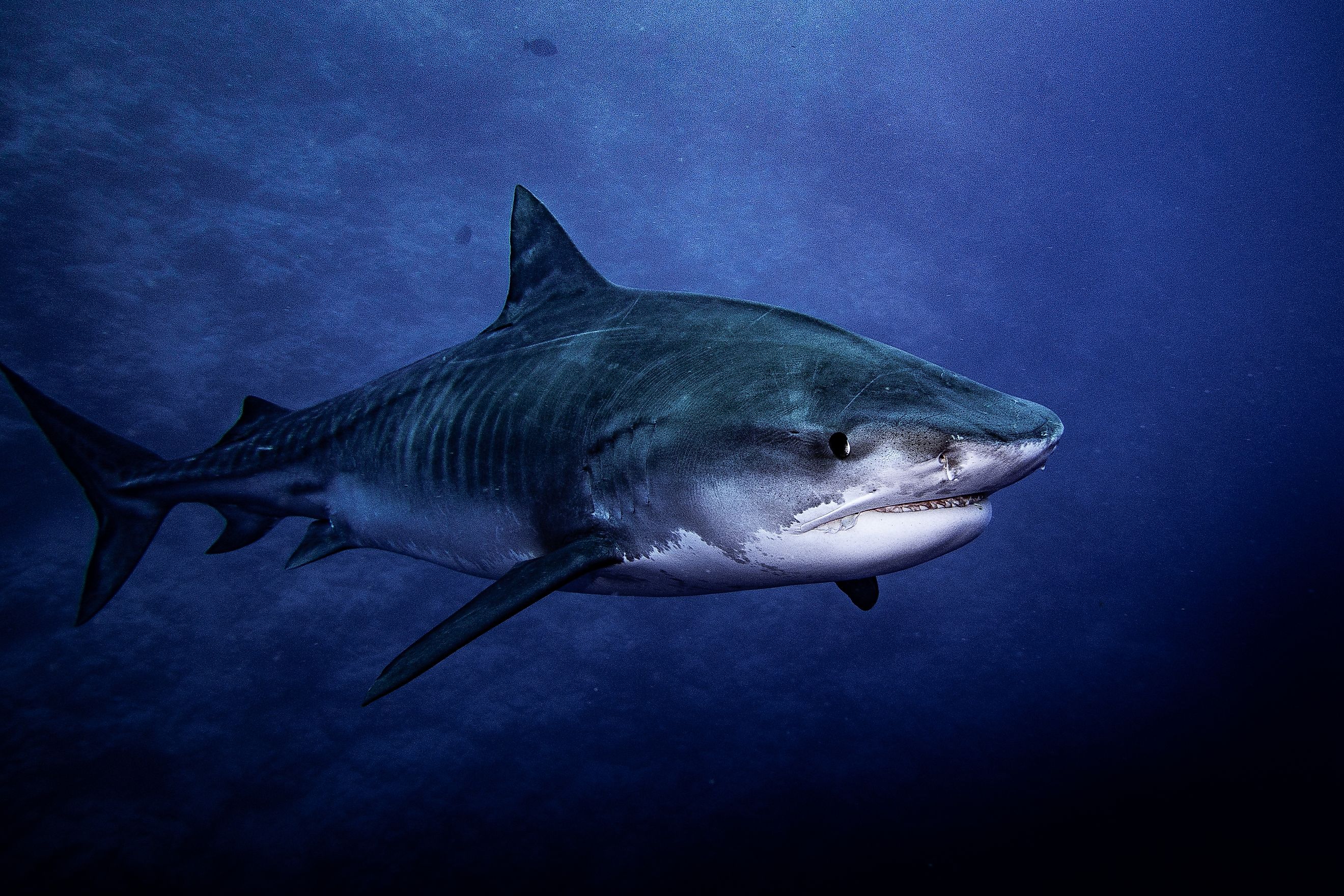
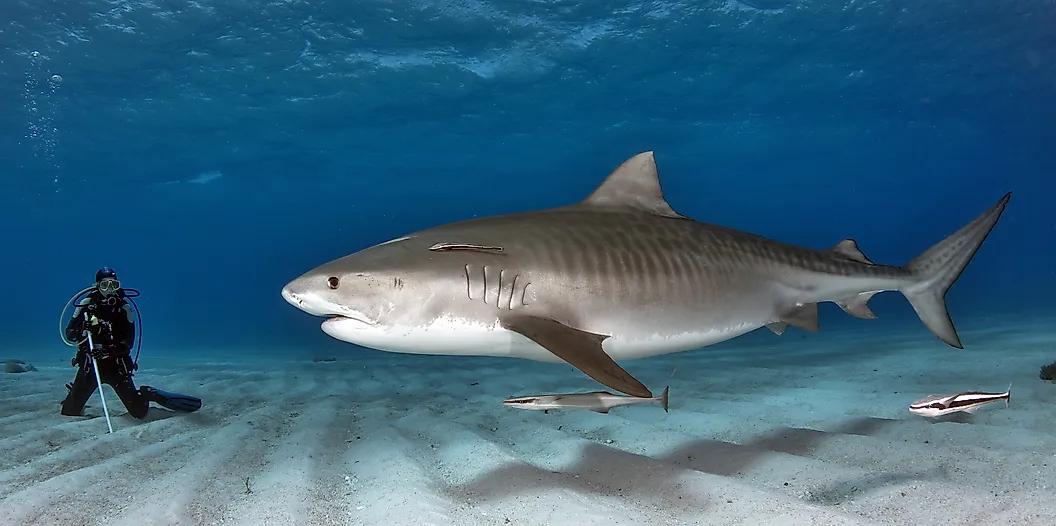
Tiger sharks are big. Adults commonly run 10 to 14 feet long and weigh somewhere between 850 and 1,400 pounds, and large females, which outsize the males, can push past 16 feet. The body is heavy and powerful, tapering to a blunt, broad snout that looks less streamlined than a great white's and more like the front of a bus. The name comes from the dark vertical bars along the flanks, which are bold and obvious on young sharks and help them stay camouflaged. Here is the fun part: those stripes fade as the shark grows, so the biggest, oldest tiger sharks barely have any tiger left in them at all.
Those Ridiculous Teeth

If tiger sharks have one true party trick, it is their teeth. Both jaws are lined with identical, heavily serrated, cockscomb-shaped teeth that curve to one side like a can opener designed by a horror movie. The serrations even have smaller serrations on them. This gives the tiger shark a rare ability among sharks: it can saw straight through a sea turtle's shell. Where most predators take one look at a turtle and give up, the tiger shark treats it as a crunchy snack, which is a big reason turtles show up so often on the menu.
The Garbage Can of the Sea

The tiger shark has the broadest diet of any shark, and it has earned the nickname "the garbage can of the sea" honestly. On the legitimate menu are fish, rays, sea turtles, dolphins, seals, dugongs, seabirds, sea snakes, squid, and smaller sharks. Then there is everything else. Because tiger sharks investigate unfamiliar objects by simply eating them, researchers cutting open their stomachs have famously found license plates, tires, dog tags, and, in one legendary case, an unopened tin can. The tiger shark is not being gross on purpose. It just has a very relaxed policy on what counts as food.
Behavior

For all their menace, tiger sharks are not pack hunters or social animals. They are mostly solitary and mostly nocturnal, cruising slowly and conserving energy until something worth chasing appears, at which point they can put on a startling burst of speed. They are also famously curious, which is not always a compliment when the animal in question explores the world with its mouth. That mix of a huge size, a bottomless appetite, and a habit of poking around in shallow water is exactly what makes them worth respecting.
Baby Tiger Sharks

Tiger sharks reproduce in an unusual way, even for sharks. The eggs develop and hatch inside the mother rather than in a laid egg case, and she then gives birth to live, fully formed pups after a long gestation of roughly 13 to 16 months. Litters are enormous by shark standards, ranging from around 10 to more than 80 pups at a time, each already a couple of feet long. From the moment they are born, the young are completely on their own, striped up and ready to start hunting without a shred of parental help.
How Dangerous Are They, Really?

Let us address the elephant in the water. Tiger sharks are responsible for the second-highest number of recorded attacks on humans, behind only the great white, and they account for most of the serious shark incidents in places like Hawaii. That reputation is not made up. But it deserves some perspective. Sharks of all kinds kill roughly ten people worldwide in a typical year, while people kill sharks by the tens of millions. Tiger sharks do not hunt humans on purpose, and many bites appear to be curious "test bites" from an animal figuring out whether the unfamiliar thing splashing above it is food. You are the statistical winner in this matchup by a mile.
Why Tiger Sharks Matter
Frightening or not, the tiger shark is doing an important job. As an apex predator, it keeps the populations below it in check, and its mere presence changes how prey behaves. In famous studies from Australia's Shark Bay, the threat of tiger sharks keeps grazers like turtles and dugongs from parking in one spot and overgrazing the seagrass meadows, which keeps the whole ecosystem healthier. In other words, the shark protects the salad by scaring the diners, an effect scientists sometimes call the ecology of fear.
Threats and Conservation
The tiger shark's only real natural predator is the orca, but its far bigger problem is us. Like many of the world's shark species, it is heavily fished for its fins, skin, and liver oil, and it has been targeted by shark-control programs meant to protect swimmers. Add slow reproduction to steady hunting pressure and the numbers start to slip, which is why the tiger shark is now listed as Near Threatened by the IUCN. It is a strange twist that the ocean's most notorious eating machine is, in the end, far more threatened by people than we ever were by it.