The First Ever Animals To Walk On Land
- First fossils of animals that could walk on land were found in a place called Willie’s Hole in Scotland.
- The first creature believed to have walked on land is known as Ichthyostega.
- The first mammals appeared during the Mesozoic era and were tiny creatures that lived their lives in constant fear of dinosaurs.
The question sounds simple, but the answer comes with a twist. The very first animals to move onto land were not our four-legged ancestors at all, but invertebrates: millipedes, early relatives of spiders and scorpions, and other arthropods that were scuttling across damp ground more than 400 million years ago, long before anything with a backbone hauled itself ashore. When people ask about the first animals to walk on land, though, they usually mean the first four-legged vertebrates, the tetrapods, the group that would eventually branch into amphibians, reptiles, birds, and mammals, including us. Their story begins in the shallow, swampy waters of the Devonian period, and some of its most important chapters were written in what is now Scotland. Here is how backboned life learned to walk.
Out of the Water
Tetrapods did not appear from nowhere. They evolved from lobe-finned fishes, whose fleshy, bony fins already held the beginnings of limbs. A famous halfway form is Tiktaalik, a roughly 375-million-year-old "fishapod" from Arctic Canada with a flat, crocodile-like head, a neck, and stout front fins that could prop its body up in shallow water. The crucial point is that fins became limbs in the water, not on land. The earliest limbs were tools for pushing through weedy shallows and mud, and only later turned out to be useful for climbing out of them. By the late Devonian period, true tetrapods, animals with digits instead of fins, had arrived.
The Oldest Footprints
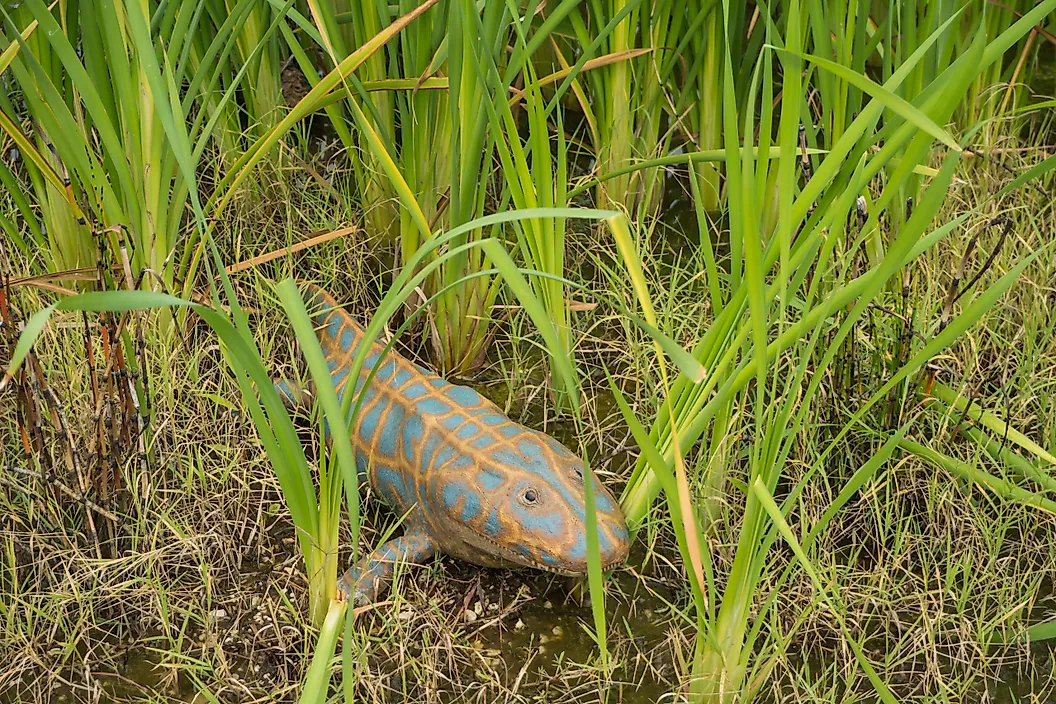
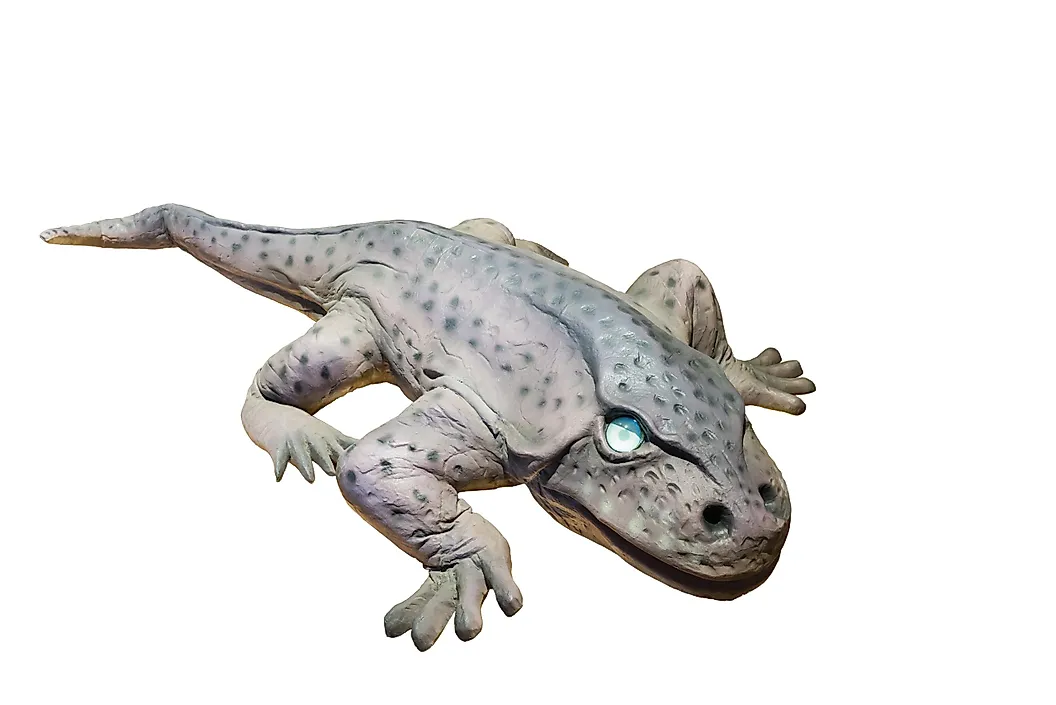
The oldest direct evidence of four-legged animals is not a skeleton but a set of footprints. In a quarry at Zachelmie in Poland, geologists found tetrapod trackways dated to roughly 390 million years ago, some 18 million years older than any tetrapod skeleton yet discovered. Whatever pressed them into the mud was already walking. The best-understood early tetrapods, however, come as body fossils from East Greenland: Acanthostega and Ichthyostega, both from the late Devonian, around 365 to 370 million years ago. Ichthyostega grew to about a meter long and still carried plenty of fish traits, including a finned tail and small body scales. Despite its sturdy limbs, it lived mostly in the water. Rather than striding like a salamander, as scientists once assumed, it probably dragged itself forward on its front limbs in a motion more like a mudskipper, closer to moving on crutches than to a confident walk. Its feet also carried more toes than ours do: Ichthyostega had seven on each hind limb, and Acanthostega had eight.
Scotland And Romer's Gap
For a long stretch just after these Devonian pioneers, the fossil record went nearly silent. The first 15 to 20 million years of the Carboniferous period preserved almost no tetrapods, a frustrating blank that the paleontologist Alfred Sherwood Romer flagged so prominently that it came to be known as Romer's Gap. This is where Scotland enters the story. Along the River Whiteadder near Chirnside in the Scottish Borders, at a site called Willie's Hole, and at nearby Burnmouth, fossil hunters uncovered a trove of early Carboniferous life. In 2016, a research team called the TW:eed Project, led by the paleontologist Jennifer Clack, described five new tetrapod species from these rocks, which are about 355 million years old. They were not the first animals to walk on land, but they were among the first to do it on the now-familiar five-toed limb, and they helped reveal how backboned life recovered and diversified after the end-Devonian extinction. The same Scottish beds preserve some of the period's earliest land invertebrates too, including millipedes and a scorpion.
The Great Divide: Amphibians And Amniotes
By the Carboniferous, the five-digit limb had become the standard blueprint, and the various lineages sporting six, seven, or eight digits had died out. Around this time the tetrapods split into two great branches that still shape the living world. One led toward the amphibians, by way of a diverse group called the temnospondyls. The other led toward the amniotes, the lineage that includes reptiles, birds, and mammals. The dividing innovation was the amniotic egg, a self-contained capsule with its own protective membranes and fluid that could be laid on dry land. Amphibians never solved that problem and still return to water to breed, which is why frogs lay their eggs in ponds. Amniotes, cut loose from the water's edge, could spread deep into the continents.
The Rise Of The Synapsids

The amniotes soon divided again, into the synapsids and the sauropsids. The sauropsids would go on to produce reptiles and, eventually, birds. The synapsids are the branch that leads to us. Through the Permian period, synapsids, including the more advanced therapsids, were the dominant large animals on land. Then, about 252 million years ago, came the Permian-Triassic extinction, the most severe mass extinction in the planet's history, often called the Great Dying. It erased the majority of species on land and in the sea and reset the course of evolution. The synapsids pulled through, but in a far humbler role.
The Age Of Reptiles

In the recovering world of the Triassic and Jurassic periods, a sauropsid group called the diapsids took center stage. The diapsids gave rise to the crocodiles, the flying pterosaurs, the dinosaurs, and, modern evidence indicates, the turtles, whose skulls were long thought to place them on a separate branch. For roughly the next 180 million years these reptiles ruled land, sea, and sky, and the Mesozoic era became the age of the dinosaurs.
And Then, Mammals

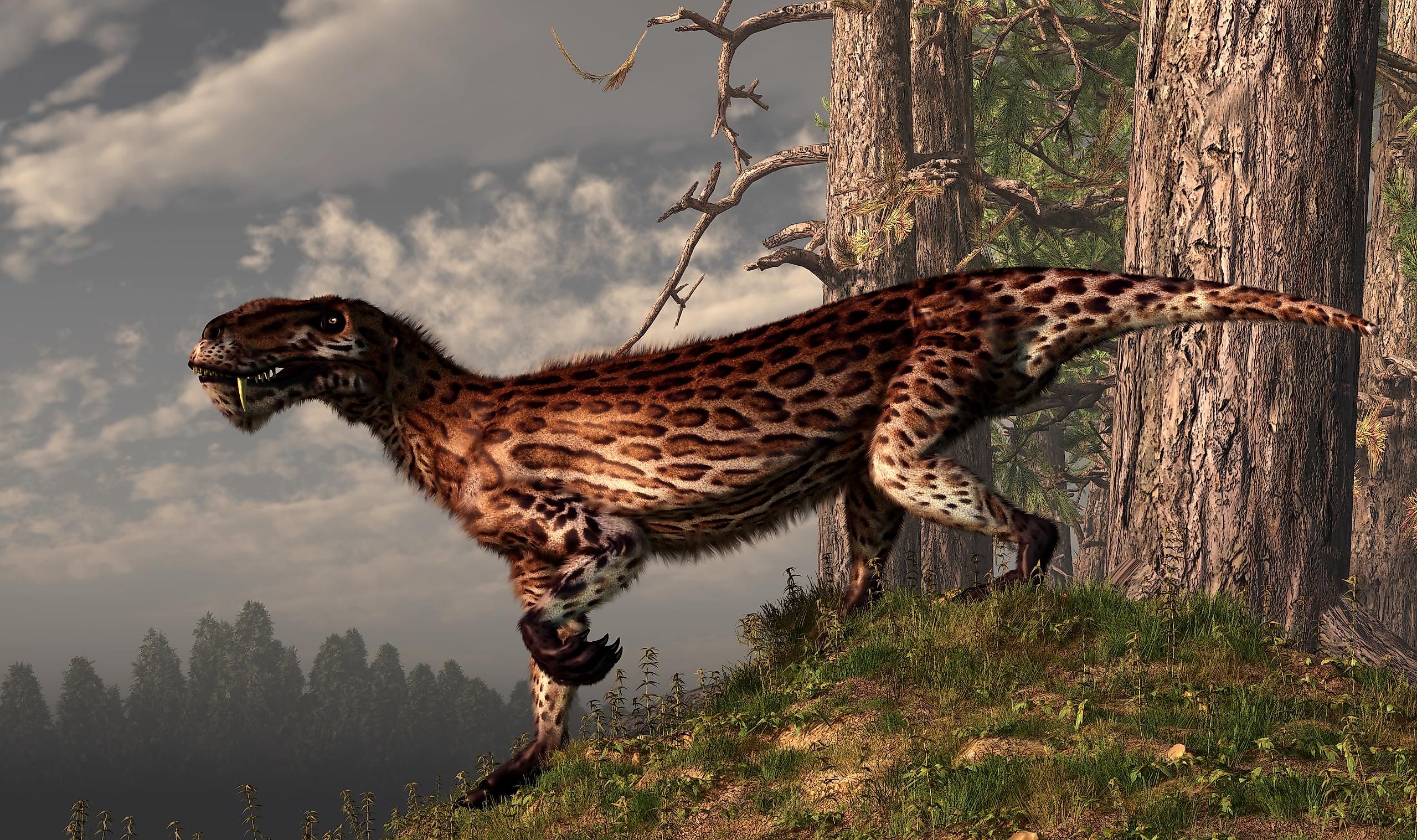
The mammals were present the whole time, keeping a low profile. The first true mammals appeared in the late Triassic, around 210 to 225 million years ago, evolving from small, advanced therapsids called cynodonts that had already acquired fur and a warm-blooded metabolism. The line between the last non-mammalian synapsids and the first mammals is genuinely blurry, drawn along fine details of the jaw and ear bones. These earliest mammals were tiny, most no larger than a mouse. Sharing the world with the dinosaurs, they mostly stayed out of the way, hunting insects by night and sheltering by day. That long nocturnal apprenticeship shaped mammalian senses for tens of millions of years, and their moment would not arrive until the dinosaurs were gone.
A Long Walk
Nearly 400 million years separate that first Devonian footprint from the crowd of animals walking the Earth today. Every land vertebrate now alive, every frog, eagle, lizard, whale, and human, traces its family tree back to those first tentative steps out of the water. And a surprising amount of that early chapter is still being read out of the rocks of Scotland.