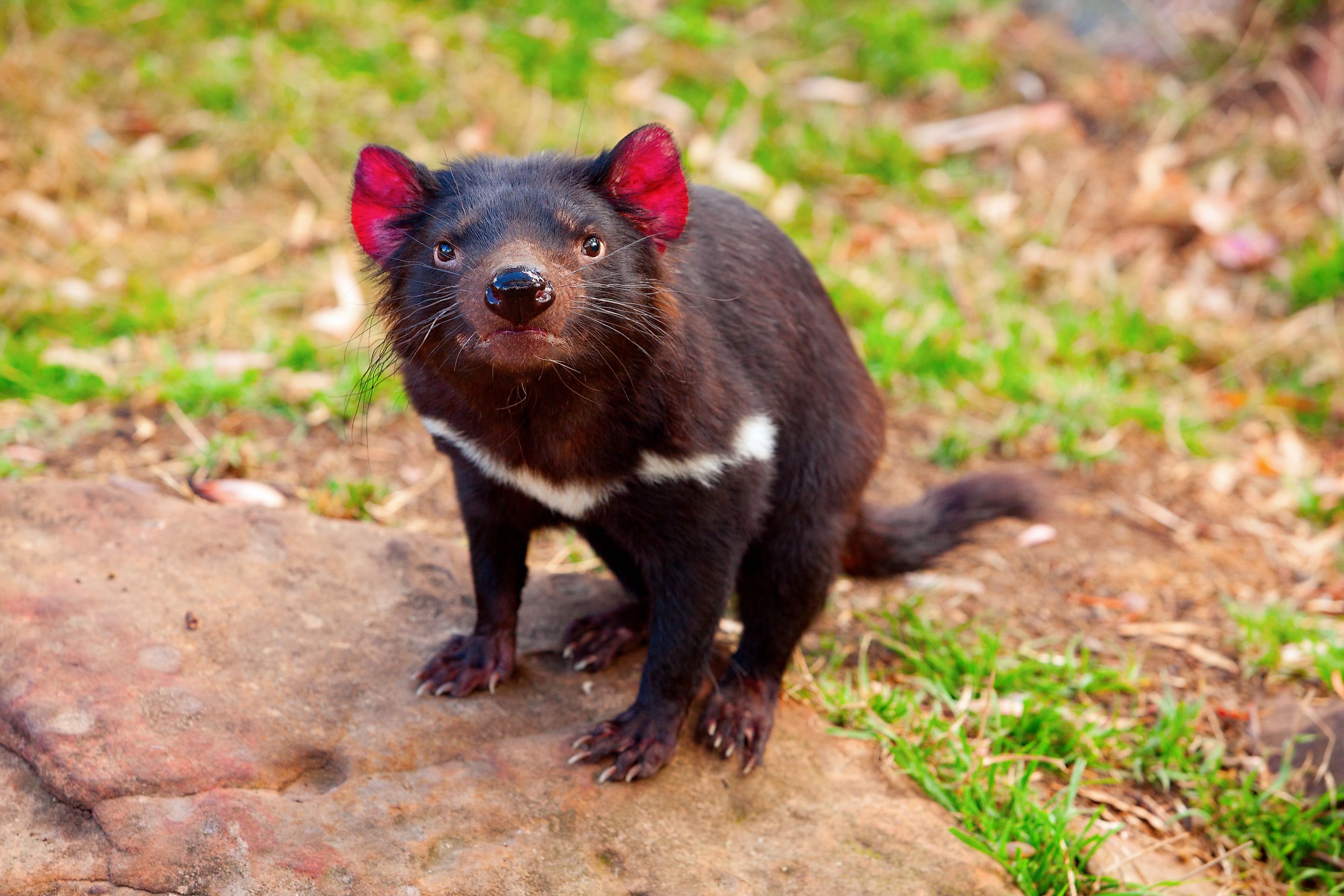
Tasmanian Devil
Few animals have a reputation as loud as their bite. The Tasmanian devil (Sarcophilus harrisii) is the world's largest surviving carnivorous marsupial, a stocky, black-furred scavenger about the size of a small dog, famous for a blood-curdling screech that helped earn it its name. It is also one of the most closely watched animals on Earth, because a bizarre and deadly cancer has pushed the species to the edge over the past three decades. Here is a closer look at Tasmania's ferocious, embattled icon.
Range and Habitat

Today the Tasmanian devil lives in the wild in just one place: the island of Tasmania, off the southern coast of mainland Australia. It once ranged across the Australian mainland as well, but it vanished from there thousands of years ago, most likely squeezed out by the arrival of the dingo. On Tasmania it turns up almost everywhere, from dry eucalyptus forests and coastal woodlands to farmland and the edges of towns. In 2020, a small population was reintroduced to a sanctuary on the mainland in an effort to build a safety net for the species.
Physical Description

For all its fearsome billing, the devil is not large. Big males weigh up to around 12 kilograms and stand only about 30 centimeters at the shoulder, with females noticeably smaller. The body is thickset and muscular, covered in coarse black fur, usually with a white blaze across the chest and rump, and it moves with a low, lumbering, almost piglike gait. The real weapon is the head. A devil's broad skull is packed with muscle and lined with bone-crushing teeth, giving it, pound for pound, one of the most powerful bites of any land mammal, strong enough to chew straight through bone.
Behavior

The Tasmanian devil is mostly nocturnal and largely solitary, spending its days holed up in a den, a hollow log, or thick brush, then roaming for miles after dark in search of food. It is famously, theatrically loud. When several devils gather at a carcass, they erupt into a chorus of screeches, growls, and snarls, along with wide-mouthed gaping displays that look terrifying but are mostly bluff and bluster used to sort out the pecking order without a real fight. That unearthly noise, heard echoing through the bush at night, is exactly what unnerved early European settlers and gave the animal its diabolical name.
Diet

Devils are carnivores and, above all, dedicated scavengers. They will hunt small live prey such as possums, wallabies, birds, and insects, but they truly shine as the bush's cleanup crew, descending on the carcasses of animals far larger than themselves. Little goes to waste. A devil eats hide, fur, and bone along with the meat, and a group can reduce a dead wombat to almost nothing. This appetite for carrion makes the species genuinely useful, since by clearing carcasses quickly it helps keep maggots and disease in check across the landscape.
Reproduction

Like all marsupials, the devil gives birth to tiny, underdeveloped young that finish growing in a pouch. Mating happens around March, and after a gestation of only about three weeks, a female can produce 20 or more minuscule babies at once. Here the odds turn brutal, because she has just four teats in her pouch. The newborns must scramble to latch on, and only the first four to arrive survive. Those lucky few stay in the pouch for around four months before moving to a den, and they are fully independent by roughly eight or nine months of age.
The Devil Facial Tumour Disease
The greatest threat to the species is one of the strangest diseases in all of nature. Devil facial tumour disease, first spotted in 1996, is a contagious cancer, one of only a handful known to science. The tumour cells themselves are the infection: when devils bite one another during their squabbles over food and mates, living cancer cells pass directly from one animal to the next. The devil's immune system fails to recognize them as foreign, and grotesque tumours grow around the face and mouth until the animal can no longer eat and starves, usually within months. Because biting is so central to devil life, the disease has spread relentlessly across the island.
Threats and Conservation

The toll has been staggering. In affected areas the disease has wiped out the large majority of devils, and the total wild population has fallen from an estimated 140,000 to somewhere in the range of 10,000 to 20,000, which is why the IUCN lists the species as endangered. Road strikes add further losses, since devils are drawn to roadkill. There is, however, real reason for hope. Programs like Save the Tasmanian Devil have established disease-free insurance populations, including one on Maria Island, and researchers have begun to document devils that appear to resist or even recover from the tumours, a sign the species may be evolving its own defense faster than anyone expected.
Importance
Beyond the science, the Tasmanian devil is a cultural emblem. It is the unofficial mascot of Tasmania, a fixture of the island's identity and tourism, and, by way of a certain spinning cartoon character, one of the most recognizable of the animals found only in Australia. Ecologically it matters just as much. As the island's dominant carnivore and its most efficient scavenger, a healthy devil population helps keep introduced predators like feral cats in check, which is one more reason the fight to save it reaches well beyond a single feisty marsupial.