Malayan Tiger
The Malayan tiger is one of only six extant tiger subspecies left in the world. This hidden feline still wanders the rainforests of the Malayan Peninsula, yet it is at risk of going extinct due to several external threats primarily caused by human activity. These efforts are further complicated by disagreements over taxonomy and whether these tigers should be viewed as distinct from other southeastern Asian subspecies. It's smaller than some of its other cousins, but it lacks none of the strength or powerful senses of other tigers.
Taxonomy

The Malayan tiger's scientific name has been a matter of some debate. In the 1960s, it was initially referred to as Panthera tigris corbetti, but in 2004, the term Panthera tigris jacksoni was adopted due to mitochondrial differences between Malayan tigers and other tigers in southeastern Asia. The word jacksoni derives from tiger conservationist Peter Jackson.
There was some debate in 2017 and 2018 regarding whether Malayan tigers should be classified simply as Panthera tigris tigris or as Panthera tigris jacksoni. One paper from the IUCN states that "The taxonomic status of tigers in Indochina and the Malay Peninsula is still unclear; 'jacksoni' is diphyletic, based on mtDNA, and must have originated very recently from corbetti. Subspecies corbetti shows further genetic structure which does not appear to have geographical significance."
Furthermore, it recommended the term Panthera tigris tigris to refer to several groups of tigers in Southeast Asia. However, a study in 2018 argued that the Malayan tiger was genetically distinct enough from other subspecies to categorize it as Panthera tigris jacksoni. Today, that designation is used by official governments, including Malaysia.
The study did note that the species itself is filled with "protracted controversies over its intraspecies taxonomy." It further adds that "The lack of consensus over the number of tiger subspecies has partially hindered the global effort to recover the species from the brink of extinction, as both captive breeding and landscape intervention of wild populations increasingly require an explicit delineation of the conservation management units."
The genus Panthera itself refers to many large cats from the cat family Felidae. It consists of leopards, tigers, lions, and jaguars, along with pumas that are commonly called panthers, such as the Florida panther. Tigris stands for the species of tigers themselves. They are the largest of the Felidae, and consist of 6 recognized subspecies today, including the Malayan Tiger.
Range and habitat

It is easy to remember where the Malayan tiger can be found, as the tiger is native to the Malayan Peninsula, which includes the southern tip of Thailand and the country of Malaysia, specifically on the peninsula, not the land on the island of Borneo to the east.
Their preferred habitats are tropical and subtropical rainforests. The Malaysian rainforests are known for being diverse in species, with an estimated 12,500 seed plant species. These rainforests are fed by heavy rain, which can total between 100 and 204 inches annually. Malayan tigers in particular are known to live in the Perak, Kelantan, Pahang and Terengganu forests of the Malaysian Peninsula. They can swim in the rivers throughout these forests and use them for travel or to cool off.
Unfortunately, due to habitat destruction and illegal hunting, there are fewer than 300 Malayan tigers existing in the wild, mainly contained within the Belum-Temengor, Taman Negara and Endau-Rompin forests in protected regions. Some estimates put their numbers at as low as 150 members left in the wild. The Taman Negara National Park is one of the top spots for Malayan tigers today.
Physical characteristics

The Malayan tiger is one of the smallest of the tigers, growing between 7.5 and 8.5 feet long and weighing up to 300 pounds. It is larger than Sumatran tigers, the smallest tiger subspecies that weighs close to 265 pounds.
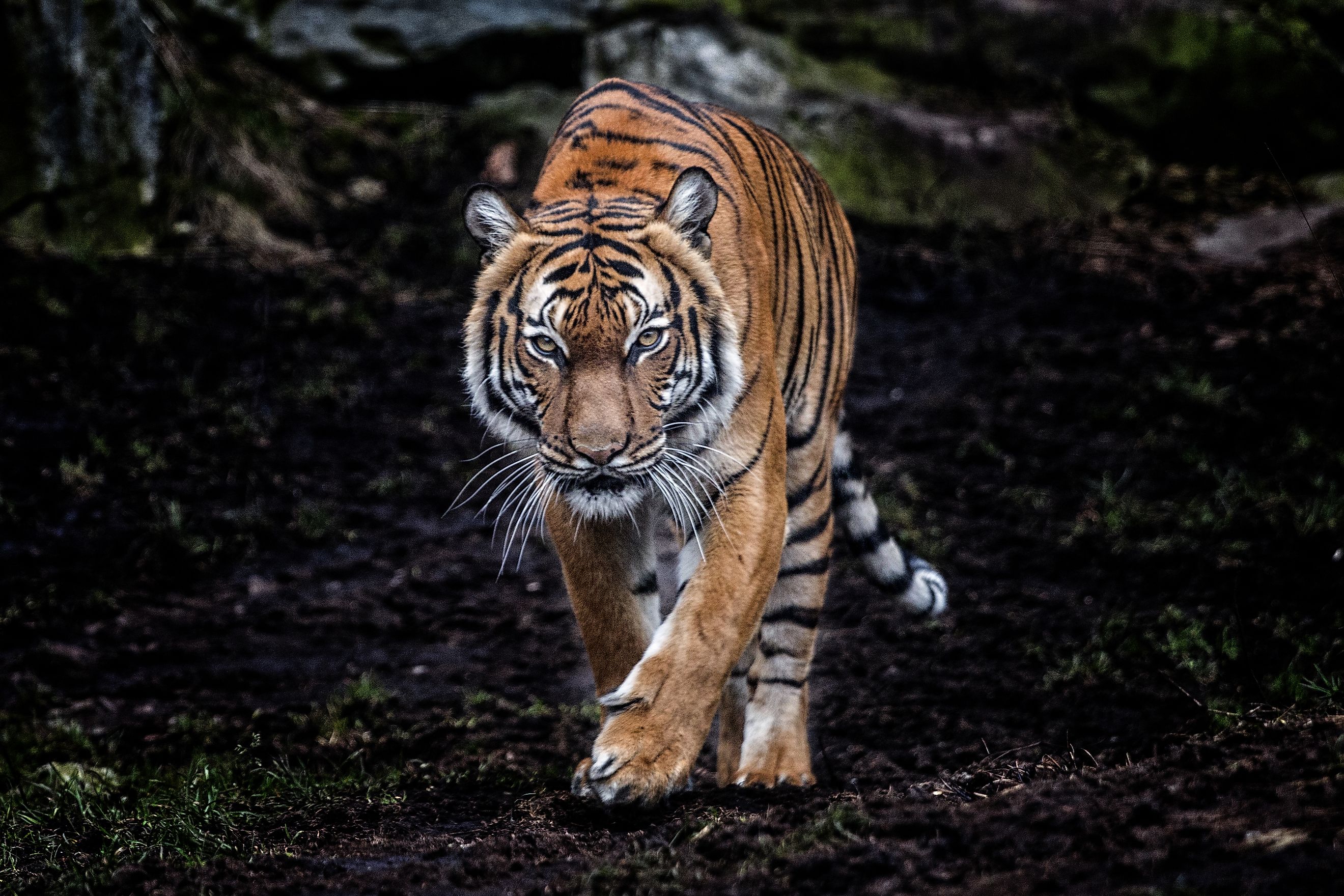
Like many tigers, it is primarily identifiable by its orange fur. In Malaysia, tigers in general are nicknamed Pak Belang, meaning Uncle Stripes. Malayan tigers share many of the same characteristics as tigers more generally, such as black stripes, white bellies, and white spots on their ears. Their tiger stripe markings are what set them apart. Every tiger has a slightly different stripe marking pattern, which is helpful for researchers tracking populations of tigers.
Tigers have powerful bite forces as well, measuring somewhere between 950 and 1,050 psi, which is more powerful on average than that of a lion, which tends to fall around 650 psi, but not as great as jaguars, which exert a bite force of 1,500 psi. The Malayan tiger's paws are padded to avoid detection when sneaking up on prey, along with retractable claws, heavily muscled forelimbs and necks, and whiskers for navigating.
It has excellent eyesight as well, with more rods than cones. These rods are what give tigers such excellent night vision, as they can detect the shapes of prey in the darkness. Their eyes also possess a tapetum lucidum at the back of the eye, which reflects light, which is useful in the night. This is also why shining a light at a tiger in the night will make their eyes glow. Due to their lesser number of cones, tigers cannot see colors as vibrantly, although they can generally distinguish between green and blue colors. Tigers' hearing is also highly developed, able to hear sounds up to 60 kHz, but their sense of smell is less developed.
Food/hunting

Malayan tigers are carnivores, and they can find plenty of prey in the Malaysian rainforests. They are highly opportunistic and will pursue a mixture of small and large prey. Of smaller prey, they will eat monkeys, porcupines, and sun bears, while the more valuable prey are barking deer, bearded pigs, wild boars, and sambar deer.
A DNA analysis of Malayan tiger scat found that the tigers subsist mainly on wild ungulates such as sambar deer and chital, while domestic cattle made up the largest share of the prey biomass in their diet. That reliance on livestock points to how often these tigers now range near farmland as their forest habitat shrinks.
Malayan tigers hunt through ambushing prey, usually by clenching onto its neck with its jaws. These attacks can suffocate prey or kill them if the jaws hit an artery, causing them to bleed out. Malayan tigers can display impressive bursts of speed at up to 37 miles per hour.
Unlike the more social lion, Malayan tigers hunt alone, typically at night. They can eat up to 80 pounds of meat in one meal, and are known to hide carcasses under the dirt as leftovers to return to later.
Reproduction/communication

Although Malayan tigers are solitary creatures, they do have ways of communicating with each other. This can be done by marking territory by scraping on trees or urinating or defecating on their territories. They can also roar or grunt at each other or moan as a way to communicate with each other.
The one time Malayan tigers break their usually solitary behavior is during the mating period from November to March. Males reach sexual maturity at 5 years of age, while females do at around 3. During mating season, females will urinate on an area to attract potential mates. This is exclusively female behavior, as males will urinate to mark their territory.
Once pregnant, female tigers will have a gestational period of 100 to 105 days and give birth to a litter of 3 to 4 cubs. The mothers will raise these cubs until they are mature at 2 years old. This is the only social group of Malayan tigers that one will find.
Threats

Due to their low numbers mentioned above, Malayan tigers are classified as critically endangered by the International Union for Conservation of Nature.
The primary factor causing this is habitat destruction through deforestation. This forces tigers onto smaller habitats, which means they have less access to prey. The deforestation also puts tigers at risk of coming into contact with humans, such as a pregnant Malayan tiger that was killed in 2016 when she was hit by a vehicle on the East Coast Highway II in Malaysia.
Illegal hunting is another factor. Poachers will set snares to catch tigers, which they can only escape by chewing off their own paws. Poachers primarily target these tigers for their fur, along with skin, teeth, and meat. Malayan tigers can also lose their primary prey through overhunting.
In order to protect the remaining Malayan tigers, the Malaysian government has established protected national parks, as mentioned above. They have also worked with the World Wide Fund for Nature to combat poaching. For example, the WWF was able to reduce snaring by more than 90% within the Royal Belum State Park. They have also worked to expand the number of ranger teams keeping watch over the tigers to nearly 150 in total from only 12 in 2015 and helped establish a Wildlife Crime Bureau. Their efforts have shown some helpful signs of recovery, such as a tigress with four cubs in 2022 and a tigress with two cubs towards the end of 2025.
How to help protect Malayan tigers
There are several ways to help protect these critically endangered tigers. The first is to donate directly to organizations like the WWF that have a presence in Malaysia. These groups need funding to pay for educational programs, conservation efforts, and to develop policies that protect farmers and others who live close by to tiger habitats. Another is to take eco trips to the Taman Negara National Park. These eco trips provide much-needed funds and awareness for conservation projects. A third is to simply spread awareness to one's social networks and groups about the threats posed to Malayan tigers and common-sense methods to protect them.