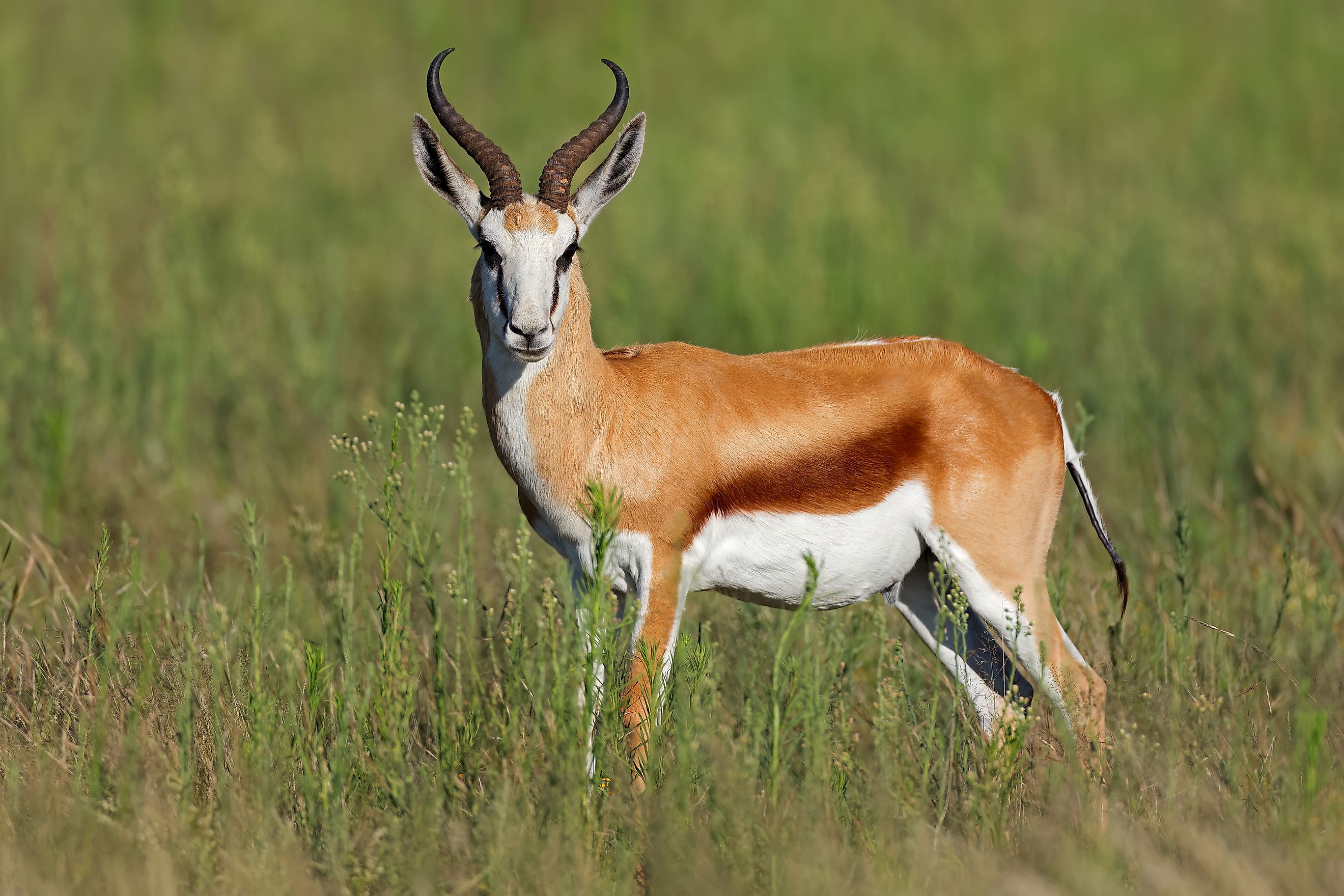
Springbok
The springbok is one of southern Africa's most distinctive antelopes, best known for its remarkable leaps and incredible speed. When startled or excited, this southern African antelope performs a series of stiff-legged leaps, springing high into the air while arching its back and raising the white hair along its spine. Known as pronking, the display can propel the animal more than 6 feet (2 m) off the ground. It is one of the most familiar sights in the African bush and reflects the springbok's adaptation to open landscapes and high-speed movement.
The springbok (Antidorcas marsupialis) is a medium-sized antelope of the dry savannas, grasslands, and semi-deserts of southern Africa. It is slender, quick, and marked with a crisp pattern of cinnamon brown, white, and a dark band along each flank. Reaching short-burst speeds of up to 55 miles per hour (88 km/h), it ranks among the fastest land animals on Earth, trailing only the cheetah and the pronghorn.
The springbok is also a national emblem. It is the national animal of South Africa and the namesake of the country's rugby team. Beyond the symbolism sits a notable survivor, one of the very few African antelopes whose numbers are holding steady or rising while so many others fall.
Taxonomic Classification

The springbok belongs to the family Bovidae, which contains cattle, goats, sheep, and antelopes. Within that family it sits in the subfamily Antilopinae and the tribe Antilopini, the group that holds the true gazelles and their closest relatives. Its genus is Antidorcas, and the springbok is the only living member of that genus, which makes it a distinctive branch of the gazelle family tree rather than one gazelle among many.
The German zoologist Eberhard August Wilhelm von Zimmermann described the species in 1780. The scientific name repays a closer look. The species word marsupialis comes from the Latin marsupium, meaning pouch, and it points to the pocket-like fold of skin that runs along the animal's back. It does not mean the springbok is a marsupial. The common name has a simpler origin, drawn from the Afrikaans words spring, to jump, and bok, a buck or antelope, with the first recorded use dating to 1775.
Three subspecies are currently recognized. Antidorcas marsupialis marsupialis occurs in South Africa, Antidorcas marsupialis hofmeyri ranges through the north and west of the animal's distribution in Namibia and Botswana, and Antidorcas marsupialis angolensis is found in southwestern Angola. Springbok share the gazelle body plan, though they differ in a small anatomical detail, carrying 28 teeth with one fewer pair of grinding teeth than a true gazelle.
Physical Description

The springbok is a lightly built antelope standing roughly 28 to 34 inches (71 to 86 cm) at the shoulder, with a head-and-body length of about 47 to 59 inches (120 to 150 cm). Adults weigh somewhere around 60 to 93 pounds (27 to 42 kg). Males average close to 90 pounds (41 kg) and females about 82 pounds (37 kg), so the sexes are similar in size compared with many larger antelopes where males tower over females.
The coat carries a clean, high-contrast pattern that helps herd members recognize one another at a distance. The upper body is a warm cinnamon or reddish brown, the underparts and rump are white, and a dark reddish-brown to near-chocolate stripe separates the two along each flank. The face is mostly white, crossed by a dark line running from each eye toward the mouth. This bold marking makes the springbok easy to pick out on the open plains.
Both males and females carry horns, which sets the springbok apart from many antelopes in which only the males are horned. The horns are black, ringed, and lyre-shaped, curving back and then inward. Male horns are the longer and heavier of the two, measuring around 14 to 19 inches (35 to 48 cm). The animal's signature feature runs down its back, a fold of skin lined with long white hairs. Normally it lies flat and hidden. During pronking or moments of alarm the fold opens, flares the white crest upward, and creates a striking visual flag. This pouch of skin gave the species its name. Long legs and a spare, aerodynamic frame round out an anatomy tuned for sprinting and leaping across exposed ground.
Range and Habitat

The springbok is an animal of southern and southwestern Africa. Its range covers South Africa, Namibia, Botswana, and the southwestern corner of Angola. It favors open, dry country, including the Karoo scrublands, the Kalahari thornveld, Highveld grasslands, and semi-desert plains. Broad, flat terrain suits it well, because good visibility lets the animal spot approaching predators early and rely on its speed to escape. It tends to avoid dense woodland and thick cover.
The picture today looks different from the one a few centuries ago. Springbok once roamed much of the southern African interior in enormous numbers, but the species vanished from large parts of its former range over the last century. Hunting, the cattle disease rinderpest, and the spread of farm fences that blocked migratory routes all played a part. The story since then has been one of recovery. Springbok have been reintroduced widely to private land and protected areas, and the largest populations now live on game farms and reserves in South Africa and Namibia rather than on open, unfenced range.
Diet

The springbok is a mixed feeder, meaning it both grazes and browses. It crops grasses when they are green and fresh, and it turns to shrubs, herbs, and succulents when the grass dries out, which makes it flexible enough to find food across seasons and habitats. This adaptability is one reason the species does so well in arid environments that would defeat a strict grazer.
The most remarkable part of the springbok's feeding is its independence from standing water. The animal draws most of the moisture it needs directly from what it eats, favoring succulent plants and wild melons such as the tsamma, and it produces additional water through the digestion of its food. A springbok can go for long stretches, in some conditions months, without drinking at all. It also times its feeding to the cooler parts of the day to conserve moisture. That water economy allows springbok to live in semi-desert country where surface water is scarce for much of the year.
Behavior

Springbok are social animals that gather in herds. In the past, before fences carved up the land, they were famous for mass movements known as trekbokke, when vast aggregations crossed the Karoo and Kalahari in numbers that observers described as herds stretching to the horizon. These treks ranked among the largest gatherings of mammals ever recorded on the continent. Modern land use has ended them, and springbok now move in far smaller herds within their reserves and farms.
The behavior that defines the species is pronking, sometimes called stotting. In this display, the animal springs repeatedly into the air on stiff legs with its back arched and the white dorsal crest raised. Biologists still debate its exact purpose. Leading ideas hold that it advertises an individual's fitness to a watching predator, signaling that the animal is healthy and hard to catch, and that it warns the rest of the herd that danger is near. It may also serve a social role among springbok themselves. Whatever its function, pronking is a distinctive sight and a reliable sign of an excited or nervous herd.
Day to day, springbok feed most actively in the cooler hours of morning and late afternoon and rest during the heat. Herds may be mixed groups of males and females, bachelor bands of young males, or territories held by dominant adult males during the breeding period. Their first and best defense is movement, combining outright speed with sharp, unpredictable turns that make them hard for a chasing predator to run down.
Reproduction

Springbok reach breeding age within their first year or two of life. Breeding can happen across the year, but it often peaks in the dry season so that lambs are born during the wetter months when food is more plentiful and a nursing mother can meet the demands of feeding a calf. Dominant males hold territories and compete for the chance to mate with females passing through.
Gestation lasts roughly 167 to 170 days, a little under six months, and almost always produces a single lamb. As her time approaches, a pregnant female leaves the herd and gives birth in cover. For the first weeks of life the lamb stays hidden in vegetation while the mother feeds nearby and returns to nurse, a strategy that keeps the vulnerable newborn out of sight of predators. The pair rejoins the wider herd once the lamb is strong enough to keep up. In the wild, springbok typically live around seven to ten years.
Importance to the World

Ecologically, the springbok is a central prey animal across the southern African plains. Cheetahs, lions, leopards, wild dogs, spotted hyenas, and jackals all hunt it, and its abundance helps support these predators. As a mixed feeder moving across grassland and scrub, it also shapes the vegetation it depends on, part of the ordinary machinery of a healthy savanna.
The species carries real economic weight as well. Springbok are among the most popular game animals in the region, valued for their lean, well-regarded venison and their hides, and they draw hunters and wildlife tourists to game farms and reserves. Culturally, the springbok stands as the national animal of South Africa and lends its name and image to the national rugby side, giving it a place in the country's identity that reaches far beyond the veld.
Threats and Conservation

The International Union for Conservation of Nature lists the springbok as Least Concern, its lowest category of concern, and records the population trend as stable. It stands out as one of the very few African antelopes whose long-term numbers have been rising rather than falling. The total population across southern Africa is estimated at somewhere around 2,000,000 to 2,500,000 animals, and the species is well represented in protected areas including Etosha National Park in Namibia and the Kgalagadi Transfrontier Park shared by South Africa and Botswana.
That comfortable status hides a change worth noting. The historical threats of unregulated hunting, rinderpest, and fencing stripped springbok from much of their former open range, and the great migratory treks are gone for good. The concern now is less about the species surviving and more about how it lives, with most animals confined behind fences on managed land where movement and gene flow depend on human decisions. As long as that management continues, the springbok's outlook remains strong, a rare bright spot among Africa's antelopes.
Takeaway
The springbok is remarkably well suited to the harsh, open landscapes of southern Africa. Its speed and powerful leaps help it evade predators, while its ability to get by on moisture-rich plants allows it to survive in the dry Karoo and Kalahari. Its striking markings also help keep the herd together as animals move across open ground. These adaptations have helped the springbok recover after a century of heavy pressure and population declines across much of its former range. Today, it stands as both a national symbol and one of southern Africa's most successful conservation stories.
Fun Facts

- Third fastest animal on land. Only the cheetah and the pronghorn are quicker, with the springbok clocked in short bursts at up to 55 miles per hour (88 km/h).
- The pronk is real. Its stiff-legged bounding leaps, called pronking, can lift the animal more than 6 feet (2 m) into the air and are named for the Afrikaans word for showing off.
- Not a marsupial. The species name marsupialis refers to a pouch of skin along the animal's back that flares a crest of white hair, not to any relationship with kangaroos or opossums.
- It barely drinks. By eating succulents and wild melons and drawing water from digestion, a springbok can go for months without touching standing water.
- Herds once darkened the plains. Historical treks known as trekbokke crossed southern Africa in numbers so large they were counted among the greatest mammal gatherings ever recorded.
- A national icon. The springbok is the national animal of South Africa and the namesake of the country's rugby team, the Springboks.
Quick Facts
- Scientific name: Antidorcas marsupialis
- Family and order: Bovidae, Artiodactyla (subfamily Antilopinae, tribe Antilopini)
- IUCN status: Least Concern, population stable to increasing
- Shoulder height: about 28 to 34 in (71 to 86 cm)
- Head-and-body length: about 47 to 59 in (120 to 150 cm)
- Weight: about 60 to 93 lb (27 to 42 kg)
- Top speed: up to 55 mph (88 km/h) in short bursts
- Lifespan: around 7 to 10 years in the wild
- Diet: herbivore and mixed feeder, grasses, shrubs, herbs, and succulents
- Range: southern and southwestern Africa, mainly South Africa, Namibia, Botswana, and southwestern Angola