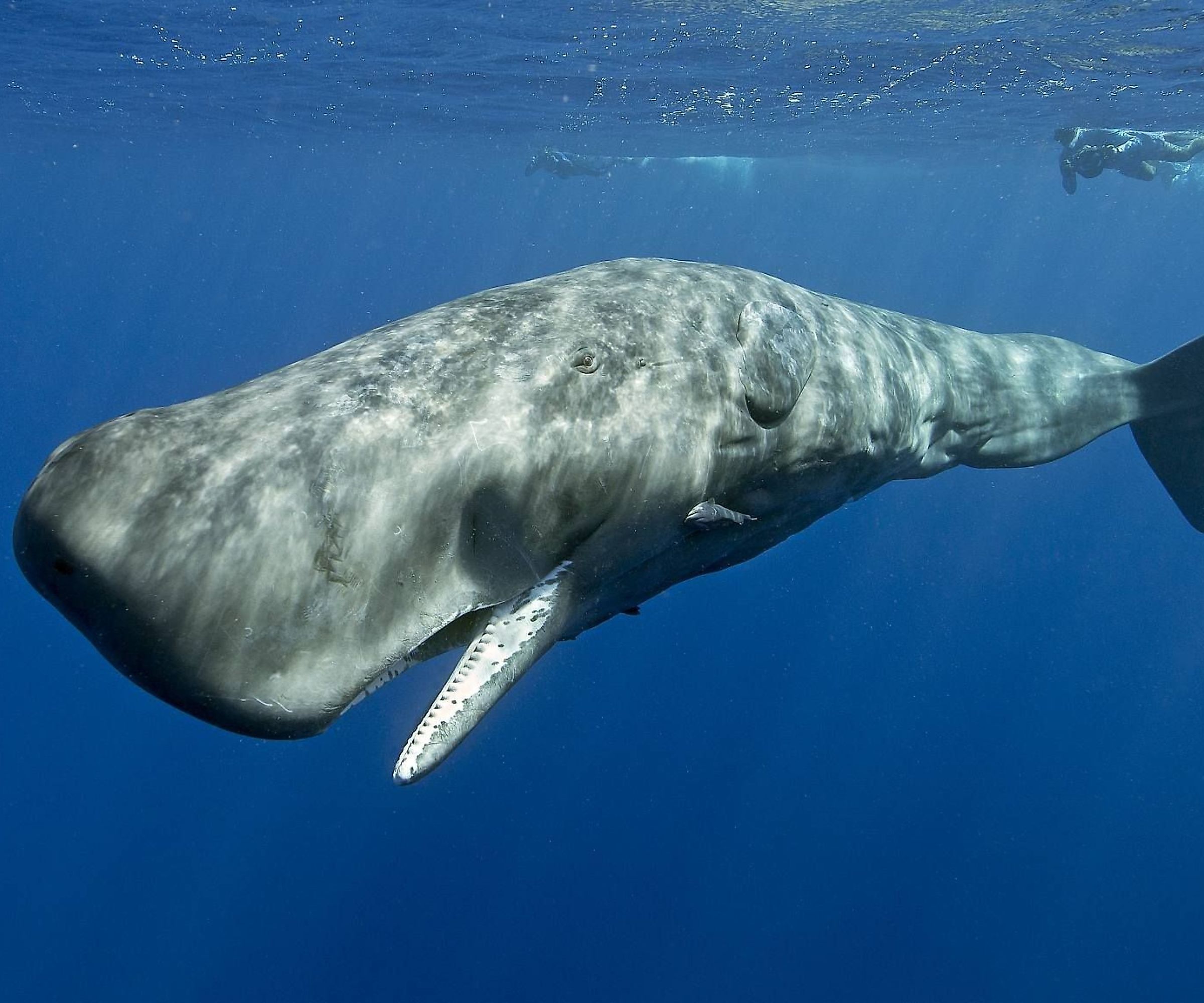
Sperm Whale
The world's most famous sperm whale, Moby Dick, was based on a real albino whale which lived off the Chilean island of Mocha. Mocha Dick, as the whale was known, was said to have had over 100 "fights" with whaling ships, and was rumored to have 19 harpoons protruding from his back from other whalers.
The sperm whale (Physeter macrocephalus) is the largest of all toothed whales. Male sperm whales can reach lengths of around 52 feet (15.8 meters) and weigh about 45 tons (40.8 metric tons), while females reach lengths of around 40 feet (12.2 meters) and weights of about 15 tons (13.6 metric tons). This singular species has become a symbol, to some, of God, nature, and the subconscious depths. Here's everything you need to know about sperm whales.
Physical Characteristics

The long body of a sperm whale is covered with dark gray skin. Their heads take up about a third of their body length. Dull and rounded at the snout, a sperm whale's head contains a waxy substance called spermaceti, which gave the species its common name. The spermaceti organ helps produce and focus the sounds used in echolocation. In the 19th and 20th centuries, sperm whales were heavily hunted for spermaceti, which was used in lamps, candles, and lubricants. A sperm whale's head also has a long, thin lower jaw lined with between 40 and 52 large teeth. Sperm whales have an S-shaped blowhole located on the left side of the head, producing a distinct angled spout when they surface.
Directly behind the head, sperm whales have a small, low dorsal fin that often resembles a hump. On their sides, sperm whales have a pair of small flippers, and at the end of the body are broad triangular flukes. Sperm whales can live for around 60 years. Females reach sexual maturity at around nine years old, while male puberty can extend from roughly 10 to 20 years of age. Males continue growing well into adulthood and may not reach physical maturity until around age 50.
Habitat and Distribution
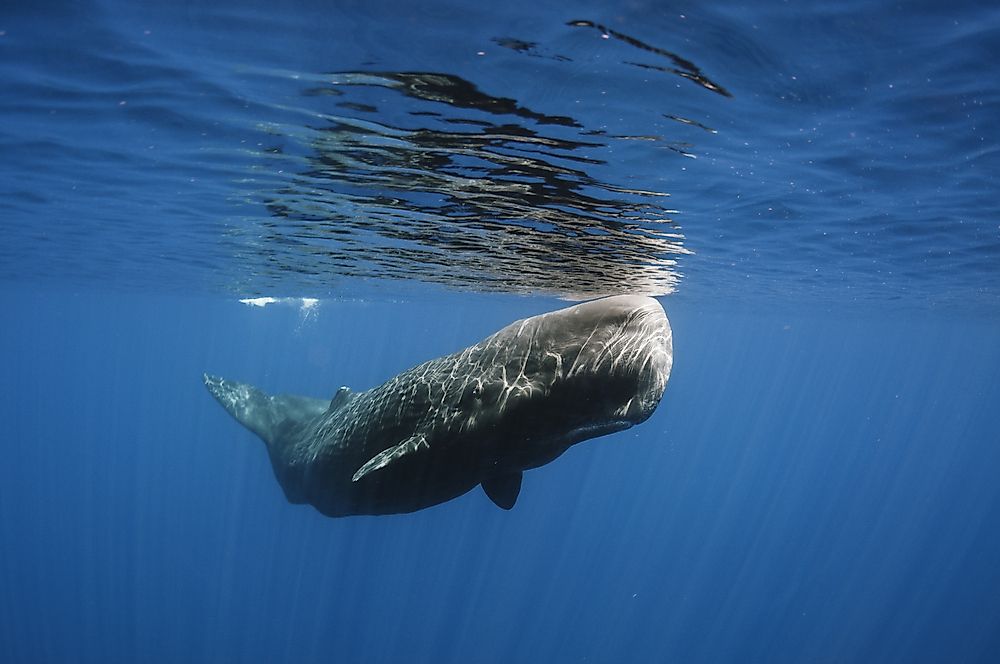
Sperm whales inhabit deep waters throughout the world's oceans. Females and young generally remain in tropical and temperate waters, while adult males can travel into colder waters at much higher latitudes. They are migratory, though their patterns are not as predictable or well understood as those of many baleen whales. Their distribution depends partly on the availability of food and suitable breeding conditions, and their movements vary with age and sex.
Behavior and Communication

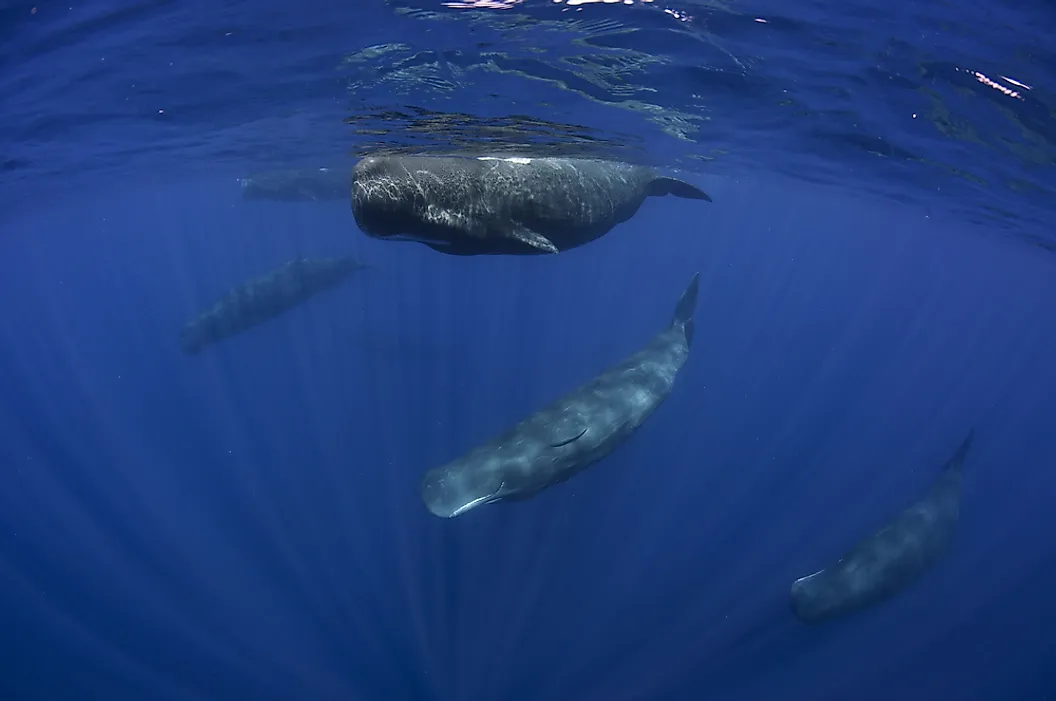
Young sperm whales and females are highly social, living in long-lasting social units that average around a dozen females and their young. These groups are based largely around maternal family lines. Calves continue to nurse for several years, and females generally remain with the same social unit throughout their lives. Male calves eventually leave these female-dominated groups, sometimes joining bachelor groups with males of similar ages and sizes. As males grow older and larger, these groups become smaller and adult males are increasingly likely to travel alone. Large males may later return to tropical and subtropical breeding areas to mate.
The huge heads of sperm whales act as a sophisticated sonar system, allowing them to emit various clicking sounds that they use to communicate and detect prey. Sperm whales communicate socially by producing patterned series of clicks called codas. Different social groups use distinctive coda repertoires or dialects that can be passed down through generations, forming large cultural groups known as vocal clans. Research has also found that codas can contain cues associated with individual whales, social units, and vocal clans, helping whales distinguish among one another.
Diving and Diet

Sperm whales are exceptional divers. Their typical deep foraging dives last around 45 minutes, although some dives last considerably longer, and they can descend thousands of feet below the ocean's surface in search of prey. After long dives, sperm whales return to the surface for several minutes to breathe and recover before submerging again.
Sperm whales feed primarily on cephalopods, especially squid, though their diets also incorporate sharks, skates, and deep-water fish. Deep below the ocean's surface, where light is scarce, sperm whales use an advanced form of echolocation to detect their prey and sense their surroundings. When searching for prey, sperm whales emit regular clicks and listen for the returning echoes. As they approach a potential meal, the clicks accelerate into a rapid series known as a buzz or creak.
Sperm whale echolocation clicks are among the most powerful sounds produced by any animal, with measured source levels exceeding 230 decibels underwater. Scientists once proposed that sperm whales might use these powerful clicks to stun or incapacitate squid, but experimental and field research has not supported that hypothesis. Instead, the evidence indicates that the clicks primarily function as an extremely powerful echolocation system for locating and pursuing prey.
Interactions With Humans
The whaling industry is perhaps the most famous example of human overhunting in the natural world. From the 1800s into the late 20th century, sperm whales were a major target of the commercial whaling industry. They were hunted for the spermaceti found in their heads, which was used in lamps, candles, and industrial lubricants. In addition to spermaceti, sperm whales were valued for ambergris, a rare waxy substance that forms in the intestines and was historically used as a fixative in perfumes.
Protections developed gradually during the 20th century. Sperm whales were listed as endangered in the United States in 1970 under the Endangered Species Conservation Act of 1969, while the Marine Mammal Protection Act of 1972 provided broader protections for marine mammals. The modern Endangered Species Act followed in 1973. Internationally, the International Whaling Commission voted in 1982 for a moratorium on commercial whaling beginning with the 1985-1986 season.
Today, commercial whaling is much smaller than it was during its peak. The IWC moratorium remains in place, although Norway conducts commercial whaling under an objection to the moratorium and Iceland under a reservation, while Japan left the IWC in 2019 and resumed commercial whaling outside its authority. The IWC separately regulates aboriginal subsistence whaling for certain whale populations. Sperm whales are no longer a major target of the global commercial whaling industry.
Conservation Status and Threats
Globally, sperm whales are classified as Vulnerable by the International Union for Conservation of Nature, while they remain listed as endangered under the U.S. Endangered Species Act. A 2022 study modeling the historical sperm whale population estimated that around 845,000 animals remained worldwide in 2022, compared with nearly two million before large-scale commercial whaling began. However, the researchers emphasized that there is considerable uncertainty surrounding both global population numbers and trends.
Sperm whale populations are still recovering from centuries of commercial whaling and face a number of modern threats. These include vessel strikes, entanglement in fishing gear, marine debris, underwater noise, and oil spills. The exact effects of climate change remain uncertain, though their enormous geographic range may make sperm whales more resilient than species with much narrower habitat requirements.