South China Tiger
Once the most widespread big cat in China, the South China tiger now holds a far grimmer distinction as the only tiger subspecies to have vanished from the wild while surviving in captivity. Not a single confirmed sighting has been recorded in roughly half a century, and every South China tiger alive today lives behind fences. Its scientific name is Panthera tigris amoyensis, and its story is one of the starkest cautionary tales in modern conservation.
This is a tiger that scientists believe may sit close to the root of the entire tiger family tree. Genetic work points to southern China as a likely cradle of tiger evolution, which makes the subspecies' near-total collapse all the more sobering. A cat that may have given rise to every other tiger on Earth now survives only through a captive breeding program built from a handful of founders.
Understanding the South China tiger means holding two facts together at once. It is a formidable predator, built like the other great tigers of Asia, and it is also a population balanced on a knife's edge, kept going by studbooks, zoos, and an ambitious rewilding experiment on another continent.
Taxonomic Classification

The South China tiger belongs to the order Carnivora, the family Felidae, and the genus Panthera, which it shares with lions, leopards, jaguars, and snow leopards. It has long been treated as one of the traditional tiger subspecies, Panthera tigris amoyensis. The name "amoyensis" derives from Amoy, the old Western name for the port city of Xiamen, which is why the animal is also called the Amoy tiger or Xiamen tiger.
The German zoologist Max Hilzheimer first described the subspecies in 1905, working from a small set of tiger skulls from southern China. He noted that their cranial proportions and coat differed from those of Bengal tigers, and on that basis proposed a distinct form. Later researchers went further. Some regarded the South China tiger as a relic of the ancestral "stem" tiger, living near the animal's probable point of origin, and molecular studies published in the early 2000s placed the center of Pleistocene tiger radiation in southern China and northern Indochina.
Taxonomy here is not settled. In 2017, the IUCN Cat Specialist Group proposed a simplified scheme recognizing just two tiger subspecies, a mainland form and a Sunda island form, which would fold the South China tiger into the continental group as a distinctive population rather than a separate subspecies. Tiger taxonomy remains under active review, so both framings appear in current scientific literature.
Physical Description

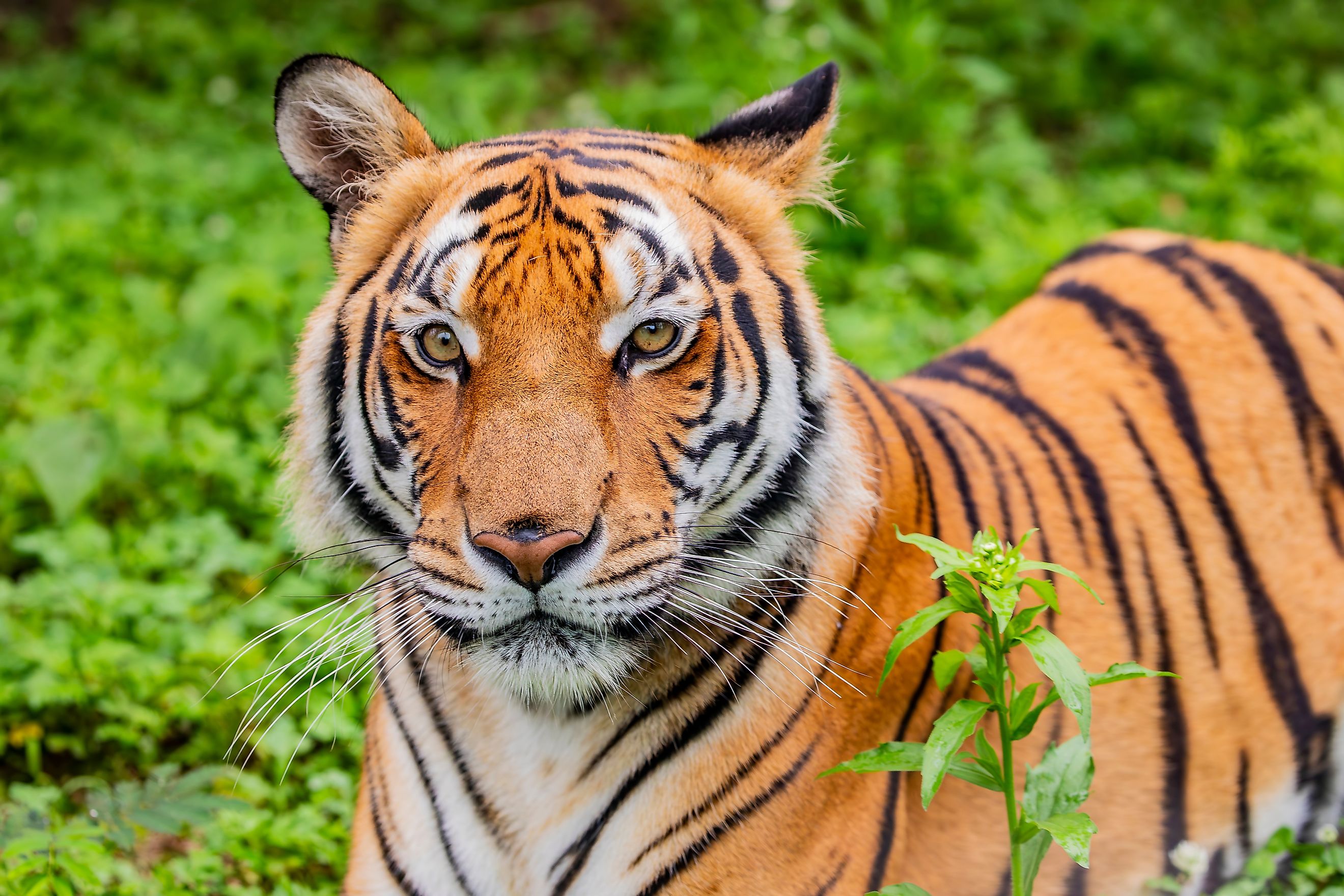
The South China tiger is a mid-sized tiger, and a frequent error is to call it the smallest of all tiger subspecies. It is more accurate to say it is the smallest of the mainland Asian tigers, still larger than the island-dwelling Sumatran tiger. Males typically measure about 91 to 104 inches (230 to 265 cm) in head and body length and weigh roughly 287 to 386 pounds (130 to 175 kg). Females are smaller, around 87 to 94 inches (220 to 240 cm) and about 240 to 250 pounds (110 to 115 kg). A typical adult male runs close to 330 pounds (150 kg) and stretches around 8 feet (2.5 m) including the tail.
Its coat is a paler, more yellowish orange than the deep rust of a Bengal tiger, marked with narrow, sharply defined black stripes. As with all tigers, the striping is unique to each individual, functioning much like a fingerprint, and keepers use facial markings to tell captive animals apart. White fur covers the throat, belly, insides of the legs, and patches around the muzzle and eyes. Its build reflects the typical tiger form, with heavy, muscular forequarters, a broad head, powerful jaws, and long canines adapted for bringing down large prey.
Range and Habitat

Historically, the South China tiger ranged across a huge swath of central and southern China, an area stretching roughly 1,200 miles east to west and close to 1,000 miles north to south. Its strongholds lay in the provinces of Fujian, Guangdong, Hunan, and Jiangxi, with populations extending into Sichuan and neighboring regions. It occupied subtropical and temperate forests, wooded hills, and mountainous terrain, hunting through dense cover.
That range has effectively ceased to exist. Decades of extensive field surveys have failed to confirm a single wild individual, and the last credible wild sightings date to the early 1970s. A field study across eight protected areas around 2001 turned up no evidence of tigers. Today the subspecies' "range" is really a list of zoos and breeding centers, spread across cities including Shanghai, Chongqing, Suzhou, Guangzhou, and Guiyang.
Diet

Like all tigers, the South China tiger is an obligate carnivore and an ambush hunter. In the wild, it preyed mainly on hoofed mammals such as wild boar, muntjac, tufted deer, sambar, serow, and hog deer, while also taking smaller animals including porcupines, hares, langurs, and peafowl. It was known to take domestic cattle where its forest gave way to farmland, and encounters with people were not unknown as human settlement pushed into tiger country.
The hunting method is patient and explosive. The tiger stalks close under cover, then rushes from behind or the side to seize the prey and kill it, typically with a bite to the neck or throat. A single tiger can consume a great deal at one sitting, on the order of 40 to 88 pounds (18 to 40 kg) of meat, then go without eating for days.
Behavior and Reproduction

South China tigers are solitary and territorial, coming together mainly to breed. Individuals patrol and scent-mark home ranges, and males and females lead largely separate lives outside the mating season. They are strong swimmers, comfortable in water in a way many cats are not, and capable climbers.
Reproduction follows the general tiger pattern. After a gestation of roughly three to three and a half months, a female gives birth to a litter of two to four cubs, which are born blind and helpless and depend entirely on their mother. Cubs stay with her for a year and a half or more while they learn to hunt, then disperse to establish their own territories. The first captive birth of the subspecies came in 1963 at a zoo in Guiyang, an early milestone in what would become a decades-long effort to keep the animal from disappearing entirely.
Importance and Cultural Significance

The South China tiger is important for reasons that go beyond its former role as an apex predator in southern China's forests, where it helped keep prey populations in balance. Its position within the tiger lineage may also be significant, as some research suggests it could be close to the ancestral form from which other tiger populations evolved. The tiger itself has a deep connection to Chinese art, folklore, and symbolism, making the South China tiger especially significant as the tiger native to China's heartland. Today, its survival has become a major conservation effort and an important test of whether a species that has disappeared from the wild can eventually be brought back.
Conservation Status and Threats

The collapse was swift and largely deliberate. In the early 1950s an estimated 4,000 South China tigers lived across roughly a dozen provinces. Under the campaigns of the Great Leap Forward, tigers were branded as pests and hunted intensively, with thousands killed. By 1982 the wild population had fallen to an estimated 150 to 200 animals, and by 1987 to perhaps 30 to 40. Protection came late. China listed the tiger for protection and banned hunting in the 1970s, while the species was added to CITES Appendix I in 1981. By then, however, the wild population had already declined beyond recovery.
The IUCN has listed the South China tiger as Critically Endangered since 1996, with the qualifier "Possibly Extinct in the Wild." Most biologists now consider it functionally extinct in the wild, meaning that even if a few individuals survive, there are far too few to form a sustainable population. Every living South China tiger descends from just six wild-caught founders, two males and four females, taken into captivity between 1958 and 1970. That tiny founder base has left the captive population, estimated at roughly 150 to 200 animals, with low genetic diversity and the burden of inbreeding, and genetic testing has revealed traces of hybridization with other subspecies in some breeding lines.
Conservation now rests on captivity. The Chinese Association of Zoological Gardens maintains a studbook and coordinates breeding to preserve what genetic variation remains. The most striking initiative has been Save China's Tigers, which relocated captive tigers to a reserve in South Africa to let them learn to hunt in open country, with the long-term aim of rewilding descendants in protected reserves within the animal's former Chinese range. Researchers have since modeled candidate reintroduction sites and estimated how many tigers suitable habitat might one day support.
Takeaway
Whether the South China tiger ever returns to the wild is an open question, and an urgent one. Its recovery depends entirely on the success of captive breeding and the political and ecological will to restore habitat and prey. For now, the animal endures as both a warning about how quickly a species can be driven out of existence and a fragile hope that careful stewardship might yet undo some of the damage.
Fun Facts

- It may be the oldest tiger of all. Genetic and morphological studies suggest the South China tiger sits close to the ancestral "stem" tiger, making it a strong candidate for the lineage from which every other living tiger descends.
- Every one alive shares six ancestors. The entire captive population traces back to just two male and four female wild-caught tigers taken into captivity between 1958 and 1970.
- Its name comes from a city. "Amoyensis" refers to Amoy, the old Western name for the port of Xiamen, which is why it is also called the Amoy tiger or Xiamen tiger.
- Some were sent to Africa to relearn how to hunt. The Save China's Tigers project moved captive tigers to a reserve in South Africa so they could develop wild hunting skills, with the goal of one day rewilding their descendants in China.
- No one has confirmed a wild sighting in about 50 years. The last credible wild sightings date to the early 1970s, and the subspecies is now widely regarded as functionally extinct in the wild.
Quick Facts
- Scientific name: Panthera tigris amoyensis (also treated as a population within Panthera tigris tigris under revised taxonomy)
- Common names: South China tiger, Amoy tiger, Xiamen tiger
- Family / order: Felidae / Carnivora
- IUCN status: Critically Endangered (Possibly Extinct in the Wild), listed since 1996
- Population: No confirmed wild individuals; roughly 150 to 200 in captivity
- Length: About 8 feet (2.5 m) including tail; males 91 to 104 inches (230 to 265 cm) head and body
- Weight: Males 287 to 386 lb (130 to 175 kg); females 240 to 250 lb (110 to 115 kg)
- Lifespan: Roughly 10 to 15 years in the wild, longer in captivity
- Diet: Carnivore; wild boar, deer, and other hoofed prey
- Range: Historically southern and central China (Fujian, Guangdong, Hunan, Jiangxi); today only zoos and breeding centers