Sharp-Nosed Viper
The sharp-nosed viper is one of the most feared snakes in East Asia, and its reputation is written into its folk names. In Taiwan it is the hundred-pace snake, and in mainland China the five-pace snake, both names hinting darkly at how far a victim might walk after a bite. That reputation is exaggerated, yet it points to a real truth. This is a large, thick-bodied pit viper with long fangs and a potent hemotoxic venom, and it deserves respect.
Scientifically known as Deinagkistrodon acutus, the sharp-nosed viper lives in the wooded hills and mountains of southern China, Taiwan, northern Vietnam, and parts of Laos. It takes its English name from its most distinctive feature, an upturned and sharply pointed snout that gives the head an unmistakable profile. Other common names include the Chinese moccasin, the snorkel viper, and the long-nosed pit viper.
Taxonomic Classification

The sharp-nosed viper belongs to the family Viperidae and the subfamily Crotalinae, the pit vipers, a group defined by the heat-sensing pit organs set between the eye and the nostril on each side of the head. Within that family it occupies its own genus, Deinagkistrodon, which was erected by the herpetologist Howard Gloyd in 1979 and contains this single species. A genus with only one species is called monotypic, and no subspecies of the sharp-nosed viper are currently recognized.
The species was first described by the German-born British zoologist Albert Günther in 1888, originally under the name Halys acutus. Over the following century it was shuffled through several genera, including Ancistrodon and Agkistrodon, before being placed in its present home. The scientific name carries a warning and a description all at once. Deinos is Greek for terrible, agkistron means fishhook and odon means tooth, a nod to the long curved fangs, while acutus is Latin for sharp and pointed, a reference to that distinctive snout.
In the standard chain of classification the animal sits within the kingdom Animalia, the phylum Chordata, the order Squamata, and the suborder Serpentes, which together place it among the scaled reptiles and the snakes.
Physical Description

The sharp-nosed viper is a heavy, powerfully built snake. Most adults measure between 2.6 and 3.3 feet (0.8 and 1.0 m) in total length, though the species can grow considerably larger. Males reach a maximum of about 5.2 feet (1.57 m) and females about 4.6 feet (1.41 m), and the largest reliably measured individual came close to 5.1 feet (1.55 m). Its stout body and short tail give it a bulky, almost sluggish look at rest.
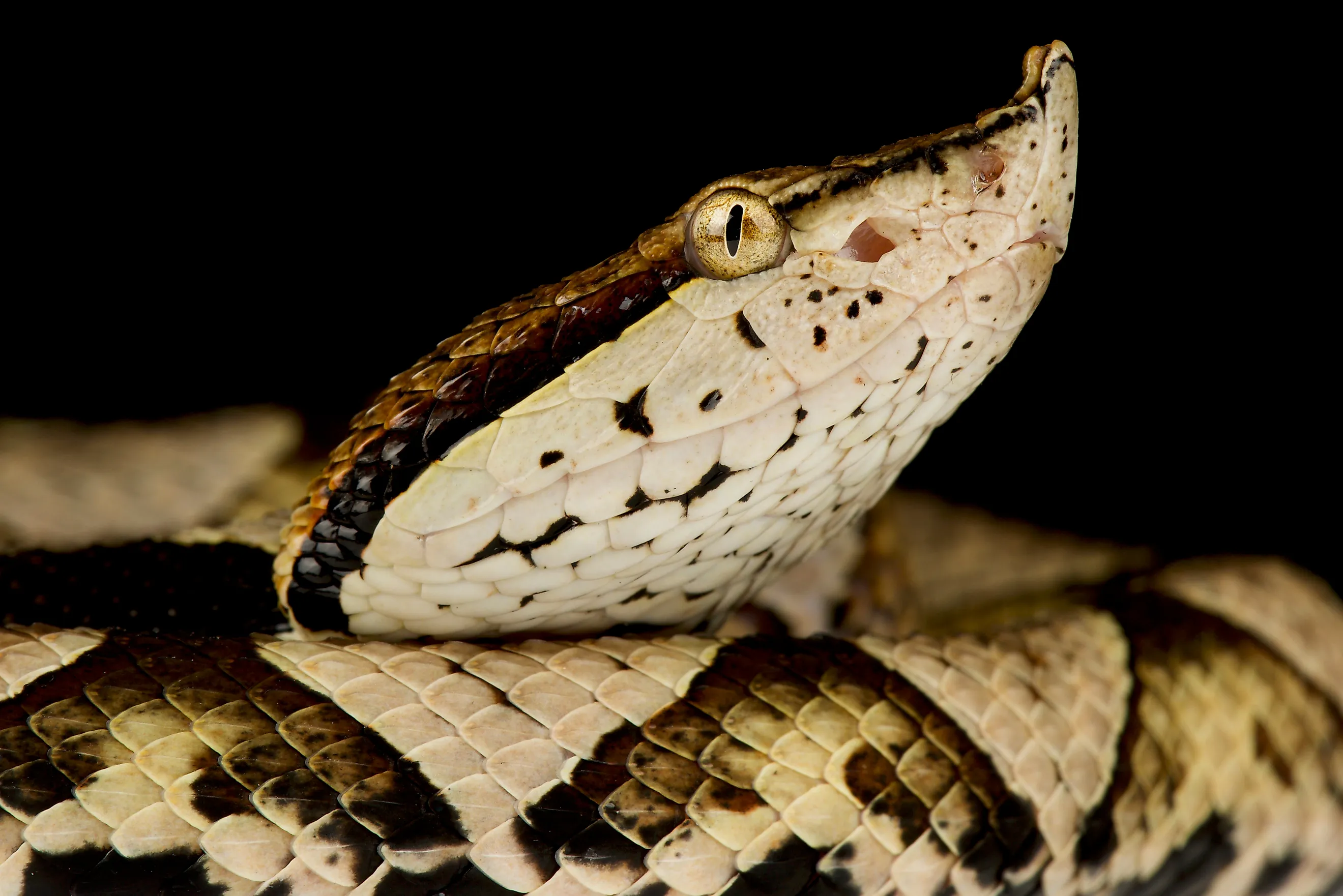
The head is large and triangular, broad at the back to house the venom glands, and it ends in the upturned, pointed snout that gives the animal both its name and its unmistakable profile. Nine large shields cover the crown of the head, and a dark streak runs from each eye back to the angle of the jaw.
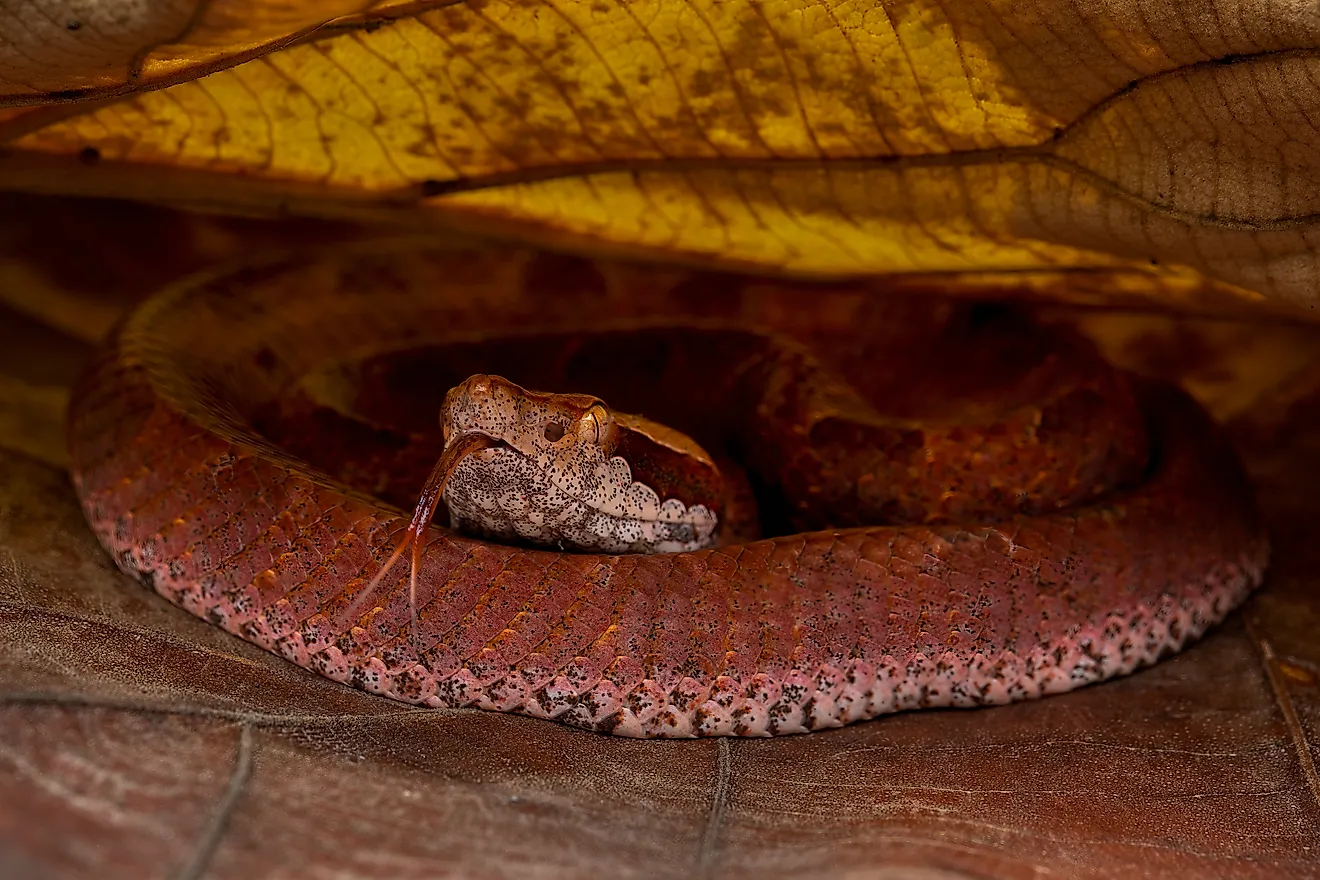
The back is light brown to grayish brown, marked along each side with a row of dark brown triangles. The tips of opposing triangles meet along the spine, forming a chain of roughly twenty squarish blotches down the length of the body. A line of large black spots runs low on each flank near the belly, and the underside is yellowish and flecked with dark brown. Against a forest floor of leaf litter and shadow, this pattern breaks up the snake's outline and makes it very hard to see. The heavily keeled scales add a rough, matte texture that further dulls any shine.
Range and Habitat

The sharp-nosed viper is native to a band of East and Southeast Asia. Its stronghold is the mountainous interior of southern and southeastern China, across provinces that include Zhejiang, Fujian, Hunan, Hubei, Guangdong, Guangxi, Guizhou, and Anhui. Beyond China its range extends to central and southern Taiwan, northern Vietnam, and probably parts of northern Laos.
This is a snake of forested hills and low mountains. It favors moist, shaded ground on lower slopes and rocky hillsides, often near small valley streams. Most populations live below about 3,900 feet (1,200 m), though the species has been recorded higher, up to roughly 4,400 feet (1,350 m), and occasionally down in coastal lowlands near 330 feet (100 m). It is often found among rocks and dense vegetation, and it sometimes turns up close to farmhouses and villages, where rodents are plentiful and stone walls offer cover. That overlap with rural human activity is one reason bites, though uncommon, do occur.
Diet

Like many vipers, the sharp-nosed viper is an ambush predator rather than an active hunter. It coils in a chosen spot, often along a game trail or near a rodent runway, and waits for prey to come within reach. The heat-sensing pits on its face let it detect the body warmth of a nearby animal even in complete darkness, guiding a fast and accurate strike.
Its diet is built mainly around small mammals such as rats and mice, but it also takes birds, frogs, toads, and lizards. The venom does more than subdue prey. It begins breaking down tissue almost immediately, which helps the snake digest meals that can be startlingly large. In one documented case, a viper about 3.4 feet (1.04 m) long and weighing around 1.3 pounds (600 g) had swallowed a rat nearly as heavy as itself. After a strike, the snake typically releases larger prey, tracks it by scent as the venom takes effect, and swallows it whole once it is dead.
Behavior

The sharp-nosed viper is largely nocturnal and crepuscular, most active in the dark and at dusk, though it will bask by day in cooler weather. It is a terrestrial snake that spends its life on the ground rather than in trees or water. For much of the time it is sedentary, relying on camouflage and stillness rather than movement.
That calm should not be mistaken for a mild temperament. When disturbed or cornered, the animal can be quick to strike, and it may do so with little warning. Activity rises on cloudy and rainy nights and falls sharply during the fiercest storms of the typhoon season. Through the cold months the snake shelters in abandoned burrows dug by small mammals, choosing dry, sunlit spots protected from wind and near a water source, where it waits out the winter.
Reproduction

Reproduction sets this species apart from most of its relatives. The great majority of pit vipers give birth to live young, but the sharp-nosed viper is one of the few that lays eggs. Breeding leads to a clutch deposited between June and August, usually of about eleven or twelve eggs, although a female can carry as many as twenty-four. The eggs are elongated, roughly 1.6 to 2.2 inches (40 to 56 mm) long.
The species also shows an unusual reproductive trick. A female may retain the developing eggs inside her body for a time before laying them, which shortens the period they must spend exposed in the nest. Once the eggs are laid, she coils around the clutch and guards it for about twenty days until the young hatch. The hatchlings emerge fully independent, already equipped with working venom, and they are more vividly patterned than the adults, darkening as they grow. In the wild the species is thought to live up to about twenty years, and one captive individual reached sixteen years and three months.
Venom and Danger to Humans

The sharp-nosed viper carries a large volume of potent venom and a pair of long, hinged fangs able to inject it deep. The venom is predominantly hemotoxic, meaning it attacks the blood and tissues rather than the nervous system. A serious bite can cause intense local pain, heavy bleeding, swelling, blistering, tissue death, and, in the worst cases, disrupted blood clotting and acute kidney failure.
The folk names promising death within a set number of paces overstate the speed of the venom, but the danger is real. In Taiwan, where good records exist, bites from this species have historically carried a high fatality rate compared with other local snakes, even though they make up only a small share of all snakebite cases. Fear of the venom has sometimes done its own harm, driving victims to amputate or burn bitten fingers before proper treatment could be given. An effective antivenom is produced in Taiwan, and prompt medical care greatly improves the outlook.
Importance to the World

As a predator of rats and mice, the sharp-nosed viper helps keep rodent numbers in check across its range, a service of real value in farming regions. It sits in the middle of its food web, both hunter and hunted, and its presence is a sign of reasonably intact forest.
The species also holds an important place in Taiwanese Indigenous culture, particularly among the Paiwan people. The hundred-pace snake is revered as an ancestor and sacred totem, with its triangular markings reflected in traditional carvings, weaving, and other forms of design. It has also long been used as food and in traditional medicine, while its venom is now being studied for compounds that may help regulate blood clotting.
Threats and Conservation

The sharp-nosed viper is listed as Vulnerable on the IUCN Red List. The main pressures come from people. The snake is heavily collected for the food and traditional medicine trades, and its forest habitat continues to be cleared and fragmented. Its large size and market value make it a frequent target for hunters.
In response, China has treated the species as a protected animal and has developed captive breeding programs aimed at supplying demand without draining wild populations. These efforts have had some success in easing pressure on the animals in the field, but continued habitat loss and collection mean the sharp-nosed viper still needs careful monitoring across its range.
Takeaway
The sharp-nosed viper is far more than the fearsome hundred-pace snake of legend. It is a superbly camouflaged ambush hunter, a rare egg-laying pit viper with a devoted mother, and a cultural emblem whose image runs through the art of Taiwan's first peoples. Its potent venom earns it real caution, yet the same qualities that make it dangerous also make it one of Asia's most fascinating reptiles. With its forests shrinking and collectors in pursuit, the future of this remarkable viper will depend on how well people balance old fears and old traditions against the need to keep it alive in the wild.
Fun Facts

- Named for its lethal folklore. The names hundred-pace snake and five-pace snake come from a belief that a bitten person can walk only that many steps before dying, a dramatic exaggeration of an already dangerous bite.
- A rare egg-layer. Most pit vipers give birth to live young, but the sharp-nosed viper lays eggs and can even hold them inside her body first to shorten their time in the nest.
- A snout with a purpose. The upturned, pointed nose that gives the snake its name makes its wedge-shaped head one of the most instantly recognizable of any Asian pit viper.
- A sacred ancestor. The Paiwan people of Taiwan honor the hundred-pace snake as a founding ancestor, and its triangular pattern appears throughout their traditional art.
- A big appetite. One recorded viper swallowed a rat almost as heavy as the snake itself, a feat made possible by venom that begins digesting the meal from the inside.
Quick Facts
- Scientific name: Deinagkistrodon acutus
- Family: Viperidae (subfamily Crotalinae, the pit vipers)
- Other names: hundred-pace snake, five-pace snake, Chinese moccasin, snorkel viper, long-nosed pit viper
- IUCN status: Vulnerable
- Length: typically 2.6 to 3.3 feet (0.8 to 1.0 m), up to about 5.2 feet (1.57 m)
- Weight: large adults around 1.3 pounds (600 g) or more
- Lifespan: up to about 20 years in the wild
- Diet: rodents, birds, frogs, toads, and lizards
- Venom type: predominantly hemotoxic
- Reproduction: egg-laying, usually 11 to 12 eggs per clutch
- Range: southern China, Taiwan, northern Vietnam, and northern Laos