Serval
The serval is the high-jump champion of the cat family, a slender African predator built almost entirely around the hunt. It carries the longest legs and the largest ears, relative to body size, of any wild cat on Earth, a combination that lets it hear a rodent moving underground and then launch itself several feet into the air to pin prey with its forepaws. Few small predators are so specialized, and fewer still are so successful at what they do.
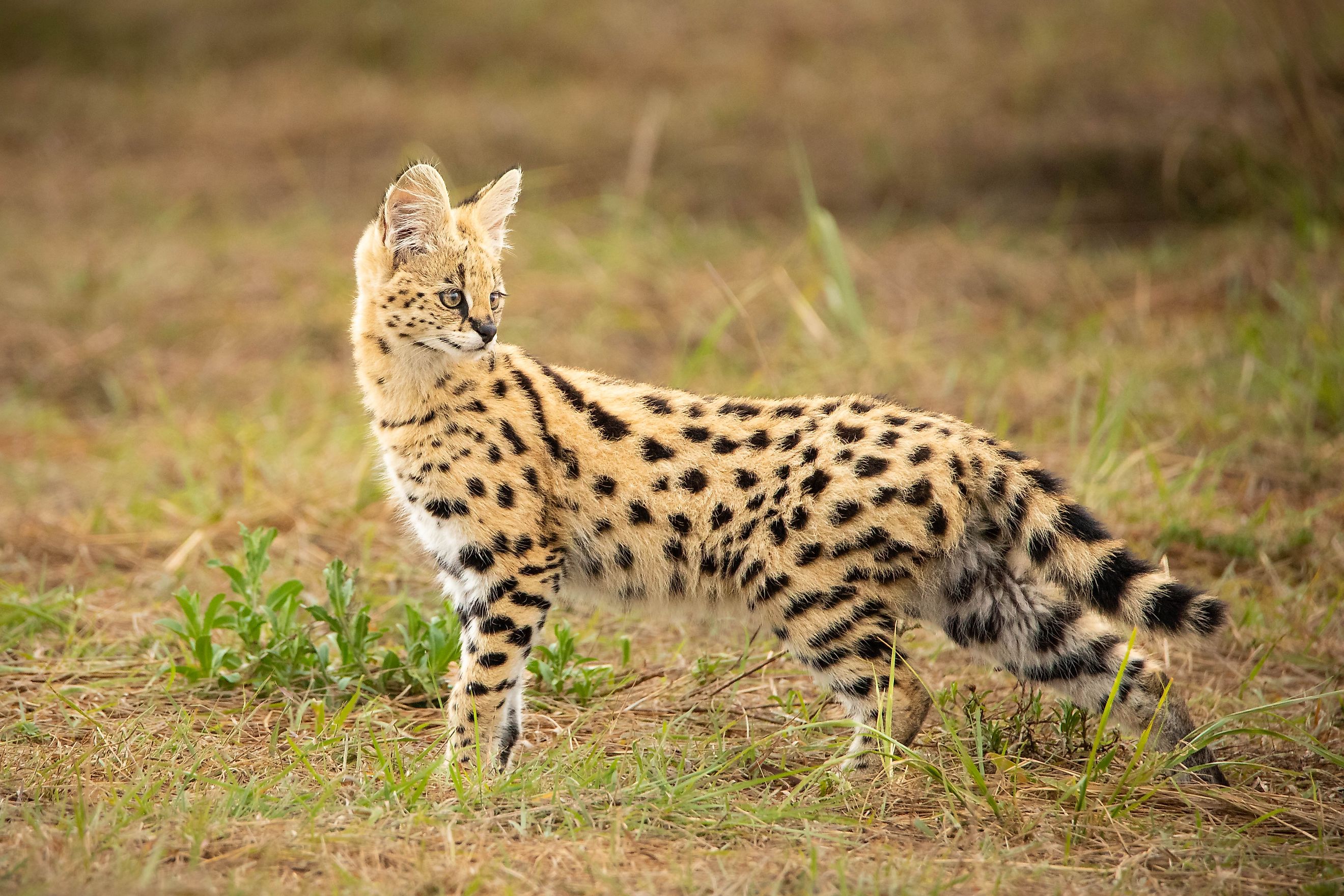
The serval (Leptailurus serval) is a medium-sized wild cat native to sub-Saharan Africa, where it haunts the tall grass and reed beds of well-watered savannas and wetlands. It is not a big cat in the way a lion or leopard is, standing only about knee-high to an adult human, yet it hunts with a precision that outperforms far larger felines. Its golden, black-spotted coat has drawn comparisons to a small cheetah on stilts.
Taxonomic Classification

The serval belongs to the family Felidae and the subfamily Felinae, the branch of cats that includes the smaller and mid-sized species rather than the roaring big cats. Within the order Carnivora, it sits in the class Mammalia alongside every other cat. Its scientific name is Leptailurus serval, and it is the sole living member of its genus, Leptailurus, which was established by Nikolai Severtzov in 1858.
The species was first formally described by the German naturalist Johann Christian Daniel von Schreber in 1776, originally under the genus Felis. Molecular studies place the serval close to two other African cats, the African golden cat (Caracal aurata) and the caracal (Caracal caracal), with the three lineages tracing back to a common ancestor roughly 5.4 million years ago.
Three subspecies are generally recognized. L. s. serval occurs across southern Africa, L. s. constantina across central and western Africa, and L. s. lipostictus in the east. As with many carnivores, the details of serval taxonomy remain under review, and researchers have noted that further genetic study is needed to clarify how these regional forms relate to one another.
Physical Description

The serval's body is perfectly suited to life in tall grass. It stands about 21 to 24 inches (54 to 62 cm) at the shoulder, with a body length of roughly 26 to 39 inches (67 to 100 cm) and a short, black-tipped tail of about 10 to 18 inches (24 to 45 cm). Adults typically weigh between 20 and 40 pounds (9 to 18 kg), with males averaging larger than females. It is a lightly built animal, and much of its apparent height comes from limbs that are exceptionally long for its mass.
Those legs are the serval's signature feature. Relative to body size, they are the longest of any cat, and the hind legs are longer than the front, giving the animal a raised, coiled posture well suited to leaping. Paired with an unusually long neck, the long legs let the serval peer over tall grass much as a giraffe surveys the savanna, a resemblance that has earned it the nickname "giraffe cat." Its assembly of a small head, oversized ears, elongated neck, and stilt-like legs has also led some to call it the "cat of spare parts."
The ears deserve their own mention. They are the largest of any cat relative to head and body size, tall and rounded, and each is packed with muscles that allow it to swivel and rotate to track faint sounds. This acute hearing lets the serval locate prey by ear alone, including rodents burrowing beneath the surface. The coat is pale yellow to tawny or golden, marked with bold black spots that merge into stripes across the neck and shoulders. The pattern varies regionally, with some cats marked in small freckle-like spots and others in large blotches, and the tail is ringed and tipped in black.
Range and Habitat

The serval occurs widely across sub-Saharan Africa, with recorded presence in more than 35 countries. It is largely absent from two extreme environments. It avoids dense tropical rainforests such as the Congo Basin and does not inhabit true deserts such as the Sahara. A small, isolated population persists north of the Sahara along the Mediterranean margin, chiefly in Morocco and possibly Algeria, with a reintroduced population in Tunisia.
Within its broad range, the serval is closely tied to water. It favors well-watered grasslands, savannas, wetlands, marshes, reed beds, moorlands, and the edges of open woodland, wherever tall grass or vegetation provides both cover and the small prey it depends on. It is most abundant where these conditions come together, and it is described as common in parts of northern Tanzania. The cat is also fairly adaptable and can persist in altered landscapes, including farmland, as long as sufficient prey and cover remain.
Diet

The serval is a specialized hunter of small prey, and rodents form the core of its diet. In many field studies, rodents such as grass rats and other small savanna species make up the large majority of prey items, in some cases well over 90 percent. A single serval may catch several thousand rodents in a year, making it an efficient natural check on rodent populations.
Beyond rodents, the serval is opportunistic and will take birds, reptiles, frogs, fish, and insects as the chance arises. It hunts largely by sound, pausing to listen with eyes half-closed, sometimes for many minutes at a stretch, before committing to a strike. The signature attack is a high vertical pounce that brings both forefeet down onto the prey to stun or kill it. The cat will also flush prey from cover, dig rodents out of burrows, and hook fish or frogs from shallow water.
What sets the serval apart is its efficiency. Its hunting success rate is often reported at around 48 to 50 percent, well above the roughly one-in-three record of lions and far above the low success rate of many smaller cats. That success is built on precise hearing, patience, and the explosive leaping power of its long hind legs.
Behavior

Servals are solitary and active across both day and night, with peaks around dawn and dusk when their small prey is on the move. They rest during the hottest part of the day, often in cover, and can range over a mile or more in a single hunting session. When hunting, a serval may cover a couple of miles of grassland, moving slowly and stopping frequently to listen.
The species is territorial, and individuals mark and defend home ranges. The social system is polygynous, with a male's range typically overlapping those of several females while individuals of the same sex generally maintain separate ranges. Outside of mating and the rearing of young, encounters between adults are brief and there is no lasting pair bond. Servals communicate through a range of vocalizations, including chirps, purrs, hisses, and growls, and through scent marking.
The long legs that make the serval such a good hunter also make it a striking athlete. It can leap roughly 9 feet (2.7 m) straight up from a standing start to snatch birds in flight, bound more than 13 feet (about 4 m) forward in a single jump, and sprint at speeds approaching 50 miles per hour (80 km/h) through open grass. When a first pounce misses, the cat often follows with a rapid series of stiff-legged hops to recover the lost prey.
Reproduction

Servals have no strict breeding season across much of their range, though births often cluster around the warmer, wetter months when prey is abundant. After a gestation of roughly 66 to 77 days, the female gives birth to a litter that usually numbers two or three kittens, with a recorded range of one to four. The young are born in a sheltered, hidden site such as dense grass or an abandoned burrow.
Kittens are tiny at birth, weighing only about 9 ounces (250 g), and open their eyes within roughly two weeks. They begin sampling solid food at about three weeks and are weaned over the following months. The mother raises the litter alone, moving the kittens between hiding places and teaching them to hunt. Young servals typically become independent between six and eight months of age, then disperse to establish their own ranges.
In the wild, servals commonly live around 10 to 12 years. In protected captive settings, where hunting pressure and disease are managed, individuals have reached roughly 20 years or more, with the oldest recorded animals in their early twenties.
Importance to the World

As a prolific hunter of rodents, the serval plays a valuable ecological role in controlling populations of rats, mice, and other small mammals across African grasslands and wetlands. In agricultural areas, this pest-control service can benefit farmers, even though servals are sometimes wrongly blamed for livestock losses. As a mid-sized predator, the serval also forms part of the prey base for larger carnivores such as leopards, linking it into the wider food web.
The serval also works as a useful barometer of ecosystem health. Because it depends on well-watered grasslands and wetlands and on healthy populations of small prey, a strong serval presence tends to signal that those habitats and their food webs are intact. Where servals thin out or vanish, it often reflects broader losses of wetland cover and prey, which makes the cat a helpful indicator species for conservation planning. Its presence in reserves adds to their draw for wildlife watchers as well, giving the species a modest supporting role in the ecotourism that helps fund protected areas across its range.
Threats and Conservation

Globally, the serval is listed as Least Concern on the IUCN Red List, with a population trend assessed as stable in its most recent evaluation. It is widespread and reasonably adaptable, and it occurs in many national parks and reserves, which has helped keep the overall species secure. No reliable global population estimate exists, in part because the cat is inconspicuous and hard to survey outside protected areas.
Least Concern applies to the serval as a whole, not to every population. In North Africa, the isolated northern form is in serious trouble, with fewer than 250 mature individuals remaining in a small, fragmented range, putting it at high risk of local extinction. Servals are also considered rare in parts of the Sahel and several West African countries.
The main pressures on servals come from people. Draining and conversion of wetlands and grasslands strip away the cover and prey the cat depends on. Servals are hunted for their skins, killed in retaliation for suspected raids on poultry and small livestock, and taken for the illegal pet trade. The species is included in CITES Appendix II, which regulates international trade, and it occurs in numerous protected areas, but enforcement and legal protection vary widely from one country to another. Conserving the serval ultimately means conserving the well-watered grasslands and wetlands it needs, and managing the conflict that arises where those habitats meet farms and settlements.
Takeaway
The serval is a reminder that a predator does not need great size to be exceptional. By committing its whole body plan to hearing, patience, and the leap, this slender African cat has become one of the most effective hunters of its size anywhere. Across most of sub-Saharan Africa it remains widespread and stable, yet its northern populations are fragile, and its long-term future is bound tightly to the health of the grasslands and wetlands it calls home. Protecting those landscapes is the surest way to keep the giraffe cat leaping through the tall grass for generations to come.
Fun Facts

- Ears like radar dishes: A serval's ears are the largest of any cat relative to its body, and it can locate and catch prey by sound alone, even rodents tunneling underground.
- The giraffe of cats: Its long legs and neck let it see over tall grass, earning it the nickname "giraffe cat," while its odd proportions have also earned it the label "cat of spare parts."
- Vertical launch: A serval can spring roughly 9 feet (2.7 m) straight up to swat a bird out of the air.
- Rodent specialist: A single serval can catch several thousand rodents in a year, making it a natural pest controller.
- Better than a lion: With a hunting success rate near 50 percent, the serval is one of the most efficient hunters among all cats.
Quick Facts
- Scientific name: Leptailurus serval
- Family / Order: Felidae / Carnivora
- IUCN status: Least Concern (population trend stable; northern populations at regional risk)
- Shoulder height: 21 to 24 inches (54 to 62 cm)
- Body length: 26 to 39 inches (67 to 100 cm), plus a 10 to 18 inch (24 to 45 cm) tail
- Weight: 20 to 40 pounds (9 to 18 kg)
- Lifespan: About 10 to 12 years in the wild; up to roughly 20 years in captivity
- Diet: Carnivore, primarily rodents, also birds, reptiles, frogs, fish, and insects
- Range: Sub-Saharan Africa, in well-watered grasslands, savannas, and wetlands; absent from rainforest and true desert