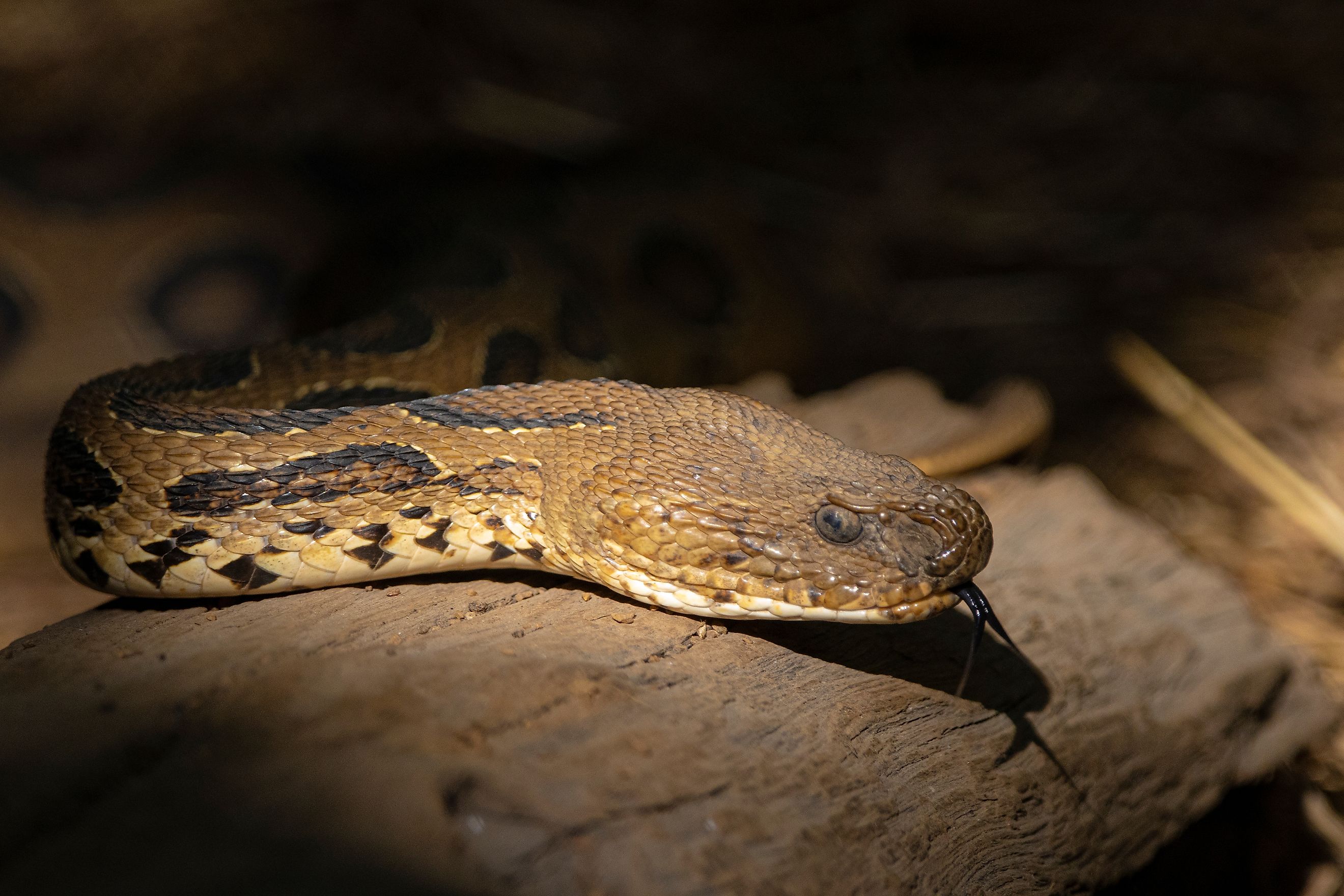
Russell's Viper
Few snakes have a body count like the Russell's viper. Across South Asia, it is one of the leading causes of death by snakebite, and by some estimates, it is responsible for more than 40% of India's snakebite fatalities. It is not the largest venomous snake in Asia, nor the fastest, but a combination of potent, blood-destroying venom, a fondness for farmland where people work barefoot, and a tendency to hold its ground rather than flee makes it one of the most dangerous animals a rural family is likely to encounter.
Russell's viper (Daboia russelii) is a heavy-bodied member of the true viper family, Viperidae, native to the Indian subcontinent. It belongs to the notorious "Big Four," the quartet of species that together account for the overwhelming majority of serious snakebites in India. Instantly recognizable by the three rows of dark, chain-like ovals running down its back, it is a snake worth understanding, both for the danger it poses and for the quiet ecological work it does keeping rodent populations in check.
Taxonomic Classification

Russell's viper sits in the animal kingdom (Animalia), phylum Chordata, class Reptilia, and order Squamata, the group that contains all snakes and lizards. Within the suborder Serpentes, it belongs to the family Viperidae, the true vipers, and to the genus Daboia. Its accepted scientific name is Daboia russelii, described in 1797 by the naturalists George Shaw and Frederick Polydore Nodder. The species honors Patrick Russell, a Scottish herpetologist who cataloged many of India's snakes in the eighteenth century and who first documented this one's lethal reputation.
Taxonomy here comes with a modern twist. For a long time, the eastern populations found in Southeast Asia, southern China, and Taiwan were treated as a subspecies of Russell's viper. In 2007, analysis of body pattern and mitochondrial DNA showed those eastern populations were distinct enough to stand as their own species, Daboia siamensis, the eastern Russell's viper. As a result, Daboia russelii as understood today refers to the South Asian animal, and range maps drawn before the split can be misleading. The species also carries a long list of regional common names, among them chain viper, Indian Russell's viper, and seven pacer, the last a grim folk claim about how far a bitten victim supposedly manages to walk.
Physical Description

Russell's viper is a stout, muscular snake that reaches a maximum recorded length of about 5.5 feet (166 cm), though a typical adult on the mainland runs closer to 4 feet (120 cm). Populations on offshore islands tend to be smaller still. It is heavy for its length, yet noticeably more slender than the bulkiest African and American vipers. Reliable field weights are scarce, but adults are generally cited at roughly 2 to 3 pounds (about 1 to 1.5 kg), with the largest individuals heavier. This is not a giant snake. Its danger comes from chemistry and circumstance, not size.
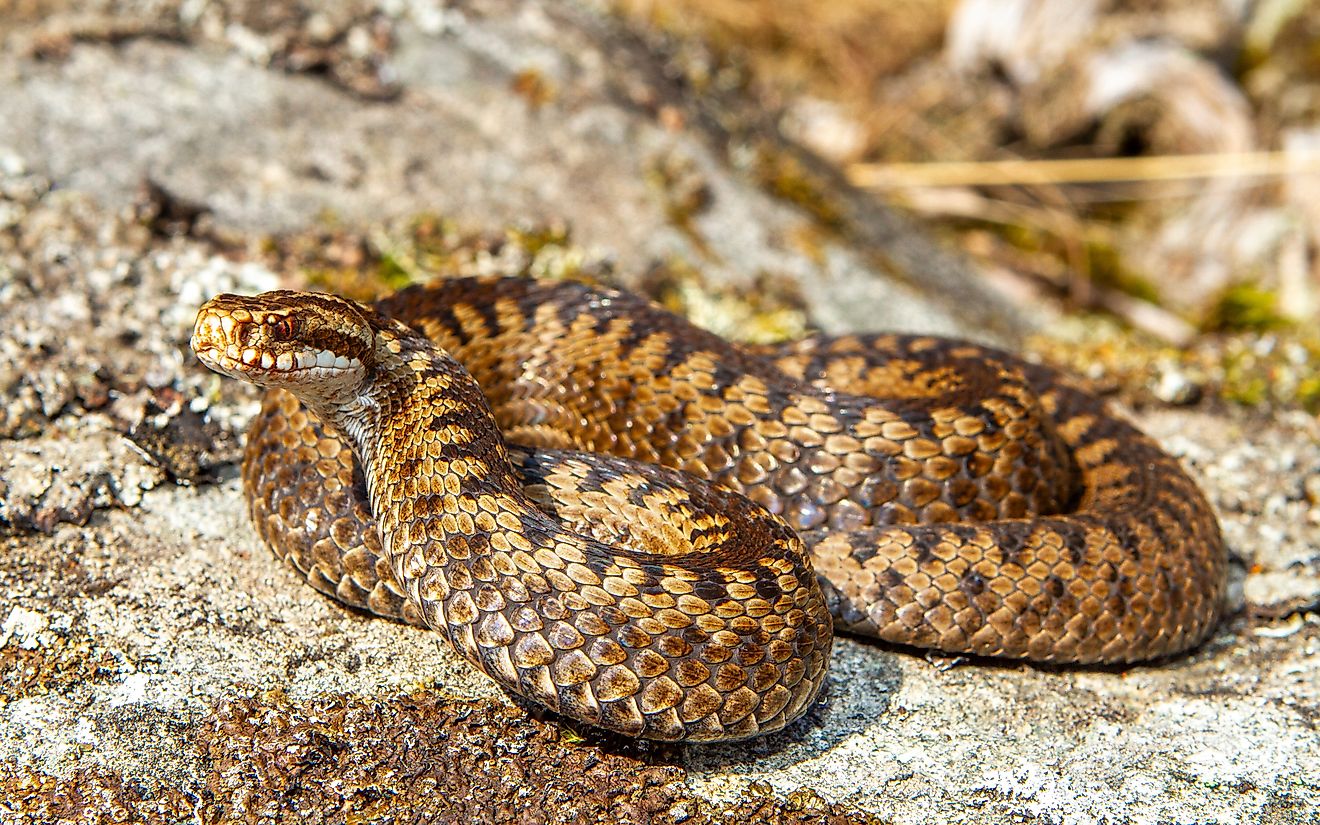
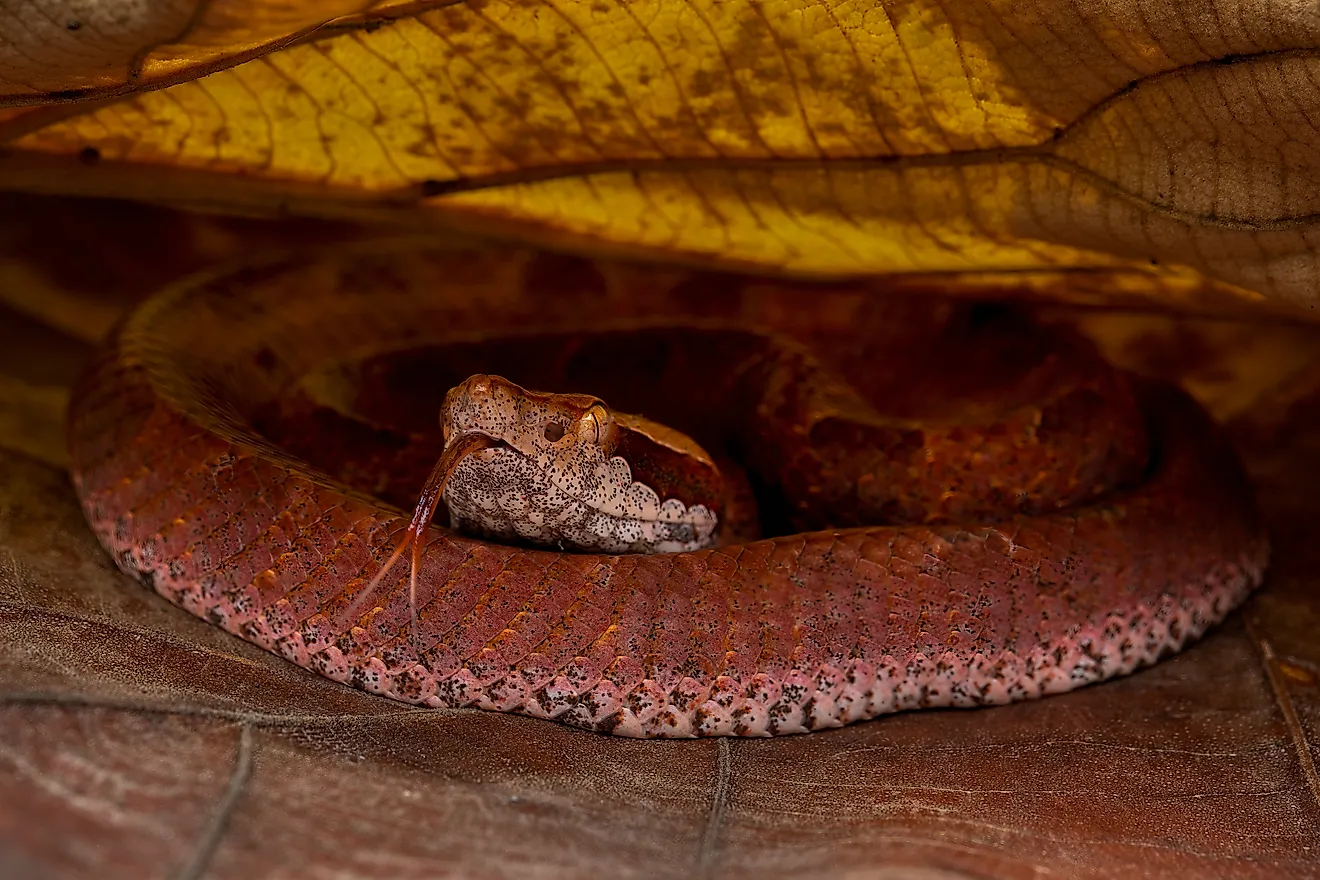
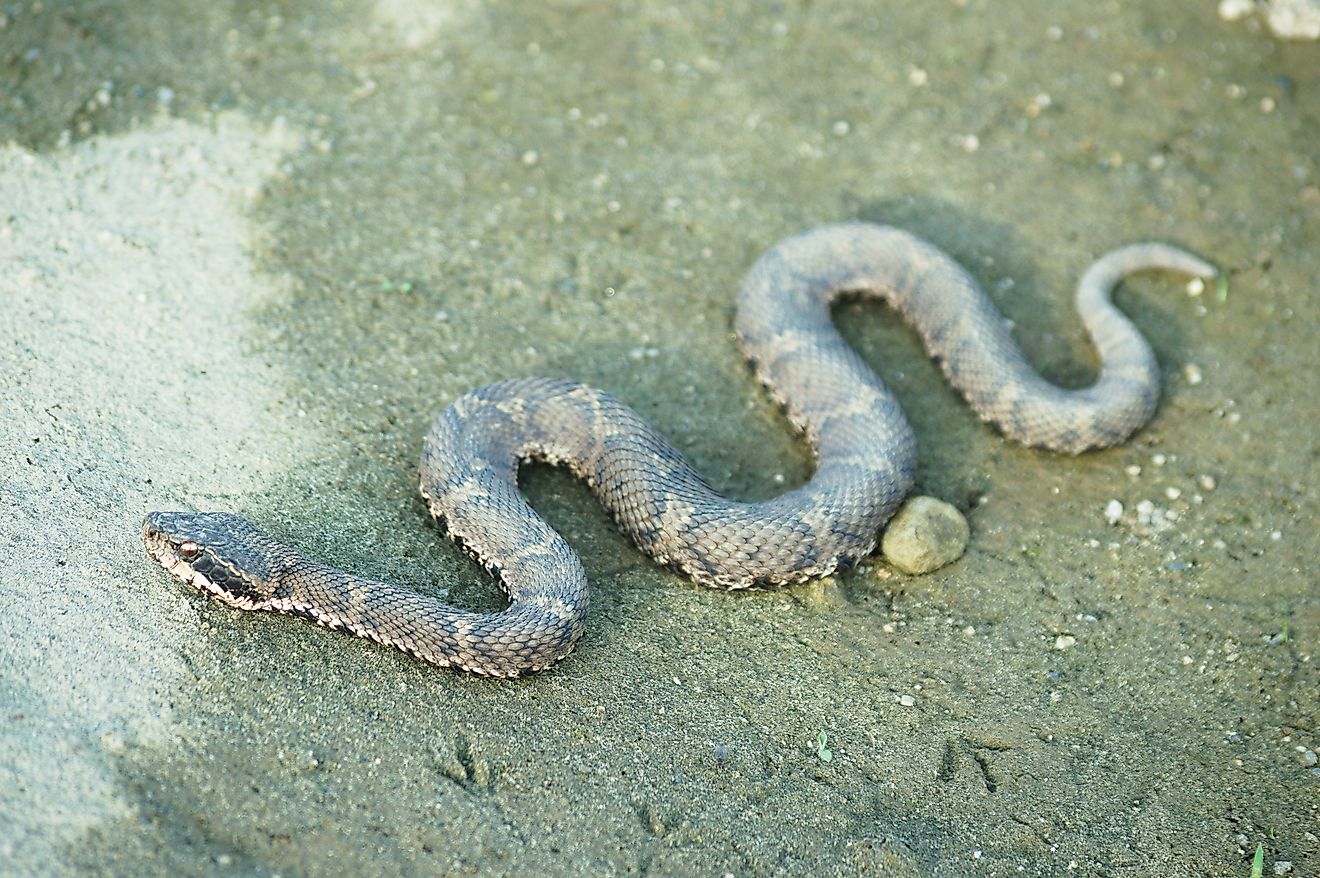
The coloration is both beautiful and functional. The ground color ranges from deep yellow through tan to brown, overlaid by three longitudinal rows of dark oval blotches that run the length of the body. Each oval is ringed in black and then edged again in white or pale yellow, producing the interlocking, chain-like pattern that gives the animal several of its common names. Against dry grass, leaf litter, and cracked farmland soil, the pattern dissolves into near-perfect camouflage. The head is broad, flattened, and distinctly triangular, marked with a pair of dark temple patches and a paler V or X shape pointing toward the snout.
Several features mark it as a highly evolved ambush hunter. The eyes are large with vertical, cat-like pupils suited to low light, and the crown is covered in small, strongly fragmented, keeled scales rather than the large plates seen on many harmless snakes. Unlike the pit vipers, Russell's viper has no heat-sensing facial pits, so it relies on vision, scent, and ground vibration to locate prey. In its mouth sit long, hinged, hollow fangs of the solenoglyphous type, which fold back when not in use and swing forward to deliver venom in a single rapid stab. When alarmed, the snake can produce a remarkably loud and sustained hiss, one of the loudest of any Asian snake, coiling tightly and drawing back into an S-shape before it strikes.
Range and Habitat

Following the 2007 split, Daboia russelii is considered native to South Asia, including India, Sri Lanka, Bangladesh, Nepal, and Pakistan. It is widespread and locally abundant, particularly common in the Punjab, along India's west coast and hills, and through southern India into Bengal. The type locality traces to the Coromandel Coast of southeastern India.
Habitat choice is a large part of why this snake is so medically important. Russell's viper is not fussy, but it clearly prefers open country over dense forest. It thrives in grasslands, scrub, savanna, coastal lowlands, foothills, and, crucially, cultivated farmland and the edges of villages. It generally avoids thick rainforest and very humid environments. During the day it shelters in rodent burrows, old termite mounds, rock crevices, and piles of leaves or debris. Because those same fields and field margins are where farm laborers walk, weed, and harvest, often at dawn, dusk, or night, the snake and the people who fear it are constantly thrown together.
Diet

Russell's viper is a carnivore, and rodents are the mainstay of its diet. It targets field and commensal rats and mice, including Rattus and Bandicota species that swarm through grain stores and paddy fields. This appetite is exactly what draws the snake toward human settlements, where rodents are plentiful year-round. Beyond rats, it also consumes small reptiles, land crabs, scorpions, and various arthropods, and juveniles rely heavily on lizards, sometimes even eating other young snakes before graduating to a rodent diet as they grow.
As an ambush predator, it hunts by patience rather than pursuit. The snake lies still and camouflaged, then strikes with a fast forward jab of its hinged fangs, injecting venom deep into the prey. It does not need to cling on. It simply releases the bitten animal, lets the venom do its work, and tracks the dying prey by scent before swallowing it. That efficient, low-energy strategy suits a heavy-bodied snake that cannot afford long chases.
Behavior

Russell's viper is largely nocturnal and crepuscular, most active in the cooler hours of dusk, night, and early morning, though it will bask by day in cooler seasons. It is a solitary animal outside the breeding period, spending much of its time coiled and motionless in cover. Lacking heat-sensing pits, it depends on sharp low-light vision, a flicking tongue that samples scent, and sensitivity to vibration through the ground.
Its defensive behavior is what makes encounters so risky. Rather than reliably retreating, a cornered Russell's viper often stands its ground, inflates its body, and unleashes that loud, drawn-out hiss as a warning. If the warning is ignored, it strikes hard and can throw its whole body forward with surprising force. Many bites happen at night when a person unknowingly steps near or on a snake that has chosen not to flee. This combination of good camouflage, a taste for farmland, and a willingness to hold position, rather than any aggression toward humans, explains its outsized role in snakebite.
Reproduction

Russell's viper is ovoviviparous, meaning the eggs develop and hatch inside the mother so that she gives birth to live, fully formed young. Mating generally occurs early in the year, roughly April through July, and the gestation period lasts more than six months. Births are concentrated between May and November, peaking in June and July to coincide with the monsoon, when prey is abundant.
It is a prolific breeder. A typical litter numbers 20 to 40 young, though a single female can occasionally produce far more, with reported extremes ranging from just one offspring up to 65 or more in a single litter. Newborns measure about 8.5 to 10.2 inches (21.5 to 26 cm) at birth and are fully venomous from the outset. They are independent, capable of delivering a serious bite, and receive no parental care. Sexual maturity arrives at around 2 to 3 years of age. Lifespan in the wild is not well documented and is likely short given heavy predation on the young, but captive individuals have lived well past a decade, with some reaching 15 to 20 years.
Importance to the World

For all its fearsome reputation, Russell's viper earns its place in the ecosystem. As a rodent specialist living alongside agriculture, it is a natural and highly effective form of pest control, suppressing populations of rats and mice that would otherwise devour stored grain and spread disease. Remove the snake, and the very rodents that plague farmers multiply unchecked. In this sense, the animal that farmers dread is also quietly working in their favor.
The species matters to medicine as well. Its venom is a key raw material for the antivenom that saves thousands of lives every year, and venom "milked" from Russell's vipers feeds ongoing research into blood clotting, since some of its components are studied for use in diagnostic laboratory tests. Culturally, the snake looms large across South Asia, feared and respected in folklore and, in some communities, treated as a spirit to be appeased. That mix of ecological value, medical utility, and deep cultural presence makes it far more than a village hazard.
Threats and Conservation

On the IUCN Red List, Daboia russelii was assessed in 2021 as a species of Least Concern, reflecting a wide distribution and populations that remain abundant across much of its range. It is not currently considered at risk of extinction. That said, it is not immune to pressure. Localized threats include collection for the leather and traditional-medicine trades, mortality on roads, habitat conversion, and, above all, deliberate killing by people who fear it.
The more urgent conservation concern lies elsewhere. This is a snake responsible for a large number of human deaths. Snakebite is a recognized neglected tropical disease, and India bears the heaviest burden worldwide. Studies estimate roughly 58,000 snakebite deaths a year in India, and the Big Four, of which the Russell's viper is a principal member, are responsible for the vast majority of serious envenomings. The venom is strongly hemotoxic and procoagulant, disrupting the blood's ability to clot. A serious bite can cause internal bleeding, tissue damage, shock, and acute kidney injury, with a single bite capable of delivering a potentially lethal dose. Effective responses focus less on the snake and more on people, through wider distribution of antivenom, faster access to hospital care, protective footwear, and public education about avoiding bites in fields at night. Conserving the species and reducing human casualties are, unusually, part of the same effort. The goal is to promote safer coexistence rather than eradicate the snake.
Takeaway
What makes Russell's viper remarkable is not its size or speed but its consequences. A snake that would rather sit still than fight has become one of the deadliest animals in Asia, purely because its potent venom, its camouflage, and its taste for farmland rats keep pulling it into the fields where people live and work. The same qualities cut both ways. The predator that fills hospital wards also keeps rodents off the harvest, and the venom that kills has taught medicine how blood clots and now supplies the antivenom used to treat its own bites. With a Least Concern listing and healthy populations, the animal itself faces no real threat of disappearing. The harder problem belongs to the people who share its ground, and progress will be measured less in the snake's survival than in how many human lives can be spared alongside it.
Fun Facts

- It hisses like a pressure cooker. A threatened Russell's viper produces one of the loudest, most sustained hisses of any Asian snake, a warning that can carry a surprising distance.
- Newborns are already deadly. Juveniles emerge fully venomous and independent, able to deliver a dangerous bite within hours of birth.
- It helped rewrite the family tree. DNA and pattern analysis in 2007 split off the eastern populations as a separate species, Daboia siamensis.
- Its venom is used to save lives. Milked venom supplies antivenom production and even features in laboratory blood-clotting tests.
- It is named after a snake cataloguer. The name honors Patrick Russell, who confirmed the snake's lethal nature in the 1790s by testing its venom on animals.
Quick Facts
- Scientific name: Daboia russelii
- Family / Order: Viperidae / Squamata
- IUCN status: Least Concern (assessed 2021)
- Length: Average about 4 ft (120 cm); up to 5.5 ft (166 cm)
- Weight: Roughly 2 to 3 lb (about 1 to 1.5 kg); heavy-bodied
- Lifespan: Poorly known in the wild; up to 15 to 20 years in captivity
- Diet: Carnivore, mainly rodents; also lizards, crabs, scorpions
- Range: South Asia: India, Sri Lanka, Bangladesh, Nepal, Pakistan