Rat Snake
For a group of snakes named after their most common prey, rat snakes hold a few surprises. The corn snake, one of the most popular pet reptiles in the world, is a rat snake. So is the "chicken snake" that raids poultry coops, and the large black serpent found in barn rafters across the eastern United States. "Rat snake" is not a single species at all but a shared way of life adopted by dozens of species across three continents, and modern genetics has shown that some of these look-alikes are only distantly related.
Rat snakes are large, nonvenomous, egg-laying constrictors in the family Colubridae, the largest snake family in the world. As a group, they range across North America, Europe, and Asia, reaching east to the Philippines, and they occupy nearly every temperate and subtropical woodland in that band. What unites them is a shared set of traits, including the ability to subdue prey through constriction, climb exceptionally well, and rely heavily on rodents as a food source. That last habit makes them among the most economically useful snakes on the planet, and among the most frequently encountered, because they thrive in the same farmland and suburbs that people do.
Taxonomic Classification

Rat snakes belong to the kingdom Animalia, phylum Chordata, class Reptilia, order Squamata, and family Colubridae, within the subfamily Colubrinae. Beyond that level, their classification is complicated, and it has changed substantially in recent decades as genetic data have refined the picture.
For most of the twentieth century, most rat snakes were placed in a single large genus, Elaphe, on the basis of their similar appearance and behavior. Molecular work revised that arrangement. In 2002, a mitochondrial DNA study by Utiger and colleagues found that the New World rat snakes of North America were not closely related to the Old World Elaphe. The North American species proved to be more closely related to kingsnakes than to the European and Asian rat snakes they had long been grouped with.
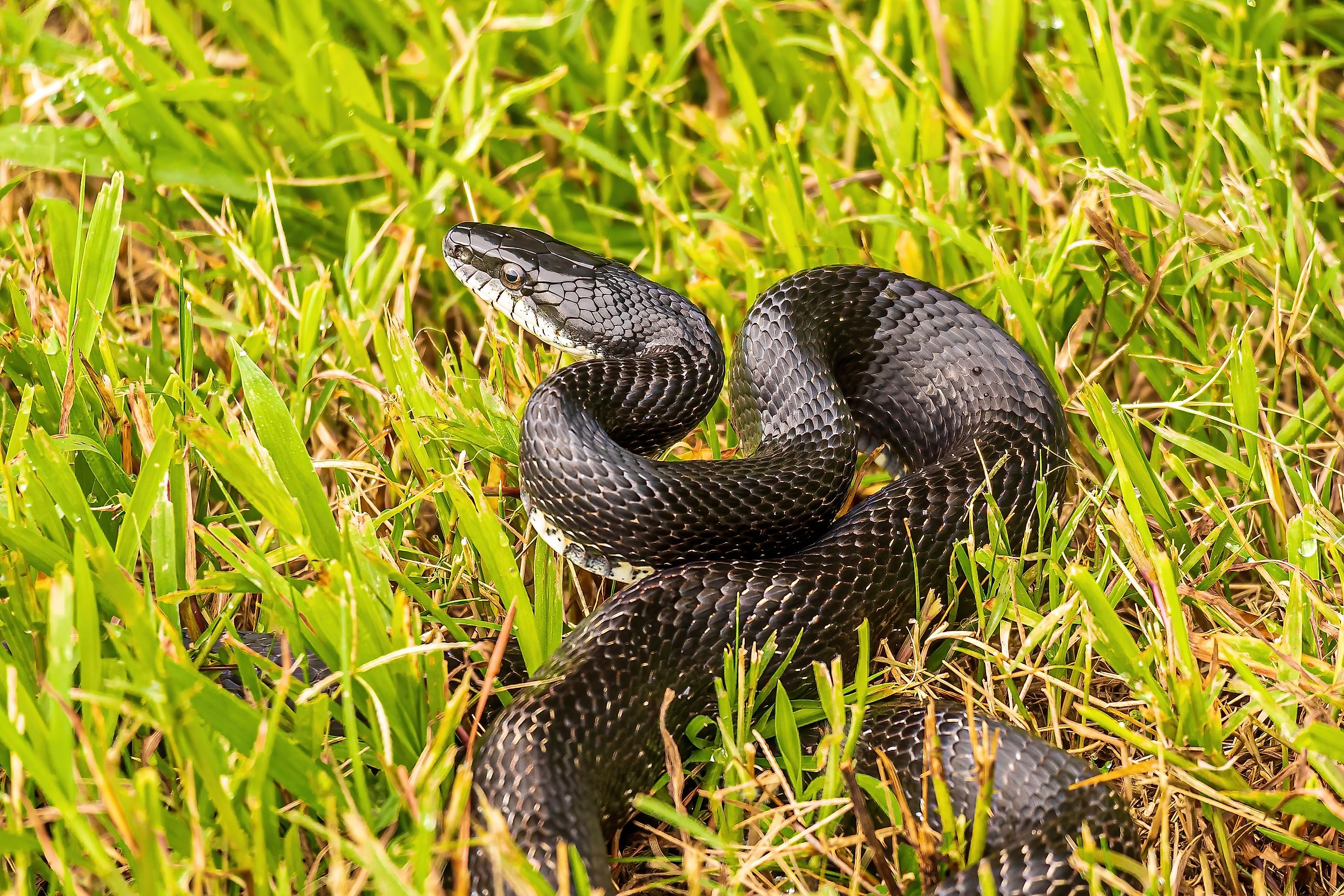
The result was a wave of reshuffling. North American species were moved into the resurrected genus Pantherophis, which now holds familiar animals like the corn snake (Pantherophis guttatus), the western rat snake (Pantherophis obsoletus), and the Great Plains rat snake (Pantherophis emoryi). Old World forms were split across genera including Elaphe, Zamenis, Orthriophis, and Ptyas. The former "common rat snake" of the eastern United States was later divided into three separate species (western, central, and eastern), a change some herpetologists continue to debate because the populations interbreed where their ranges meet. In practice, "rat snake" describes a shared ecology and body plan across several genera rather than a single natural lineage.
Physical Description

Rat snakes are large, slender, and muscular. Adult length across the group runs roughly from 2 to 8 feet (0.6 to 2.4 m), with most familiar North American species measuring between 3.5 and 6 feet (1.1 to 1.8 m). The western rat snake is among the longest snakes in North America, with a record specimen measured at 8 feet 5 inches (2.6 m). Typical adults are light for their length, generally 1 to 3 pounds (0.5 to 1.4 kg), consistent with their climbing habits.
Coloration varies widely across the group. Adults may be glossy black, gray with darker blotches, yellow with four longitudinal stripes, or, in the corn snake, orange with red saddles. Juveniles typically begin gray with dark blotches and darken with age, which is why young black rat snakes are frequently misidentified. One structural feature is particularly distinctive. The body is not round in cross section but instead has a flat belly that meets the sides at an angle, creating a loaf-shaped profile. The keeled, ridged belly scales grip bark and masonry, and this build is generally interpreted as an adaptation for climbing. Sexual dimorphism is limited, though males tend to be slightly longer with proportionally longer tails.
Range and Habitat

As a group, rat snakes occupy an enormous slice of the Northern Hemisphere. New World species blanket the eastern and central United States and reach into Canada and northern Mexico. Old World species range across Europe and much of Asia, spanning the Mediterranean, China, and Southeast Asia, and reaching east to the Philippines. Almost every temperate and subtropical woodland in that vast band has a rat snake of some kind.
They favor habitats defined by edges and varied layers, including hardwood forests, forest borders, fields, rocky hillsides, riverbanks, and the boundaries where wild land meets farmland. Because they climb so well, they use vertical space that many snakes ignore, including tree cavities, cliff faces, and the beams of barns. Old World relatives push the range of habitats further still. The Taiwan beauty snake (Elaphe taeniura), for instance, hunts in caves, where it preys on bats. Across these habitats, the common factor is abundant prey. Rat snakes tend to concentrate where rodents and birds are plentiful, which often includes areas shaped or modified by people.
Diet

Rodents are the dietary staple, and rat snakes are effective at controlling local mouse and rat populations. The group is opportunistic, however, and prey varies by species, age, and location. Recorded prey also includes chipmunks, squirrels, voles, juvenile rabbits, songbirds, lizards, frogs, other snakes, and, among some cave-dwelling Old World species, bats.
Eggs are an important food source. Rat snakes climb to reach bird nests and poultry coops, a behavior that produced the folk name "chicken snake." Diet also shifts with age. Hatchlings and juveniles take a higher proportion of lizards and amphibians, then move toward a rodent-dominated diet as they grow large enough to handle larger prey. Their climbing ability lets them exploit food beyond the reach of ground-dwelling predators, including nests high in trees. This dietary flexibility is a major reason rat snakes succeed across such varied habitats.
Behavior

Rat snakes are generally docile, and their usual first response to a threat is to freeze and rely on camouflage. If pressed further, they employ a series of bluffing defenses. Many vibrate the tail rapidly in dry leaves, producing a buzzing sound that resembles a rattlesnake despite the absence of a rattle. They may also flatten the body, rear up, strike in warning, and release a foul-smelling musk from glands near the tail. A bite from a large rat snake can break the skin but is nonvenomous and not medically significant.
Climbing is the group's most distinctive ability, with their keeled belly scales allowing rat snakes to ascend rough bark and masonry walls while gripping surfaces that most snakes cannot. This is why they are frequently found in attics, chimneys, and rafters, and why they rank among the snakes most often encountered around buildings. Activity patterns vary by season and species. Eastern rat snakes, for example, tend to be active by day in spring and fall and shift to nocturnal activity during the summer heat. In cold weather, rat snakes enter brumation, a reptilian dormancy, and multiple individuals, sometimes of different species, may share a communal den.
Reproduction

Rat snakes are oviparous, meaning they lay eggs rather than giving live birth. Breeding generally runs through spring and early summer, roughly April to June in temperate North America, when males search out females and, in some species, wrestle rival males for the chance to mate.
Several weeks after mating, the female lays a clutch of leathery, oblong eggs in a hidden, humid location. Suitable sites include rotting logs, compost piles, deep leaf litter, and cavities beneath rocks. Clutch size varies widely, typically ranging from 5 to 30 eggs. The female provides no parental care once the eggs are laid. Incubation takes roughly two months, and hatchlings emerge already long and capable, often around 12 to 15 inches (30 to 38 cm), climbing competently within days of leaving the shell. In some species, the young linger near the nest site for a year or more before dispersing. Rat snakes have relatively long lifespans for snakes, with many living 10 to 20 years in the wild, while captive individuals can sometimes survive beyond 25 or even 30 years.
Importance to the World

Rat snakes provide significant ecological and economic value. As efficient rodent predators, they act as natural pest control, suppressing populations of mice and rats that would otherwise damage crops, contaminate stored grain, and spread disease around homes and farms. Areas with healthy rat snake populations generally experience reduced rodent pressure.
Their influence extends through the food web. By suppressing rodents, rat snakes can indirectly reduce the ticks that feed on those rodents, linking them to the dynamics of tick-borne disease. They are also prey for hawks, owls, foxes, and other predators, occupying an intermediate position in the food web. Rat snakes also occupy a notable place in regional folklore, particularly in North America. The name "chicken snake" comes from their habit of raiding poultry nests, while "pilot black snake" traces to an old belief that a black rat snake would lead copperheads and rattlesnakes to shared winter dens, a story rooted in the real tendency of these species to hibernate together. In parts of the rural eastern United States, a resident "black snake" living in a barn was regarded as good luck and a sign of protection, precisely because it kept grain stores free of rats and mice. These traditions reflect how closely rat snakes have lived alongside people, and how their usefulness earned them a degree of tolerance uncommon for a large predator.
Threats and Conservation

Because "rat snake" spans so many species, there is no single conservation status for the group. Many of the widespread North American species are assessed by the IUCN Red List as Least Concern, including the corn snake, the Great Plains rat snake, and the eastern rat snake, and populations of the common species remain broadly secure. That good news does not extend to every relative. Some range-restricted Old World species and isolated regional populations face real pressure, and status should always be checked species by species rather than assumed from the group.
The main threats are consistent across the group. Habitat loss from development and agriculture fragments the forest-edge habitats rat snakes depend on. Road mortality is significant for animals that move slowly across open ground. Rat snakes are also killed deliberately by people who mistake them for venomous species or who simply object to their presence. For the common species, public education is among the most effective conservation measures, since correctly identifying rat snakes as harmless reduces needless killing.
Takeaway
Few reptiles illustrate the value of adaptability as clearly as rat snakes. What began as a single loosely defined group has proven, under closer genetic study, to be a set of only distantly related lineages that arrived at the same successful formula on separate continents. That formula, a climbing, constricting, rodent-eating generalist, has allowed rat snakes to persist where more specialized predators have declined, including in the farms and neighborhoods people occupy. They are easy to overlook and easy to misidentify, yet they remain one of the most familiar and beneficial reptiles across three continents. Recognizing them for what they are, harmless and quietly useful, is the simplest step toward keeping them a common part of the landscape.
Fun Facts

- They mimic rattlesnakes. When threatened, rat snakes vibrate the tail rapidly in dry leaves, producing a buzz similar to a rattlesnake despite having no rattle.
- Constriction does not kill by suffocation. A 2015 study measuring rats in the coils of boa constrictors found that circulation shut down within seconds, cutting off blood flow to the brain. Rat snakes constrict in the same way, subduing prey faster than suffocation would.
- The corn snake is a rat snake. One of the world's most popular pet snakes, Pantherophis guttatus, is a brightly colored rat snake.
- Their belly scales aid climbing. Keeled ventral scales and a loaf-shaped body allow rat snakes to climb bark and vertical masonry.
- Some prey on bats. The Old World Taiwan beauty snake (Elaphe taeniura) hunts bats inside caves.
Quick Facts
- Scientific grouping: Family Colubridae, subfamily Colubrinae; main genera Pantherophis (New World) and Elaphe, Zamenis, Orthriophis, and Ptyas (Old World)
- Order / Family: Squamata / Colubridae
- IUCN status: Varies by species; many common species are Least Concern
- Length: About 2 to 8 feet (0.6 to 2.4 m); record western rat snake around 8.5 feet (2.6 m)
- Weight: Roughly 1 to 3 pounds (0.5 to 1.4 kg) for typical adults
- Lifespan: 10 to 20 years in the wild; 25 to 30 or more in captivity
- Diet: Carnivore (rodents, birds, eggs, lizards, amphibians)
- Range: North America, Europe, and Asia east to the Philippines