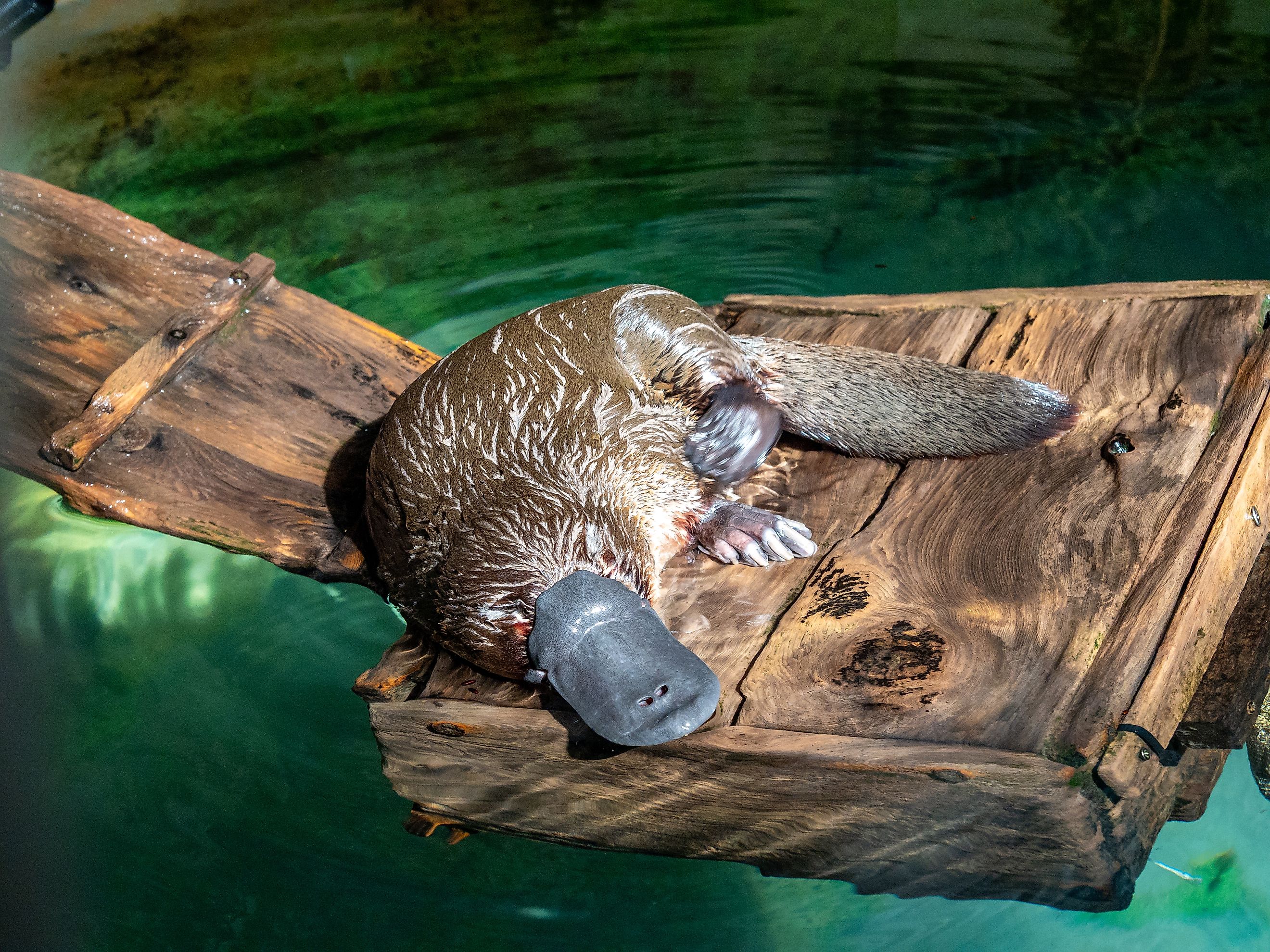
Platypus
Few animals have puzzled scientists quite like the platypus. When the first preserved specimen reached Britain in 1799, naturalists thought it was a hoax, believing someone had attached a duck's bill to the body of a mole. The animal was very real, however, and it remains one of the world's most unusual vertebrates. It is a mammal that lays eggs, produces venom, feeds its young without nipples, and hunts underwater with its eyes, ears, and nostrils closed.
The platypus (Ornithorhynchus anatinus) is a semi-aquatic, egg-laying mammal endemic to the freshwater rivers and streams of eastern Australia and Tasmania. It is one of only five living species of monotreme, the most ancient surviving branch of the mammal family tree, and the sole member of its genus and family. No other animal on Earth combines its particular set of traits.
Beyond its bizarre appearance, the platypus is a finely engineered specialist. It reads the faint electrical signals of prey buried in riverbed mud, stores fat in its tail, and shelters in burrows dug into earthen banks. It is also an indicator of freshwater health, which makes its recent decline a warning worth heeding.
Taxonomic Classification

The platypus belongs to the kingdom Animalia, phylum Chordata, and class Mammalia. Within the mammals it sits in the order Monotremata, the egg-laying mammals, which today includes only the platypus and four species of echidna. The platypus is the only living member of both its family, Ornithorhynchidae, and its genus, Ornithorhynchus, represented by the species O. anatinus.
The naturalist George Shaw formally described the species in 1799, initially placing it in a genus he called Platypus. That name was already in use for a group of beetles, so the German naturalist Johann Blumenbach supplied the genus name Ornithorhynchus, from Greek roots meaning "bird snout," in 1800. The species name anatinus is Latin for "duck-like."
Monotremes diverged from the lineage leading to marsupials and placental mammals more than 160 million years ago, and the platypus retains a genome that blends reptilian, avian, and mammalian genes. It carries 52 chromosomes, including an unusual set of 10 sex chromosomes, where most mammals have just two. This deep evolutionary separation is why the platypus is often described as a living link to the earliest mammals.
Physical Description

An adult platypus is roughly the size of a small domestic cat, with a streamlined body, dense fur, and a broad, flattened tail. Males are noticeably larger than females, by about 25 percent. Males measure 16 to 25 inches (40 to 63 cm) from bill tip to tail tip and weigh 1.8 to 6.6 pounds (0.8 to 3 kg). Females measure 15 to 22 inches (37 to 55 cm) and weigh 1.3 to 3.7 pounds (0.6 to 1.7 kg). Body size increases with latitude, so animals in cooler southern regions such as Tasmania tend to be larger than those in warmer northern Queensland.
The fur is dark brown on the back and lighter underneath, with two layers that work together to provide insulation. A coarse outer coat covers a fine, woolly underfur that traps air, helping keep the animal warm and dry in cold water. The tail is not just a rudder. It stores fat reserves that can account for up to 40 percent of the animal's total body fat, thinning noticeably during winter and lactation.
The most recognizable feature is the pliable, leathery bill, which is not a rigid beak but a sophisticated sensory organ. Its surface holds tens of thousands of receptors, including electroreceptors that detect the faint electrical fields produced by the muscle movements of prey, alongside mechanoreceptors sensitive to pressure and motion. This electroreception is rare among mammals and evolved independently in the platypus rather than being inherited from a mammalian ancestor.
Adult platypuses have no teeth. They grind food between horny plates in the bill, often aided by grit picked up from the streambed. They also lack a true stomach, with the esophagus connecting almost directly to the intestine without an acid-producing chamber in between. Males carry one more distinction. Each hind ankle bears a hollow, keratin spur linked to a venom gland in the thigh, making the platypus one of the very few venomous mammals.
Range and Habitat

The platypus is found only in eastern Australia and Tasmania. Its range runs from around Cooktown in far north Queensland south through New South Wales and Victoria, and it is widespread across Tasmania and King Island. A population was introduced to Kangaroo Island in South Australia in the twentieth century, where it now persists.
Platypuses live almost exclusively in fresh water, favoring rivers, streams, lakes, and ponds with stable banks and reliable flow. They depend on earthen banks with overhanging vegetation, which provide both the soft ground for their burrows and the leaf litter that supports the invertebrates they eat. Consolidated banks and healthy riparian vegetation are essential, which is why river regulation and land clearing hit platypus habitat so directly.
Diet

The platypus is a carnivore that feeds on bottom-dwelling freshwater invertebrates. Its diet is dominated by insect larvae, along with crustaceans such as shrimp and yabbies, aquatic worms, and the occasional small fish egg or mollusc. Because it burns considerable energy to stay warm in cold water, it eats a great deal for its size, sometimes consuming a significant fraction of its own body weight in a single night of foraging.
Hunting takes place mostly underwater, in dives that typically last a minute or two. Once submerged, the platypus closes its eyes, ears, and nostrils and relies entirely on its bill, moving it side to side in rapid motions to pinpoint the electrical signals of hidden prey. It scoops up food along with gravel and stores the mixture in cheek pouches, then surfaces to grind and swallow. This combination of electroreception and touch lets the animal forage effectively in murky, dark water where sight would be useless.
Behavior

Platypuses are largely solitary and most active from dusk into the night, though they may forage during the day in cold weather or in undisturbed areas. Between foraging bouts they rest in burrows dug into riverbanks, usually with entrances hidden just above the waterline. On land they move with an awkward gait because their legs splay out to the sides rather than sitting beneath the body, an arrangement shared with echidnas and reminiscent of reptiles.
In the water they are agile and efficient, propelled by their webbed forefeet while the partially webbed hind feet and tail steer. When digging or walking, the webbing on the forefeet folds back to expose strong claws. Platypuses are generally quiet and secretive, and males can become aggressive during the breeding season, using their venomous spurs in contests over territory and mates.
Reproduction

Platypuses reach sexual maturity at about two years of age. Breeding occurs from late winter into spring on the Australian mainland and can extend into early summer in Tasmania. Courtship takes place in the water and involves the pair rolling, diving, and touching, with the male sometimes grasping the female's tail with his bill. These interactions may last from under a minute to more than half an hour and are often repeated over several days.
After mating, the female digs a long, complex nesting burrow, which can extend many feet into the bank, and lines it with wet vegetation to keep her eggs and young from drying out. She usually lays one to three eggs, most often two, each about the size of a small grape. She incubates them against her body for roughly ten days. The hatchlings are tiny and helpless, and because females have no nipples, they nurse by lapping milk that seeps through pores in the skin of the mother's belly. Young remain in the burrow for several months before entering the water. In the wild, platypuses may live for well over a decade, and captive animals have reached ages of around 20 years.
Importance to the World

As a predator of aquatic invertebrates, the platypus helps regulate the food webs of the freshwater systems it inhabits. Because it depends on clean water, stable banks, and abundant invertebrate life, its presence is a useful indicator of the overall health of a river or stream. Where platypuses vanish, it usually signals that the wider ecosystem is under stress.
The platypus has long attracted attention from both scientists and the cultures that share its range. Its venom and unusual milk have attracted medical research, with compounds in its venom including a long-lasting hormone related to insulin regulation that scientists are investigating for potential applications in diabetes and chronic pain treatment. Culturally, the platypus is a national emblem of Australia, appearing on the 20-cent coin and serving as a symbol of the continent's singular wildlife.
Threats and Conservation

The International Union for Conservation of Nature lists the platypus as Near Threatened, a status applied within Australia in 2014 and internationally in 2016. Estimating its numbers is difficult because the animal is elusive and hard to survey, and published estimates range widely, from roughly 30,000 to 300,000 individuals as of 2016. The platypus population is declining overall, with some regional populations facing even greater concern. It is listed as Vulnerable in Victoria and Endangered in South Australia.
The platypus faces several overlapping pressures, with dams and water extraction altering natural river flows and reducing the habitat available to it. Land clearing and urban expansion strip away the bank vegetation that platypuses need for burrowing and feeding. Prolonged drought and bushfires, both intensified by climate change, dry out waterways and force animals to travel overland, where they are exposed to predators. Pollution degrades water quality, and platypuses are also drowned in discarded fishing gear and enclosed traps. Conservation work now focuses on restoring riverbank vegetation, securing environmental water flows, and using environmental DNA sampling to track populations that are otherwise almost impossible to count.
Takeaway
For anyone hoping to spot a platypus in the wild, being there at the right time helps. They are most active around dawn and dusk and are often revealed by small rings of ripples rather than splashes in quiet, well-vegetated stretches of river. Sightings have become less common across much of their historic range, making public reports increasingly useful for conservation efforts. People can help by reporting sightings to local platypus monitoring groups, keeping riverbanks vegetated, avoiding enclosed yabby traps and discarded fishing line, and supporting healthy environmental water flows. The platypus has survived largely unchanged for millions of years, but its future now depends heavily on the condition and management of the freshwater systems it calls home. Protecting those rivers is one of the best ways to protect the animal itself.
Fun Facts

- The name means "flat foot." It comes from Greek, and the correct plural is "platypuses," not "platypi."
- They glow in the dark. In 2020, researchers found that platypus fur is biofluorescent, absorbing ultraviolet light and re-emitting it as a blue-green glow. The purpose is still unknown.
- They have no stomach. Food passes from the grinding plates in the bill straight into the intestine, with no acid-producing stomach in between.
- Ten sex chromosomes. A male platypus carries a chain of ten sex chromosomes, where humans have just two, and some resemble those found in birds.
- Venom that resists painkillers. A spur strike delivers venom that causes intense, long-lasting pain in humans and can be strong enough to kill a dog.
Quick Facts
- Scientific name: Ornithorhynchus anatinus
- Family / Order: Ornithorhynchidae / Monotremata
- IUCN status: Near Threatened (declining)
- Length: males 16 to 25 in (40 to 63 cm); females 15 to 22 in (37 to 55 cm)
- Weight: males 1.8 to 6.6 lb (0.8 to 3 kg); females 1.3 to 3.7 lb (0.6 to 1.7 kg)
- Lifespan: commonly over a decade in the wild; up to about 20 years in captivity
- Diet: carnivore (aquatic invertebrates such as insect larvae, crustaceans, and worms)
- Range: eastern Australia, Tasmania, King Island, and introduced to Kangaroo Island