Pangolin
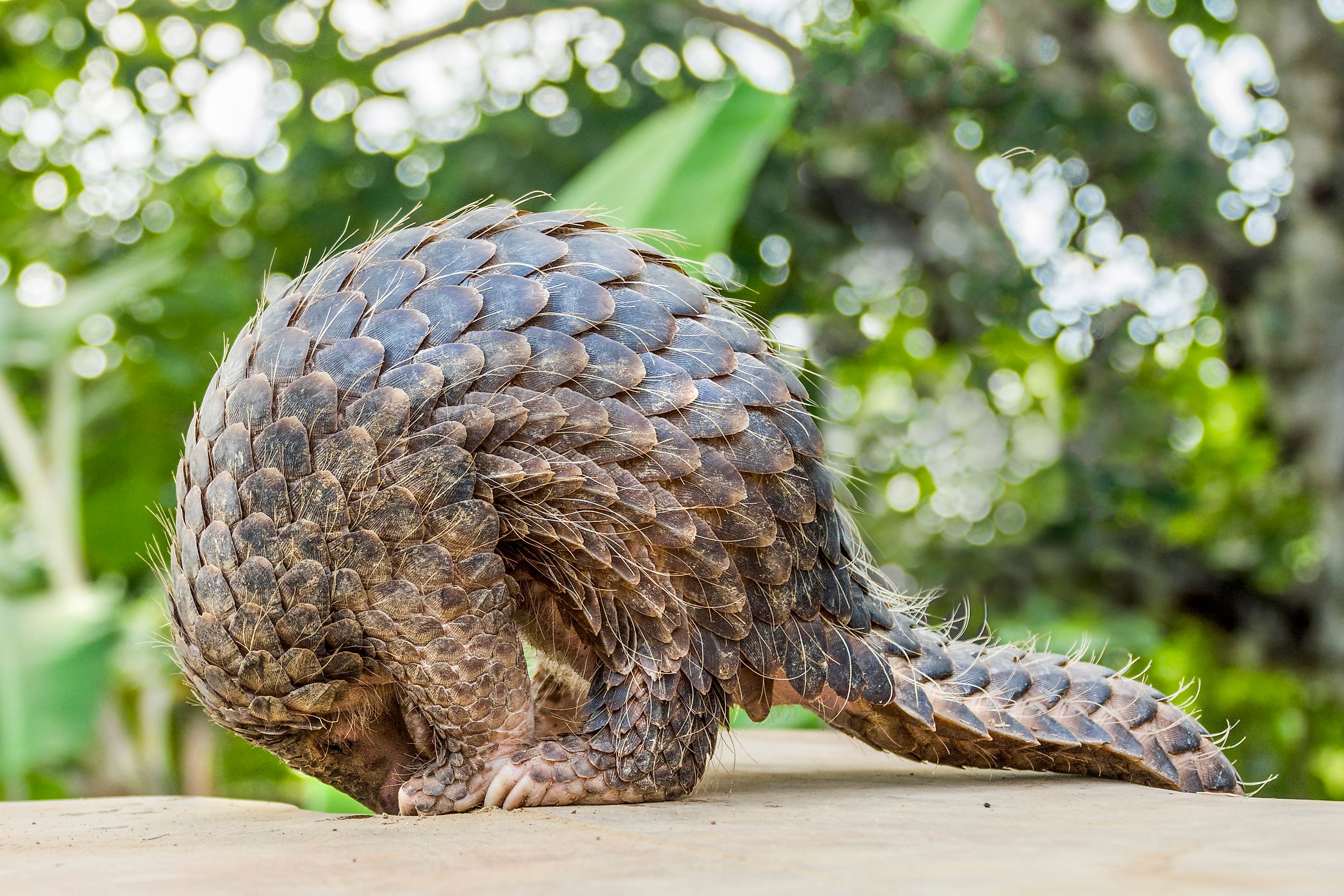
Roll a house cat into a pinecone, give it the appetite of an anteater, and armor it in overlapping plates of the same material as your fingernails, and you have something close to a pangolin. It is the only mammal on Earth whose body is covered in true scales, and that single trait has made it both one of the planet's strangest animals and one of its most endangered. Pangolins are widely described as the most trafficked wild mammals in the world.
Pangolins, also called scaly anteaters, are insect-eating mammals of the order Pholidota. Eight living species range across the tropical forests and grasslands of sub-Saharan Africa and southern and eastern Asia. They include the giant ground pangolin of the Congo Basin and the tree-dwelling species of Southeast Asia. Despite the anteater nickname and an armadillo-like habit of curling into a ball, pangolins are not closely related to either. Genetic work places them nearest to the carnivores, the group that includes cats and dogs.
They are shy, nocturnal, and so poorly studied that scientists still cannot say how many remain in the wild. What is clear is the pressure they face. Every species is threatened, and demand for their scales and meat drives an illegal trade that has removed more than a million pangolins from the wild in a single decade.
Taxonomic Classification

Pangolins make up the entire mammalian order Pholidota, a name drawn from the Greek for "clad in scales." The order contains a single living family, Manidae, which is split into three genera. Manis holds the four Asian species: the Chinese pangolin (Manis pentadactyla), the Sunda or Malayan pangolin (Manis javanica), the Indian pangolin (Manis crassicaudata), and the Philippine pangolin (Manis culionensis). The two African genera are Phataginus, the tree pangolins, and Smutsia, the ground pangolins. Together they account for the white-bellied pangolin (Phataginus tricuspis), the black-bellied or long-tailed pangolin (Phataginus tetradactyla), the giant ground pangolin (Smutsia gigantea), and Temminck's ground pangolin (Smutsia temminckii).
The common name comes from the Malay word pengguling, meaning roughly "one that rolls up," a nod to the animal's signature defense. For a long time pangolins were assumed to be relatives of the anteaters, armadillos, and sloths, since all share a diet of ants and termites and a toothless, tube-shaped snout. DNA evidence has since shown that this resemblance is the result of convergent evolution rather than close kinship, with pangolins actually being more closely related to true carnivores. The lineage is ancient, with a fossil record for the order reaching back roughly 60 million years.
Taxonomy here is still moving. Most authorities recognize eight living species, but researchers described a possible ninth in 2023, known only from scales seized by customs officers and never seen alive. A 2025 study then split an Indo-Burmese population away from the Chinese pangolin as a separate species, and follow-up work in 2026 matched that animal to an older name given in the 1830s, Manis aurita. Both cases show how much remains uncertain about an animal that is difficult to find and harder to observe.
Physical Description

The scales are the whole story. They are made of keratin, the same protein found in human hair and nails and in rhino horn, and they overlap like roof tiles across the animal's back, sides, and tail. They can account for about 20 percent of a pangolin's body weight. The belly, face, and inner limbs remain soft and unscaled, which is why a threatened pangolin tucks its head and rolls into a tight sphere. Its armor protects these vulnerable areas while leaving predators with little more than sharp, overlapping plates to contend with. The plates are tough enough that a lion or leopard usually cannot bite through them.
Size varies widely across the eight species. The giant ground pangolin is the largest, reaching up to 33 kilograms (73 pounds) and measuring 140 to 180 centimeters (about 4.6 to 5.9 feet), nose to tail. The black-bellied pangolin is the smallest, weighing as little as 1.6 to 2.5 kilograms (3.5 to 5.5 pounds) with a head and body around 30 to 40 centimeters (12 to 16 inches). Coloration runs through sandy yellow, olive, and dark brown depending on the species. Many pangolins show marked sexual dimorphism, with males noticeably larger than females.
Beyond the armor, pangolins are built entirely around eating ants and termites. They have no teeth at all. Instead, they carry an extraordinarily long, sticky tongue that in some species is longer than the head and body combined and is anchored deep in the chest, near the pelvis and last pair of ribs. To grind food without teeth, the muscular stomach works like a bird's gizzard, lined with hardened spines and often holding small swallowed stones. Powerful forelimbs and long, curved claws let the animal tear open insect nests and dig burrows. Eyesight is poor, but the sense of smell is excellent, and a pangolin can seal its nostrils and ear openings to keep biting insects out while it feeds.
Range and Habitat

Pangolins live only in Africa and Asia, split evenly with four species on each continent. The Asian species occupy a broad band across southern and eastern Asia. The Chinese pangolin ranges through parts of China, Taiwan, and the eastern Himalayas into Nepal and northeast India; the Indian pangolin covers much of the Indian subcontinent; the Sunda pangolin spreads across mainland Southeast Asia and the islands of Indonesia; and the Philippine pangolin is found only on Palawan and nearby islands.
The four African species live across sub-Saharan Africa. The giant ground and white-bellied pangolins inhabit the forests of West and Central Africa, including the Democratic Republic of the Congo, while Temminck's ground pangolin ranges widely across southern and eastern Africa, the only species found in that region. Habitats span tropical rainforest, moist and dry woodland, thick bush, and open savanna grassland. Ground-dwelling species den in burrows they excavate themselves, sometimes to depths of a few meters, or in cavities under debris. Tree pangolins such as the black-bellied and white-bellied species spend most of their lives in the canopy, gripping branches with a prehensile tail. What all species have in common is not a particular landscape but a particular food source. They are found wherever ants and termites are abundant.
Diet

Pangolins are specialist insect eaters, or myrmecophages, and their diet consists almost entirely of ants and termites, with the occasional larva. A single pangolin can consume enormous quantities, with estimates reaching as many as 70 million insects in a year. To find a nest, it relies on its sense of smell rather than sight, then uses its claws to tear open termite mounds or dig into ant colonies. The long tongue does the rest, probing through tunnels and galleries and trapping insects on its sticky surface. Tree-climbing species also strip bark off trunks to reach nests hidden underneath.
For all that appetite, pangolins are surprisingly fussy. An individual often feeds on just one or two preferred prey species even when many others are available nearby. Because they have no teeth, they cannot chew, so the gizzard-like stomach and its swallowed grit do the grinding. That combination of selective hunting and huge intake makes each pangolin a steady, targeted consumer of the insects around it.
Behavior and Reproduction

Pangolins are solitary and, for the most part, nocturnal, resting by day curled in a burrow or tree hollow and emerging after dark to feed. The black-bellied pangolin is the exception, sometimes active during daylight. They are unhurried walkers that often shift onto their hind legs, tucking the front claws under the foot pads and using the heavy tail for balance, and most species are capable swimmers. Their eyesight is weak, so they navigate the world largely by scent. When alarmed, a pangolin hisses, curls tight, and can release a foul-smelling fluid from a gland near the base of the tail, which it also uses to mark territory.
Reproduction is slow, which is central to why the animals are so vulnerable. Adults come together only to mate, and females typically give birth to a single offspring, affectionately called a pangopup, after a gestation of roughly 140 days. The newborn arrives with soft scales that harden over the following weeks and rides on the base of its mother's tail as she forages. Young pangolins stay with their mother until around two years of age, when they reach maturity. Lifespan in the wild is poorly documented, but individuals have lived up to about 20 years in captivity, and pangolins are notoriously difficult to keep alive outside their natural habitat.
Importance to the World

As natural pest controllers, pangolins earn their keep. By eating tens of millions of ants and termites each year, a single animal helps regulate insect populations that would otherwise damage crops and structures, reducing the need for chemical insecticides. In this role they sit alongside other specialist insect eaters such as the aardvark and the termite-eating aardwolf, quietly shaping the ecosystems they move through.
Their digging matters too. Ground-dwelling pangolins turn over and aerate soil as they excavate for food, and the burrows they abandon become shelter for reptiles, birds, and other small mammals, and refuge for animals fleeing fire. Removing pangolins from a landscape therefore does more than erase a single species; it takes away a pest controller and an unintentional engineer of habitat for others.
Threats and Conservation

Every pangolin species is threatened with extinction. On the IUCN Red List, three are Critically Endangered (the Chinese, Sunda, and Philippine pangolins), three are Endangered (the Indian, white-bellied, and giant ground pangolins), and two are Vulnerable (the black-bellied and Temminck's ground pangolins). All eight carry a decreasing population trend, and because the animals are so hard to survey, no reliable global population figure exists. These assessments date to 2018 and 2019.
The driving force is illegal trade, which has made the pangolin the most trafficked wild mammal on the planet. Their meat is treated as a luxury delicacy, and their scales are used in traditional medicine in parts of Asia, chiefly China and Vietnam, despite having no proven medicinal value. More than a million pangolins are estimated to have been taken from the wild over the past decade, with roughly 20 tonnes of scales trafficked internationally in some single years. As Asian populations have collapsed, traffickers have increasingly turned to Africa to supply the same demand. Habitat loss caused by expanding agriculture adds even more pressure, while the pangolin's natural defense can work against it. Instead of fleeing, it curls into a ball, making it easy for a hunter to simply pick it up.
There has been a conservation response. In 2016, the parties to the Convention on International Trade in Endangered Species voted to ban commercial international trade in all eight species, moving them to CITES Appendix I effective January 2017. Conservation groups now run detection-dog units at ports and borders, support anti-poaching patrols, and campaign to reduce consumer demand, and some consumer nations have signaled intentions to cut medicinal use of scales. Enforcement across dozens of range countries remains difficult, and the pangolin's slow reproduction means recovery, where it happens at all, will be gradual. Pangolins also drew scientific and public attention as a species studied for a possible role in the transmission of coronaviruses, which sharpened scrutiny of the wildlife trade that endangers them.
Takeaway
The pangolin is a study in contradiction. It is an armored, ancient mammal seemingly built to withstand predators, yet its most effective defense leaves it vulnerable to the one threat it cannot escape. Its scales turn away lions but invite poachers, and its slow, solitary life leaves little margin for recovery once populations fall. Across Africa and Asia, all eight species are now sliding in the same direction, kept there by a trade that values them dead. Their outlook depends less on the animal, which has endured for tens of millions of years, than on whether demand for its scales and meat can be brought down before the wild populations are gone.