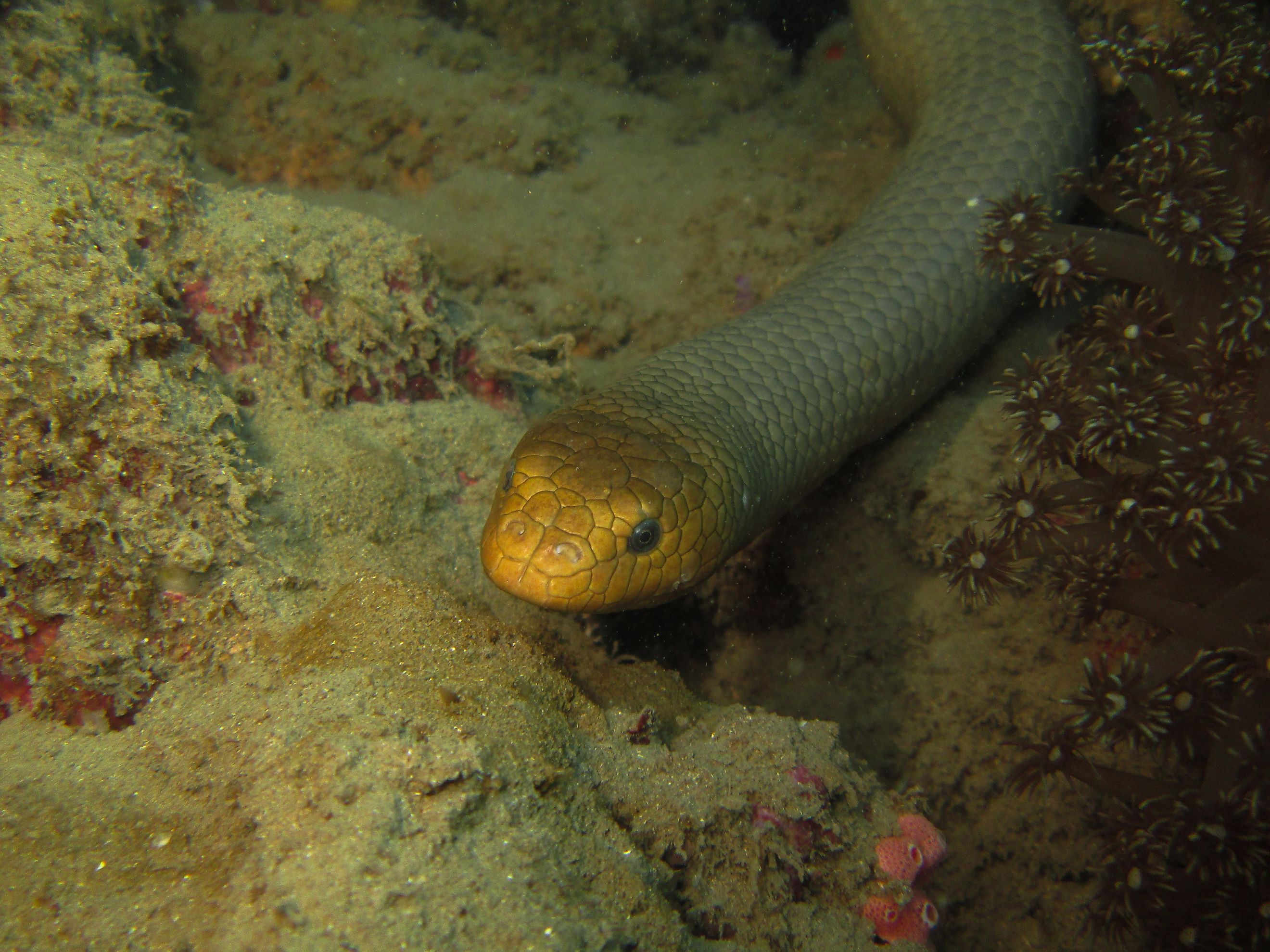
Olive Sea Snake
Among the more than sixty species of true sea snakes that inhabit the warm waters of the Indo-Pacific, few are as widespread, well-studied, or frequently encountered as the olive sea snake (Aipysurus laevis). A robust, fully marine reptile, it glides through coral reefs with an ease that its terrestrial relatives could never match. For divers exploring Australia's Great Barrier Reef, an encounter with this large, inquisitive serpent is one of the region's more memorable wildlife experiences. Yet beneath its unassuming olive coloration lies a remarkable suite of adaptations that make it one of the ocean's most accomplished reptilian predators.
Taxonomic Classification

The olive sea snake belongs to the family Elapidae, the group of front-fanged venomous snakes that also includes cobras, mambas, and taipans. Within this family, it is placed in the subfamily Hydrophiinae, which encompasses the true sea snakes, fully aquatic species that live and breed in the ocean, as distinct from the amphibious sea kraits. Its genus, Aipysurus, contains a number of reef-associated sea snakes, and the species itself was formally described as Aipysurus laevis by the French naturalist Bernard Germain de Lacépède in 1804.
The olive sea snake belongs to the kingdom Animalia, phylum Chordata, class Reptilia, order Squamata, suborder Serpentes, family Elapidae, subfamily Hydrophiinae, genus Aipysurus, and species Aipysurus laevis. This placement reflects its evolutionary origins among the elapid snakes of Australasia, a lineage that gave rise to the true sea snakes as they radiated into marine environments. Understanding these relationships helps explain both the potency of the species' venom, inherited from its elapid ancestry, and the specialized adaptations it shares with other members of the Hydrophiinae.
Physical Description

The olive sea snake takes its name from the muted olive-brown that dominates its body, though individuals can range toward purple, reddish, or golden hues depending on age, location, and lighting. Unlike many of its relatives, it lacks the bold banding patterns seen in sea kraits and some other hydrophiine species, giving it a comparatively plain and uniform appearance. The scales are smooth, and the body is thick and muscular, tapering toward a distinctive paddle-shaped tail that is flattened laterally to function as a swimming fin.
Adults typically measure between one and one-and-a-half metres (about 3 to 5 feet) in length, though exceptionally large specimens can approach two metres (roughly 6.5 feet). The head is relatively small and rounded, blending smoothly into the body without the pronounced neck seen in many terrestrial snakes. Juveniles tend to display a slightly more contrasted pattern that fades as they mature. This overall lack of striking markings can make the species easy to overlook against the complex backdrop of a coral reef, where it often rests wedged into crevices.
Range and Habitat

The olive sea snake is a creature of the tropical Indo-Pacific, with its stronghold in the waters off northern Australia, including the Great Barrier Reef and the Coral Sea. Its range extends westward and northward into the seas around New Guinea, parts of Indonesia, and other portions of Southeast Asia. Throughout this range it shows a strong preference for coral and rocky reef environments, where the abundance of crevices and prey supports its foraging lifestyle.
It is predominantly a shallow-water species, most commonly living in the upper waters down to about forty metres (roughly 130 feet), although it can venture deeper. Coral reefs provide it with both hunting grounds and shelter, and individuals often maintain relatively small home ranges centred on familiar reef structures. This reliance on healthy reef habitat means the species is intimately tied to the fortunes of the coral ecosystems it depends upon.
Anatomy and Adaptations for Ocean Life

The olive sea snake is fully aquatic and displays a range of specializations that distinguish true sea snakes from land-dwelling serpents and even from the semi-terrestrial sea kraits. The most obvious is the flattened, oar-like tail, which provides powerful propulsion and allows the snake to maneuver precisely through the three-dimensional maze of a coral reef.
Internally, the species possesses a single greatly elongated lung that extends much of the length of the body. This oversized lung serves not only as a respiratory organ but also helps regulate buoyancy, allowing the animal to control its position in the water column. While it must surface periodically to breathe air, the olive sea snake can remain submerged for extended periods, and it supplements its breathing through cutaneous respiration, absorbing a meaningful portion of its oxygen directly across the skin from the surrounding water.
Living permanently in salt water presents an osmotic challenge, and the olive sea snake meets it with specialized salt glands located beneath the tongue. These glands actively excrete excess salt taken in with food and seawater, allowing the snake to maintain its internal salt balance without needing access to fresh water. Valvular nostrils that can seal shut prevent water from entering the airways during dives, completing a body plan finely tuned for a life spent beneath the waves.
Diet and Hunting

As an active reef predator, the olive sea snake forages methodically among coral heads, ledges, and crevices in search of prey. Its diet consists largely of reef fish, along with fish eggs, crustaceans such as crabs and shrimp, and other small invertebrates. Rather than pursuing fast-moving prey in open water, it tends to probe into holes and gaps in the reef, flushing out hidden animals and seizing them with a rapid strike.
The species is primarily diurnal in much of its range, hunting during daylight hours when it can navigate the intricate reef terrain by sight. Once prey is captured, potent venom quickly subdues it, and the snake swallows its meal whole. This foraging strategy positions the olive sea snake as an important mid-level predator on the reefs it inhabits, helping to shape the populations of the smaller animals it feeds upon.
Venom and Danger to Humans

Like all true sea snakes, the olive sea snake is venomous, and its venom is potent, containing neurotoxins and other components typical of the elapid family to which cobras and taipans also belong. In principle, a bite is capable of causing serious harm to a human. In practice, however, bites are rare, and the species is generally regarded as non-aggressive toward people.
Most encounters with divers pass without incident, and the snake often appears more curious than hostile. Serious envenomations tend to occur in situations where the animals are handled, trodden upon, or otherwise provoked, particularly among fishermen who catch them accidentally in nets. When bites do happen, prompt medical attention and, where appropriate, antivenom treatment are important. For the ordinary observer who maintains a respectful distance, the risk posed by the olive sea snake is minimal, and the reptile shows little inclination to initiate conflict.
Reproduction and Life Cycle

The olive sea snake is viviparous, meaning it gives birth to live young rather than laying eggs. This is a crucial adaptation, because unlike sea kraits, true sea snakes such as Aipysurus laevis do not return to land at any stage of their lives. Mating, gestation, and birth all take place at sea. Females carry their developing young internally and, after a gestation period of several months, deliver a modest litter of fully formed offspring directly into the water.
Newborn snakes are independent from birth and must immediately fend for themselves on the reef, hunting small prey and evading predators. This live-bearing strategy frees the species entirely from any dependence on shorelines or beaches, a liberation that has allowed sea snakes to colonize marine habitats far more thoroughly than most other reptile groups. The species is thought to live for around fifteen years in the wild, reaching sexual maturity after several years of growth.
Behavior and the "Curious Diver" Phenomenon

One of the olive sea snake's most talked-about traits is its apparent curiosity toward human divers. Individuals will sometimes approach people closely, circling, investigating, and even attempting physical contact. This behavior can be unnerving to the uninitiated, but research suggests a fascinating explanation. During the breeding season, male snakes searching for mates may mistake a diver for a potential female or a rival male, leading to what looks like inquisitive or affectionate approaches. Some of these interactions appear to be misdirected courtship behavior rather than aggression.
Outside of these encounters, the species spends much of its time foraging or resting within the reef. Individuals often show fidelity to particular patches of reef, returning repeatedly to familiar shelters and hunting grounds. This site attachment makes them a reliable presence for divers who frequent the same locations over time.
Sensory Abilities

Beyond its visual hunting abilities, the olive sea snake has another remarkable sensory adaptation that has attracted considerable scientific interest. Its skin contains light-sensitive cells that allow it to detect changes in light. Researchers have found that the species can detect light through photoreceptors in the skin of its tail. This capacity is thought to help the snake ensure that its paddle-shaped tail remains hidden within a crevice while it forages, protecting this vulnerable appendage from predators that might otherwise spot it protruding into the open. This form of dermal light sensitivity is a striking example of the subtle adaptations that fit the animal so precisely to reef life.
Conservation Status

The olive sea snake is currently listed as Least Concern by the International Union for Conservation of Nature, reflecting its wide distribution and generally stable populations across much of its range. Nevertheless, the species faces genuine pressures. Accidental capture in fishing gear, particularly trawl nets, accounts for significant mortality in some areas, and the degradation of coral reefs through warming seas, pollution, and physical damage threatens the habitat on which it depends.
Because its life is so closely bound to the health of coral reef ecosystems, the long-term fortunes of the olive sea snake are tied to the broader challenge of reef conservation. Protecting reef habitat, reducing bycatch, and monitoring populations remain the most important measures for ensuring that this graceful and widespread predator continues to thrive throughout the Indo-Pacific.
Takeaway
The olive sea snake stands as a compelling example of how thoroughly a reptile can adapt to life in the ocean. From its paddle-shaped tail and elongated lung to its salt-excreting glands and light-sensing skin, every feature reflects millions of years of evolution toward a marine existence. Widespread, ecologically important, and endlessly intriguing to the divers who encounter it, Aipysurus laevis remains one of the Indo-Pacific's most notable reef inhabitants. It is a venomous yet rarely dangerous predator whose future is inseparable from the coral reefs it calls home.
Fun Facts
- The olive sea snake can "see" light with its tail, thanks to light-sensitive photoreceptors in the skin near its rear end.
- It breathes partly through its skin, absorbing oxygen directly from the surrounding water to extend its dives.
- A single lung runs much of the length of its body and doubles as a buoyancy aid, like a built-in diving vest.
- Special glands under its tongue let it "spit out" excess salt, so it never needs a drink of fresh water.
- Amorous males sometimes chase or circle scuba divers, apparently mistaking them for potential mates.
- It never touches dry land. Mating, pregnancy, and birth all happen entirely underwater.
- Despite carrying venom potent enough to be dangerous, it is so mild-mannered that bites on divers are rare.
- Its flattened, paddle-shaped tail works like an oar, making it a surprisingly agile swimmer among the corals.
Quick Facts
- Scientific name: Aipysurus laevis
- Common names: Olive sea snake, golden sea snake
- Family: Elapidae (subfamily Hydrophiinae, the true sea snakes)
- Typical length: 1 to 1.5 metres (3 to 5 feet), occasionally reaching 2 metres (6.5 feet)
- Coloration: Olive-brown to purplish-brown, sometimes with a golden or reddish tint
- Range: Coral reefs of the Indo-Pacific, especially northern Australia, the Coral Sea, and parts of Southeast Asia
- Habitat: Shallow coral and rocky reefs, generally to depths of about 40 metres (130 feet)
- Diet: Reef fish, fish eggs, crustaceans, and other small marine prey
- Reproduction: Viviparous (gives birth to live young at sea)
- Venom: Highly venomous but rarely aggressive toward humans
- Lifespan: Estimated at around 15 years in the wild
- Conservation status: Listed as Least Concern by the IUCN