Ocelot
Ocelots have been highly regarded by humans for thousands of years. These cats climb, swim, and hunt in pitch-black forests. They cover several miles each night within their territory. They pack the energy and toughness of much larger cats into the size of a housecat. Worshipped as symbols of power in ancient Aztec and Mayan cultures, ocelots featured prominently in the artwork of these ancient civilizations. Today, they face modern challenges of habitat loss and fragmentation, and population decline from human activity, but efforts are well underway to ensure these animals receive the help they need to thrive.
Taxonomic Classification

The term "ocelot" comes from the Uto-Aztecan word ōcēlōtl, which refers more to a jaguar than the ocelot, or the Latin ocellatus, which means having little eyes or marked with eye-like spots. Throughout its range in Central and South America there are numerous names for it depending on the country. By the mid-1900s, researchers had grouped the ocelot (Leopardus pardalis) into as many as nine subspecies, though in 2017 the Cat Classification Task Force of the IUCN Cat Specialist Group noted that up to four subspecies can be identified and recognized only two as valid taxa. Results of a phylogenetic study indicate that the Leopardus lineage genetically diverged from other cat lineages about 8 million years ago. The ocelot's association with humans dates back to the Aztec and Inca civilizations, when it was occasionally kept as a pet.
Range and Habitat
The ocelot's range is expansive. Its northern limit reaches Texas and Arizona, and it extends south through Mexico and Central America into northern Argentina and Uruguay. It is not present in Chile and is considered endangered in southern Texas and Mexico. They live in tropical and subtropical forests, mangrove swamps, thorn scrub, and savannas, and rely on thick brush, shrubs, or trees to hide from predators and stalk prey. Ocelots usually keep to lower elevations, though some have been recorded as high as 9,800 feet (3,000 meters). They usually stay near steady water sources and shy away from open places, especially where there are roads or settlements.
Food

Ocelots are opportunistic, nocturnal carnivores that hunt almost exclusively at night, relying on stealth and camouflage to capture a wide variety of small prey. Mice, rats, and agoutis (guinea pig-like rodents) make up their main diet, and they will occasionally hunt larger prey like opossums, armadillos, and small monkeys. They also frequently eat iguanas, lizards, snakes, and frogs, and will sometimes catch ground-nesting birds. To stalk prey, they move slowly through the dense brush, using their spotted coats as camouflage before pouncing. They are excellent climbers and swimmers, but hunt primarily on the ground, working alone and covering up to several miles each night within their established territory. Since they hunt in the dark, ocelots rely on sharp night vision, acute hearing, and sensitive whiskers to locate prey in complete darkness.
Physical Description

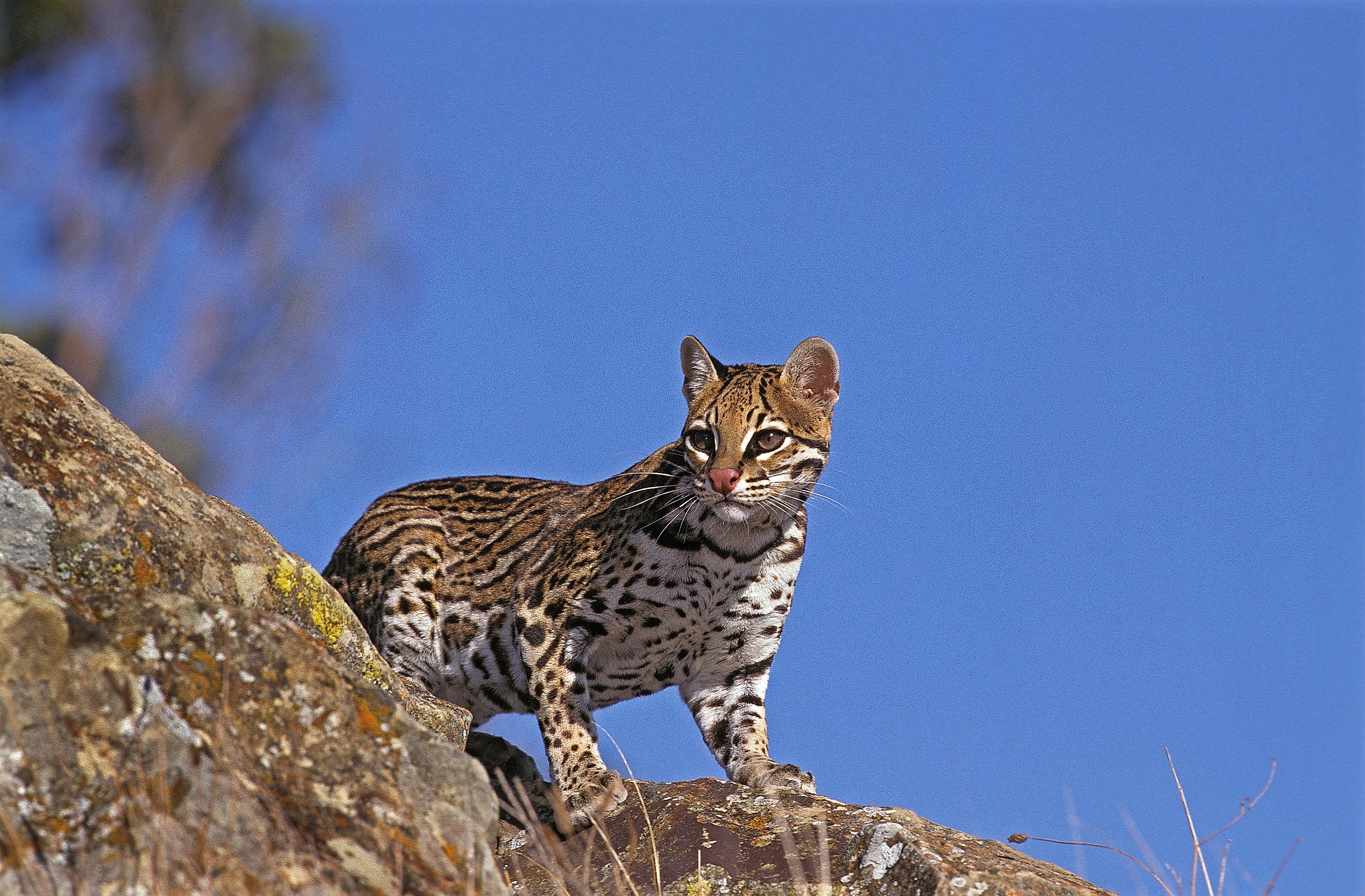
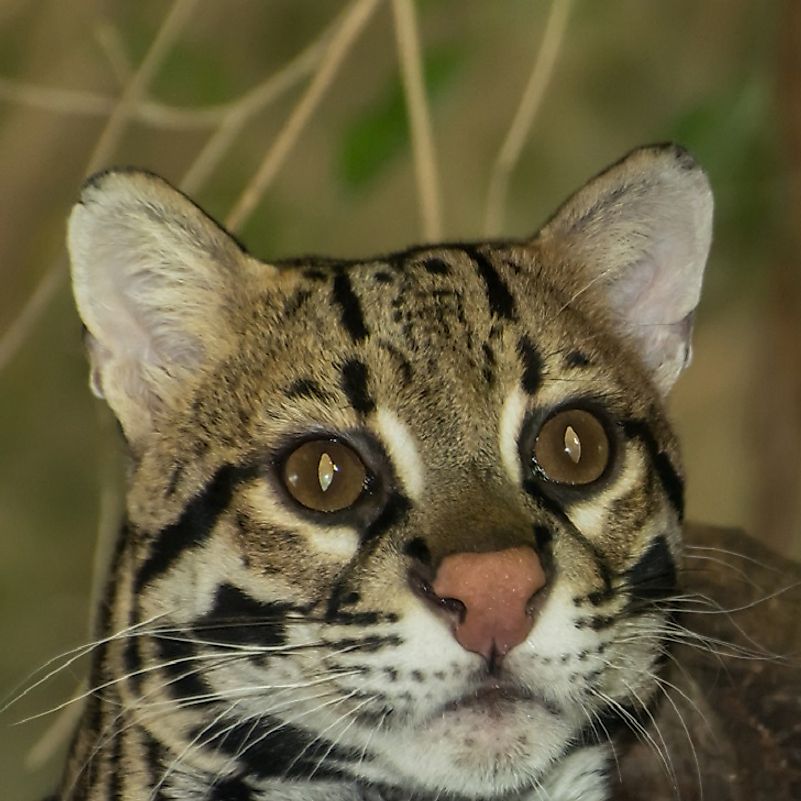
Ocelots are medium-sized cats with a chain-like spotted coat and sleek, muscular bodies. They weigh between 15 and 35 pounds, with males being significantly larger than females. They stand about 15 to 18 inches at the shoulder and measure 20 to 40 inches from the tip of the nose to the base of the tail, with their tails adding another 12 to 18 inches. The base coat varies in color, pale yellow through reddish-gray, over an almost white underbelly. Their coat is covered in dark rosettes, spots, and stripes that form a chain-like pattern along the body. Every ocelot features two distinct black stripes on each cheek and parallel lines running from the eyes over the head. They have large, brown eyes with adaptable pupils that dilate completely for night vision, large front paws relative to their body size, and long, highly sensitive whiskers.
Behavior

Ocelots are solitary, secretive, shy, and highly territorial cats that prefer to avoid conflict with other predators, instead focusing on spending their energy hunting. When resting during the day, it is usually in hollow trees or thick brush to hide from predators. When active, they spend most of their time on the ground, but will climb trees or swim to escape predators or pursue prey. Ocelots only seek out other ocelots during a brief mating period. Male ranges will often overlap several female ranges, though they maintain distinct territories with other males and will fiercely defend their territory against same-sex rivals, sometimes fighting to the death. To communicate they use low meows, yowls, and mutters.
Reproduction

Ocelots have a slow reproductive rate, and females will invest significant time and energy into raising just one or two kittens at a time. They mate throughout the year, though breeding peaks in winter months in the northern ranges. Adults come together for mating for only a few days before separating completely. The gestation period lasts 80 to 85 days, and the female will find a safe, secluded den in a hollow log, rocky cave, or thick, thorny brush to give birth, typically to just one kitten. Born blind and helpless, kittens open their eyes at about two weeks and begin walking at around three weeks. They start eating solid meat brought to them by their mother, who raises them alone, at around six to eight weeks, but have been known to nurse for up to six months.
Importance to the World
Regulating populations of rodents, ocelots play a significant role in reducing the spread of disease and overgrazing of vegetation and crops. By controlling seed-eating rodents, they also indirectly protect forest regeneration. Their presence within their range indicates a healthy, intact ecosystem with sufficient forest cover and available prey, and protecting ocelots and their habitat safeguards hundreds of other plants and animals that share the same space. Because of their beauty and elusiveness, ocelots hold a historical significance in Mesoamerican cultures and frequently appear in Aztec and Mayan art.
Threats
Ocelots face numerous pressures today, mostly driven by human expansion and activities that destroy their habitats and reduce their populations. Deforestation, urbanization, and roadkill are their primary threats, with illegal poaching for their fur continuing despite international bans. The illegal pet trade is also a threat, as kittens are illegally captured from the wild and sold as exotic pets. With habitats becoming more fragmented, isolated populations cannot reach each other to mate, resulting in increased inbreeding and leading to low genetic diversity and health issues. Globally the ocelot is listed as Least Concern, but it is federally endangered in the United States, where fewer than 100 remain in South Texas, and it is also endangered in Mexico.
Conclusion
Ocelots are considered one of the coolest cats on the planet because they pack the fierceness of bigger jungle cats into the compact size of a large housecat. No two ocelots share the same coat, and they are sleek, capable swimmers and climbers that can endure difficult conditions. A distinctive feature is the bright white spot on the back of each ear, which researchers think may help kittens follow their mothers through dark forests. Fortunately, these cats are receiving the protections they need across their range from numerous agencies and conservation groups. Conservation teams have built highway underpasses to cut vehicle collisions in South Texas. They have restored thousands of acres of farmland to continuous thorn scrub habitat. Collaborative programs like the SAFE Ocelot initiative bring these efforts together. These cats have turned human heads for thousands of years, and with such work, they may for thousands more.