Naked Mole-Rat
Few animals overturn expectations as thoroughly as the naked mole-rat (Heterocephalus glaber). This small, hairless rodent of East Africa can live past 30 years, resists cancer to a degree that fascinates medical researchers, feels no pain from acid or chili burn, and survives long stretches with almost no oxygen. It also happens to be one of only two mammals on Earth known to be eusocial, meaning it lives in insect-like colonies ruled by a single breeding queen.
Beneath the arid grasslands of the Horn of Africa, a naked mole-rat colony operates as a coordinated superorganism. Dozens of workers dig, forage, and tend the young, while a lone queen produces every pup in the group. Almost blind and homely by conventional standards, the species has become one of the most studied rodents in modern biology, precisely because it breaks so many of the rules that govern other mammals.
Taxonomic Classification

The naked mole-rat belongs to the order Rodentia, which makes it a true rodent, though it is only distantly related to the moles and rats its name suggests. Its closest relatives are other African burrowers along with porcupines, guinea pigs, and chinchillas. The German naturalist Eduard Rüppell first described the species in 1842, giving it the scientific name Heterocephalus glaber, a label that roughly translates as different-headed and hairless.
For decades the species sat within the family Bathyergidae alongside the other African mole-rats. More recent taxonomic work, supported by genetic and anatomical evidence, places it in a family of its own, Heterocephalidae, with Heterocephalus glaber as the single living member. It is the only species in its genus, a lonely branch that split from its relatives tens of millions of years ago and then evolved down a remarkable path.
Physical Description

An adult naked mole-rat measures roughly 3 to 4 inches (8 to 10 cm) in head and body length, with a short tail adding another inch or two, and it weighs only about 1 to 2 ounces (30 to 60 g). The queen is the largest colony member and can reach 2.5 ounces (about 70 g) or more. The body is cylindrical and tube-shaped, built for sliding through narrow tunnels rather than for speed above ground.
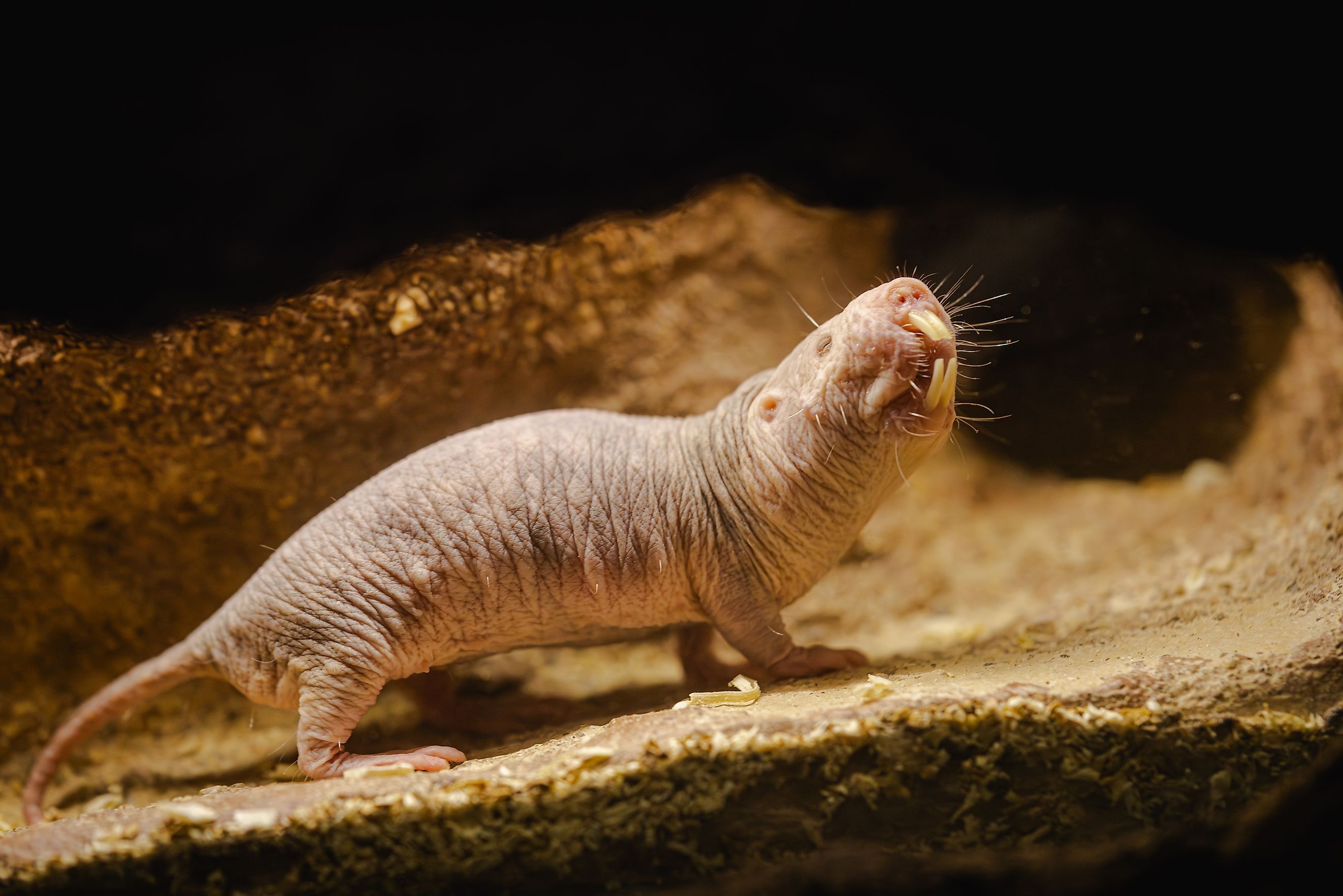
The skin is the animal's most distinctive feature. Wrinkled, loose, and nearly hairless, it is pink to brownish purple and lacks the insulating fur that most mammals rely on. Around 100 fine hairs are scattered across the body and act like whiskers, helping the animal feel its way through pitch-black burrows. The eyes are tiny and eyesight is poor, so touch and smell guide almost everything the animal does.
Its teeth define its lifestyle. A naked mole-rat's large incisors sit outside its lips, which seal shut behind the teeth so the animal can dig without swallowing soil. Roughly a quarter of its muscle mass powers those jaws, and the incisors can move somewhat independently, working like a pair of handheld picks. This dental toolkit lets the species chew through hard, sun-baked earth and, on occasion, even concrete.
Range and Habitat

Naked mole-rats live in the hot, dry lowlands of the Horn of Africa. Their range covers Kenya, Ethiopia, and Somalia, extending across the Somali-Masai arid zone, with populations reported as far north as Djibouti. They favor semiarid grasslands and savannas where the soil holds the tuberous plants they depend on for food.
The entire life of the animal unfolds underground. Colonies excavate extensive tunnel networks that can total up to about 2.5 miles (4 km) in length and sit around 6.5 feet (2 m) below the surface. These burrows include chambers set aside for nesting, food storage, and waste, all linked by a maze of passages. Because the animals rarely surface, the underground climate shapes their biology far more than the weather above ever could.
Diet

Naked mole-rats are strict herbivores that feed almost entirely on the roots, tubers, and bulbs of plants. A single large tuber can weigh a thousand times more than the animal itself and can sustain a colony for months. Workers hollow out these underground storehouses from the inside, leaving the outer skin intact so the plant keeps living and regrowing, a form of slow-motion farming.
The species draws nearly all of its water from this plant matter, an adaptation to a landscape with little standing water. To squeeze the most nutrition from tough, fibrous food, naked mole-rats also practice coprophagy, re-ingesting droppings to recover nutrients that escaped the first pass through the gut. Their appetite for crops such as sweet potatoes and cassava occasionally brings them into conflict with farmers.
Behavior

The defining feature of naked mole-rat life is its eusocial structure, a system otherwise seen mainly in ants, bees, and termites. A colony averages around 70 members and can swell to nearly 300. Only one female, the queen, reproduces, supported by one to three breeding males. Every other animal is a non-breeding worker, and larger individuals often act as soldiers that defend the colony against snakes and rival groups.
Life underground has reshaped the animal's senses and physiology. Naked mole-rats cannot regulate their body temperature the way most mammals do, a condition close to cold-bloodedness, so they huddle in warm heaps or shuttle between deeper and shallower tunnels to manage heat. They communicate through at least 18 distinct sounds, one of the broadest vocal ranges recorded in any rodent, and each colony carries its own recognizable dialect. They can also run backward through their tunnels almost as easily as they run forward.
Reproduction

Reproduction in a naked mole-rat colony is a strict monopoly. Through aggressive shoving and chemical cues, the queen suppresses breeding in every other female, keeping them reproductively dormant for as long as she rules. When a queen dies, several females may fight, sometimes fatally, until a new queen emerges, and her body physically lengthens to accommodate large litters.
The queen carries her young for about 70 days, a long pregnancy for so small a rodent, and gives birth to unusually large litters that can exceed two dozen pups. She nurses them from around 12 nipples. Workers of both sexes then raise the young cooperatively, feeding, grooming, and guarding pups that are not their own. This shared care, combined with the queen's near-total control of breeding, keeps the colony functioning as a single reproductive unit.
Importance to the World

Underground, naked mole-rats act as ecosystem engineers. Their constant digging turns and aerates the soil, mixes nutrients, and opens channels for water, which shapes the plant communities of the dry grasslands they inhabit. As prey for snakes and other predators, they also feed into the wider food web of their region.
Their greatest impact, though, may be on human medicine. The species almost never develops cancer, and researchers have traced part of that resistance to an unusually sticky sugar compound in its tissues that appears to stop cells from crowding together into tumors. Naked mole-rats also age without the steep rise in death rate seen in nearly every other mammal, and they shrug off certain kinds of pain and long periods without oxygen. Each of these traits offers a possible window into human aging, cancer, and stroke, which is why the animal has become a prized laboratory model.
Threats

The naked mole-rat is currently listed as Least Concern on the IUCN Red List, and its populations are considered stable. The species is widespread across its range and locally common, and no global population estimate has been calculated. Because it lives in remote, thinly settled country and even inside protected areas such as Kenyan national parks, it faces little direct pressure from people.
The longer-term outlook is less certain. Climate change is expected to intensify droughts across East Africa, which could dry the soil and reduce the tuberous plants that colonies rely on for both food and water. For now, however, the naked mole-rat remains one of the more secure rodents in its region, its subterranean lifestyle shielding it from many of the dangers that threaten animals living above ground.
Takeaway
The naked mole-rat is proof that evolution can produce something stranger than fiction. A near-blind, wrinkled rodent that lives like an insect, feels no acid burn, resists cancer, and can outlast its relatives by decades, it challenges almost every assumption about how small mammals are supposed to live and die. For scientists it is a living laboratory of longevity and disease resistance. For the rest of us it is a reminder that some of the most extraordinary animals on Earth spend their entire lives out of sight, beneath the surface of a dry African plain.
Fun Facts

- Oxygen optional. Naked mole-rats can survive up to about 18 minutes with no oxygen at all by switching their metabolism to run on fructose, a trick otherwise seen mostly in plants.
- Immune to the burn. They feel no pain from acid or from capsaicin, the compound that makes chili peppers hot, because their skin lacks a key pain-signaling chemical.
- They chew through concrete. Their powerful, self-sharpening incisors have been known to gnaw straight through solid concrete.
- A queen for decades. A single queen can rule and reproduce for more than 20 years, and top recorded lifespans for the species approach 40 years.
- Two-way runners. They move backward through their tunnels nearly as fast as they move forward, using sensitive tail hairs to feel where they are going.
Quick Facts
- Scientific name: Heterocephalus glaber
- Family: Heterocephalidae (order Rodentia)
- IUCN status: Least Concern (population stable)
- Length: About 3 to 4 inches (8 to 10 cm) head and body
- Weight: About 1 to 2.5 ounces (30 to 70 g)
- Lifespan: Up to about 30 years in the wild, close to 40 in captivity
- Diet: Herbivore (roots, tubers, and bulbs)
- Range: East Africa (Kenya, Ethiopia, and Somalia)