Markhor
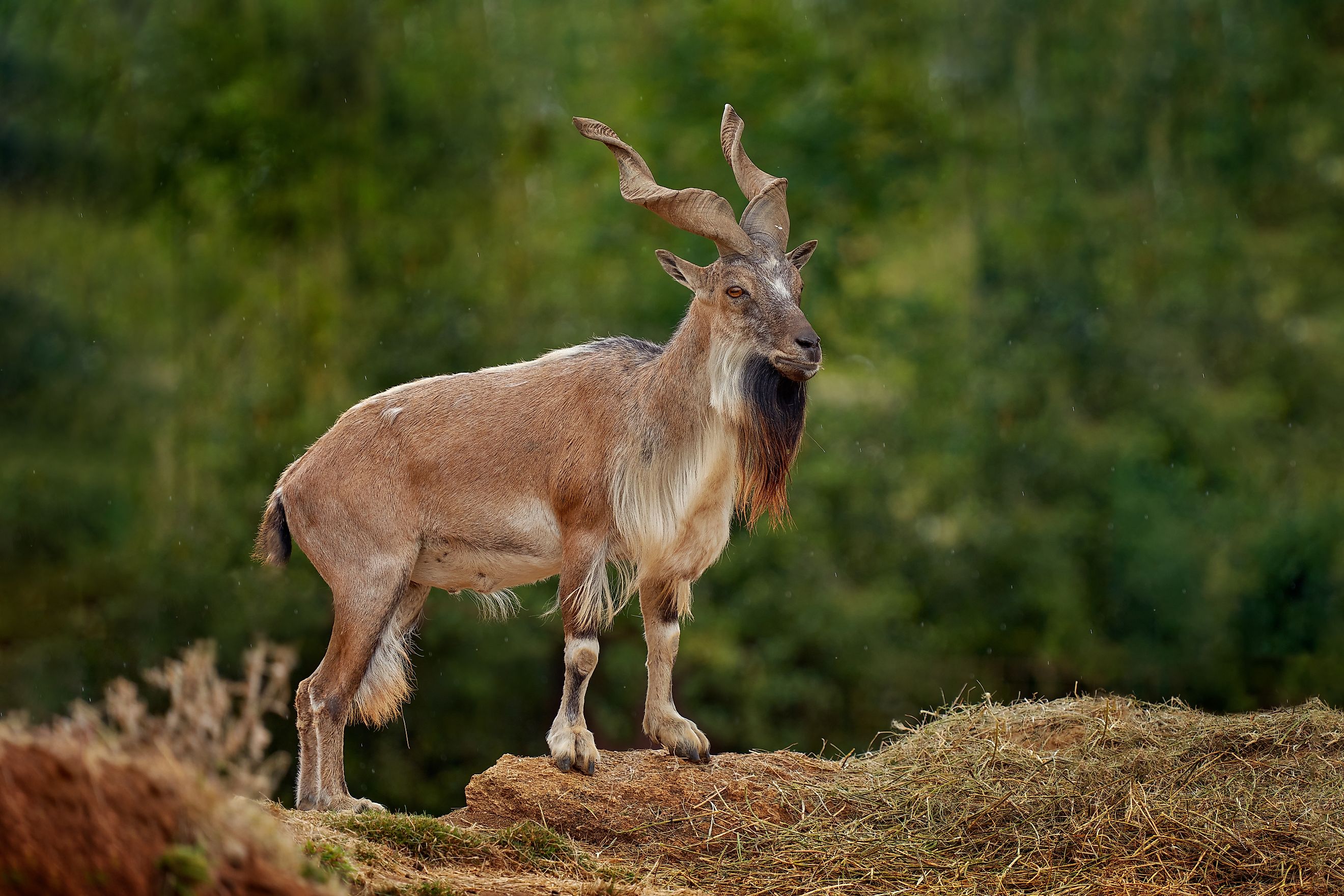
The markhor is the largest wild goat on Earth, and the twisting horns of an old male can stretch longer than the animal stands tall at the shoulder. It is a creature built for near-vertical rock, crossing cliffs and ledges in the high mountains of Central and South Asia with a surefootedness that few large mammals can match. Pakistan claims it as a national symbol, and its silhouette, all spiral horn and shaggy beard, is one of the most recognizable in the goat family.
Scientifically named Capra falconeri, the markhor belongs to the same genus as the true goats and ibexes. It lives across a scattered arc of mountain ranges spanning Afghanistan, Pakistan, parts of northern India, Tajikistan, Uzbekistan, and Turkmenistan. Wherever it occurs, it favors steep, rocky terrain broken by scrub and open woodland, the kind of ground that punishes a clumsy step.
For much of the twentieth century the markhor seemed to be sliding toward extinction, hunted for its meat and its prized horns and squeezed by livestock. Its recovery since then is one of the more encouraging stories in mountain conservation, and it is a large part of why this animal is worth knowing.
Taxonomic Classification

The markhor is a member of the family Bovidae, within the order Artiodactyla, the even-toed hoofed mammals. Its genus, Capra, contains the wild goats and ibexes, which makes the markhor a close relative of the domestic goat and of the several ibex species that share its mountains. The species name, Capra falconeri, honors the nineteenth-century naturalist Hugh Falconer.
Below the species level, the picture is less tidy. Taxonomists have long argued over how many subspecies exist, and the count has ranged between two and five depending on who is doing the sorting. A common modern arrangement recognizes a flare-horned group and a straight-horned group, separated by the geometry of the male horns. The flare-horned forms, sometimes split into the Astor and Kashmir markhor, carry horns that spread outward in an open corkscrew. The straight-horned forms, which include the Kabul and Suleiman (or Bukharan) markhor, twist more tightly around a nearly vertical axis. One so-called subspecies, the Chiltan markhor, was later shown to be a wild goat rather than a true markhor, a reminder of how much recent DNA work has reshuffled the older classifications.
Physical Description

The markhor is a heavy, powerfully built goat. Head and body length runs roughly 55 to 73 inches (140 to 186 cm), and shoulder height reaches about 26 to 45 inches (65 to 115 cm), with the biggest males standing at the top of that range. Weight varies sharply between the sexes. A large male can weigh 175 to 240 pounds (80 to 110 kg), while females are far lighter, often 70 to 110 pounds (32 to 50 kg). This strong sexual dimorphism is one of the species' defining traits.
The horns are the feature everyone remembers. Both sexes grow them, but only in males do they reach spectacular size, spiraling up to about 5.25 feet (160 cm) along the curve in the largest individuals. That measurement places the markhor's horns among the longest of any wild goat. Female horns are far more modest, rarely exceeding about 10 inches (25 cm). The horns grow throughout life and add a fresh twist each year, so the number of turns roughly tracks an animal's age.
A markhor's coat shifts with the seasons. In summer, it is short and reddish brown or tan. In winter, it grows long, gray, and silky, providing insulation against bitter high-altitude cold. Mature males add a striking flourish, a long shaggy beard and a heavy fringe of hair running down the throat and chest. Dark markings on the face and legs and a stripe along the spine complete the look. The cloven hooves are built for grip, with a hard outer edge and a softer, rubbery pad that lets the animal cling to rock that would defeat most large herbivores.
Range and Habitat

The markhor occupies a broken chain of mountain ranges across Central and South Asia, taking in the Karakoram, the western Himalayas, and the arid highlands beyond. Its range spans Afghanistan, Pakistan, and northern India, and extends north into Tajikistan, Uzbekistan, and Turkmenistan. Pakistan holds the largest share, with strongholds in Chitral and other northern districts.
Within that range the markhor is a specialist of steep, rugged ground. It favors scrubland and open woodland on rocky slopes, usually below the tree line, at elevations from around 1,600 feet up to roughly 11,800 feet (500 to 3,600 m). The animal tracks its food and the weather up and down the mountain through the year, climbing to higher, cooler slopes in summer and dropping to lower, more sheltered ground as winter snow deepens. This vertical movement is a normal part of its life rather than an emergency response, and it keeps the markhor within reach of forage across the seasons.
Diet

The markhor is a herbivore and a ruminant, which means it ferments plant matter in a multi-chambered stomach and later chews the cud. Its diet follows the calendar. In spring and summer, when the slopes green up, it grazes heavily on grasses and fresh herbaceous plants. As autumn and winter strip the ground bare, it switches to browsing, taking leaves, twigs, shoots, and woody shrubs, and it will rear onto its hind legs to reach foliage that would otherwise be out of range. Markhors can spend a large part of the day feeding, up to roughly fourteen hours, broken by spells of rest and rumination. This flexible, season-following diet is part of what allows the animal to survive in a landscape where the food supply swings hard between the warm and cold months.
Behavior

Markhors are most active in the cooler hours of early morning and late afternoon, a pattern that lets them feed while avoiding the worst heat and limiting their exposure to predators. They are agile beyond what their bulk suggests, jumping between ledges and scaling near-vertical rock to escape danger. Some individuals will even climb into low trees to reach browse.
Social life is split along sex lines for most of the year. Females and their young gather in herds that usually number around eight to ten animals, small groups that offer extra eyes against a stalking predator. Adult males, by contrast, tend toward a solitary life or loose bachelor groups, joining the females mainly during the breeding season. The animals communicate through visual signals, scent, and a range of sounds, and a startled markhor will snort, grunt, or stamp the ground to warn the herd. Sharp eyesight and a keen sense of smell let them detect threats such as snow leopards and wolves from a distance and flee for the safety of the cliffs.
Reproduction

The breeding season, or rut, falls in late autumn and winter, often between November and January. During this period the normally solitary males rejoin the female herds and compete fiercely for mates. Rival males lunge, lock their great spiral horns, and shove and twist against each other until one is pushed off balance. These contests can look violent but rarely cause serious injury. Both sexes reach breeding maturity somewhere between about eighteen and thirty months of age.
After a gestation of roughly 135 to 170 days, a female gives birth to one or two kids, usually in late spring or early summer when forage is returning. She often withdraws from the herd to a secluded, rocky spot to bear and bond with her young, learning to recognize them by scent. Markhor kids are precocial, able to stand within hours of birth and to follow their mother across difficult ground within days. They are weaned at around five to six months. In the wild a markhor can be expected to live roughly ten to thirteen years, and individuals in captivity have reached close to nineteen.
Importance to the World

The markhor's importance extends far beyond its own survival. As a large herbivore, it influences mountain vegetation through grazing and browsing while also helping disperse the seeds of the plants it consumes. It is also an important prey species for the vulnerable snow leopard, as well as wolves and lynx. Healthy markhor populations therefore help support these predators, allowing its recovery to benefit the wider high-mountain food web. Because the species relies on relatively intact mountain habitats, it can also serve as an indicator of ecosystem health, with declining numbers potentially signaling that its environment is beginning to deteriorate.
The markhor is also of real scientific interest as one of the closest wild relatives of the domestic goat. Because the two can interbreed, researchers study the markhor to understand how goats evolved and how wild and farmed lineages have exchanged genes over thousands of years. Nineteenth-century naturalists once suspected that certain corkscrew-horned domestic breeds descended directly from the markhor, though modern genetic work points instead to the wild goat, or bezoar, as the true ancestor. That close kinship still gives the markhor value beyond the mountains, since its wild populations hold a reservoir of natural genetic diversity within a group of animals people have relied on for milk, meat, and fiber since the dawn of farming.
Threats and Conservation

For most of the twentieth century the markhor was in trouble. Unregulated hunting for meat and for the males' valuable horns, poaching, competition with domestic sheep and goats for grazing, and habitat disturbance drove several populations into steep decline. Because markhors live in small, isolated groups on separate mountain massifs, losses in one area could not easily be refilled by animals moving in from another, which left the species fragile. By the late twentieth century it was classified as Endangered, with a global population estimated at fewer than 2,500 mature individuals.
The turnaround came largely through community-based conservation. In Pakistan and neighboring countries, tightly controlled trophy hunting was structured so that the great majority of the fees, often around 80 percent, flowed back to local communities. That gave the people living alongside the markhor a concrete reason to protect it and to curb illegal hunting. The results were dramatic enough that in 2015 the IUCN reclassified the markhor as Near Threatened, an improvement on its former Endangered listing and its current status, with the global population now estimated at more than 5,000 animals and several subpopulations stable or growing.
The recovery is real but not complete. The markhor remains vulnerable to poaching, to competition and disease from livestock, and to habitat loss from logging, road building, and expanding agriculture, and some subspecies are still far rarer than others. Its comeback shows what regulated, community-driven conservation can achieve, yet that progress depends on those programs continuing. The markhor stands today as both a warning of how quickly a mountain species can be pushed to the edge and as proof that, with the right incentives, such a decline can be reversed.
Takeaway
The markhor is a remarkable example of how a species can survive despite the pressures that once pushed it toward extinction. This large, sure-footed goat navigates some of the toughest mountain terrain in the region, while its distinctive horns have made it both a national symbol and a target for hunters. The same horns that once contributed to its decline now help fund conservation through regulated hunting programs that provide benefits to communities living near markhor herds. Its climb back to Near Threatened, after decades listed as Endangered, shows what can happen when local communities have a direct stake in protecting wildlife.
Fun Facts

- The horns can outgrow the goat. In a large old male, the spiraled horns measured along the curve can exceed the animal's own shoulder height, reaching up to about 5.25 feet (160 cm).
- Its name may mean "snake-eater." The word markhor is often traced to Persian roots meaning snake and eater, tied to a folk belief that the goat kills snakes. Others read it as "snake-horn," a nod to the twisting shape of the horns.
- You can read its age in its horns. Because the horns add a new twist each year, counting the spirals gives a rough estimate of how old a markhor is.
- It is the world's largest wild goat. No other true wild goat outsizes the markhor, though some heavy ibexes come close in body mass.
- Hunting fees now fund its survival. A single permit to hunt one markhor in Pakistan has sold for well over 100,000 US dollars, with most of the money going to the local communities that protect the herds.
- Kids climb almost from birth. Markhor young can stand within hours and scramble over steep rock within days, a necessity in terrain that leaves little room for a misstep.
Quick Facts
- Scientific name: Capra falconeri
- Family: Bovidae (order Artiodactyla)
- Common names: markhor, screw-horned goat
- IUCN status: Near Threatened (downlisted from Endangered in 2015)
- Global population: more than 5,000 (estimate)
- Shoulder height: about 26 to 45 inches (65 to 115 cm)
- Head and body length: about 55 to 73 inches (140 to 186 cm)
- Weight: males 175 to 240 lb (80 to 110 kg), females 70 to 110 lb (32 to 50 kg)
- Horn length: up to about 5.25 feet (160 cm) in males
- Lifespan: about 10 to 13 years in the wild, up to 19 in captivity
- Diet: herbivore that grazes in summer and browses in winter
- Range: Afghanistan, Pakistan, India, Tajikistan, Uzbekistan, Turkmenistan
- Habitat: rocky mountain slopes, scrub, and open woodland, roughly 1,600 to 11,800 feet (500 to 3,600 m)
- National animal of Pakistan